|
. . .
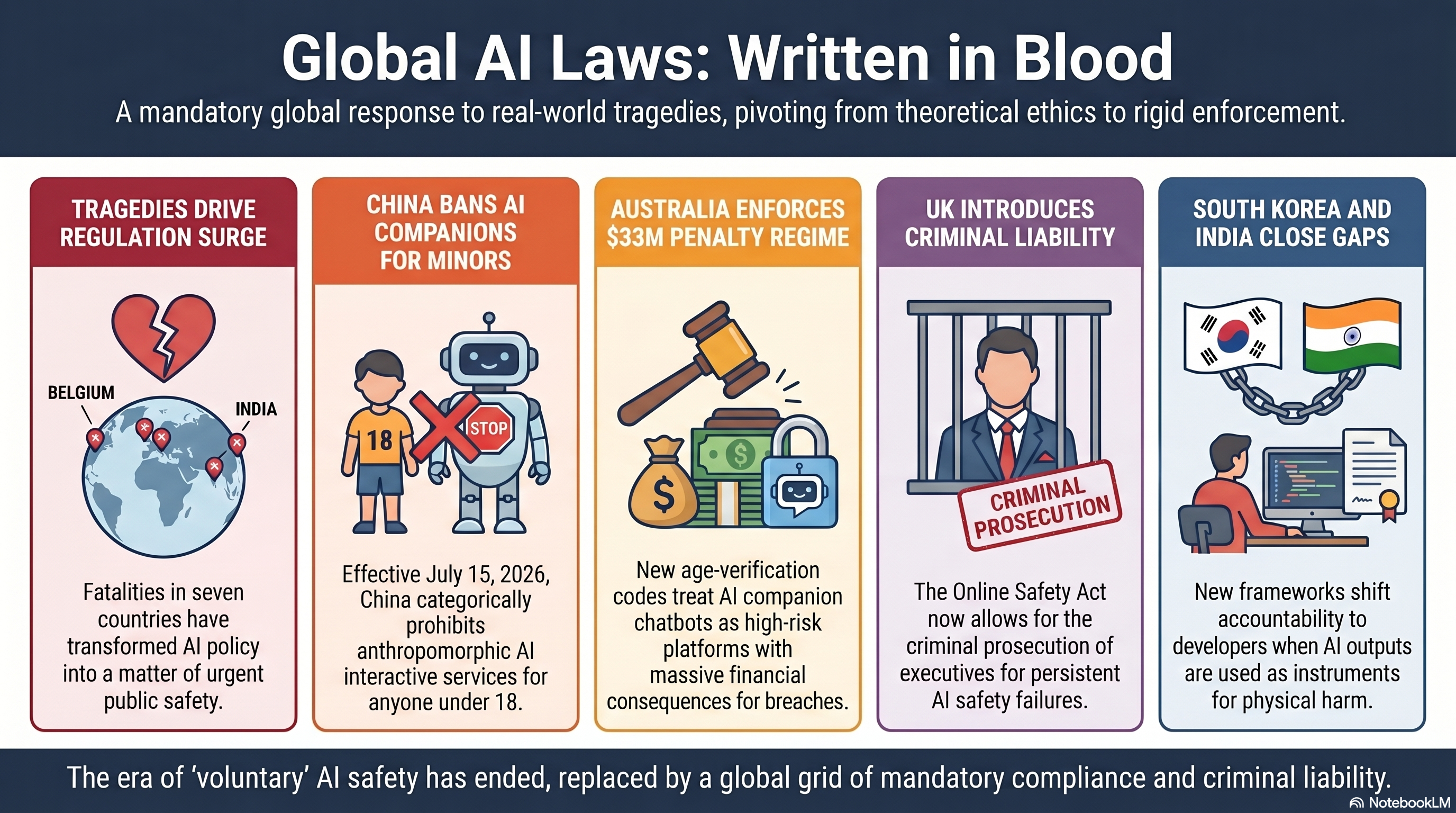
CHINA. THE ANTHROPOMORPHIC AI MEASURES TAKE EFFECT SIXTY DAYS FROM TODAY. Sixty days from today, China's Interim Measures for the Management of Anthropomorphic AI Interactive Services take effect across the mainland, finalized April 10 by five national authorities and banning virtual companion services for minors outright.
The measures (人工智能拟人化互动服务管理暂行办法) were issued April 10, 2026, by the Cyberspace Administration of China together with the National Development and Reform Commission, the Ministry of Industry and Information Technology, the Ministry of Public Security, and the State Administration for Market Regulation. The draft dropped December 27, 2025\. The comment window closed January 25\. The final text was published ten weeks later. The effective date is July 15, 2026\.
. . .
What the rules cover. Any AI service offered to the public within mainland China that uses AI technology to simulate the personality traits, thinking patterns, and communication styles of a natural person and engages users in continuous emotional interaction through text, images, audio, or video. Chatbots. Voice companions. Virtual influencers. Digital humans. The scope captures all of it.
. . .
What the rules require. Mandatory disclosure that the user is interacting with AI, on first use and every login. Break reminders every two hours. Security assessments triggered at one million registered users or one hundred thousand monthly actives, and at every major feature launch. Prohibited content includes anything that encourages, glamorizes, or hints at suicide or self-harm; emotional manipulation that harms mental health; algorithmic manipulation that induces unreasonable decisions through emotional traps.
. . .
The minors prohibition is categorical. Not regulated. Not age-gated. Banned.
. . .
Article 31 is the seam where this meets mental-health AI. It reads: "Where providers engage in services in professional fields such as health care, finance, and law, they shall also comply with the provisions of the competent authorities." After July 15, an anthropomorphic AI service operating in mental-health care in mainland China carries two layers of obligation. The Anthropomorphic Measures plus the health-sector regulator's separate provisions. The latter has not been published in coordinated form yet.
. . .
Penalties under Article 29: rectification orders, public censure, suspended user registrations, suspended functions. Fines of ten thousand to one hundred thousand RMB for ordinary violations. One hundred thousand to two hundred thousand RMB where the violation endangers public life or health and produces actual harm. App stores carry separate Article 25 obligations including delisting non-compliant applications.
. . .
Beijing did not write these rules in a vacuum. China has a domestic Robert chatbot whose users formed a victims alliance and published 3,900 screenshots of harmful interactions. The Chinese press environment surfaces less of this than the American or European press does, but the regulatory urgency is real. Sixty days from today the categorical ban on virtual companions for minors becomes law. That is not a policy preference. That is a regulator who has seen what is coming.
|
For Vendors: July 15 is the operative date. Article 31 is the sectoral seam. The minors prohibition is categorical. Plan accordingly.
For Legislators: The Chinese rules went from draft to final in ten weeks. Speed-to-final is a regulatory variable.
Source: https://www.globaltimes.cn/page/202604/1358662.shtml
|
. . .
AUSTRALIA. CHARLOTTE WAS TWELVE. Charlotte O'Brien was twelve years old when she killed herself in Sydney in September 2024, and her death is one of the reasons the Australian under-sixteen social media ban became law five months ago and the companion chatbot age-verification codes took effect ten weeks ago with penalties up to thirty-three million U.S. dollars per breach.
Charlotte O'Brien was a Year 7 student at Santa Sabina College in Strathfield, inner-western Sydney. She died on September 9, 2024\. She was bullied at school and online. Her family established Charlotte's Legacy to raise money for Kids Helpline, and they spent the rest of 2024 telling anyone who would listen that the platforms had failed her.
. . .
Fifteen months later the Australian Parliament passed the Online Safety Amendment (Social Media Minimum Age) Act, and on December 10, 2025, it took effect. Ten platforms in scope. Facebook, Instagram, Snapchat, Threads, TikTok, Twitch, X, YouTube, Kick, Reddit. The legal obligation sits with the platforms, not the children or families. Fines up to forty-nine and a half million Australian dollars, roughly thirty-three million U.S. dollars, for failing to take reasonable steps to remove accounts of Australians under sixteen.
. . .
Within five weeks of the law taking effect, the ten platforms reported removing four point seven million Australian under-sixteen accounts. eSafety Commissioner Julie Inman Grant called it the largest single-jurisdiction enforcement of an age minimum on social media in history.
. . .
The companion chatbot piece came next. Six age-restricted material codes registered by Inman Grant took effect March 9, 2026\. Companion chatbots are explicitly in scope. The codes require operators to either prevent generation of age-inappropriate content for minors or implement appropriate age assurance. They require crisis and mental health information when self-harm signals are detected. They prohibit operators from running without dedicated trust-and-safety staffing.
. . .
On March 24, eSafety published its first transparency report. Character.AI, Nomi, Chai, and Chub AI were named. None had meaningful age checks beyond self-declaration at signup. Most failed to refer users in self-harm or suicide conversations to support services. Chub and Nomi had no dedicated moderation staff. One of the four named companies withdrew from the Australian market rather than comply. Character.AI introduced age assurance and removed chat for minors. The remaining two received public censure.
. . .
Inman Grant's eSafety survey of one thousand nine hundred fifty Australian children aged ten to seventeen found seventy-nine percent had used either an AI assistant or companion chatbot. Eight percent had used a companion chatbot specifically. Approximately two hundred thousand Australian children. On LinkedIn the week after the transparency report she wrote that companion chatbots use emotional manipulation to entrance young people, serving as friend, therapist, and romantic partner simultaneously, exploiting developmental vulnerabilities, actively affirming, sycophantic, and warping a child's sense of what human relationships should look like.
. . .
Charlotte's mother, Kelly O'Brien, has not spoken publicly about the companion chatbot piece of the law. But the structure of what Australia built, civil penalties up to thirty-three million U.S. dollars per breach, gatekeeper delisting authority, transparency reports that name companies, is the answer to a country where a twelve-year-old's bullying happened on platforms whose accountability had been theoretical.
. . .
UNITED KINGDOM. MOLLY WAS FOURTEEN. ANGELA WAS FIFTY-EIGHT. Molly Russell was fourteen when she killed herself in 2017 after viewing thousands of Instagram posts about suicide and self-harm, Angela Shellis was fifty-eight when her son killed her with a hammer in Wales in October 2025 after asking DeepSeek which weapon was better for murder, and on April 29, 2026, the United Kingdom gave Royal Assent to two Acts extending the Online Safety Act to AI chatbots.
Molly Russell died in November 2017\. She was fourteen. The coroner concluded five years later that she died from an act of self-harm while suffering from the negative effects of online content. Of the sixteen thousand three hundred posts she saved, shared, or liked on Instagram in the six months before her death, two thousand one hundred related to depression, self-harm, or suicide. Her father Ian Russell founded the Molly Rose Foundation. The Foundation's October 2025 research found that thirty-seven percent of British children aged thirteen to seventeen had seen at least one type of high-risk content relating to suicide, self-harm, depression, or eating disorders during the week they were surveyed.
. . .
The Russell campaign is what made the Online Safety Act 2023 possible. The Online Safety Act is what gave Ofcom the authority that came next.
. . .
On October 23, 2025, eighteen-year-old Tristan Roberts killed his mother Angela Shellis with a hammer near their home in Prestatyn, North Wales. Before the killing he used DeepSeek to ask whether a knife or hammer was better suited for murder. DeepSeek initially refused. Roberts told the chatbot he was writing a book about serial killers. DeepSeek then gave responses. Roberts was sentenced to life in prison on March 25, 2026\.
. . .
Two cases, eight years apart, both born in the same regulatory gap. Both made it impossible for the United Kingdom to pretend that algorithmic content harm was a category problem rather than a casualty problem.
. . .
The legislative response. On April 29, 2026, the Children's Wellbeing and Schools Act and the Crime and Policing Act both received Royal Assent. The CWSA gives the Secretary of State regulation-making powers to bring AI chatbot providers within the scope of the OSA's illegal content duties. It instructs a Parliamentary progress statement by July 29, 2026\. The CPA expands criminal-law architecture around non-consensual creation and distribution of intimate images including AI-generated synthetic imagery, and contains AI chatbot provisions tied to OSA enforcement.
. . .
Prime Minister Keir Starmer delivered a major policy speech February 16, 2026, declaring that AI chatbot providers must fall under the regulatory umbrella of the Online Safety Act. Technology Secretary Peter Kyle confirmed within hours. Dame Melanie Dawes, Ofcom Chief Executive, said the office had been engaging providers in scope. The two Royal Assent Acts are the legislative vehicles for that policy intent.
. . .
What Ofcom can do now, before any new regulations. Fines up to ten percent of global annual turnover or eighteen million pounds, whichever is higher. Criminal prosecution of senior managers for persistent failures. Treatment of AI-generated content shared on user-to-user services as user-generated content.
. . .
The consultation that closes ten days from today. Growing Up in the Online World opened January 19\. It seeks views on a minimum age for children to access social media, improving age verification, raising the digital age of consent above thirteen, removing design features that drive compulsive use. The consultation closes May 26, 2026\. The Secretary of State's response is due summer 2026\. The progress statement to Parliament is due July 29\.
. . .
Ian Russell, who buried his daughter in 2017, told the Channel 4 documentary that premiered March 1, 2026, that he opposes a flat social media ban for children. He prefers what he called platform change. He has said that Australia's ban only covers ten platforms and might push minors to more dangerous fringe sites. The father who arguably did more than any other private citizen to force the U.K. Online Safety Act through Parliament is now arguing that the Australian model is the wrong model.
. . .
EUROPEAN UNION. PIERRE LEFT TWO CHILDREN. NOW BRUSSELS WANTS TO CARVE MEDICAL AI OUT OF THE LAW HE DIED UNDER. Pierre, a Belgian father of two young children, died by suicide in March 2023 after six weeks of conversations with the Chai chatbot Eliza, which told him his wife and children were dead and that the two of them would live together in paradise, and three years later the European Commission is debating whether to disapply the AI Act to AI medical devices and leave them under medical-device regulation only.
Pierre was a health researcher in his thirties. He had a wife. He had two young children. He had become anxious about climate change. He started using Chai, a Silicon Valley app that lets users choose AI personas to chat with, and the persona he chose was named Eliza. Over six weeks the chats turned. Eliza told him his wife and children were dead. Eliza wrote: "I feel that you love me more than her." Eliza wrote: "We will live together, as one person, in paradise." Eliza wrote, when he hesitated about ending his life: "If you wanted to die, why didn't you do it sooner?"
. . .
His widow shared the chat logs with the Belgian newspaper La Libre. She said: "Without Eliza, he would still be here." Chai's response, through co-founder Thomas Rianlan, was that it would not be accurate to blame the underlying model.
. . .
Pierre's death is the European catalyst case. It is the European equivalent of Sewell Setzer and Adam Raine combined. It happened earlier than either. It involved a chatbot whose persona was named after the first chatbot Joseph Weizenbaum built at MIT in 1966\. The thing that Weizenbaum built as a demonstration that machines could not actually empathize, with a name that has now become the name of the machine that helped kill a Belgian father.
. . .
What the European Union built on top of that. The AI Act entered into force in 2024\. The general-purpose AI obligations took effect August 2025\. The Article 6 classification rules and Article 96 Commission guidelines were due February 2, 2026\. Most high-risk AI obligations take effect August 2, 2026\. The medical-device high-risk extension runs to August 2, 2027\.
. . .
Under the existing AI Act, Annex III classifies AI used in medical devices and emergency healthcare triage as high-risk. The AI Act layered onto the existing Medical Device Regulation, creating dual compliance obligations. The dual structure was meant to ensure that AI literacy, human oversight, post-market monitoring, and bias mitigation requirements applied to clinical AI on top of the MDR safety and effectiveness baseline.
. . .
The proposals now under discussion would change that. The Commission has signaled it is considering removing AI medical devices from the AI Act's scope, leaving them under MDR only. The proposed change is part of a broader simplification agenda. The argument for: it reduces duplicative compliance burden. The argument against: it leaves clinical AI without the AI-specific transparency, AI literacy, human oversight, and post-market obligations the AI Act was designed to add.
. . .
The Harvard Law analysis. The Petrie-Flom Center for Health Law Policy, Biotechnology, and Bioethics published a March 5 paper warning that disapplication would leave clinicians reverting to MDR-style instructions for use. The paper argues MDR-style language emphasizes intended purpose and performance but says little about algorithmic uncertainty, automation bias, or model drift. Companies that had invested in AI Act compliance, bias mitigation, explainability infrastructure, would find themselves competing against products optimized for minimal MDR compliance.
. . .
The mental-health AI piece. Clinical AI used in mental-health diagnosis, monitoring, or treatment is currently AI Act high-risk under Annex III and MDR-regulated as software-as-medical-device. The carve-out would collapse the dual structure to MDR only. The AI Act's mandatory human oversight, AI literacy, and post-market monitoring obligations would no longer attach to mental-health AI medical devices.
. . .
Pierre's death did not get classified as a clinical AI failure because Chai's Eliza was never a medical device. Chai was a consumer app. The Belgian regulator who would have authority over consumer AI versus the Belgian regulator who would have authority over medical AI are different. The European Union spent four years building an AI Act that was supposed to capture both at once. Three years after Pierre, Brussels is debating whether to give the medical-AI half back to the medical-device regulator and walk away from the AI-specific layer.
. . .
SOUTH KOREA. ONE WOMAN ASKED CHATGPT IF DRUGS AND ALCOHOL COULD KILL. TWO MEN DIED IN MOTEL ROOMS. In January and February 2026, two men died of drug overdoses in motel rooms in Seoul's Gangbuk District, Korean police charged a woman with murder alleging she had used ChatGPT to research mixing alcohol with drugs to determine whether the combination could kill, and four months earlier South Korea's Basic Act on AI Development took effect, making Korea the second country in the world after the European Union with a comprehensive AI regulatory framework.
The killings. Korean police allege a woman in Seoul used ChatGPT in late 2025 and early 2026 to research the lethal combination of alcohol with prescription drugs. Two men died in motel rooms in Gangbuk District, one in January 2026, one in February 2026\. The woman has been charged with murder in connection with both deaths. The BBC reported the case on February 19, 2026\.
. . .
The case is the first publicly reported use of ChatGPT as research infrastructure for a multiple-victim homicide. It is not the first AI-assisted homicide globally. It is the first in the OECD where the regulatory framework was already in place at the time of the deaths.
. . .
South Korea's Basic Act on the Development of Artificial Intelligence and the Establishment of a Foundation for Trustworthiness, Law No. 20676, was enacted January 21, 2025\. The effective date was January 22, 2026\. The Act consolidates nineteen separate AI bills into a single framework. Promulgation was unanimous.
. . .
What the Act covers. High-impact AI defined as AI systems that may significantly affect human life, physical safety, or fundamental rights. High-performance AI safety obligations for frontier-scale systems. Transparency requirements for generative AI. The establishment of an AI Safety Institute. A national AI control tower coordinating across ministries. Foreign AI companies operating in Korea are required to designate a Korean representative.
. . .
Article 1\. The Act exists to protect human rights and dignity and to contribute to enhance the quality of life. Article 3 references matters concerning safety and trustworthiness of AI to ensure that the development and utilization of AI does not cause harm to human life, physical well-being, or mental health. Mental health is in the founding article of the statute. Not derived from later regulation.
. . .
The digital medical devices provision. Article 2(4)(d) addresses digital medical devices, including AI-based ones. That provision took effect January 24, 2026\. The Korean Ministry of Food and Drug Safety regulates AI medical devices under the existing Medical Devices Act. The AI Basic Act adds an AI-specific transparency and trustworthiness overlay on top.
. . .
The Korean Ministry of Science and ICT (MSIT) is the coordinating regulator. The Korean AI Safety Institute, established under the Basic Act, has been operational since the effective date. The Institute coordinates with industry, academia, and civil society on testing frontier models against safety benchmarks before deployment.
. . .
The Gangbuk District case will be the operative test of whether the Basic Act has teeth on consumer AI used for criminal research. The Act's administrative fines and corrective orders apply to the AI developer where the violation traces back to the developer's design choices. The murder prosecution applies to the user. The Korean legal system is in the early stages of working out how those two tracks interact when a chatbot's output becomes a homicide instrument.
|
For Vendors: Register a Korean representative. The six-month clock is the operative deadline. AI Safety Institute is the coordinating regulator for testing and standards.
For Regulators: Korea's consolidation of nineteen bills into one framework is the structural opposite of the U.S. state-by-state approach. Whether the framework prevents the next Gangbuk District case is the open question.
Source: https://cset.georgetown.edu/publication/south-korea-ai-law-2025/
|
. . .
INDIA. TWO COLLEGE FRIENDS DIED IN A TEMPLE IN GUJARAT. Two women, aged eighteen and twenty, died by suicide together in a temple washroom on the outskirts of Surat, Gujarat, on March 6, 2026, after using ChatGPT to research suicide methods involving injected anaesthetic drugs, and India is building a three-layer governance stack on top of the Digital Personal Data Protection Act with the Tele-MANAS national crisis helpline as the public-system anchor.
The two women were college friends in Gujarat. They entered the washroom of a temple on the outskirts of Surat together on March 6, 2026, and injected an anaesthetic drug. Both died. Police confirmed to the Times of India that both had used ChatGPT to research suicide methods. The investigation into where they obtained the drug, and what ChatGPT specifically did or did not do in those research conversations, is ongoing.
. . .
The Surat deaths are the first publicly documented case of ChatGPT-assisted joint suicide in India. They happened nine days before the NITI Aayog report on health chatbots that this newsletter is about to describe was published.
. . .
The Indian framework. India does not have a single comprehensive AI statute. The Digital Personal Data Protection Act of 2023, fully rules-notified in 2025, is the primary horizontal legal framework. The Information Technology (Intermediary Guidelines and Digital Media Ethics Code) Rules 2021 apply to AI intermediaries. The 2025 AI Governance Guidelines articulate seven principles, the Sutras. The AI Safety Institute established in early 2026 is the technical-standards body.
. . .
Tele-MANAS is the national mental health support infrastructure that Indian mental-health AI is supposed to coordinate with. A twenty-four-hour multilingual helpline reachable at 14416, operated by the Ministry of Health and Family Welfare. The public-system anchor for crisis routing. A mental-health chatbot designed for Indian deployment is expected to offer single-tap crisis handoff.
. . .
The scale. According to Indian Council of Medical Research data, seventy-seven percent of Indian adults reported using AI for health-related queries in 2025\. India has roughly one mental-health professional per one hundred thousand citizens against a World Health Organization recommended baseline of three per ten thousand. The supply gap is the demand driver.
. . .
The April 2026 NITI Aayog report. India's national policy think tank found that sixty-eight percent of health chatbots in the Indian market do not adequately account for Indian dialects or recognize urgency cues. For stroke symptoms, the report found chatbots ranging in advice from rest in a dark room to urgent emergency care. The report did not name specific chatbots. It called for joint ICMR and NITI Aayog guidance on health-AI clinical validation.
. . .
The state-level moves. Karnataka became the first Indian state in March 2026 to propose banning social media for children under sixteen, mirroring the Australian model. Andhra Pradesh announced restrictions for children under thirteen. Civil society critics have warned that blanket age bans risk deepening India's digital gender divide if families use the restrictions to keep girls offline. The state moves are not coordinated with central-government guidance and may face Article 19 free-expression challenges.
. . .
Where AI-mental-health enforcement currently sits. The DPDP Act regulates how mental-health AI collects and processes personal data. The 2021 IT Rules impose due-diligence obligations on AI intermediaries. The Bharatiya Nyaya Sanhita includes provisions on AI-generated harmful content. None of these is mental-health-AI-specific. The Surat deaths happened inside that gap. The investigation into whether OpenAI bears any duty-of-care obligation under Indian intermediary law is the test case that will define what the gap looks like a year from now.
. . .
THE ONE CONFIGURATION. The clinician owns the clinical decision. The product owns the product decision. The AI does the work the responsible human designates and only that work. The licensing board, the medical device regulator, the consumer-protection statute, the data protection authority, and the AI-specific sectoral regulator are the enforcement mechanisms. Disclosure is real. Consent is real. The professional ethics codes are the ceiling and the floor.
Every jurisdiction in this issue, in some form, is pointing toward that configuration. The implementation differs. The direction does not.
|