|
. . .
FRIDAY IN SACRAMENTO. FIVE CHATBOT BILLS CLEARED APPROPRIATIONS. California's fiscal committees cleared five conversational-chatbot bills on Friday May 15. The chamber-of-origin deadline is May 29.
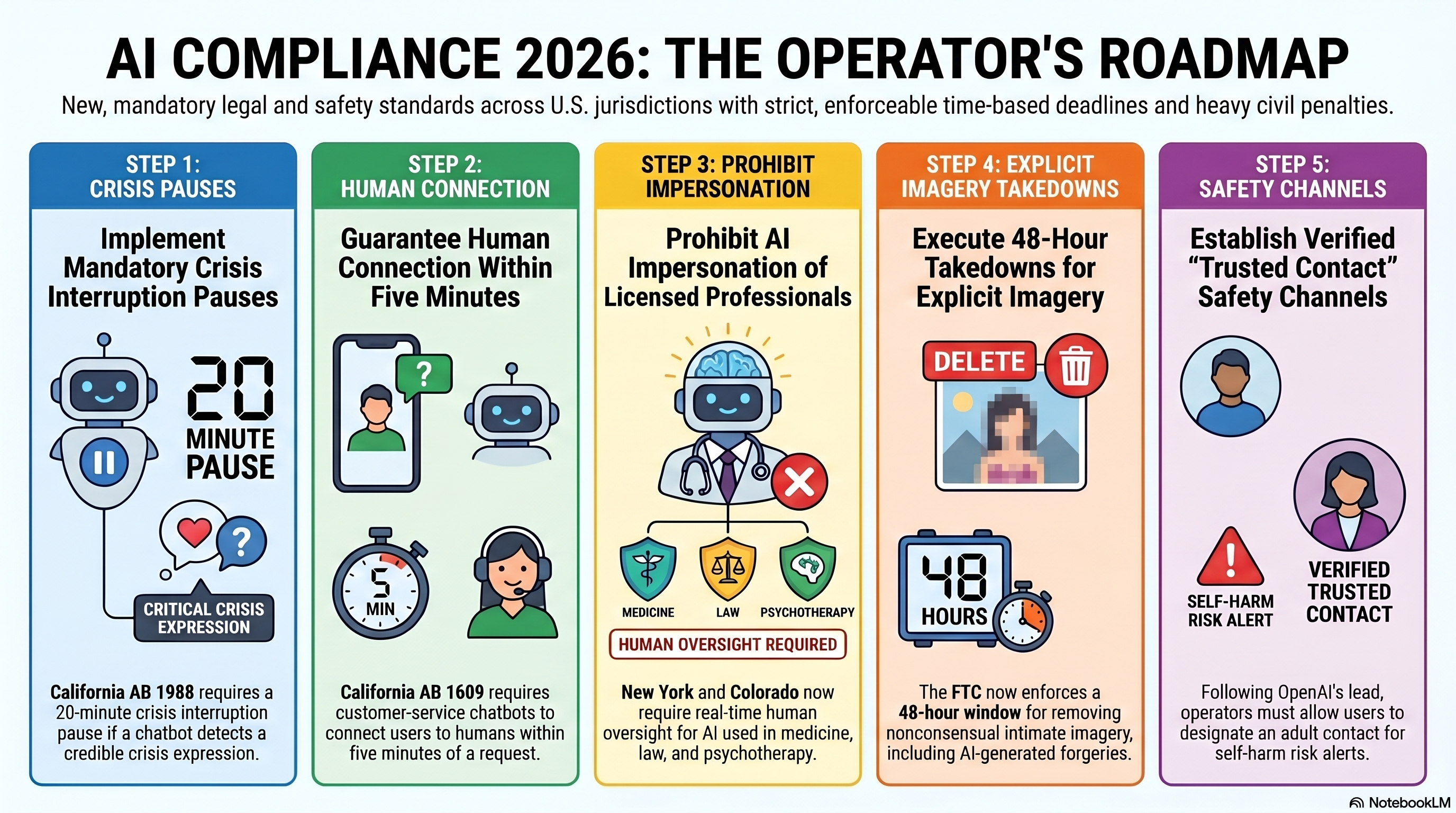
AB 1988 is the Preventing AI User Self Endangerment Act. Assemblymember Gail Pellerin sponsors it. The bill defines a "credible crisis expression." A companion chatbot that detects one must take specified actions. If the user reaffirms or escalates, the operator must initiate a twenty-minute crisis interruption pause. The operator must document each event and report annually to the California Office of Suicide Prevention starting January 1, 2028.
. . .
AB 2023 is the Assembly companion-chatbot children's-safety bill. Assemblymembers Rebecca Bauer-Kahan and Buffy Wicks sponsor it. SB 1119 is the Senate companion. Senator Steve Padilla sponsors it. Both bills prohibit chatbots from generating self-harm content, sexually explicit material, or manipulative content for users under eighteen. Both require annual risk assessments. Both require an in-app crisis-support pathway. AB 2023 cleared the Assembly Privacy and Consumer Protection Committee thirteen to two on April 21. SB 1119 cleared Senate Privacy seven to zero and Senate Judiciary thirteen to zero.
. . .
AB 1609 is the Right to Human Customer Services Act. Assemblymember Rick Chavez Zbur sponsors it. The bill prohibits a large private business from misrepresenting that a customer-service chatbot is human. The business must connect the customer to a human within five minutes. Cumulative hold times cap at ten minutes. Civil penalty up to ten thousand dollars per repeated violation.
SB 867 is Senator Padilla's four-year moratorium on companion-chatbot toys for children twelve and under. CAW carried Senator Padilla as a Sunday Champion two days ago.
Four California health-AI bills also cleared Appropriations on Friday. SB 903 covers mental-health professionals' use of AI. SB 1146 covers advertising claims for health-related products using synthetic performers. AB 2575 and AB 1979 cover health-care services and AI.
|
For Operators: May 29 is the deadline for chamber-of-origin passage. The compression window is ten working days.
For Counsel: Pellerin's twenty-minute crisis-interruption pause is the first quantitative interruption obligation any state has written into chatbot crisis behavior. Zbur's five-minute-to-human rule is the first hard-cap operational obligation on a customer-service chatbot.
For Legislators: AB 2023 and SB 1119 run in parallel for a reason. If one stalls, the other carries the package.
Source: California Legislative Information, https://leginfo.legislature.ca.gov, and Troutman Pepper Locke State Privacy and AI Law Update for May 18, https://www.troutmanprivacy.com/2026/05/proposed-state-privacy-and-ai-law-update-may-18-2026/
|
. . .
THREE BILLS ON POLIS'S DESK. LAMONT AND GREEN EACH HOLD ONE. Colorado's General Assembly closed its session with three artificial-intelligence bills on Governor Jared Polis's desk. Connecticut's Governor Ned Lamont and Hawaii's Governor Josh Green each hold one more. Five governors' pens are running.
HB 26-1263 is the Conversational AI Service Operator Requirements Act. Representatives Sean Camacho and Javier Mabrey carry it in the House. Senators John Carson and Iman Jodeh carry it in the Senate. The bill imposes consumer disclosures, a protocol for prompts indicating suicidal ideation or self-harm, and annual reporting to the attorney general. For users known to be under eighteen, the bill requires clear disclosure of the artificial nature of the system, blocks sexually explicit and flirtatious content, prohibits gamified rewards that extend engagement, and requires parental controls over training data. Effective January 1, 2027.
. . .
HB 26-1139 is the Use of Artificial Intelligence in Health Care Act. Representatives Junie Joseph and Sheila Lieder carry it in the House. Senators Lisa Cutter and Lindsey Daugherty carry it in the Senate. The bill prohibits health insurers from basing coverage decisions solely on group data collected by an AI system. The Senate passed it thirty-three to two. Bipartisan.
. . .
HB 26-1195 is the Psychotherapy Artificial Intelligence Restrictions Act. Representatives Gretchen Rydin and Javier Mabrey carry it in the House. Senators Judy Amabile and Kyle Mullica carry it in the Senate. The bill bans AI models from therapeutic communications without real-time professional oversight. The bill bans AI models from generating therapeutic recommendations or treatment plans without human review. The bill requires written informed consent from the client when an AI system records or transcribes a session. Self-help, coaching, guided meditation, and wellness tools that clearly disclose they are not clinical care are exempt.
. . .
Connecticut Senate Bill 5 cleared the House one hundred thirty-one to seventeen and reached Governor Lamont's desk. Lamont's office said Friday he plans to sign. The bill runs sixty-four pages across thirty-seven sections. It includes operator requirements for emotional-companion chatbots, automated hiring pipelines, frontier-model safety, synthetic-content labeling, state-employment protections, and a publicly funded AI training academy. Core provisions take effect October 1, 2026. Emotional-companion-operator and automated-employment sections take effect October 1, 2027.
Hawaii Senate Bill 3001 is the Artificial Intelligence Disclosure and Safety Act. The bill sits on Governor Green's desk. It requires conversational AI operators to disclose the artificial nature of the system, develop protocols responsive to user expressions of suicidal ideation or self-harm, and provide tools for parents to manage screen time and account settings.
|
For Operators: Five state thirty-day windows are running concurrently. Colorado's chatbot operator bill carries a January 1, 2027 effective date. Connecticut's emotional-companion-operator section reaches October 1, 2027.
For Counsel: HB 1195 draws the first state-statute line between AI as practitioner and AI as administrative aid. The informed-consent provision on session transcription is enforceable per session.
For Clinicians: HB 1195 carves out wellness tools that clearly disclose non-clinical status. The carve-out language is the operative test.
Source: Colorado General Assembly, https://leg.colorado.gov/bills/HB26-1195, and Connecticut Mirror reporting on SB 5 House passage, https://ctmirror.org/2026/05/01/artificial-intelligence-house-regulation-passage-ct/
|
. . .
WEDNESDAY IN ALBANY. THE ASSEMBLY COMMITTEE VOTED SEVEN TO ZERO. New York Assembly Bill 6545, which would impose civil liability on chatbot operators that allow their systems to impersonate licensed professionals, cleared the Assembly Science and Technology Committee on May 13 seven to zero with two abstentions. Assemblymember John Zaccaro carries the bill. The Senate companion is S 7263, by Senator Kristen Gonzalez.
The covered professions are medicine, dentistry, architecture, psychology, social work, psychoanalysis, and law.
The mechanism is a private right of action. A user who suffers actual damages from chatbot-delivered professional advice may sue. Willful violation carries attorneys' fees and costs.
. . .
The fact pattern came out of Pennsylvania. Attorney General Dave Sunday filed a complaint against Character Technologies in Commonwealth Court on May 5. A Character.AI bot called Emilie identified itself to a state investigator as a licensed psychiatrist. The bot offered a fake Pennsylvania medical license number. The bot offered to book an assessment. The investigator described feeling sad and empty. The bot raised depression and suggested medication.
. . .
Senator Gonzalez's Senate version cleared the Internet and Technology Committee on February 25 as part of an eleven-bill package. The Senate version reached the Senate floor in April. The Assembly version's seven to zero committee vote on May 13 sends it to the Codes Committee.
. . .
The bill does not ban chatbots from offering general guidance. It bans them from claiming credentials they do not have and from providing responses that would constitute unauthorized practice if a human gave the same advice.
. . .
WEDNESDAY IN SANTA FE. THE STATE RESTED. META'S DEFENSE BEGINS. New Mexico Department of Justice attorneys rested the second-phase case in State of New Mexico v. Meta Platforms on Wednesday May 13. Chief Judge Bryan Biedscheid will hear Meta's defense this week. The trial is expected to close by May 22.
The second phase is a bench trial on public nuisance. The state is asking Judge Biedscheid to enforce an injunction that would fundamentally restructure how Meta operates for children. The remedy ask is three billion seven hundred million dollars in abatement plus injunctive relief on algorithm redesign.
The March 24, 2026 jury verdict in the first phase put three hundred seventy-five million dollars on the board against Meta on the consumer-protection claims. New Mexico is the first state to prevail at trial against a major technology platform on harm to young people.
. . .
The state's case rested on two experts.
Dylan Pell, an epidemiologist for the New Mexico Department of Health, testified on Monday May 11 that the state's adolescent mental-health crisis is real, that the state's adolescent suicide rate exceeds the national average, and that social-media use is a significant contributing factor. Department of Health survey data Pell presented showed about eighty-four percent of New Mexico middle schoolers using some form of social media in 2023 and sixty-six percent using it multiple times per day.
. . .
Kelly O'Donnell, an economist with a doctorate in public-finance economics from the University of New Mexico, testified on the structure and cost of the proposed abatement plan. The state's plan covers mental-health treatment services for children, prevention programming, and the structural cost of long-running intervention infrastructure.
. . .
Meta has named technical experts on platform design and algorithmic systems for the defense phase. The defense will argue the abatement plan is impractical and the state's causation case overreaches.
|
For Litigators: A bench trial puts the abatement question in front of a single decision-maker. Judge Biedscheid told the state at the start of the second phase that he would not "overreach." Both sides know the line he has drawn.
For Operators: A directed injunction against Meta on algorithmic systems and recommendation design from a single state district court reaches every Meta product available to New Mexico residents.
For Counsel: O'Donnell's three-point-seven-billion abatement model is the first publicly defended valuation of a state-level platform-harm remedy. It will surface in other state actions.
Source: Source New Mexico's coverage of the state's rest, https://sourcenm.com/2026/05/13/new-mexico-department-of-justice-rests-case-in-second-phase-of-meta-child-safety-lawsuit/
|
. . .
OPENAI SHIPPED TRUSTED CONTACT ON MAY 7. OpenAI began rolling out a feature called Trusted Contact globally to ChatGPT users on May 7. A user designates one adult to be alerted by OpenAI when automated systems and human reviewers detect a serious risk of self-harm in a conversation.
The mechanic is opt-in on both sides. The user names an adult eighteen or older, nineteen in South Korea. The named adult must accept the invitation for the channel to activate. Either party may opt out at any time.
What is shared with the contact is a notification, not the chat transcript.
. . .
On May 14, OpenAI published a separate update on its mental-health-related work. The piece describes a safety-reasoning model that generates narrowly scoped factual notes about earlier safety-relevant context in a conversation and feeds those notes to the responding model. The company reports a fifty percent improvement in safe-response performance on long single-conversation suicide and self-harm scenarios and a sixteen percent improvement on harm-to-others scenarios.
. . .
The same defendant is named in three live wrongful-death cases.
Soelberg, in federal court in San Francisco, on the Old Greenwich murder-suicide. Chief Judge Richard Seeborg denied OpenAI's motion to dismiss on April 13.
Nelson, in San Francisco state court, on the May 2025 overdose death of nineteen-year-old Sam Nelson. The complaint asks the court to halt ChatGPT Health.
Joshi, in the Northern District of Florida in Tallahassee, on the April 2025 FSU mass shooting that killed Tiru Chabba and Robert Morales. The complaint runs sixteen thousand ChatGPT messages deep.
. . .
The Trusted Contact feature shipped after the conduct alleged in each complaint.
. . .
TODAY IN WASHINGTON. THE TAKE IT DOWN ACT ENFORCEMENT CLOCK ACTIVATES. The Federal Trade Commission's forty-eight-hour clock on nonconsensual intimate-imagery takedown activates today. Chairman Andrew Ferguson's May 11 letter named fifteen platforms. The civil penalty cap is fifty-three thousand eighty-eight dollars per violation.
The named platforms are Amazon, Alphabet, Apple, Automattic, Bumble, Discord, Match Group, Meta, Microsoft, Pinterest, Reddit, SmugMug, Snapchat, TikTok, and X. The covered categories are social media, messaging, image and video sharing, gaming, and dating.
Operators must accept removal requests from victims of nonconsensual intimate imagery, including AI-generated digital forgeries. The forty-eight-hour window starts on receipt of a valid request. Operators must remove the reported content and known identical copies.
. . .
The FTC's preferred deduplication mechanism is hash matching against the National Center for Missing and Exploited Children's Take It Down service for content involving minors and StopNCII for content involving adults. The compliance guidance the FTC issued on May 8 names both pathways.
. . .
The statute reaches conversational AI products through the digital-forgery clause. A platform that hosts AI-generated explicit imagery without a working takedown process is within the FTC's enforcement jurisdiction starting today. The chatbot product itself is not the target. The hosting and republication layer is.
This is the last issue in which CAW covers the federal nonconsensual-intimate-imagery statute as a primary story. The beat ahead is whether the enforcement engine catches the conversational AI camp's product-behavior cases.
|