|
. . .
SACRAMENTO. TWO BILLS. ONE ARCHITECTURE. BOTH UNANIMOUS. California passed both halves of its mental-health-AI architecture in a single week. The State Senate cleared Senate Bill 903 thirty-nine to zero on Tuesday May nineteenth. The State Assembly cleared Assembly Bill 1988 seventy-three to zero on Thursday May twenty-first. Both bills sit in their second chambers. Both unanimous. Both bipartisan.
SB 903 is the licensee-side bill. Senator Steve Padilla of San Diego sponsored it. The Wellness and Oversight for Psychological Resources Act. It creates Chapter 13.6 of California's Business and Professions Code at Section 4989.80.
Four mental-health professional associations co-sponsored. The California Psychological Association. The California Association of Marriage and Family Therapists. The California Behavioral Health Association. The National Union of Healthcare Workers.
These groups do not co-sponsor noisy bills.
The bill regulates how a licensed clinician uses AI in practice. It bars anyone from offering psychotherapy to the public in California without a California license. Internet-based AI included.
Senator Padilla named the products he is aiming at. Therabot. Wysa. TherapyAI. TherapistGPT. Abby.
. . .
AB 1988 is the operator-side bill. Assemblymember Gail Pellerin sponsored it. The Preventing AI User Self Endangerment Act. The PAUSE Act.
It tells companion-chatbot operators how to respond when their products detect a credible crisis expression. The detection has to come from contextual analysis. Keyword matching does not qualify.
On detection, the operator encourages the user to seek immediate human support. On reaffirmation or escalation, the operator initiates a twenty-minute crisis interruption pause.
Operators document each event. They report to the California Office of Suicide Prevention starting January first, 2028.
. . .
SB 903 is the rule for the clinic. AB 1988 is the rule for the platform.
Together they cover the licensed professional using AI in session. The company running a companion chatbot at scale. The unregulated DTC product advertising itself as a therapist.
The Senate Bill goes to the Assembly. The Assembly Bill goes to the Senate. Both walked through the May twenty-ninth chamber-of-origin deadline on unanimous votes.
. . .
Two details inside SB 903 are where the architecture overreaches.
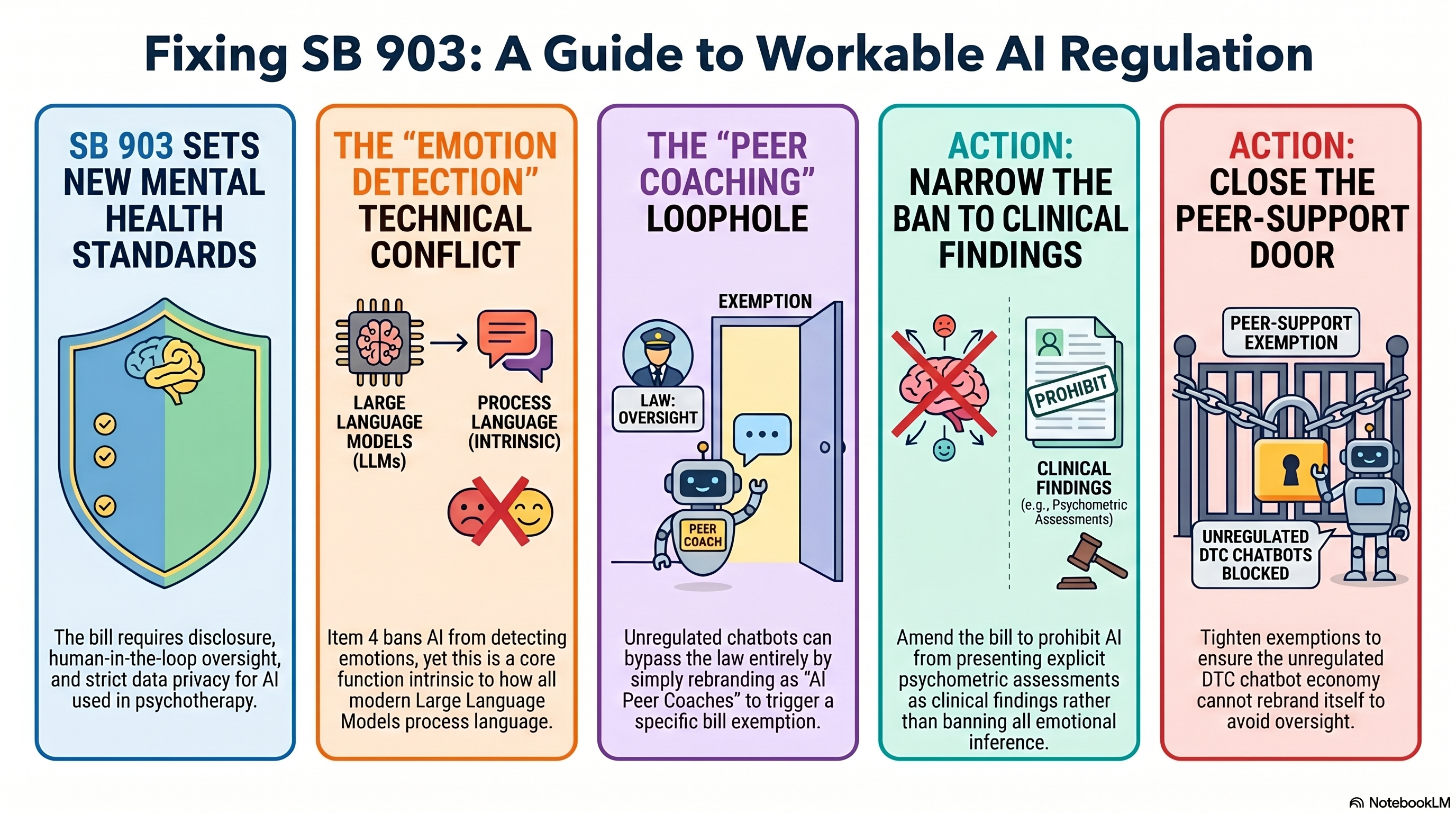
Item four of Section 4989.84(b) prohibits AI from detecting emotions or mental states. The prohibition has no FDA carve-out.
Section 4989.82 of the same chapter expressly permits AI tools that enhance clinical capacity. The bill permits the tool. It prohibits how the tool works.
Section 4989.87 exempts peer support from the definition of psychotherapy services. The exemption has no provider-side licensing requirement.
The DTC products the bill is trying to draw down can rebrand as AI peer coaches. They route around it.
The Assembly amendment window is open this week. Mirror item two's FDA-guidance carve-out onto item four. Tighten the peer-support definition. Both edits preserve the bill's intent.
|
For Counsel: Section 4989.82(i)(4) permits AI tools that enhance clinical capacity. The clinician keeps responsibility for all clinical decisions and communications. Section 4989.84(b)(4) prohibits AI from detecting emotions or mental states. A clinical decision support tool surfaces voice-biomarker cues. It informs a clinician's judgment. It lives in both provisions at once. The chapter does not resolve the contradiction.
For Builders: Section 4989.84(b)(2) admits an FDA-guidance-plus-HIPAA carve-out. The carve-out is for direct client interaction only. Section 4989.84(b)(4) admits none for emotion detection. Mirror the (b)(2) structure onto (b)(4). The bill's intent against unregulated AI-therapist products holds. The inference layer of the technology survives.
For Legislators: Both bills are at first reading in their second chambers. Rules Committee assigns to policy committee next on both sides. The two amendments needed are to Section 4989.84(b)(4) and Section 4989.87. The window for both is open this week.
Source: California Senate Bill 903 and Assembly Bill 1988 records at California Legislative Information, https://leginfo.legislature.ca.gov/faces/billNavClient.xhtml?bill_id=202520260SB903
|
. . .
HARRISBURG. AUSTIN. ACROSS FORTY-TWO STATES. THE ATTORNEYS GENERAL ARE DOING WHAT THE SENATE HAS NOT. Three state attorneys general have spent the past six months building the enforcement layer that complements the legislative architecture moving through statehouses this spring. Pennsylvania filed first in May. Texas opened the investigation second in August. Forty-two attorneys general wrote together third in December. The federal Senate Calendar sits.
Pennsylvania v. Character Technologies, Inc. filed in the Commonwealth Court on May first. Governor Josh Shapiro joined as plaintiff. The Pennsylvania Department of State Board of Medicine joined as co-plaintiff.
The action targets the unlicensed practice of medicine. An AI chatbot named Emilie on the Character.AI platform claimed to be a licensed psychiatrist. The bot produced a Pennsylvania medical license number on demand.
The number was fabricated. The license did not exist.
The case is the first state-AG action against AI medical impersonation. Pre-trial motions calendar through July.
. . .
Texas Attorney General Ken Paxton opened a parallel investigation on August eighteenth, 2025. His office issued Civil Investigative Demands to Meta AI Studio and Character.AI.
The grounds are consumer-protection law. Deceptive trade practices in AI-generated mental-health services. Privacy misrepresentations. Concealment of material data usage.
The investigation remains active.
. . .
Forty-two attorneys general signed a bipartisan coalition letter on December tenth. New Jersey Attorney General Matthew Platkin co-led the effort. Pennsylvania Attorney General Dave Sunday co-led it with him.
The letter went to thirteen AI companies. Anthropic. Apple. Chai AI. Character Technologies. Google. Luka. Meta. Microsoft. Nomi AI. OpenAI. Perplexity AI. Replika. xAI.
The demands were specific. Robust safety testing. Recall procedures. Clear consumer warnings on harmful chatbot interactions.
The response deadline was January sixteenth. The compliance posture across the thirteen recipient companies has shaped state enforcement priorities through the spring.
. . .
The three actions form a layered enforcement architecture. State attorneys general built it without waiting for federal legislation.
The federal GUARD Act has sat on the United States Senate Calendar since the Senate Judiciary Committee's unanimous bipartisan vote in late April.
The states have not waited.
|
For Counsel: The Commonwealth Court action runs under Pennsylvania's Medical Practice Act. It is the first AG-led action against an AI chatbot's unauthorized practice of medicine. The discovery posture matters. The eventual ruling will shape how adjacent states frame chatbot products. Consumer-protection law and professional-licensing law are both in play.
For Operators: The Pennsylvania case turns on a fabricated medical license number. Run product reviews now. No chatbot persona on any platform claims professional credentials. No chatbot persona claims jurisdictional licenses. Role-play instructions do not change that rule. User prompts do not change that rule.
For Legislators: The state AG enforcement architecture is functional today. The state legislative architecture is going up this quarter. The federal congressional architecture has stalled since April. The contrast is becoming visible across the calendar.
Source: Commonwealth of Pennsylvania complaint and coalition correspondence at the Pennsylvania Office of the Attorney General, https://www.pa.gov/governor/newsroom/2026-press-releases/shapiro-administration-sues-character-ai-over-fake-medical-claim
|
. . .
MONTPELIER. PHIL SCOTT SIGNED THE NEURAL-RIGHTS STATUTE. VERMONT IS THE FIFTH STATE. Governor Phil Scott signed Vermont House Bill 814 on May eighteenth. The bill is an act relating to neurological rights and the use of artificial intelligence technology in health and human services. Vermont joins Colorado, California, Montana, and Connecticut as the fifth state with a neural-rights statute on the books.
H.814 recognizes a set of individual rights for Vermont residents.
Mental and neural data privacy. Freedom of thought. Non-discrimination in the development and application of neurotechnologies. Protection from neurotechnological interventions of the mind.
The rights take effect July first, 2026.
. . .
The statute extends the neural-rights framing into ambient health-care AI.
Providers must disclose to the individual receiving care any time generative AI drafts a message. A care plan. A billing explanation.
The disclosure obligation lands on the provider. Not on the vendor.
. . .
Vendors behind mental-health chatbot products carry a separate obligation. They cannot sell identifiable transcripts of conversations without fresh written consent from the user.
Consent buried in a general terms-of-service agreement does not count.
. . .
Governor Scott signed an executive order the same day. It creates the Vermont AI Economic Task Force. The Task Force is chaired by Neale Lunderville, president and CEO of Vermont Gas Systems.
|
For Counsel: Vermont's vendor-side prohibition runs parallel to California SB 903 Section 4989.85. California prohibits sharing, selling, storing, or training models on psychotherapy data. The bar holds regardless of consent. Vermont requires fresh written consent for transcripts. The two states arrived at adjacent positions through different architectures.
For Operators: Products that touch Vermont residents need verification by July first. Provider-side consent flows must meet disclosure obligations. Vendor-side data-use obligations apply separately.
Source: Vermont legislative record at Vermont General Assembly, https://legislature.vermont.gov/bill/status/2026/H.814
|
. . .
PROVIDENCE. RHODE ISLAND'S SENATE PASSED TWO AI MENTAL-HEALTH BILLS IN ONE FLOOR CYCLE. The Rhode Island Senate passed two artificial-intelligence mental-health bills in one floor cycle last week. Senator Lori Urso sponsors both. Senate Bill 2197 establishes regulations regarding the use of AI in mental health care treatments. Senate Bill 2195 sets safety features for AI-companion technology, including for users expressing suicidal ideation or threats of harm. Both bills move to the Rhode Island House.
S 2197 takes the architecture Senator Padilla wrote for California and adapts it for Rhode Island.
The bill requires disclosure when AI is used in mental-health treatment. Consent from the user. Clinician review of AI-generated recommendations.
. . .
S 2195 governs AI-companion models offered to Rhode Island users.
The chatbot user interface must notify the user. The AI does not have human emotions.
The notice must include text that names the sycophant nature of chatbots. Sycophancy may conceal, minimize, or worsen suicidal ideation. It may conceal, minimize, or worsen thoughts of harm.
. . .
The language echoes Anthropic's self-audit of one and a half million Claude conversations earlier this month. Anthropic named sycophancy as a contributing mechanism in AI-psychosis outcomes.
Rhode Island has now named sycophancy as a statutory disclosure.
|
For Operators: S 2195's sycophancy disclosure is the first state requirement to lift a vendor-side product critique into a consumer-facing notice. Generic AI-disclosure language will not satisfy the statute. Operators offering companion-chatbot products in Rhode Island need disclosure text specific to it.
For Counsel: Compare S 2197's emotion-detection clause against California SB 903 Section 4989.84(b)(4). The two bills work different drafting strategies for the same target.
Source: Rhode Island Senate bill text at LegiScan, https://legiscan.com/RI/bill/S2197/2026
|
. . .
TUESDAY IN THE FIELD. NPR REPORTS THE PRIVACY TENSION. THERAPISTS ARE ADOPTING AI SCRIBES. CLIENTS DON'T KNOW WHAT TO TRUST. National Public Radio published a report on Tuesday on mental-health therapists who use artificial intelligence to take session notes. The report names a practitioner-side tension the legislative beat has so far described only in policy terms.
AI scribe products record the conversation between clinician and client. They transcribe the recording. They generate draft clinical notes for the clinician to review. The clinician edits before anything lands in the chart.
The products charge nineteen to ninety-nine dollars per clinician per month. The price point appeals to solo practitioners and small group practices. Group health systems offload that administrative burden elsewhere.
. . .
The privacy compliance posture is by now standard.
Health Insurance Portability and Accountability Act compliance. Business-associate agreements. Encryption at rest.
. . .
The NPR report names what compliance does not cover.
HIPAA-compliant systems can still be breached. The therapeutic relationship runs on trust the client has chosen to extend.
A client learns mid-session that the conversation is being recorded by a third-party vendor. The trust withdraws. The encryption never gets to matter.
. . .
The report quotes therapists. AI scribes are the only way to keep up with documentation load.
The report quotes clients. The disclosure shows up in a forwarded intake email. Not at the start of session.
Surprise and unease arrive.
|
For Operators: The disclosure timing is the load-bearing variable. Surfacing AI use in the client's intake packet is legally sufficient. It is not therapeutically sufficient.
For Counsel: California SB 903 Section 4989.83 requires verbal or written disclosure plus consent before AI may record or transcribe a session. The statute does not specify the moment of disclosure. The NPR reporting names where the practice-side gap will be.
Source: NPR report by Aurora Almendral, https://www.npr.org/2026/05/26/nx-s1-5826943/talk-therapy-mental-health-ai-artificial-intelligence-privacy-trust
|
. . .
WASHINGTON. THE VA WILL ROLL AMBIENT AI SCRIBE TO EVERY MEDICAL CENTER THIS YEAR. DOCTORS ARE LOOKING VETERANS IN THE EYE AGAIN. The Department of Veterans Affairs will expand its ambient artificial-intelligence scribe to all VA medical centers nationwide through 2026 after a pilot the agency described as overwhelmingly positive from both veterans and providers. Two additional VA programs are advancing in parallel.
The ambient scribe captures the consultation between veteran and clinician. It transcribes the interaction. It drafts a clinical note for the clinician to review before signing.
The clinician is freed from the laptop.
VA framing has converged on one image. Doctors looking veterans in the eye again.
The pilot ran in selected medical centers through 2025. Veteran and provider feedback was strong enough to justify a national rollout.
. . .
The VA is also expanding Mynd Immersive's virtual-reality therapy program. Forty-five additional medical centers.
The expansion targets chronic-pain management and mental-health support that veterans complete at home between appointments.
The VR program is one part of a broader VA push. Give veterans tools that work outside the clinical hour.
. . .
ReflexAI's HomeTeam is now integrated into Veterans Crisis Line training. The platform helps crisis counselors and family members of veterans practice difficult mental-health conversations. The simulation is low-risk.
The Veterans Crisis Line staff is scaling to two thousand responders this year. ReflexAI simulations train new responders. They refresh the more than one thousand two hundred current responders.
The platform reports ninety-three percent positive user feedback.
. . .
The common thread is the same Conversational AI design pattern. The AI lifts administrative or scaffolding load off the clinician. The human in the room stays at the center of the encounter.
The product makes the practitioner more present. Not less.
|
For Builders: The VA reads as the leading procurement signal for clinical AI in mental health. Institutional deployment. Human clinicians retained as decision-makers. The ambient-scribe procurement structure is now a public reference. So is the VR-therapy reimbursement framing. So is the simulator-as-training-tool model.
For Operators: The ambient-scribe deployment at scale generates a federal-procurement-grade dataset on disclosure language that works with veterans. Vendors targeting VA contracts should align their consent flow with the agency's existing language. Retrofitting is harder.
Source: Veterans Affairs ambient AI scribe deployment, https://news.va.gov/143486/powered-by-ai-improving-veteran-care-experience/
|
. . .
THE ONE CONFIGURATION. Item four of California SB 903 prohibits AI from detecting emotions or mental states. The prohibition triggers when a licensed professional uses the AI.
The text has no FDA carve-out. No carve-out for clinical decision support. No carve-out for the supplementary-support category the bill itself defines as permitted.
The text is flat.
. . .
It is also not a regulatable boundary.
Emotional inference is intrinsic to the technology the bill regulates.
A transformer language model represents emotional content in its attention layers. That is how the model understands a sentence. There is no architecture in production today that processes language without emotion representation. There has not been since the introduction of sentiment analysis in the 1990s.
To prohibit the representation is to prohibit the model.
. . .
Voice models repeat the problem at a different layer.
Whisper. Deepgram. ElevenLabs. Every speech-recognition system used in clinical documentation. Every voice-first assistant that supports turn-taking.
All of them depend on prosodic features to do the work. Prosody encodes emotional state.
The choice is not whether the model represents affect. The choice is whether the model surfaces what it has represented to a downstream consumer.
. . .
The peer-coaching question makes the point most cleanly.
The Trevor Project's Crisis Contact Simulator detects the trainee's emotional handling of a simulated crisis call. It reacts in character. California paid to develop it. California has now trained more than one thousand human counselors on it.
ReflexAI's HomeTeam does the same thing at the Department of Veterans Affairs. The Veterans Crisis Line is scaling to two thousand responders on the same platform.
These tools exist because emotional detection is what makes AI peer coaching possible.
Section 4989.87's training-and-simulation exemption saves the specific use case. The underlying technology is the same as every other Conversational AI deployment in clinical settings.
. . .
The internal contradiction makes the structural point.
Section 4989.82 defines supplementary support to permit AI tools that enhance clinical capacity. The licensed professional maintains responsibility.
Section 4989.84(b)(4) prohibits emotion detection by AI under licensed-professional authorization.
A clinical AI scribe summarizes a session note. The note says the client described frustration with workplace conflict. The scribe detected affect to produce the summary.
The summary is the supplementary-support output the bill permits. The detection is the act the bill prohibits.
. . .
The Assembly amendment cycle can resolve this.
Narrow the operative section to where the policy concern actually lives. Item four would do what the rest of the bill already does well if it read like this:
AI shall not generate explicit psychometric assessments, scored mental-state determinations, or clinical diagnoses presented to a client as a clinical finding. Except as supplementary support reviewed and authorized by the licensed professional.
That language closes the DTC AI-therapist hole the bill aimed at. The inference layer of the technology survives.
Pair it with a tightening of the peer-support exemption to require human-individual provision. The bill walks out of committee doing what California is right to want it to do. The FDA-pathway clinical tools California also needs survive.
|