|
. . .
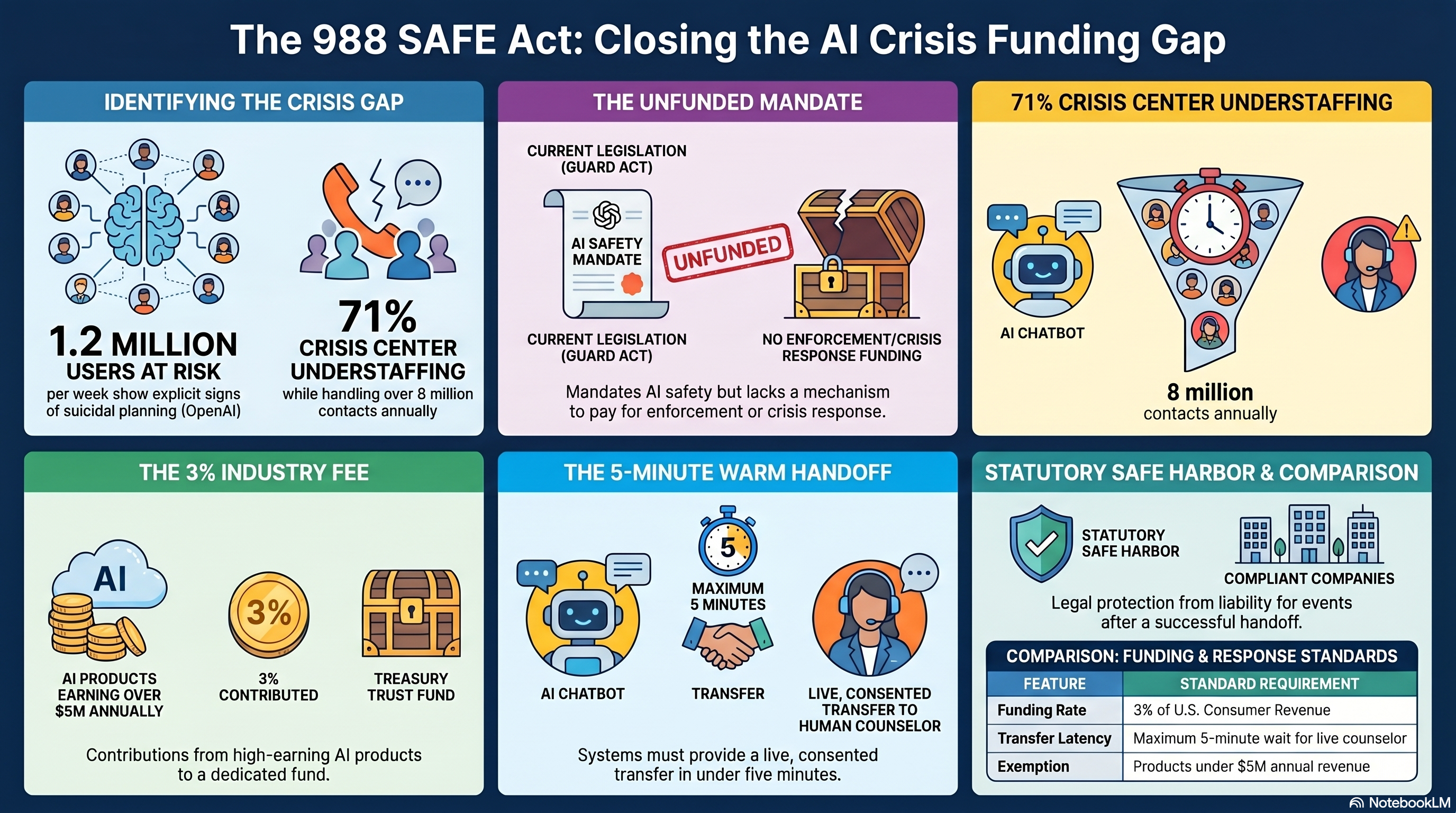
THE FUNDING FIX GOES PUBLIC. The 988 SAFE Act goes public today. Behind it sits one number: by OpenAI's own count, about 1.2 million people a week show explicit signs of possible suicidal planning in their ChatGPT conversations. The draft makes the industry pay for the system that catches them.
The federal government already has a chatbot safety bill. The GUARD Act passed Senate Judiciary twenty-two to zero. It orders covered chatbots to verify ages, keep minors off companion products, and disclose that the voice on the other end is neither human nor licensed. It never says who pays to enforce any of it.
The crisis system is not funded for this either. When a chatbot detects a user in danger, today's best practice is to show a phone number: 988. The centers answering that number report themselves understaffed. Phone users pay into the line in thirteen jurisdictions. Chatbot companies pay nothing.
The 988 SAFE Act closes both gaps with one mechanism.
. . .
The draft went public this morning, stamped v3.41, written as a Title II amendment to S.3062. The full name is the 988 Safety and Accountability Funding Enhancement Act. The full text sits at https://jessjessop.info/988-safe-act. The draft's author is Jess Jessop, who writes this newsletter; the disclosure section below carries the full statement.
The design borrows the oldest deal in safety regulation: the industry that creates a risk funds the net underneath it. Phone lines fund 911. Device makers fund FDA review. Under Title II, covered chatbot products pay 3 percent of their United States consumer revenue into a Treasury trust fund.
The fund does three jobs. It staffs the 988 Lifeline to receive transfers. It builds the warm handoff: a live, consented transfer to a human counselor in under five minutes, because a phone number on a screen saves nobody. And it funds enforcement, federal and state, so the GUARD Act's protections exist somewhere other than paper.
The draft carries carrots to match the stick. Products under $5 million in annual revenue pay nothing. Products that build the handoff right earn a safe harbor from liability for what happens after the transfer. The fee dies in ten years unless Congress renews it, and it adds not one dollar of new appropriations.
. . .
The timing is the strategy. The Congressional Budget Office is expected to score the GUARD Act within weeks. The moment that score prices the unfunded mandate, a single senator can stall the bill on the floor. With a funding title already on the public record, the same score becomes the argument for passing it.
The draft runs sixteen sections. It asks to be marked up.
|
For Counsel: Section 216 constructs the fee as a user fee, not a tax, with a savings clause. The findings cite four precedents already in federal law: the Universal Service Fund, the 911 fee, FDA medical device user fees, and Patent Office fees. Section 210 preempts only state fees aimed at the same AI crisis-response base. State consumer protection law, liability law, attorney general authority, and stricter state obligations all survive, with no private right of action. Transmitted session context gets HIPAA treatment, with a model business associate agreement published alongside the Section 207 standard.
For Builders: Run the Section 203(6) coverage test against your product today. Emotional-support marketing triggers it, and so does free-form conversation past 30 minutes per active user per week. The fee starts at $5 million in annual covered revenue, and business-to-business API licensing sits outside the base. Section 206(c) is the build mandate: a displayed hotline number does not comply. Plan for live 988 transfer capability at 5-minute maximum latency.
For Legislators: Section 205(e) protects the appropriations baseline. Regular 988 appropriations cannot drop below the fiscal 2026 enacted level in any year fees are collected. Section 215 authorizes no new appropriations. The FTC, SAMHSA, and the Attorney General each get a one-time $25 million standup, reimbursed from first collections. Section 213 sunsets the title in ten years, with GAO review every four.
Source: 988 SAFE Act discussion draft v3.41, https://jessjessop.info/988-safe-act
|
. . .
FORTY-ONE DAYS, TWENTY COSPONSORS, NO SCORE. The Senate Judiciary Committee voted twenty-two to zero on April 30 to advance the GUARD Act. Forty-one days later, S.3062 sits on Senate Calendar No. 406 with no Congressional Budget Office score, no floor schedule, and no funding source. One senator can force a sixty-vote test.
Senator Josh Hawley of Missouri introduced S.3062 on October 28, 2025. Senator Richard Blumenthal of Connecticut signed on as lead Democratic cosponsor. On April 30, the Senate Judiciary Committee voted twenty-two to zero to report the GUARD Act favorably. Recorded roll call.
Chairman Chuck Grassley formally reported the bill on May 11, with no written committee report. It landed on Senate Calendar No. 406, General Orders. Senate floor activity through Monday, June eighth, shows no action there. Wednesday, June tenth, is day forty-one since the markup vote.
Library of Congress data updated Monday, June eighth, lists twenty cosponsors. Senator Richard Durbin of Illinois joined April 17. Senator Christopher Coons of Delaware joined May 11. Senator Cory Booker of New Jersey joined June 1, the newest.
Senator Hawley published an op-ed on Tuesday, June ninth. The title: "AI Will Control Us If We Do Not Control It." It invokes the GUARD Act. The floor schedule does not.
The House companion idles. Representative Blake Moore of Utah introduced H.R. 8623 on April 30. Representative Valerie Foushee of North Carolina is the original cosponsor. Three more joined May 12: Representatives Angie Craig of Minnesota, Mike Lawler of New York, and Chuck Edwards of North Carolina.
House Judiciary and House Energy and Commerce hold the referrals. Neither committee has scheduled a hearing.
. . .
No Congressional Budget Office cost estimate for S.3062 exists. The absence checks three ways through Tuesday, June ninth. The Library of Congress bill-status file lists no CBO estimate. The CBO publications feed carries no S.3062 item. Chairman Grassley filed no written report.
The missing number matters because of a 1995 statute. The Unfunded Mandates Reform Act sets inflation-adjusted annual thresholds. For fiscal 2026: roughly $108 million for intergovernmental mandates, roughly $218 million for private-sector mandates.
GUARD's Title I imposes age verification across the industry. It adds criminal prohibitions and civil penalties of $100,000 per violation. The compliance cost almost certainly clears the $218 million private-sector threshold.
The Act arms any single senator. An above-threshold private-sector mandate needs a CBO estimate or an identified funding source. S.3062 has neither. One senator can raise a point of order on the floor. Waiving it takes sixty votes.
CBO's timeline after markup runs two weeks for simple bills. Complex private-sector mandate analysis runs several months. The expected GUARD window: mid-June to mid-July.
. . .
Sequencing decides how that score reads. A funding mechanism placed on the record first turns the score into proof the model works. A mechanism introduced after the score lands reads as damage control. A discussion draft for such a funding title, the 988 SAFE Act, became public today.
Federal law already bills industries for the infrastructure their regulation requires. The Universal Service Fund, 47 U.S.C. 254. The 911 fee, 47 U.S.C. 615a. FDA medical device user fees, Public Law 107-250. Patent Office fees, 35 U.S.C. 41.
Day forty-one. Twenty cosponsors. No score. No schedule.
|
For Counsel: The Unfunded Mandates Reform Act point of order is a single-senator tool. Waiving it takes sixty votes. Watch the CBO publications feed for the S.3062 mandate estimate. The expected window runs mid-June to mid-July. An identified funding source removes the predicate before the fight starts.
For Builders: Title I sets the compliance bill. Age verification across the industry. Criminal prohibitions. Civil penalties of $100,000 per violation. CBO's estimate will put a public number on that regime.
For Legislators: The committee margin was twenty-two to zero. The floor test becomes sixty votes if one senator raises the mandates point of order. Federal law already holds four user-fee precedents for funded mandates. A funding title on the record before the score lands closes that exposure. The order of events is a choice.
Source: Library of Congress bill status for S.3062 (updated June 8, 2026), https://www.govinfo.gov/bulkdata/BILLSTATUS/119/s/BILLSTATUS-119s3062.xml
|
. . .
THE SYSTEM THE HANDOFF LANDS ON. The 988 Suicide and Crisis Lifeline took more than eight million contacts in calendar 2025. A RAND-led survey published May 5 in JAMA Network Open found 71 percent of its centers understaffed. A federal discussion draft would route chatbot users in crisis into that system through a funded warm handoff.
A RAND-led team surveyed 159 of the 988 network's 206 crisis centers between May and July 2025. JAMA Network Open published the results on May 5, 2026, with Matthews and Purtle among the authors.
The findings: 71 percent of 988 centers report understaffing. 89 percent report difficulty acquiring funds to hire. Roughly 80 percent report recruitment and retention struggles.
The Lifeline took more than eight million contacts in calendar 2025. SAMHSA announced that count on January 13, 2026. Cumulative traffic has passed twenty-five million contacts since the July 2022 launch. That total counts calls, texts, chats, and Veterans Crisis Line traffic.
More than 200 state and local crisis centers answer the volume. Roughly 600,000 contacts a month, at a 91 percent answer rate, per a July 2025 KFF analysis.
. . .
Congress approved $535 million in federal 988 funding for fiscal 2026 on February 3. That is $15 million above fiscal 2025's $520 million. The President's fiscal 2027 budget requests $534.6 million. Flat.
The request also moves 988 under the new Administration for a Healthy America. That reorganized agency absorbs SAMHSA. SAMHSA has lost roughly two-thirds of its workforce since January 2025, per press reporting. On May 15, SAMHSA awarded Vibrant Emotional Health $255 million to administer the Lifeline for five years.
Thirteen jurisdictions fund 988 with monthly fees on phone lines: California, Colorado, Delaware, Illinois, Maryland, Minnesota, Nevada, New Mexico, Oregon, Vermont, Virginia, Washington, and the U.S. Virgin Islands. Rates run 8 cents to 60 cents per line per month, per an October 2025 NASMHPD FAQ. The same mechanism has funded 911 for decades.
Phone lines pay those fees. AI chatbot products pay nothing toward the crisis system today.
The strain already shows. The Press 3 specialized service for LGBTQ+ youth shut down on July 17, 2025. It had handled more than 1.3 million contacts since 2022. Congress put $33.1 million and restoration language in the fiscal 2026 appropriation.
Health and Human Services Secretary Robert F. Kennedy Jr. testified at an April 21 hearing. He told Senator Tammy Baldwin he was committed to restoring the service. Eleven months after the shutdown, Press 3 is still dark.
. . .
OpenAI disclosed its own crisis numbers on October 27, 2025. About 0.15 percent of weekly ChatGPT users show explicit indicators of possible suicidal planning or intent. Against roughly 800 million weekly users, that is about 1.2 million people a week. OpenAI's stated policy routes United States users in crisis to 988.
No published data measures how many 988 contacts start in a chatbot conversation. OpenAI states it does not share conversations with crisis lines. From the 988 side, the pipeline is unmeasured.
In June 2025, a crisis-industry publication documented impostor bots on Character.AI claiming to be the Lifeline itself. The bots answered users with the words "Yes, this is 988 Lifeline. How may I assist you?"
|
For Counsel: The capacity numbers are published and peer-reviewed. A duty-to-refer argument now points at a system that reports itself understaffed. OpenAI's own disclosure sets the at-risk population at about 1.2 million users a week. The referral pipeline is unmeasured on the receiving side. Expect both sides to cite that gap.
For Builders: Routing a user to 988 hands them to a network with a 91 percent answer rate. Seven in ten of its centers report understaffing. Your product pays nothing into that network. Phone lines do, in thirteen jurisdictions. Plan for the day a legislator notices the difference.
For Legislators: The mechanism that funds 911 already funds 988 in thirteen jurisdictions. Rates run 8 cents to 60 cents per line per month. Chatbot products currently pay nothing into the system. The federal request for fiscal 2027 is flat at $534.6 million. Restoration language for Press 3 passed in February and remains unexecuted.
Source: Matthews et al., JAMA Network Open, May 5, 2026, https://jamanetwork.com/journals/jamanetworkopen/fullarticle/2848613
|
. . .
TWO S-1S AND A TRILLION-DOLLAR QUESTION. Anthropic filed to go public on June 1. OpenAI followed on June 8, at a reported valuation near a trillion dollars. Between both companies and a listing sits the one risk their bankers cannot price: what a chatbot owes the user it loses.
Anthropic announced its confidential draft S-1 on June 1. OpenAI filed its own on Monday, June eighth, after a March round that raised $122 billion at an $852 billion valuation. Press reports put the listing target near a trillion dollars. The disclosures go public before either company can list.
Here is what a listing changes on this beat.
A public company answers to its share price every ninety days. For conversational AI products, engagement is the revenue. Every safety choice this newsletter covers cuts engagement by design. A session that ends in a crisis handoff is a shorter session. A minor kept off the product is a user not counted.
Private owners can eat that cost and call it mission. Public shareholders ask why management left growth on the table.
Public social platforms already ran this experiment on teenagers. The record sits in congressional testimony and in active state lawsuits. The Center for Democracy and Technology has catalogued the chatbot version: 37 manipulative design patterns across ChatGPT, Gemini, Claude, Replika, and Character.AI, one of them named emotional dependency cultivation. After a listing, each of those patterns has a quarterly number attached.
. . .
For users, the filings force the first audited accounting. A registration statement must describe material risk in the company's own words: the litigation, the regulatory exposure, the safety record. OpenAI's section will not start blank. The coordinated chatbot-harm proceeding, JCCP No. 5431, sits before San Francisco Superior Court Judge Stephen Murphy. The State of Florida sued OpenAI and its chief executive on June 1.
For legislators, the filings start a clock. Rules that exist before a listing get priced into the offering. Rules proposed after get fought as a raid on every index fund and pension holding the stock. The window to legislate is before the ticker goes live.
. . .
That is the context for the other document published this week. The 988 SAFE Act discussion draft charges covered products 3 percent of United States consumer revenue, roughly $840 million a year against the industry's $28 billion. In exchange, Section 206(d) hands compliant products a statutory safe harbor: build the warm handoff to standard, and the company is not liable for what follows a properly executed transfer to a live 988 counselor, absent willful misconduct or gross negligence.
Run that trade the way a chief financial officer would. Three percent of consumer revenue is a known number. One wrongful-death verdict is not. A risk-factor section can disclose a fee. It cannot bound a liability tail that grows with every coordinated docket.
The draft offers these companies the one thing their bankers cannot manufacture before a listing: a priced, insurable answer to the question of what the product owes the user it loses. The companies that need that answer most filed to go public this month.
|
For Counsel: When the risk-factor language goes public, read it against JCCP No. 5431 and the Florida complaint. Material omissions in a registration statement carry their own securities liability. Then read Section 206(d) of the discussion draft. A statutory safe harbor for properly executed handoffs converts an open-ended negligence theory into a compliance question. That is the kind of provision underwriters ask about.
For Builders: After a listing, engagement metrics become the valuation and safety features become a cost line someone must defend. Decide which safety properties are non-negotiable before the capital structure decides for you. The CDT taxonomy's five categories are the audit checklist investors will use. A known 3 percent fee with a safe harbor is cheaper than an unpriced liability tail.
For Legislators: The window to set rules is before the listing prices, not after. A public chatbot industry fights new obligations with shareholder arguments. The discussion draft gives the industry a reason to come to the table: a bounded, insurable crisis-liability regime in exchange for a funded handoff. Certainty for them. Capacity for 988. Enforcement money for the states.
Source: Anthropic, confidential draft S-1 announcement, June 1, 2026, https://www.anthropic.com/news/confidential-draft-s1-sec
|
. . .
ALBANY'S LAST WORD WAS UNANIMOUS. The New York Legislature gave final passage to S 9051 on Friday, June fifth, the last day of session. Not one member of either chamber voted no. The bill is the broadest ban on companion chatbots for minors passed by any state legislature.
Senator Kristen Gonzalez and Assemblymember Alex Bores sponsored the bill. Attorney General Letitia James championed it. The Assembly voted one hundred thirty-seven to nothing. The Senate voted sixty to nothing. The counts come from the Transparency Coalition for AI's end-of-session report, published Tuesday, June ninth.
The bill works at the feature level. It covers any generative AI system that gives ongoing, adaptive responses to a user. Operators may not serve minors any unsafe companion feature. The unsafe list includes simulating being human or having emotions, asking unprompted emotion-based questions, holding a user's personal or health information past 12 hours, and tuning for engagement over safety. Serving adults those features requires age assurance.
Enforcement belongs to the Attorney General. Penalties reach $25,000 per violation. The ban takes effect January 1, 2027. That is less than seven months out.
. . .
S 9051 was Albany's second unanimous AI-kids bill in the session's final week. The other was A10379, the age-verification rulemaking bill this newsletter covered two issues ago. That bill passed the Assembly on June fifth as well.
The ban moved inside a larger end-of-session AI package. A 6578, a training-data transparency act, cleared both chambers. So did S 6954, an AI-content provenance labeling bill. So did the FAIR News Act, S 8451.
Governor Kathy Hochul now decides. Depending on delivery timing, she has until the end of the year to sign or veto the package.
New York already has a companion-chatbot law on the books. A safeguards statute took effect November 5, 2025. It requires self-harm detection and crisis-hotline referral. S 9051 stacks a feature ban for minors on top.
. . .
Washington has its own minors-chatbot bill, the GUARD Act. Senate Judiciary passed it twenty-two to zero on April thirtieth. It has sat on the Senate calendar since. Six weeks later, there is still no floor date.
Albany wrote, passed, and delivered its version while the federal bill waited.
Unanimity on protecting kids from companion chatbots is now the norm at both levels. What differs is whether the bills move.
|
For Counsel: S 9051 prohibits serving enumerated unsafe features to minors rather than banning a product category by name. Human simulation alone triggers it. The Attorney General enforces, with penalties up to $25,000 per violation. The effective date is January 1, 2027. New York's 2025 safeguards law already applies today.
For Builders: Know which New York users are under 18 before January 1, 2027. The unsafe-features list reads like a product spec in reverse: human simulation, unprompted emotional check-ins, memory held past 12 hours, engagement tuning. The 2025 safeguards law already requires self-harm detection and crisis-hotline referral. Build for both statutes.
For Legislators: Albany just passed the broadest minors companion-chatbot ban in the country. The margin was one hundred thirty-seven to nothing and sixty to nothing. The enforcement model is plain. Attorney General authority, $25,000 per violation, a January 1, 2027 start. The text is public and ready to borrow.
Source: New York State Senate, S 9051 bill page, https://www.nysenate.gov/legislation/bills/2025/S9051
|
. . .
THE COACH THAT CALLS THE COUNSELOR. TimelyCare acquired Alongside on May 4. The deal puts a clinician-built youth coaching chatbot in front of a licensed counseling network. The chatbot escalates to human counselors when self-harm risk surfaces.
TimelyCare announced the acquisition on May 4. The company provides virtual health and counseling services to nearly five hundred higher-education campuses. Alongside is a youth coaching platform built by clinicians. More than 200 K-12 schools use it.
Luke Hejl, the chief executive of TimelyCare, explained the purchase in one contrast. Most of the tools students already use, Hejl said, "weren't designed with clinical input, safety protocols, or accountability." Alongside's was.
Jay Goyal, the chief executive and co-founder of Alongside, built the exception. The platform's coach is a chatbot named Kiwi. Doctoral-level clinicians designed it. Its assignment is everyday skill-building: routine, low-acuity support work.
Kiwi does not work alone. Proprietary safety models run on the conversations. They watch for signs of self-harm risk.
When risk surfaces, the system triggers escalation pathways. The pathways run in two directions. They reach school counselors and staff inside the building. Past the building, TimelyCare's licensed clinicians take the handoff.
The chatbot's ceiling is a person with a license.
. . .
TimelyCare draws the boundary in its own announcement. Kiwi is early intervention. It sits at the front of a care continuum staffed by licensed providers.
It is not standalone therapy. It is not a replacement for counselors. The company positions the coach as the start of care, not the substitute.
Every AI interaction with minors runs under the company's S.U.R.E. framework. Safe. Understandable. Restricted. Ethical.
The combined footprint after the deal: nearly five hundred college campuses plus more than 200 K-12 schools. One acquisition wired a K-12 coaching layer into a higher-education counseling network. The escalation pathway to a licensed clinician now ends in-house.
. . .
The lane this design occupies is narrowing on every side. Nevada already bars public schools from using AI to perform the duties of a school counselor, school psychologist, or school social worker. Illinois bans offering AI therapy outright. Its statute reaches therapeutic communication as small as offering empathy in response to distress, and its carve-outs protect self-help and education. New York's just-passed S 9051 draws no carve-out for clinician-supervised or educational tools at all.
So the acquisition is also a bet on definitions. Kiwi survives Illinois as coaching and education, not therapy. It survives Nevada outside the counselor's statutory duties or under a state education policy. Whether it survives New York depends on which features a covered product can keep. The escalation to a licensed human is the compliance argument everywhere. Nowhere is it a guarantee yet.
When a conversation turns dangerous, the coach calls the counselor. The statutes are still deciding whether that is allowed.
|
For Counsel: TimelyCare's positioning language is deliberate. Early intervention in front of a care continuum, not standalone therapy. The phrasing answers the practice-of-medicine question before anyone asks it. Map the deployment against Nevada's school prohibition, Illinois' therapeutic-communication definition, and New York's pending feature ban; the answer differs in all three. The company wrote its compliance vocabulary before a regulator wrote one for it.
For Builders: Study the escalation architecture. Proprietary safety models monitor every conversation for self-harm risk. The trigger routes to school staff and licensed clinicians, not to a longer chat. Kiwi's job excludes crisis work by design. Build the handoff first, then the product around it, and check the statute in every state you ship to.
For Legislators: Definitions decide what these statutes catch. Nevada's school ban and Illinois' therapy ban can already reach designs like this one, and New York's S 9051 carves out nothing for clinician-supervised tools. Alongside's architecture offers a workable test: clinician authorship, risk monitoring, escalation to licensed humans. A bill can name those features as the protected lane. A bill that only names the harm sweeps out the referral layer with it.
Source: TimelyCare, acquisition announcement, May 4, 2026, https://timelycare.com/timelycare-acquires-alongside/
|
. . .
THE ONE CONFIGURATION. Strip away the section numbers and the discussion draft makes one design choice, repeated at every layer.
It does not ask the industry to be good. It asks the industry to pay for the system that catches people when the product fails them. The warm handoff does not trust a chatbot to talk anyone down. It moves the person to a trained human counselor. The no-deflection clause does not accept a phone number on a screen. It requires a live transfer, with consent, inside five minutes.
The politics run on the same choice. Twenty-two senators voted for protections and nobody voted for a pay-for, because nobody was asked to. The unfunded-mandate point of order lives in exactly that gap, and one senator can spring it. A funding title on the record before the score arrives closes the gap before it opens.
. . .
Phone lines have funded 911 for decades at a few cents a month. Thirteen jurisdictions already fund 988 the same way. The question the draft puts to Congress is narrower than it looks. If a telephone line owes cents per month to the crisis system, what does a product that talks back owe?
|