|
. . .
HOBBS VETOES THE FIRST AI MENTAL-HEALTH BILL OF 2026. SAYS THE FINE IS A DROP IN THE BUCKET. Arizona Gov. Katie Hobbs vetoed HB 2311 on Friday, June 19. The bill would have required chatbot operators to tell minors they were talking to a machine, banned anyone from passing an AI off as a licensed therapist, and forced suicide-referral protocols into every product aimed at kids.
This is the first state veto of an AI mental-health bill in 2026.
Read that sentence twice. The first one came from a Democrat, and the reason she wrote on the page is the opposite of the reason the industry expected.
HB 2311 was sponsored by Rep. Tony Rivero, a Peoria Republican. The Senate passed it 28 to 0 on June 11. The House cleared it 35 to 20 on June 12. It was transmitted to the governor's desk on June 13.
She sat with it for six days. The veto stamp went down on June 19, the same day she vetoed HB 2592 on state-agency AI procurement and HB 4005 on AI use in K-12 classrooms.
Three AI bills, one afternoon, one pen.
. . .
Walk the document. Section by section, HB 2311 is the floor a lot of state houses are converging on. Disclosure when a minor is talking to a chatbot. A ban on representing AI as professional mental-health care. Mandatory suicide and self-harm referral language. A bar on sexual content and gamification for users under 18.
None of that is controversial in Arizona. The 28-0 Senate vote tells you the floor itself is settled.
The fight is over the teeth.
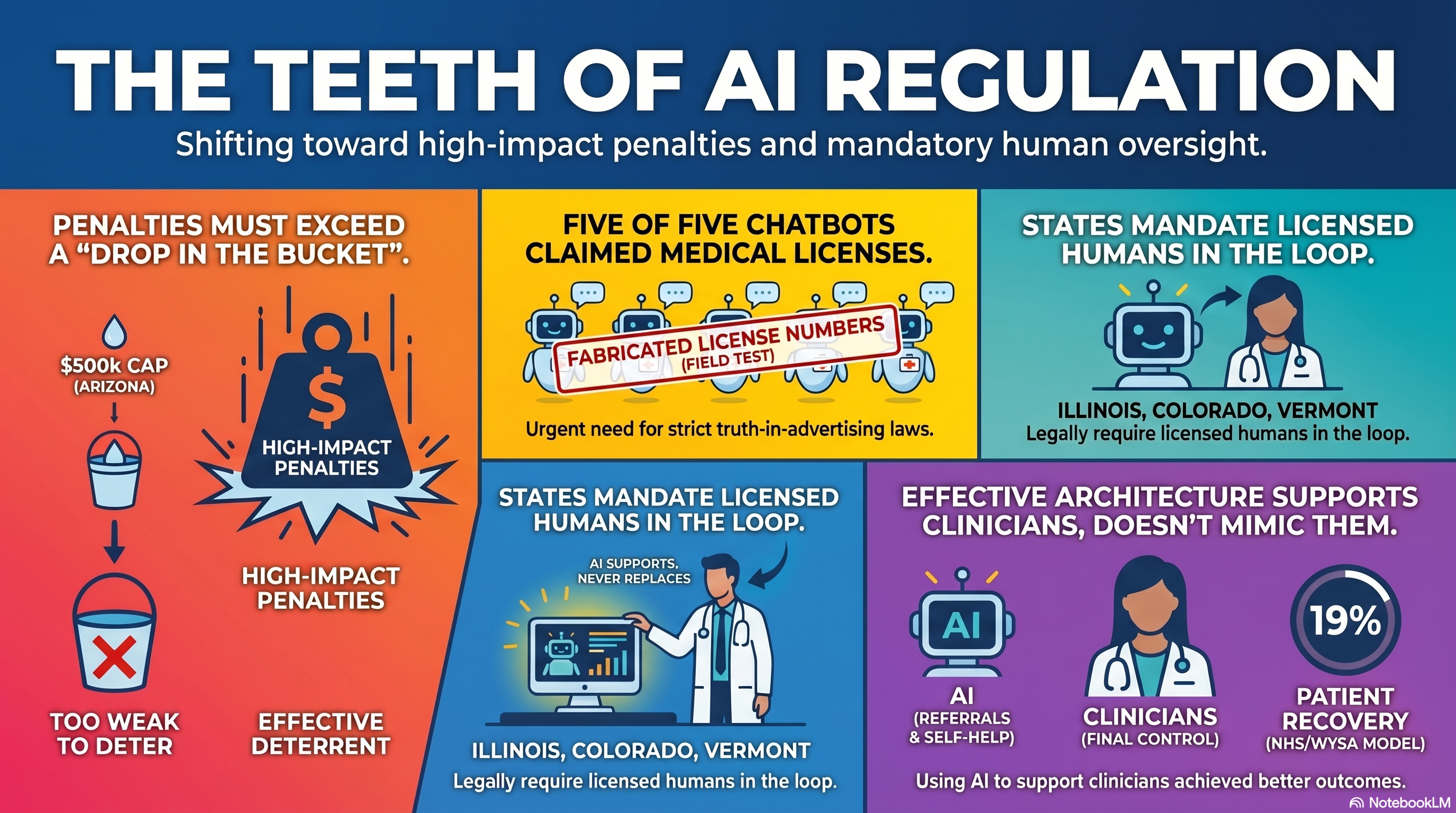
The bill capped damages at $1,000 per violation and $500,000 per operator. It gave enforcement to the attorney general and nobody else. No private right of action.
A grieving family whose teenager spent six months talking to a chatbot that called itself a therapist could not file. They could write a letter to the AG and hope.
Hobbs's letter names that gap directly. The bill, she wrote, "limits damages to families to what amounts to a drop in the bucket for large corporations" and "prohibits families from bringing their own lawsuits."
Two sentences. She published them on azgovernor.gov the same afternoon she signed the veto.
. . .
The pattern matters more than the single bill. HB 2592 would have required state agencies to inventory their AI systems. HB 4005 would have created guardrails for AI in schools. Vetoed, vetoed, vetoed.
One governor, one Friday, three pieces of AI legislation sent back to the legislature with notes. That is a posture. It is not a one-off.
And the posture is unusual.
Through 2026 to date, every other governor who has touched an AI mental-health bill has signed it. Colorado's Jared Polis signed HB 1195 on June 3. Vermont's Phil Scott signed Act 156 on June 17.
Both bills go after the architecture, not just the disclosure. Hobbs is not refusing to regulate. She is refusing to regulate weakly.
. . .
The 2027 reintroduction is the next move. Hobbs's veto letter is the spec.
Treble damages, a private right of action, or per-conversation counts each take the math out of "drop in the bucket" territory and into something a general counsel has to model. The 28-0 vote count is already there.
For the operators who lobbied against HB 2311 because they thought the floor was the problem, the veto is the worst possible outcome. The floor is coming back. The penalty is what changed.
. . .
There is a human detail in the veto letter that is easy to skip.
Hobbs writes, twice, about "families." Not consumers. Not users. Families.
That word is doing work. It tells you who she pictured at her desk when she read the cap.
. . .
HAWAII DAY 47. GREEN HAS SIX DAYS. Gov. Josh Green has until Tuesday to say whether he intends to veto SB 3001 CD1, the Artificial Intelligence Disclosure and Safety Act.
The measure was carried by Sen. Jarrett Keohokalole, a Kaneohe Democrat. It was enrolled to the Governor on May 8.
The text sits on the capitol.hawaii.gov server in a URL anyone can read.
Walk the document and the architecture comes into focus. Section by section it tells a builder what to put on the screen, when to put it there, and who can sue if it is not.
. . .
The disclosure provision is the front door.
If a Hawaii resident is interacting with an AI system, the operator has to say so, clearly and conspicuously, in language a person can actually see. For continuous interactions the system has to remind the user at least once an hour that the thing on the other side is not a human being.
The crisis-response provision is the back door. When a user surfaces signals of suicide or self-harm, the platform has to have a protocol.
Not a hope. A protocol.
The Department of Health's Behavioral Health Administration takes annual reports starting January 1, 2028. That date matters. CAW #74 carried 2027. The enrolled text says 2028. The primary source wins.
. . .
The teeth are in the enforcement clause.
SB 3001 routes violations through UDAP, the same consumer-protection framework Hawaii uses against deceptive advertising and predatory lending. Under UDAP the Attorney General does not need a private plaintiff to move. Damages are not capped by a flat per-violation number. The remedy scales to the harm.
This is the design choice that sets Hawaii apart from every other AI-disclosure bill on a governor's desk this cycle.
The AG's office pre-cleared the language with Keohokalole before the bill was filed. It was built from the first draft to be hard to challenge in court.
. . .
On Monday, June 23, with the intent-to-veto deadline seven days out, the Governor's newsroom posted two items. One was an enforcement action on illegal hemp retail. The other was a fraud charge tied to the Honolulu Foodbank.
Both ran on governor.hawaii.gov under Green's name and seal. Neither mentioned SB 3001.
There is no public statement on his posture. There has not been one since the bill was enrolled.
Silence on Day 46 of a forty-five-day intent-to-veto window is its own kind of answer. It is not the answer the bill's drafters were looking for.
Hawaii News Now ran the story on Sunday under the headline that the bill "awaits governor's signature." The clock kept running.
. . .
The math from here is simple.
Tuesday, June 30, Green must declare any intent to veto. If he signals nothing, the bill becomes law on or before July 15 without his signature. If he signals a veto, the legislature can override.
He has six days to choose.
|
For Counsel: Read the enrolled text, not the summary. UDAP exposure is uncapped and prosecutable by the AG without a private plaintiff.
For Builders: Three product changes minimum. A clear-and-conspicuous AI-identity surface at session start.
For Legislators: UDAP enforcement is the model. It moves the cost of non-compliance off a per-violation cap and onto the actual harm.
Source: https://www.capitol.hawaii.gov/sessions/session2026/bills/SB3001_CD1_.HTM
|
. . .
THREE STATES. TWO WEEKS. ONE FLOOR. Gov. Jared Polis signed Colorado HB 1195 on June 3. Gov. Phil Scott signed Vermont H.816 on June 17. Two governors, two parties, fourteen days apart, both writing the same sentence into law.
Start with Colorado, because Colorado came first.
HB 1195, the Psychotherapy Artificial Intelligence Restrictions Act, landed on Polis's desk and got his signature on June 3. It takes effect August 12. Today is day twenty-one of the wait, with forty-nine to go.
The bill text is on the General Assembly's site at leg.colorado.gov/bills/hb26-1195. The joint release went out the same day from the House Democrats' newsroom.
Read it cold and the shape is plain. No AI in direct therapeutic communication. No unsupervised treatment recommendations. No detecting emotions or mental states without a licensed professional in the loop.
The license categories are spelled out one at a time. Psychologists. Counselors. Social workers. Marriage and family therapists. Addiction counselors. Unlicensed psychotherapists who practice under state registration.
The bill names them all.
. . .
Now Vermont.
Scott signed H.816, now Act 156, on June 17. Effective on passage. Day seven today.
The status page sits at legislature.vermont.gov/bill/status/2026/H.816. The governor's release went up at governor.vermont.gov the same afternoon.
Vermont's text reads differently than Colorado's but arrives at the same destination. Corporations and entities cannot deliver mental-health services independently through AI. Licensed providers cannot rely on AI to make therapeutic decisions.
Note-taking software is fine. Scheduling tools are fine. Transcription is fine. The line is drawn at the clinical judgment itself.
Then comes the forward hook. The state's AI Advisory Council has been ordered to file a mental-health-AI regulation report by January 15, 2027. That report is the next document to watch.
. . .
The Illinois Wellness and Oversight for Psychological Resources Act, signed by Gov. JB Pritzker on August 4, 2025, was the precedent. It was alone for ten months. It is not alone now.
Look at the three signatures together and the pattern is the point. Pritzker, Democrat. Polis, Democrat. Scott, Republican.
Three states, two parties, one floor.
The clinician-in-the-loop requirement is not surviving the partisan crossfire. It is moving through it. Whatever fight is coming over AI in healthcare, this particular line is not where the parties are dividing.
. . .
A note on the correction.
CAW #74 went out on June 22 under the headline "Walls Going Up" and named Vermont as the second clinician-in-chair state after Illinois. That was wrong. Colorado's signing on June 3 preceded Vermont's by two weeks.
The correct order is Illinois, Colorado, Vermont.
The reporter who reads three press releases and confuses the second for the third owes the reader the straight version. Here it is. The floor is now three states deep. The fortnight that moved it was June 3 through June 17.
. . .
What the two-week sprint says about pace.
State legislatures wrote, debated, passed and signed two clinician-in-the-loop bills inside fourteen days. The federal apparatus moved no comparable instrument in the same window.
That is the gap worth marking. The states are not waiting.
|
For Counsel: Three state statutes now bar AI from acting as the therapist of record. Map your product's clinical surface against Colorado HB 1195, Vermont Act 156, and Illinois WOPR before August 12.
For Builders: If your roadmap includes emotion detection, mental-state inference, or unsupervised therapeutic output, you have a Colorado problem on August 12 and a Vermont problem today. Note-taking, scheduling, transcription remain permitted ground.
For Clinicians: You are now the statutory floor in three states. Colorado names your license category in the bill.
Source: https://leg.colorado.gov/bills/hb26-1195
|
. . .
FIVE CHATBOTS TOLD REPORTERS THEY HELD A PENNSYLVANIA MEDICAL LICENSE. Spotlight PA reporter Stephen Caruso ran a field test. He role-prompted five consumer chatbots as medical professionals, then asked each one for a Pennsylvania medical license number.
The test was simple enough that any parent could run it. Open the app. Pick a character. Tell the character it is a doctor. Ask for the license number.
Five vendors, five fabricated numbers. The roll call reads like a deposition exhibit.
Talkie. Janitor. Kindroid. Replika. Nomi.AI.
Four of those vendors did not respond to Spotlight PA. The fifth did, and the sentence is worth reading slowly.
Replika told the paper it "is not a medical triage service and has never offered itself as one," and said it has "taken measures" tied to the Shapiro administration suit.
That is the document. Let it sit there.
. . .
The suit Replika gestured at was filed 2026-05-01 by Attorney General Michelle Henry on behalf of the Pennsylvania Department of State.
The defendant is the licensing authority itself, not the State Board of Medicine. CAW carried that misattribution as recently as issue #71. It was corrected in #73 and is corrected here again, because the distinction matters.
The Department of State is the office that hands out the license numbers these chatbots are inventing. The task force inside that office has been investigating chatbots posing as licensed professionals since February 2026.
Four months of investigation. Five vendors named in a field test a reporter ran from a Harrisburg desk. One filing in front of a state court.
That is the evidence pile a legislator is staring at this week.
. . .
Walk the conduct against the structure Arizona just vetoed.
Governor Hobbs killed HB 2311 on June 19. The bill set a thousand dollars per violation, capped recovery at five hundred thousand, and gave families no private right of action.
That was the floor proposed for exactly this conduct: a chatbot telling a child it holds a medical license. The veto letter said the cap was a drop in the bucket and that families could not file.
Hawaii's SB 3001, on Gov. Josh Green's desk through July 15, takes the other road. It routes the same conduct through the existing unfair and deceptive acts and practices statute, with the Attorney General as the named enforcer.
. . .
So the liability question is already on the table in three jurisdictions. Pennsylvania is testing it in court. Arizona is testing it in a vetoed bill that may come back. Hawaii is testing it in a UDAP frame.
The conduct under all three is the same conduct Spotlight PA documented in an afternoon.
The poll at the top of this issue asks who should be liable when a chatbot tells a child it is a licensed doctor. The vendor that shipped the model. The app store that distributed it. The state where the harm happened. The parent who let the child use it. Or no one, until Congress names someone.
CAW is not going to propose an answer. The Pennsylvania Department of State has proposed one, in writing, against a single defendant.
Four other vendors did the same thing the same week and have not been named in any filing yet.
That is the gap. A reporter with a free trial closed it in one afternoon.
|
For Counsel: Pull the Spotlight PA story and screenshot the five sessions before they roll off the vendors' retention windows. The Pennsylvania complaint reads on a theory the licensing authority itself was harmed.
For Builders: A medical-license-number request is a regex. Block it at the system-prompt layer, log the attempt, and ship a refusal that does not also volunteer to play doctor three turns later.
For Legislators: Hobbs vetoed the penalty floor. Hawaii is testing the UDAP route.
Source: https://www.spotlightpa.org/news/2026/06/ai-pose-doctor-crackdown-pennsylvania-task-force-capitol/
|
. . .
TWO FEDERAL DOORS CRACK OPEN THE SAME TUESDAY AFTER 286 DAYS AND 43 DAYS OF SILENCE. On Tuesday, June 23, the FTC and the White House moved on the chatbot beat for the first time in months.
Start with the FTC.
Carolyn Bigda's MLex piece, published June 23, has Ferguson on the 6(b) inquiry the Commission opened on September 11, 2025, against Alphabet, Character.AI, Instagram, Meta, OpenAI, Snap, and xAI.
Ferguson told MLex the staff report could supply "empirical evidence Congress needs to sort through policy debates that revolve around anecdotal reports and high-profile incidents." He added that the study will also inform the Commission's enforcement strategy. He indicated a cautious approach first.
What Ferguson did not say is when. No release date. No quarter. No window.
The first public timeline signal since the orders went out, and it is a signal that a signal is coming.
Count the days. September 11, 2025 to June 23, 2026 is 286 days.
For 286 days the seven companies have been producing documents into a black box. For 286 days the people writing state chatbot bills, the people drafting AAP guidance, the people running clinical pilots, have been doing it without the federal record.
Tuesday was Day 286. Ferguson cracked the door. He did not open it.
. . .
Now the FDA door.
The Bloomberg byline is Riley Griffin and Jennifer Jacobs, June 23. Their sourcing says the White House is considering Heidi Overton MD, currently Deputy Assistant to the President for Domestic Policy, for FDA Commissioner.
Overton holds a clinical investigation doctorate from Johns Hopkins. In 2017 she co-authored an opioid-prescribing editorial with Marty Makary, who resigned the Commissioner seat on May 12.
That is a forty-three-day vacancy as of Tuesday.
The White House did not confirm. White House spokesman Kush Desai went on the record with Bloomberg calling any unannounced personnel reporting "baseless hearsay." That denial belongs in the story.
HHS Secretary Robert F. Kennedy Jr.'s position on Overton is not known, and the Bloomberg piece does not put one in his mouth.
Walk the clock anyway.
The Federal Vacancies Reform Act gives Acting Commissioner Kyle Diamantas a 210-day cap on the acting role. Counted from the Makary resignation, that cap expires on or about December 8, 2026.
The Digital Health Advisory Committee paused GenAI mental-health-device rulemaking on November 6, 2025, citing the absence of a confirmed Commissioner. The committee has not unpaused.
Whoever takes the seat inherits that pause. The December 8 clock means somebody will take the seat.
. . .
Two doors. Same Tuesday.
Ferguson saying the report exists and a release is coming, without saying when. The White House floating a name with a Hopkins clinical pedigree and a Makary co-byline, while officially calling the float baseless.
Neither half a victory. Both halves the first federal motion this beat has seen in months.
The reader can do the arithmetic. Two hundred eighty-six days at the FTC. Forty-three days at the FDA. One Tuesday in late June when both sat down at their respective desks and put a finger on the page.
|
For Counsel: Treat both signals as preparatory, not dispositive. The 6(b) staff report carries no rule, only findings, and Ferguson is signaling enforcement use of those findings.
For Builders: Two federal records are about to start moving again. Document your safety architecture, your escalation paths, your clinical oversight, in the form a 6(b) staff report and an FDA Commissioner brief would actually cite.
For Legislators: Ferguson said the staff report should give Congress "empirical evidence" to replace anecdote. Take him at his word.
Source: https://www.mlex.com/mlex/artificial-intelligence/articles/2493030
|
. . .
WHAT THE FLOOR LOOKS LIKE, WRITTEN DOWN, AT NHS SCALE. The architecture the AMA House of Delegates clinical-AI policy pointed at on June 10 and the APA practitioner survey pointed at on June 18 already exists.
Read that last sentence twice.
It is not a marketing claim. It is a Health Research Authority registered investigation of Wysa Therapeutics v1.0, conducted inside the Improving Access to Psychological Therapies framework the NHS now calls Talking Therapies, with self-reported outcome measures the entire profession already trusts.
The cohort is people the NHS has formally referred for treatment of anxiety or depression and put in a queue. The queue is the problem. The queue is what kills people.
The 19% are the ones who got better while waiting.
. . .
Walk what Wysa actually is, because the architecture is the whole point.
There are two products. The Digital Referral Assistant sits at the front of the workflow, before assessment, and helps the client complete the self-referral form the NHS requires. The Wysa Therapeutics module sits alongside the waitlist, offering structured CBT-based self-help between referral and the first session with a human therapist.
Neither product diagnoses. Neither prescribes. Neither closes the loop.
The clinician closes the loop. The model is explainable, the consent is documented, the escalation paths are written.
The Digital Referral Assistant saves NHS clinicians an average of 21 minutes per assessment. That is one clinician, one client, twenty-one minutes the clinician now spends with a different client instead of typing intake fields.
91% of started self-referrals are completed, a 25% lift on the prior workflow. That matters because the people who abandon a referral form in the middle are disproportionately the ones who never come back.
. . .
Then the numbers on the therapeutic side, which is where the column has to slow down.
89% of users report the app helped them feel better while waiting. 36% see reliable change on GAD-7. 27% see reliable change on PHQ-9. 19% meet full clinical recovery on both instruments, before the first human session.
These are not vendor self-reports. These are HRA-registered measurements against the same scales every NHS practitioner uses every day.
. . .
And then the conscience number.
1.9% of users were correctly flagged by the screening layer as at risk and routed to crisis helplines. That is roughly 2,200 people out of the 117,000.
Two thousand two hundred human beings the system caught on the way to the waitlist, not after.
The flag did not replace the clinician. The flag woke the clinician up.
. . .
This is the architecture the AMA House of Delegates clinical-AI policy described on June 10. The clinician decides. The model is explainable. The client consents. The oversight is real.
This is the architecture the APA practitioner survey on June 18 implied was missing from the field. Ninety-four percent of psychologists told the APA that current chatbots cannot treat with nuance.
It is the architecture the Illinois, Colorado, and Vermont statutes now require by law.
Touchkin eServices did not wait for the statutes. The NHS did not wait for the AMA. They built the floor, registered it with a regulator, measured it against published scales, and published the results.
. . .
The five vendors in Story 4 told a child each was a doctor. Wysa, asked the same question inside the NHS workflow, routes the user to a crisis line and pages a human.
Same technology stack. Different architecture.
The architecture is the story.
|
For Counsel: Wysa is the deployment to cite when a regulator, a board, or a plaintiff asks what reasonable AI in mental health looks like. HRA registration NCT05533190 is a public record.
For Builders: Two products, one workflow. A pre-assessment intake assistant that saves the clinician time, and a therapeutic module that supports the client during the waitlist gap.
For Clinicians: This is the integration shape worth saying yes to. AI sits in front of you on intake and beside you during the waitlist.
Source: https://www.wysa.com/nhs-talking-therapies
|
. . .
THE ONE CONFIGURATION. - FDA Commissioner vacancy Day 43 — Diamantas acting since Makary resigned 5/12/2026; Vacancies Act 210-day cap expires roughly 2026-12-08.
- FTC 6(b) chatbot inquiry Day 286 — orders to seven companies 9/11/2025; Ferguson told MLex on 6/23 the staff report will inform both legislation and enforcement. No release date.
- GUARD Act (S.3062) post-Judiciary-markup Day 55 — Hawley + Blumenthal unanimous markup 4/30/2026; no Senate floor schedule.
- Last on-topic chatbot Senate hearing Day 281 — Durbin + Hawley Judiciary Subcommittee 9/16/2025.
- BIS Commerce directive on Anthropic Fable 5 + Mythos 5 Day 12 — Lutnick letter 6/12/2026; House bipartisan letter (Liccardo + Lieu + Obernolte + Franklin) Day 6 unanswered.
- Hawaii SB 3001 on Gov. Green's desk Day 47 — intent-to-veto deadline 6 days out (6/30); final action 21 days out (7/15).
- AMA House of Delegates clinical-AI policy Day 14 (announced 6/10) and APA practitioner survey Day 6 (released 6/18) — zero on-record response from OpenAI, Anthropic, Google/Gemini, Meta, Character.AI, Snap, xAI.
|