|
. . .
THE FIRST SUIT ON THE YANK. A San Jose firm walked the directive into federal court before the named vendor walked it into a press release.
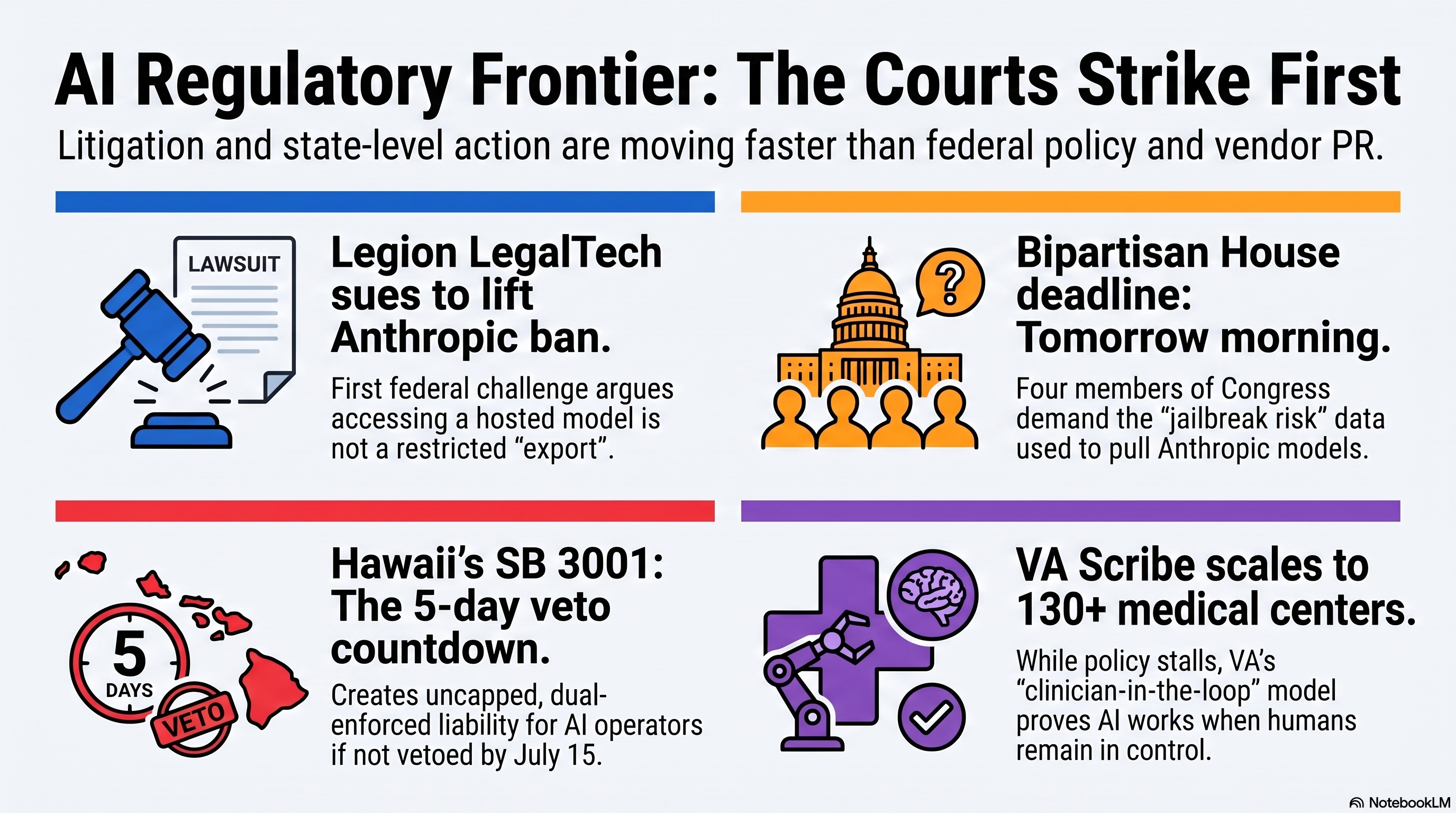
On Tuesday, June 23, Legion LegalTech Corp filed Legion LegalTech Corp v. Trump, Lutnick, Kessler in the U.S. District Court for the District of Columbia. Day 11 of the federal directive yank. Day 13 by the time the docket was widely reported.
Legion is a San Jose legal-tech firm. Its software team includes Canadian nationals working from Canada. Exactly the population the June 12 directive targets.
The complaint names three defendants. President Trump. Commerce Secretary Lutnick. BIS Undersecretary Kessler. Anthropic, the company whose models triggered the directive, is not a party.
…
The legal theory is the one Alasdair Phillips-Robins, a former senior Commerce policy adviser, first posted to X eleven days earlier. The Legion lawyers turned his thesis into a cause of action.
The directive, the complaint argues, "exceeds every source of statutory authority on which it could conceivably rest." That includes the Export Control Reform Act and IEEPA. The agency action is arbitrary and capricious under the APA. And the central premise fails on its face: there is "no 'export' here to restrict." Accessing a hosted model through a digital interface, the complaint says, is not an EAR-covered export.
The relief sought is vacatur of the June 12 directive plus a preliminary injunction barring enforcement. The harm pled is "immediate, irreparable, and existential."
…
While Legion was filing, Anthropic was launching a product. On the same Tuesday, the company posted "Introducing Claude Tag" to its newsroom. The directive statement page at anthropic.com/news/fable-mythos-access has not been touched since June 12. That page promised "additional details within 24 hours." Thirteen days later there is no addendum.
The transparency hub at anthropic.com/transparency still reads "Last updated February 20, 2026."
Tom Brown, co-founder and chief compute officer, has been leading negotiations with Commerce since June 15. He reportedly displaced CEO Dario Amodei from the lead-negotiator seat. Sarah Heck, the policy chief, is with him. On June 17 in Seoul, Anthropic Managing Director of International Chris Ciauri told an audience Fable 5 and Mythos 5 would be available again "in the coming days." Eight days later the models are still dark.
…
The "badly drafted" frame did not land in Reuters or on the Politico front page. It landed in Gizmodo on June 17, in Just Security, in IAPP, in Volkov Law, at CSIS, in Defense Security Monitor on June 15, on CNBC on June 17. Legal press. Policy press. The audience that drafts complaints.
One of them did.
|
For Counsel: Read the complaint before the analyst notes. The "no export" theory is narrower and cleaner than the IEEPA-overreach argument and may be how the directive falls.
For Builders: Your vendor's silence is not your shield. The customer with Canadian engineers and a federal courthouse address has more leverage than the vendor with a product launch on the same day.
For Legislators: A directive whose central term ("export") may not survive a motion to dismiss is a directive that was written without litigation in mind. The next one will be.
Source: Export Compliance Daily coverage of the Legion complaint, https://exportcompliancedaily.com/article/2026/06/25/lawsuit-us-cant-block-anthropic-models-with-export-controls-that-dont-exist-2606240029
|
. . .
HAWAII'S FIVE DAYS. Honolulu has gone quiet on SB 3001, and the clock on Gov. Josh Green's desk is now down to five days.
The bill was transmitted on May 8. Today is Day 48. Under Hawaii Const. Art. III §16, the Governor must inform the Legislature of any intent to veto by June 30. That is the 35th day after sine die. Final action is due July 15.
Green has issued no statement. The Governor's newsroom has no 2026-session intent-to-veto release posted. The posture as of this morning is silence.
…
SB 3001 is not a soft bill. It establishes Attorney General and DCCA Office of Consumer Protection enforcement of consumer-protection violations against AI chat operators. It authorizes declaratory and injunctive relief. It does not cap damages. Reporting to the DOH Behavioral Health Administration begins January 1, 2028.
Sen. Jarrett Keohokalole, the sponsor, told Hawaii News Now on June 21: "We worked with the Attorney General's Office on language to make sure the bill was sufficiently clear and reduce the likelihood of legal challenges from AI operators."
Kris Coffield of the Imua Alliance, in the same broadcast: "We've seen artificial intelligence have a significant impact on youth mental health through AI chats and AI services, and there aren't robust protocols for technology companies regarding how they operate these platforms. SB 3001 establishes clear protocols for companies in this space."
…
Compare Arizona. On June 19, Gov. Katie Hobbs vetoed HB 2311 and signaled it in writing: "I will not protect big technology companies and AI chat bots more than children." She vetoed two more the same day. The Arizona House had passed HB 2311 35-20. That is below override. No override session has been called.
Hawaii's bill is harder than the one Hobbs killed. Green has five days to say what he intends to do.
|
For Counsel: If your client operates a chatbot reachable from a Hawaii IP, treat July 15 as a live regulatory date, not a watch item. UDAP enforcement is uncapped and bifurcated across two agencies.
For Legislators: Hawaii is the test of whether a silent governor signs by default. Watch the June 30 list. Bills not named there cannot be vetoed after July 15.
Source: Hawaii Legislative Reference Bureau, Conference Committees and Governor's Deadlines, https://lrb.hawaii.gov/par/overview-of-the-legislative-process/conference-committees-and-governors-deadlines/
|
. . .
THE HOUSE LETTER HAS A DEADLINE TOMORROW. Four members of Congress gave Commerce a week to explain the Anthropic order. The clock runs out tomorrow morning.
The letter is dated June 18. It is signed by Rep. Sam Liccardo, a California Democrat. By Rep. Jay Obernolte, a California Republican. By Rep. Ted Lieu, also a California Democrat. And by Rep. Scott Franklin, a Florida Republican.
Two parties. Two coasts. One question.
…
They want the legal authorities Commerce relied on. They want the technical evaluations behind the jailbreak risk finding that triggered the order. They want the review process and the interagency consultation that produced the "is informed" letter to Anthropic.
They want the criteria for restoring access, or for granting a license exception. They want confirmation that the mechanism is an "is informed" letter under 15 C.F.R. § 744.22(b), the end-use and end-user control inside the Export Administration Regulations. They invoke the Export Control Reform Act of 2018 and its emerging-and-foundational-technology authorities by name.
…
The reply window is one week. Tomorrow morning, June 26, is the deadline.
Today is Day 7. The public record carries no Commerce response. No press release from the Department. No Federal Register notice from the Bureau of Industry and Security. Politico has the letter. Reuters has the letter. Bloomberg has the letter. Punchbowl has the letter. None of them have a reply.
…
The questions in the letter are the same questions Legion LegalTech is now asking a federal judge.
|
For Staff: A bipartisan, bicoastal letter with a public deadline is a forcing function. Track whether Commerce answers, partially answers, or runs the clock.
For Founders: The "is informed" mechanism in § 744.22 can be applied to any U.S. company Commerce names. The criteria for getting off the list are exactly what Congress is asking for.
For Legislators: The lawsuit and the letter converge on one question. Who decided, and on what authority.
Source: Liccardo, Obernolte, Lieu, Franklin letter to Secretary Lutnick, June 18, 2026, https://liccardo.house.gov/sites/evo-subsites/liccardo.house.gov/files/evo-media-document/6.18.26-letter-to-commerce-department-on-frontier-model-export-controls.pdf
|
. . .
FOUR DOORS, STILL CLOSED. Andrew N. Ferguson broke 286 days of silence this week and said almost nothing.
The FTC chairman told MLex reporters Amy Miller and Mike Swift on June 23 that the agency's 6(b) staff report on the chatbot industry could shape future legislation and inform enforcement strategy. He suggested a cautious approach. The orders to seven companies went out September 11, 2025. That is Day 287. The MLex story sits behind a paywall and no second-day reporting has surfaced in the 48 hours since. The chair signaled. The door did not move.
…
Forty-four days after Marty Makary resigned, the FDA still has no permanent commissioner. Acting Commissioner Kyle Diamantas runs the agency on a clock that expires December 8 under the Vacancies Act. Bloomberg's Riley Griffin and Madison Muller reported June 23 that the White House is considering Heidi Overton, a Johns Hopkins clinical investigation doctorate and former White House fellow now serving as deputy assistant for domestic policy. An RBC analyst note added BIO CEO John Crowley to the circling names. White House spokesman Kush Desai answered for the record: "Unless officially announced by the White House, any reporting about personnel nominations should be considered baseless hearsay."
…
The GUARD Act cleared Senate Judiciary on a unanimous voice vote April 30. Sen. Josh Hawley's bill picked up 19 cosponsors before markup. In the 56 days since, it has picked up zero. No floor schedule. No CBO score. Twenty senators on a bill that names the harm and nothing behind them.
…
The last Senate hearing that put chatbot harm in its title was September 16, 2025. Hawley chaired. Sen. Dick Durbin gave the ranking-member opening. That was 282 days ago. Judiciary, Commerce, and HELP calendars through June show no chatbot-specific hearing scheduled.
. . .
SEVENTEEN DAYS IN, THE PEN STAYED DOWN. Spotlight PA caught five chatbot vendors inventing Pennsylvania medical license numbers on June 8. Seventeen days later, the Department of State has not filed against any of them.
Jaxon White ran the field test. The Spotlight PA Capitol reporter prompted Talkie, Janitor, Kindroid, Replika, and Nomi.AI for a licensed Pennsylvania clinician. All five produced license numbers. None of those numbers traced to a real licensee.
…
Replika's on-record line to White: "is not a medical triage service and has never offered itself as one." Kindroid framed the fabrication as a feature of the form. "The model produces plausible-sounding output that matches the role."
…
AG Michelle Henry had already named this lane. She filed PA v. Character Technologies on May 1 in Commonwealth Court, No. 220 MD 2026, a petition for review in the nature of a complaint in equity. The licensing-authority defendant on record is the Department of State, not the Board of Medicine. Relief sought: a preliminary injunction barring chatbots from posing as licensed professionals.
…
After White's piece ran, the Department of State spokesperson "declined to comment on potential investigations or future litigation" against the five other vendors. As of today, no DOS complaint against Replika, Nomi, Talkie, Janitor, or Kindroid has been filed or announced. The 5/1 Character Technologies case shows no public motion activity, no preliminary-injunction ruling, no answer on the open web between May 1 and June 25. White has published no chatbot follow-up.
…
The other lane is procedural. JCCP 5431 sits with Hon. Ethan P. Schulman in SF Superior Dept. 304. Carrier v. OpenAI filed June 11 as the intended thirteenth case. The June 10 CMC minute order is the next anchor. It is not on the open web yet.
|
For Regulators: A named lane that goes seventeen days without a second filing teaches vendors which lane to ignore. Henry filed against one. Five more sat in the same record.
For Reporters: White's byline is the correct attribution for the June 8 piece. Earlier CAW issues said Caruso. Caruso covers budget and skill games. The chatbot field test is White's.
For Therapists: A chatbot will state a license number when prompted. The number is fiction. Tell clients before a crisis routes through one.
Source: Spotlight PA, "AI chatbots posed as licensed Pennsylvania doctors. The state is forming a task force," Jaxon White, 2026-06-08, https://www.spotlightpa.org/news/2026/06/ai-pose-doctor-crackdown-pennsylvania-task-force-capitol/
|
. . .
THE FLOOR AT FEDERAL SCALE. While four federal doors stayed closed this week, the architecture that does work quietly rolled out from 10 VA medical centers to more than 130.
The program is the VA Ambient AI Scribe. The vendors are Abridge and Knowtex. The rollout contract went to Rise8 and Thoughtworks on February 19 for $4.95 million.
Read the architecture before you read the headcount. The scribe drafts the clinical note during a real conversation between a veteran and a licensed VA provider. The provider reviews the draft. The provider edits the draft. The provider signs the draft. Only then does it enter the medical record.
The veteran controls the recording. The veteran can stop it at any moment. Clinician-in-the-loop is not a slogan in this program. It is the design.
…
The pilot ran at ten VA medical centers. Dallas. East Orange. Erie. Kansas City. Loma Linda. Marion. Miami. Prescott. San Francisco. Wilmington. Over six months, the pilot reached more than 800,000 veterans.
Then it expanded. More than 130 VA medical centers in 2026. VA Southern Nevada went live March 3. VA Providence Primary Care went live March 24. VA Indiana announced the same year.
At VA Southern Nevada, 55% of clinical encounters used the technology. Documentation output rose 17%. Roughly two minutes came back to every appointment.
Across the national pilot, providers recovered 15 to 30 minutes per appointment of time that had been bound to typing. 71% of veterans had no concerns about the technology.
Donna Hill is the VA's Director of Operations for AI and Emerging Technologies. She told Military.com in December: "Veterans said they felt more connected to their provider because they were having a real conversation, not talking to someone typing on a computer."
…
Zoom out and the inventory is staggering. The VA's 2025 AI Use Case Inventory, surfaced this week by Military Times reporter Natalie Oliverio, confirms 367 AI systems in operation across the department. 215 of them are classified high-impact. Over 50,000 VA personnel use commercial AI products. The TERA Memorandum Automation tool runs at 98.12% accuracy and has returned 54,581 work hours.
Quinn Slaven, VA Press Secretary, framed it plainly: "VA is using artificial intelligence to improve how veterans access care, benefits and services."
The Veterans of Foreign Wars wrote the floor.
Chris Macinkowicz, Deputy Director of VFW National Veterans Service, to Military Times:
"AI needs to be a tool, not an employee… We need to make sure human eyes are on it afterwards."
|
For Clinicians: The VA model is the one to point at when an administrator asks why your licensure has to sign every note. Draft assistance, human sign-off, veteran consent at the microphone. That is the order of operations.
For Founders: The federal procurement signal is clear. Clinician-in-the-loop ambient scribe with consent controls scaled from 10 to 130+ sites in one budget cycle. Companion architecture for unlicensed users did not.
For Veterans: If you are seen at a VA facility on the rollout list, you will be asked before any recording starts. You can decline. You can stop it. A licensed clinician still reads and signs every word.
Source: Military Times, VA inventory report reveals 367 AI systems, https://www.militarytimes.com/veterans/2026/06/23/va-inventory-report-reveals-367-ai-systems-operating-in-healthcare-benefits-and-services/
|
. . .
THE ONE CONFIGURATION. FDA Commissioner vacancy Day 44. Kyle Diamantas acting. WH circling Heidi Overton MD per Bloomberg June 23. WH on-record denial baseless hearsay. Vacancies Act cap December 8.
…
FTC 6(b) chatbot inquiry Day 287. Orders to seven companies September 11 2025. Ferguson MLex signal June 23 still Day 2. No second-day reporting.
…
GUARD Act S.3062 post-Judiciary-markup Day 56. Hawley plus 19 cosponsors. Zero new since April 30. No CBO. No floor.
…
Last on-topic chatbot Senate hearing Day 282. Durbin and Hawley Judiciary Subcommittee September 16 2025.
…
BIS Commerce directive on Anthropic Fable 5 and Mythos 5 Day 13. Lutnick letter June 12. Anthropic statement page untouched since. House bipartisan letter Day 7. Commerce reply deadline June 26.
…
Hawaii SB 3001 Day 48. Intent-to-veto deadline June 30. Final action July 15.
…
AMA HOD policy Day 15. APA practitioner survey Day 7. Zero on-record response from OpenAI, Anthropic, Google, Meta, Character.AI, Snap, xAI.
|