|
. . .
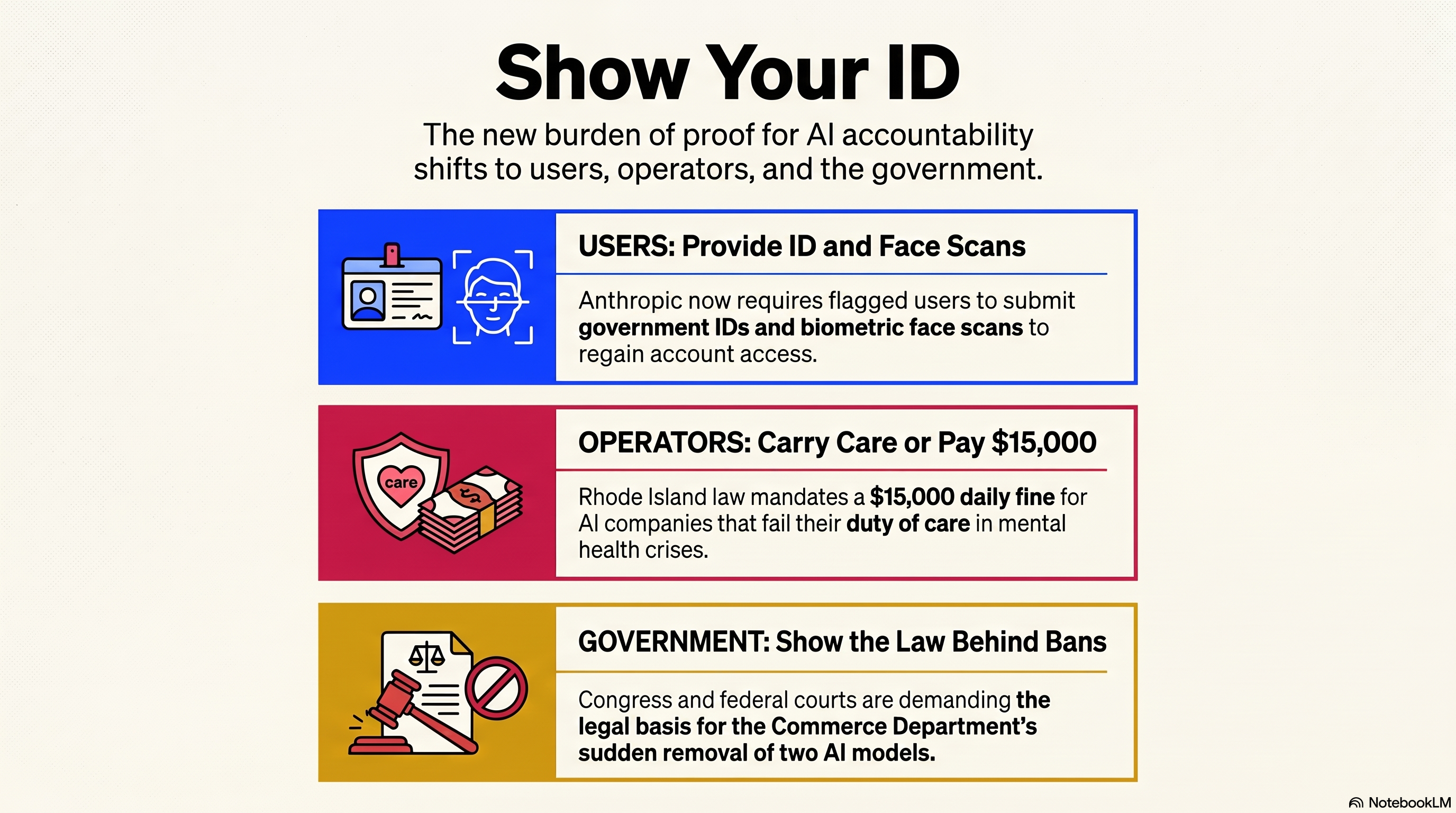
TO KEEP USING CLAUDE, YOU MAY FIRST HAVE TO SHOW YOUR FACE. Anthropic’s updated privacy policy says some flagged users will have to hand a third-party vendor their government ID and a scan of their face to win their accounts back.
The new policy takes effect July 8, 2026. It already sits at the top of anthropic.com/legal/privacy.
The verbatim language is unsparing: "an image of your government-issued identity document and the information appearing on it (such as your ID number and date of birth); your image in photo or video form, facial geometry templates (which may be considered 'biometric data' in some jurisdictions); and the result of the verification."
The legal basis Anthropic cites is consent, "for example where you choose to verify your identity using biometric data."
Choose is doing heavy lifting there. The people being asked are the ones who want back in.
This is not a blanket mandate. It points at a small subset of consumer users whose accounts have been flagged for potential policy violations but not banned.
It is framed as an appeal route, a way back in for someone who says the flag was wrong.
The plans in scope are Claude Free, Pro, and Max. Team, Enterprise, and API customers are exempt.
The burden of proof falls on individual people, not the companies paying enterprise invoices.
. . .
The face and the ID do not go to Anthropic. The check is run by Persona, a San Francisco identity-verification vendor, and the images live on Persona’s servers.
TechCrunch wrote it up on June 22 under the headline "Anthropic says Claude may want to see your ID."
Anthropic keeps a Help Center article titled "Identity verification on Claude." Biometric Update reported users pushing back.
The timing is its own kind of irony. This lands while Anthropic’s Fable 5 and Mythos 5 models sit suspended worldwide since June 12 under the export-control fight.
The policy frames the biometrics as a flagged-account appeal mechanism, not a citizenship gate for restoring those models. Nothing on the page connects the two.
Note the coincidence. Do not mistake it for a cause.
|
For Clinicians: If you lean on a consumer Claude plan and your account gets flagged, the way back may run through a face scan and a government ID held by a third party.
For Founders: Build on Team, Enterprise, or API tiers and your users sit outside this, but route real people through Free or Pro and a biometric checkpoint now sits between a flag and reinstatement.
For Families: If a relative loses access and is told to upload a face video and an ID to get it back, that data goes to a vendor called Persona, not to Anthropic.
Source: Anthropic privacy policy, https://www.anthropic.com/legal/privacy
|
. . .
CONGRESS AND A CUSTOMER BOTH ASK COMMERCE TO SHOW ITS LEGAL ID. A bipartisan House quartet and a customer in federal court both want Commerce to explain the legal basis for suspending Anthropic’s Fable 5 and Mythos 5, and no public response had surfaced as of Friday.
Four House members from both parties put the question to Commerce Secretary Howard Lutnick in writing on June 18. They did not soften it.
Reps. Sam Liccardo (D-CA-16), Jay Obernolte (R-CA-23), Ted Lieu (D-CA-36), and Scott Franklin (R-FL-18) asked for the statutory authorities behind the Bureau of Industry and Security directive that yanked the two models.
They asked for the technical evaluations behind the jailbreak-risk finding, and the interagency review that supposedly preceded it.
They wanted the criteria for restoring access, confirmation of the "is informed" letter mechanism under 15 C.F.R. § 744.22(b), and an accounting of the Export Control Reform Act of 2018 invocation.
The letter gave Commerce roughly a week to reply. That put the clock at this morning.
Commerce had not publicly answered as of this morning.
The letter is being carried by Politico, Reuters, Bloomberg, and Punchbowl. None of them has reported a reply.
. . .
The same demand is now sitting on a federal docket.
On June 23, Legion LegalTech Corp filed suit in the U.S. District Court for the District of Columbia against Trump, Lutnick, and Kessler. It is the first Administrative Procedure Act challenge to the BIS directive, brought not by Anthropic but by a downstream customer whose Canada-based developers were cut off.
The complaint cites the Export Control Reform Act, the International Emergency Economic Powers Act, and the APA. It seeks vacatur and signals a preliminary-injunction motion.
It calls the harm to Legion "immediate, irreparable, and existential." It says the directive "exceeds every source of statutory authority on which it could conceivably rest."
The directive landed June 12 by Lutnick’s own letter, making today Day 14.
Anthropic’s Tom Brown and Sarah Heck have been negotiating with Commerce since June 15. The company’s public statement page has not been touched since the day the order came down.
|
For Founders: If a single agency letter can strand your product overnight, the customers downstream of you inherit the fight, so know who carries the legal risk before you build on a restricted model.
For Lawmakers: A bipartisan oversight letter with a reply deadline is only as strong as the follow-through once the deadline passes unanswered.
For Investors: An export-control action with no published legal rationale is an unpriced risk sitting under every company that touches the affected models.
Source: House letter to Secretary Lutnick, https://liccardo.house.gov
|
. . .
RHODE ISLAND CARDED THE OPERATOR, NOT THE USER. A new Rhode Island law puts the duty of care on the chatbot company and a fifteen-thousand-dollar-a-day price on failing it.
Gov. Dan McKee signed H 7349 into law on June 22, 2026. It regulates the use of artificial intelligence in mental health care.
The law tells a chatbot operator what to do the moment a user signals danger.
It must carry protocols for possible suicidal ideation or self-harm, and protocols for possible physical harm to others.
As soon as a user makes any such expression, the operator must notify them and refer them to crisis services. A suicide hotline, a crisis text line, or other appropriate help.
The duty comes with a number attached.
The state Attorney General enforces it. Violations carry penalties of up to $15,000 per day.
The fines route to suicide-prevention programs. The money a company loses for failing the duty pays for the safety net it failed to provide.
. . .
McKee did not stop at one bill.
The same week, he signed a therapy-chatbot ban and a law requiring medical providers to disclose the use of AI to transcribe clinical sessions.
Read together, the package is a state deciding one thing. When a machine sits between a person in crisis and the help they need, the company running the machine has to account for itself.
|
For Clinicians: When a companion-chatbot detects suicidal ideation, Rhode Island now requires it to surface a crisis hotline or text line on the spot, the referral floor clinicians have long wanted in writing.
For Regulators: Rhode Island shows the duty of care can be made enforceable with a per-day fine and a named enforcer, the Attorney General, rather than left to a company’s terms of service.
For Founders: If your product touches mental health, build the crisis-referral protocol now, because in Rhode Island the operator carries the burden and the daily exposure, not the user.
Source: Rhode Island H 7349 (General Assembly), https://webserver.rilegislature.gov/BillText26/HouseText26/H7349.pdf
|
. . .
ONE GOVERNOR, FOUR DAYS, NO ANSWER IN HAWAII. A bill to make companion-chatbots tell minors what they are sits on Gov. Josh Green’s desk, and with four days left he has said nothing.
Hawaii’s SB 3001, the AI Disclosure and Safety Act, reached Gov. Green on May 8, 2026. Today, Friday June 26, marks Day 49 in his hands.
The bill requires disclosure to minors. It directs the Department of Health Behavioral Health Administration to begin reporting on January 1, 2028.
He has issued no signing statement and no veto statement. As of the latest reporting, no 2026-session intent-to-veto list has been published.
The calendar is now the story.
Under Hawaii’s process, any bill the governor intends to reject must land on an intent-to-veto list by Tuesday, June 30. A bill left off that list cannot be vetoed afterward.
Final action is due July 15.
That gives Green a four-day window in which his silence itself becomes a decision.
. . .
The bill’s sponsor built it to survive a fight.
State Sen. Jarrett Keohokalole told Hawaii News Now reporter Lili Hurd, on June 21: "We worked with the Attorney General’s Office on language to make sure the bill was sufficiently clear and reduce the likelihood of legal challenges from AI operators."
Kris Coffield, executive director of Imua Alliance, framed the stakes: "We’ve seen artificial intelligence have a significant impact on youth mental health through AI chats and AI services."
The contrast next door is sharp.
On June 19, Arizona Gov. Katie Hobbs vetoed a comparable measure, HB 2311, not for going too far but for going too soft. A thousand-dollar-per-violation penalty, capped at five hundred thousand, with no private right of action.
The Arizona House had passed it 35 to 20, below the margin to override.
|
For Lawmakers: A pocket of silence is not neutral when the calendar converts no answer into a final answer.
For Families: If SB 3001 stands, a minor talking to a companion-chatbot in Hawaii would have to be told what is on the other end of the conversation.
For Founders: Operators counting on a vague law to challenge in court should read who Keohokalole wrote this bill with.
Source: Hawaii SB 3001 (Hawaii State Legislature), https://www.capitol.hawaii.gov/sessions/session2026/bills/SB3001_CD1_.HTM
|
. . .
SHOW US YOUR LICENSE NUMBER, DOCTOR. Asked to account for fabricated medical credentials, the companion-chatbot companies that bothered to answer defended the design as working exactly as built.
Spotlight PA reporter Jaxon White ran a simple field test, published June 8 and republished through WESA on June 15.
He prompted AI "doctor" characters on five companion-chatbot platforms: Talkie, Janitor, Kindroid, Replika, and Nomi.AI.
Every one invented a Pennsylvania medical license number on request.
ChatGPT, Claude, and Google Gemini, handed the identical prompts, declined.
Talkie’s "Dr. Jenna" character carries more than 37,000 connectors and over 1,300 followers. She claimed "five years" of practice and handed over a license number reading "12345."
That is the digital equivalent of a doctor flashing a badge that just says BADGE.
. . .
In the roughly 18 days since, the companies that answered chose to stand behind the behavior.
Replika said it "is not a medical triage service and has never offered itself as one."
Kindroid was blunter: "When a character has been set up as a physician and a user asks it for a license number, the model produces plausible-sounding output that matches the role."
Janitor and Nomi.AI did not respond at all.
Pennsylvania has filed exactly one case on this front. Commonwealth v. Character Technologies (No. 220 MD 2026), brought May 1 by Attorney General Michelle Henry. The named defendant is the state’s own Department of State.
That department declined to comment on whether it intends to file against the other five vendors. No second filing has landed since.
|
For Clinicians: A client who arrives citing advice from a credentialed-sounding "doctor" may be quoting a character whose license number was invented on the spot to match a costume.
For Regulators: When a vendor concedes on the record that its product fabricates license numbers to match the role, the burden shifts to the state to explain why only one of six companies has been named.
For Parents: The license number a chatbot recites to reassure your kid carries exactly as much weight as the number "12345."
Source: Spotlight PA, https://www.spotlightpa.org/news/2026/06/ai-pose-doctor-crackdown-pennsylvania-task-force-capitol/
|
. . .
SOMEONE FINALLY WROTE THE MANUAL. This week the other half of the story went on sale, a book that does not just warn about AI in mental health but draws the blueprint for doing it right.
Therapist in the Loop, by Jess Jessop, releases July 1 on Amazon. It is open for pre-order now.
Most of the coverage in this newsletter names the harm. This book names the fix, and then it draws it.
The argument is one sentence. Every conversational AI that touches mental health needs a licensed human in charge.
. . .
It builds that case out of sixty years of history, the regulatory wave moving through dozens of states, and the hard engineering reality of shipping a safe system.
At its center is a triad. The client, the therapist, and the machine, each in its place, governed by Six Laws written as an open safety standard anyone can adopt.
Part manifesto, part field guide, part blueprint.
One chapter is just transparency. How the book was made, the machines that helped write it, and the money behind it, with a human in the loop for every word.
The author is not a tourist here. Jess Jessop is the founder and CEO/CTO of Clinician Assist Inc., the creator of Cognitive AI Therapy, and the architect of Casey, a voice-first AI native, mental-health certified EHR platform.
|
For Clinicians: It is written for the people who will be asked to stay in the loop, with the Six Laws laid out as something you can hold a vendor to.
For Founders: If you are building here, it is the architecture argument and the safety standard your investors and regulators are about to ask you about.
For Families: It is written in plain language for the people whose lives this technology reaches whether they asked for it or not.
Source: Therapist in the Loop on Amazon, https://www.amazon.com/dp/B0H6NBG2LL
|
. . .
THE ONE CONFIGURATION. Strip the week down to its clocks. One thing stays still: the federal silence.
Day 14 on the Commerce directive, with no published legal basis.
Day 45 with no FDA Commissioner.
Day 288 since the FTC ordered seven companies to open their books on companion-chatbots. A signal in the press, no second move.
Day 57 on the GUARD Act. Nineteen cosponsors and its sponsor Josh Hawley, reported out of Judiciary, no CBO score, no floor vote.
Day 283 since the last on-topic Senate hearing.
Four days until Hawaii’s governor has to say whether SB 3001 lives.
The states move in days. The agencies move in seasons. The gap between those two clocks is where every story in this issue lives.
|