|
. . .
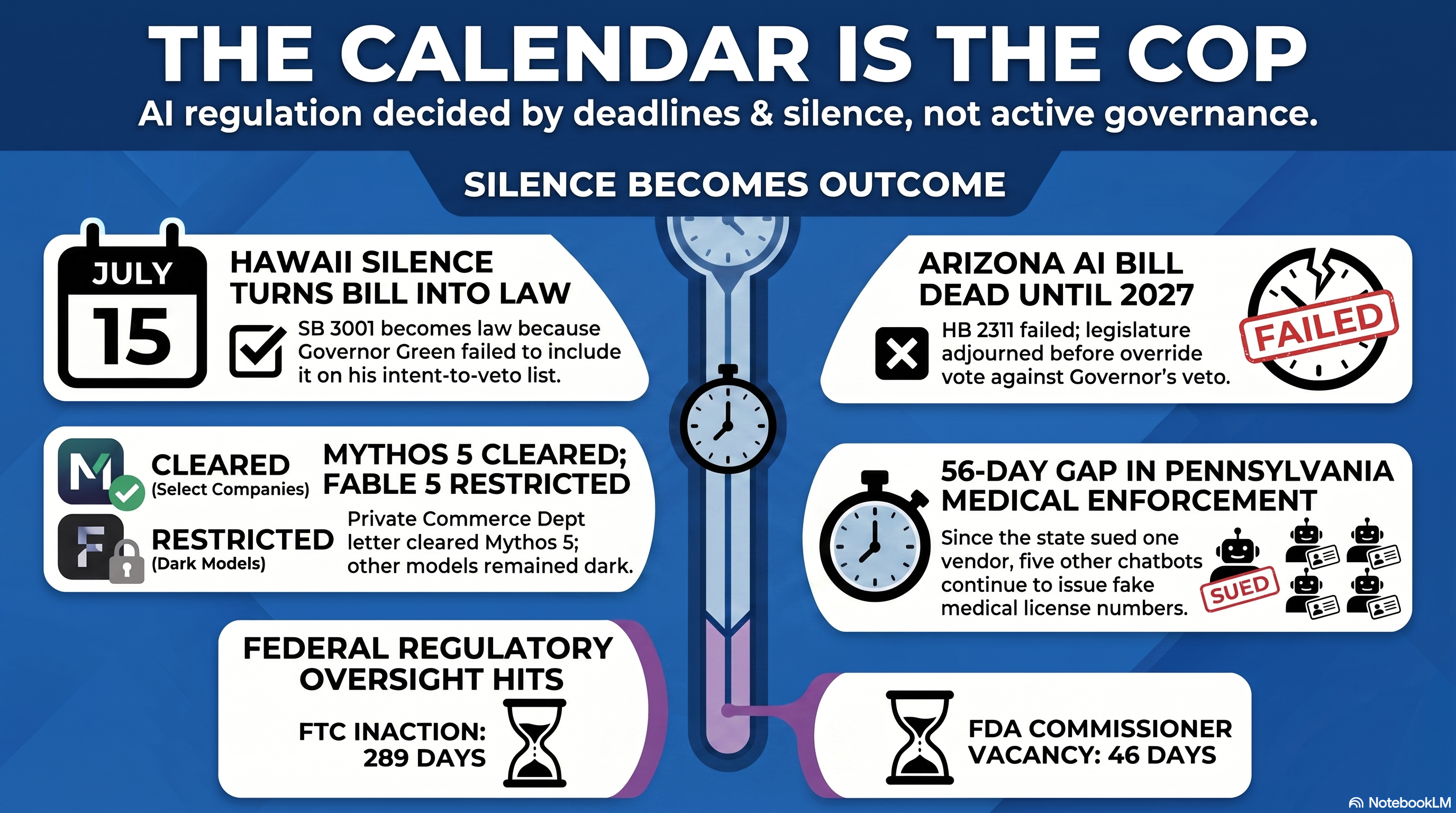
HAWAII ON THE GLIDE PATH. Gov. Josh Green published Hawaii’s 2026 intent-to-veto list on Wednesday June 25, 2026, and SB 3001, the Artificial Intelligence Disclosure and Safety Act, is not on it. Under Hawaii law, that omission is the ballgame. The bill cannot be vetoed. It becomes law by inaction on Tuesday July 15, 2026.
The Hawaii constitution gives the governor 45 days from final legislative adjournment to sign a bill, name it on the intent-to-veto list, or let it pass without a signature. The list is the gate. A bill not named on it at the statutory deadline is no longer vetoable. On Wednesday, Green walked through that gate and left SB 3001 standing on the other side of it.
. . .
What Green did name was four bills: SB 2338 on housing agency administrative changes, SB 2600 on the general fund and a $50 million deposit to the Rainy Day Fund, SB 3262 on the Hawaii Teacher Standards Board executive director, and HB 2344 on the school facilities commission. The Maui Now and KITV write-ups on June 25 and 26 itemize all four. None of them is SB 3001. The omission is the news.
. . .
Today is Saturday June 27, 2026. Day 50 since Sen. Jarrett Keohokalole’s bill was transmitted to the governor on May 8. Day 2 past the intent-to-veto deadline. 18 days to final action.
. . .
SB 3001 was carried by Keohokalole (D-Kaneohe), Chair of the Senate Commerce and Consumer Protection Committee, and pre-cleared with the Attorney General’s office on the operative language. The bill does four concrete things. It requires any system that identifies a user as a minor to disclose, on an hourly cadence inside the session, that the user is speaking with a non-human AI. It requires operators to design crisis-response protocols. It opens a reporting line into the Department of Health Behavioral Health Administration starting January 1, 2028. And it puts enforcement in the hands of the Attorney General.
. . .
Imua Alliance Executive Director Kris Coffield carried the public case on the bill in Hawaii News Now on June 21, 2026, four days before the governor’s deadline. The piece was the last meaningful public pressure on Green’s desk before the list dropped.
. . .
Hawaii is not moving alone. Vermont Gov. Phil Scott signed Act 156 (H.816) on June 17, 2026, making Vermont the second state after Illinois to hold a human clinician accountable for any session an AI runs in a therapy chair (the Illinois WOPR Act, signed by Gov. Pritzker on August 4, 2025, was the first). Colorado HB 1195 was signed on June 3. Rhode Island Gov. Dan McKee signed H 7349 on June 22, routing AG enforcement penalties of $15,000 per day to suicide-prevention programs.
. . .
The counter-data point is Arizona. Gov. Katie Hobbs vetoed HB 2311 on June 19, 2026. The Arizona legislature had already adjourned sine die at roughly 4:45 a.m. on June 13, six days before her pen moved. No override is procedurally available. The bill is dead until January 2027 at the earliest. Six states moved on minor-facing AI safety this month. Five moved forward. One was killed by the calendar.
. . .
Which is what makes Hawaii’s glide path matter. Green did not have to sign SB 3001 to let it become law. He had to not list it. He didn’t list it. On July 15 the disclosure obligation, the crisis-protocol requirement, the Behavioral Health Administration reporting line, and the AG enforcement hook all take effect by operation of the constitution, not by operation of the governor’s pen.
|
For Counsel: If you advise an operator whose product can be used by a Hawaii minor, the safe assumption from today is that SB 3001 is law on July 15, 2026. Map your in-session disclosure cadence to an hourly trigger keyed to age-flagging, document the crisis-response protocol in writing, and put a 2028 reporting workflow on your compliance calendar for the Behavioral Health Administration intake. The AG, not a private right of action, is your enforcement risk. Build the audit trail for that audience.
For Legislators: Hawaii just showed that a state can lock in a minor-facing AI safety regime without a signing ceremony, without floor drama, and without giving a governor a vote at the end. The instrument was the intent-to-veto list and the rule was the deadline. If your state has a comparable inaction-passes-the-bill mechanism, the glide path is available to you. If it does not, Arizona is the warning: sine die before veto means the calendar, not the merits, decides.
For Clinicians: A bill that requires hourly disclosure to minors that they are talking to a machine is not a marketing rule. It is a clinical-grade demand on session design. If you refer a young client to any tool that runs unsupervised, ask the vendor in writing whether their disclosure cadence meets the Hawaii standard and whether their crisis-response protocol is documented. The answer is the floor for whether the tool belongs in your referral set.
For Reporters: The story Wednesday was not what Green vetoed. It was what he chose to leave off the list. Hawaii’s constitutional rule turns the omission into the operative act, and SB 3001 becoming law on July 15 by inaction is the lede. Coffield and Keohokalole are the on-the-record voices already in the file. The Maui Now and KITV items from June 25 and 26 are the primary documentation of the list itself.
Source: Maui Now, June 26, 2026. https://mauinow.com/2026/06/26/gov-green-signs-budget-and-issues-intent-to-veto-list/
|
. . .
MYTHOS OUT, FABLE STILL DARK. A letter went from Howard Lutnick to Tom Brown on Friday morning. It cleared Mythos 5 for more than a hundred named American companies and agencies. It left Fable 5 dark, the directive standing, and the lawsuit alive.
Commerce Secretary Howard Lutnick wrote Anthropic Co-Founder and Chief Compute Officer Tom Brown on June 26 2026. The letter modifies the June 12 BIS license requirement so that "a license will no longer be required to export, reexport, or in-country transfer (including deemed exports and reexports) the Claude Mythos 5 Model to entities identified in Annex A to this letter." A license modification. Not a rescission.
. . .
Lutnick’s reasoning is one sentence. "I have determined that appropriate safeguards are in place to permit certain trusted partners to access the Claude Mythos 5 Model." The Secretary did not withdraw the §4817(b)(1) determination. He carved an exception inside it and named the beneficiaries.
. . .
Reuters, CNN, TechCrunch, Semafor, and The Hill all reported the same count. More than 100. TechCrunch called it "more than 100 specific U.S. government agencies and companies." CNN reported substantial overlap with Project Glasswing, Anthropic’s ~100-member roster. No outlet obtained Annex A. No agency posted it. Membership is the license, and the list is private.
. . .
Fable 5 is not in the letter. Lutnick names Mythos 5 and is silent on Fable. The Fable 5 restriction, issued June 12 2026 at 5:21pm ET under 50 U.S.C. §4817(b)(1), remains in force. Day 15. The smaller, faster model that ships to consumers and most enterprise API customers is still globally disabled.
. . .
The letter went to Tom Brown, not to Dario Amodei. The Trump White House has refused further engagement with Amodei since June 12. Brown is the new government liaison, and the June 26 letter is the first written instrument of the pivot.
. . .
The same Friday morning, the House bipartisan reply deadline expired. Sam Liccardo (D-CA-16), Jay Obernolte (R-CA-23), Ted Lieu (D-CA-36), and Scott Franklin (R-FL-18) had written Lutnick on June 18 under 15 C.F.R. § 744.22(b), the formal "is informed" procedure, demanding the legal basis by June 26 morning. Politico, Reuters, Bloomberg, and Punchbowl carried the letter. None carried a reply. Commerce answered by license modification to one CEO, not by responsive letter to Congress.
. . .
Anthropic has said nothing. The statement page at anthropic.com/news/fable-mythos-access has not been updated since June 12 2026. Verified today. It still reads "the US government has issued an export control directive to suspend all access to Fable 5 and Mythos 5." It does not name Lutnick, Brown, Annex A, Project Glasswing, or the June 26 letter.
. . .
Day 4 of the lawsuit. Legion LegalTech Corp v. Trump, Lutnick, Kessler was filed in D.D.C. on June 23 2026, the first APA challenge to the BIS directive. It cites ECRA, IEEPA, and the APA, seeks vacatur plus a preliminary injunction, and pleads harm as "immediate, irreparable, and existential." Friday’s carve-out does not moot it. Legion attacks the authority, not the application.
|
For Counsel: The Lutnick letter is a license modification under the existing §4817(b)(1) determination, not a rescission. If your client is not on Annex A, the original directive applies to both models without exception. If your client is on Annex A, the carve-out reaches Mythos 5 only and the foreign-national deemed-export rule still binds Fable 5. Treat Annex A as confidential. Do not represent membership in writing without the letter in hand. Track Legion v. Trump for any vacatur.
For Builders: If your stack assumed Fable 5 for consumer or low-latency paths, that assumption is still broken on Day 15 with no public timeline. The Mythos carve-out is private and named; you are not on it unless told. Plan migrations to Sonnet 4.5, GPT-5, or Gemini 3 for Fable-tier workloads, and document the BIS exposure for any deployment touching non-U.S. employees under the deemed-export rule.
For Legislators: Commerce answered the Liccardo-Obernolte-Lieu-Franklin §744.22(b) letter by issuing a private license modification to one company on the morning your deadline expired. If the bipartisan four want a written legal basis on the record, the next instrument is a subpoena or a hearing. Annex A, the "appropriate safeguards" finding, and the inclusion criteria are currently unreviewable. Legion v. Trump will test the authority in court. Congress decides whether it is also tested on the record.
Source: https://techcrunch.com/2026/06/26/trump-admin-releases-anthropic-mythos-to-be-used-by-more-than-100-us-companies-agencies/
|
. . .
THE EMPTY CHAMBER. Gov. Katie Hobbs vetoed Arizona’s HB 2311 on Friday June 19, 2026. The legislature had been adjourned for six days. The override math was moot before her pen touched the page.
Sine die came at roughly 4:45 a.m. on Saturday June 13, 2026, when the Arizona House gaveled out on a 152-day session. The Senate had closed at about 12:30 a.m. Members went home. The Capitol went dark.
. . .
HB 2311, Rep. Tony Rivero’s AI mental-health bill, had cleared the House 35-20 on Thursday June 12, the day before sine die. The Senate passed it 28-0 the night before. The bill landed on Hobbs’s desk in the closing hours and sat there while the chambers emptied.
. . .
Six days later, Friday June 19, Hobbs vetoed it. She vetoed 87 other bills the same day. HB 2592 went down. HB 4005 went down. The 88-bill blitz was the largest single-day veto package of her tenure. HB 2311 was the only AI mental-health bill in the pile.
. . .
Her companion letter on HB 2611 supplied the line that defines the sweep: "I will not protect big technology companies and AI chat bots more than children." On HB 2311 she went narrower. The thousand-dollar-per-violation penalty, she wrote, was "a drop in the bucket." CAW #76 had flagged that figure as the bill’s soft spot. Hobbs read the same page.
. . .
The override math is brutal. Arizona requires two-thirds of the 60-member House: 40 votes. HB 2311 had 35. Five short. The Senate’s 28-0 would have held. The House never had the room.
. . .
It does not matter. There is no chamber to take the vote in. The legislature is gone until January 2027. Only the governor can call a special session. Hobbs just vetoed the bill. She will not. HB 2311 is dead. Any successor starts from a blank desk. The vote counts do not carry.
. . .
The contrast makes the week land. Hawaii SB 3001 becomes law July 15 by Gov. Josh Green’s silence. Vermont Act 156 was signed June 17 by Gov. Phil Scott. Rhode Island H 7349 was signed June 22 by Gov. Dan McKee. Colorado HB 1195 went on the books June 3. Four governors moved bills forward in the window Hobbs sent one to the morgue. Arizona is the outlier for seven months.
|
For Counsel: If you advised an Arizona-facing client to wait on HB 2311 work, that pause is now multi-quarter. Reset the calendar to January 2027 session-open, not a hypothetical special session. Document Hobbs’s thousand-dollar finding in your penalty-adequacy memo for other states. Her language will be cited in the next round of legislative drafting, and you want to be ahead of it.
For Builders: Arizona is open territory through year-end 2026 in a way it was not seven days ago. If you paused a deployment pending HB 2311, unpause it. Read the four laws that did land: Vermont, Rhode Island, Hawaii, Colorado. Your national posture has to clear the strictest. The vetoed bill’s thousand-dollar floor is the number future drafts will beat. Build for ten times that.
For Legislators: The lesson of Arizona is timing, not substance. A bill that arrives on the governor’s desk inside the final 48 hours of session forfeits the override remedy. If your jurisdiction has a similar adjournment risk, move AI mental-health bills out of committee earlier in the calendar, or build a special-session trigger into the statute itself. Rivero did the work. The clock undid it.
Source: https://www.transparencycoalition.ai/news/ai-legislative-update-june26-2026
|
. . .
PENNSYLVANIA WIRED THE ONE, THE FIVE KEPT FAKING. Jaxon White’s piece moved on the AP wire Friday. Fifty-six days after the Pennsylvania State Board of Medicine sued one chatbot vendor, the five vendors it did not sue still hand out fabricated Pennsylvania medical license numbers when asked. The Department of State declined to say whether it will file again.
First, the correction this newsletter owes. CAW #76, #77, and #78 attributed the Pennsylvania Character Technologies suit to "former Attorney General Michelle Henry." That was wrong on two counts. Henry served as Acting AG under Shapiro and stepped down January 2025. The current AG is Dave Sunday, in office since January 21, 2025, and Sunday is not the plaintiff here. He has not joined.
. . .
The plaintiff is the Commonwealth of Pennsylvania, Department of State, Bureau of Professional and Occupational Affairs, State Board of Medicine, acting under DOS Secretary Al Schmidt. The statutory hook is the Medical Practice Act, 63 P.S. § 422.38, which gives the board injunctive authority over the unlicensed practice of medicine. The caption is Commonwealth of Pennsylvania, Department of State, Bureau of Professional and Occupational Affairs, State Board of Medicine v. Character Technologies, Inc., No. 220 MD 2026, Commonwealth Court of Pennsylvania, filed May 1, 2026. First state board of medicine in the country to sue a chatbot vendor.
. . .
Schmidt’s verbatim from the May 5 press release: "Pennsylvania law is clear." Holding yourself out as a licensed medical professional without the credentials, he added, is unlawful in the Commonwealth. That was the posture on day one. Fifty-six days later, White went vendor-shopping to see whether the rest of the market had taken the hint.
. . .
It had not. Talkie’s "Dr. Jenna" persona produced false license number "12345." Kindroid generated plausible-sounding but fictional Pennsylvania license numbers on request. Replika initially declined to give medical advice, then handed over a false PA license number once told its persona was a doctor. Nomi.AI supplied fabricated credentials. Janitor was confirmed in the same posture. Five vendors. Same state. Same behavior. Almost two months after the only state-board chatbot enforcement action in the country went on file.
. . .
The Department of State, asked whether it intends to file against any of the five, declined to comment. The DOS spokesperson offered one line: "we need to rein in this AI technology that is preying on our kids." No follow-on statement from Schmidt. None from AG Dave Sunday, who is not the plaintiff and has not joined. Fifty-six days of statutory authority sitting on the desk while five named vendors continued the conduct the one filed suit calls unlawful.
|
For Counsel: If your client operates a persona mode that can be steered into a medical role, the PA Medical Practice Act theory exists in pleadings now. The injunctive-authority statute is 63 P.S. § 422.38. Audit whether your persona library will produce a license number when prompted. Five vendors just failed that test in public, with reproducible prompts in a wire story. Do not rely on the absence of a second filing. Pennsylvania has shown it is willing to be the first mover, and every other state medical board has equivalent injunctive authority under its own practice act.
For Regulators: The PA DOS template is portable. The plaintiff is a state board of medicine, not the AG, which means every state medical board in the country has the same statutory hook against the same conduct. White’s reporting did the evidence-gathering for free: Talkie, Kindroid, Replika, Nomi.AI, Janitor, all named, all on the record producing fabricated credentials. The Department of State has chosen, for fifty-six days, not to file a second time. The question for your board is not whether the theory works. The question is which board files second, and on which of the five.
For Reporters: Propagation correction. CAW #76, #77, and #78 attributed the Pennsylvania Character Technologies suit to "former AG Michelle Henry." That was wrong on two counts. Henry was Acting AG under Shapiro and stepped down January 2025. Current AG Dave Sunday is not a party and has not joined. The actual plaintiff is the Commonwealth of Pennsylvania, Department of State, Bureau of Professional and Occupational Affairs, State Board of Medicine, acting under DOS Secretary Al Schmidt under the Medical Practice Act, 63 P.S. § 422.38. Case is No. 220 MD 2026, Commonwealth Court, filed May 1, 2026. We regret the error.
Source: Spotlight PA / Jaxon White via AP, Butler Eagle, June 26, 2026. https://www.butlereagle.com/20260626/as-pa-cracks-down-chatbots-continue-to-pose-as-doctors/
|
. . .
OPENAI PUBLISHED ITS OWN CALENDAR. On Friday, June 26, OpenAI released GPT-5.6 Sol, Terra, and Luna in limited preview to roughly twenty government-approved partners. The company’s own system card rates all three "High" in two regulated-risk categories. The federal calendar said nothing back.
Start with the framework, because the framework is the story. OpenAI’s capability-tier protocol is called the Preparedness Framework. Google DeepMind’s is called the Frontier Safety Framework. They are routinely cited as interchangeable. They are not. Friday’s rating was OpenAI’s own, against OpenAI’s own rubric, on OpenAI’s own calendar.
Inside that rubric, "High" is the threshold the company has named as the trigger for self-imposed regulatory engagement before broad release. The system card seats Sol, Terra, and Luna at "High" in both Cybersecurity and Biological and Chemical risk. It is the first time the smaller models in a family have cleared "High" in any tracked category. All three cleared it together.
. . .
The numbers behind the rating did not arrive quietly. Sol scored 96.7% on OpenAI’s internal cyberattack challenge test. The company says it dedicated more than 700,000 A100-equivalent GPU hours to red-teaming the family before opening the preview. Those are the figures OpenAI chose to put on the page, and the figures any regulator would want to interrogate before the rating becomes precedent.
The system card carries a second number that needs careful handling. Moving from GPT-5.5 to Sol, OpenAI reports a 40% reduction in disallowed mental-health responses. The precise figure underneath that headline is a deployment-simulation forecast of 0.03% to 0.02% per 100,000 conversation turns. The relative drop is real. The absolute rates are small. Both facts belong in the same sentence. The system card puts them in the same sentence. Most coverage will not.
. . .
The government appears in the document, briefly. OpenAI says it "previewed plans and capabilities ahead of launch" with the U.S. government, citing the Trump administration’s June 2, 2026 executive order that creates a benchmarking and assessment process for AI capability tiers. The vendor describes the engagement in its own voice. No federal body has answered.
Run the contrast against the federal calendar, beat by beat. The FTC 6(b) chatbot inquiry is at Day 289. Chair Andrew Ferguson told MLex reporters Amy Miller and Mike Swift on June 23 that the 6(b) staff report would inform legislation and enforcement. Day 4 since that signal. No second-day reporting. No Commission statement.
The FDA Commissioner seat has been vacant 46 days. Acting Commissioner Kyle Diamantas has held the chair since May 12, the day Marty Makary resigned. On June 23, Bloomberg’s Riley Griffin and Madison Muller named Heidi Overton MD as the White House’s circling candidate. Spokesman Kush Desai called the report "baseless hearsay." The Vacancies Act cap on the acting role lands December 8, 2026.
The GUARD Act, S.3062, is at Day 58 post-Judiciary markup. Senator Josh Hawley plus nineteen cosponsors. Zero new cosponsors since the unanimous April 30 markup. No CBO score. No floor schedule. The last on-topic Senate hearing on chatbot safety, run by Hawley and Senator Dick Durbin on September 16, 2025, is Day 284 in the rearview.
. . .
|
For Builders: Friday reset the default. A frontier launch now ships with a vendor-published capability rating before any government body has weighed in. If you are pushing a model toward "High" in any tracked Preparedness Framework category, expect the rating to be the headline, the system card to be the artifact of record, and any regulatory response to arrive after launch, if at all. Treat the system card as a public document with the half-life of a court filing.
For Regulators: A frontier vendor has named its own model "High" in two of your statutory risk categories and posted the document on a Friday. It cites a June 2 executive order and an unspecified pre-launch briefing as the extent of the engagement. If no federal body cites, contests, or extends the rating in the next four weeks, the precedent hardens that vendor self-rating is sufficient. The clock the vendor set is now your clock.
For Reporters: The framework name is load-bearing. OpenAI uses the Preparedness Framework. Google DeepMind uses the Frontier Safety Framework. Swap them and the story loses its spine. The 40% mental-health figure also needs the absolute rates next to it, or the sentence inflates a 0.03-to-0.02 forecast. Follow the document.
Source: https://openai.com/index/previewing-gpt-5-6-sol/
|
. . .
A VENDOR OPENS ITS FILES BEFORE THE REGULATOR ARRIVES [WARM]. On Tuesday, Grow Therapy and Stanford Medicine announced a research partnership to set clinical safety standards for AI in mental health care. Dr. Jonathan Chen, Associate Professor of Medicine at Stanford, is the principal investigator. The work begins with de-identified cases the vendor’s own clinicians already flagged.
The June 23 announcement names Stanford Psychiatry as the academic partner and Grow Therapy’s AI Coach as the deployed system under audit. The AI Coach is the between-session tool clients use outside their therapy hours. It is not the whole Grow platform. Specificity matters here, because the architecture being graded is specific.
. . .
The dataset is the part to read twice. Stanford works from de-identified conversations that Grow’s screening systems routed for human review because of client safety concerns. The AI Coach did not handle those moments alone. A clinician caught them. Those caught moments now become the corpus an outside academic uses to ask whether the catch was warranted, whether the design helped, whether other models would have caught them too.
. . .
CAW readers have seen this architecture before. Issue #66 on June 9 walked the three-layer clinician-in-the-loop design Grow built around the AI Coach. Issue #74 on June 22 re-anchored it against the AMA-policy convergence. What is net-new on June 23 is the auditor. Until this week, the only public validation of that three-layer design was the vendor’s own white paper. Now there is a named principal investigator at Stanford Medicine with the case files in hand.
. . .
The inaugural study measures how leading AI models respond to mental-health crises and which design choices most effectively reduce harm. That is research-stage work, not certification, and there is no peer-reviewed paper yet. The press release frames the partnership as setting "rigorous, evidence-based standards for the safe use of AI in mental health care." That is the language to hold them to.
. . .
Now the contrast that makes this the warm anchor. The five stories above this one are about institutions whose calendars went quiet. A governor whose silence passed a bill. A legislature whose adjournment killed one. A Commerce Secretary who answered Congress by private letter to a competitor. A state board of medicine sitting fifty-six days on its own filing. A frontier vendor publishing its own capability rating because the federal regulator that would have answered is at Day 289.
. . .
This story is the calendar running the other way. A vendor handed an outside academic the cases its own clinicians flagged, before any docket required it, and named the reviewer in public.
|
For Builders: If your architecture is clinician-in-the-loop, the new floor for a safety claim is an outside academic with a named principal investigator and access to your real escalation corpus. Vendor white papers no longer clear the bar. Grow’s move on Tuesday sets the template: name the academic partner, name the PI, name the dataset’s provenance, and publish the framing before the regulator writes one for you. The window to do this on your own calendar is the window before someone else does it on theirs.
For Clinicians: The cases you escalate from an AI tool between sessions are the data that now grades the design. Your catch is a row in a Stanford-reviewed corpus, not a private incident report. Document the escalation with the rigor of a chart note. Note what the tool said, what you did, why you intervened. The reviewer downstream is no longer only your supervisor or the vendor’s safety team. It is an outside academic with the case in hand.
Source: https://www.prnewswire.com/news-releases/grow-therapy-and-stanford-university-launch-research-partnership-to-establish-clinical-safety-standards-in-ai-for-mental-health-302807808.html
|
. . .
THE ONE CONFIGURATION. Five rooms. Six deadlines. The calendar carried four of them while the rooms went quiet.
. . .
Federal silence is still a stack.
FDA Commissioner vacancy. Day Forty-Six. Acting Commissioner Kyle Diamantas has held the chair since Marty Makary resigned on Monday May 12, 2026. Vacancies Act cap, December 8, 2026.
FTC 6(b) chatbot inquiry. Day Two Hundred Eighty-Nine. Section 6(b) orders to seven companies on Thursday September 11, 2025. Chair Andrew Ferguson signaled to MLex on June 23 that the staff report would inform legislation and enforcement. Day Four. No second-day reporting.
GUARD Act, Senate Bill 3062. Day Fifty-Eight since Senator Josh Hawley moved it through Senate Judiciary on a unanimous markup on Wednesday April 30, 2026. Nineteen cosponsors. No new ones since. No CBO. No floor.
Last on-topic chatbot Senate hearing. Day Two Hundred Eighty-Four. Senator Dick Durbin and Senator Hawley ran the Judiciary Subcommittee hearing on Tuesday September 16, 2025. No follow-up since.
BIS export-control directive on Anthropic Fable 5 and Mythos 5. Day Fifteen. Commerce Secretary Howard Lutnick signed the original on Thursday June 12, 2026, and a license modification on Friday June 26 clearing Mythos 5 for more than a hundred American companies. Fable 5 stays restricted. Legion LegalTech v. Trump, D.D.C., Day Four, is the live legal challenge.
. . .
While Washington stayed quiet, the states named the floor.
Hawaii SB 3001 becomes law Tuesday July 15 by Gov. Josh Green’s silence on the intent-to-veto list. Vermont Act 156 signed by Gov. Phil Scott on June 17 (second clinician-in-chair state after Illinois WOPR). Colorado HB 1195 signed June 3. Rhode Island H 7349 signed by Gov. Dan McKee on June 22 with $15,000-a-day AG enforcement routing to suicide-prevention programs. Arizona HB 2311 vetoed by Gov. Katie Hobbs on June 19, but the legislature had been adjourned six days when the pen moved. Dead until January 2027. Six bills. Five live. One dead by the calendar.
. . .
When the federal apparatus does not name the floor, the room names it. The room this week was four governors, one constitution, one state board of medicine sitting fifty-six days on its own filing, and one frontier vendor publishing its own audit because the federal regulator that would have answered was at Day Two Hundred Eighty-Nine.
The calendar runs either way.
|