|
. . .
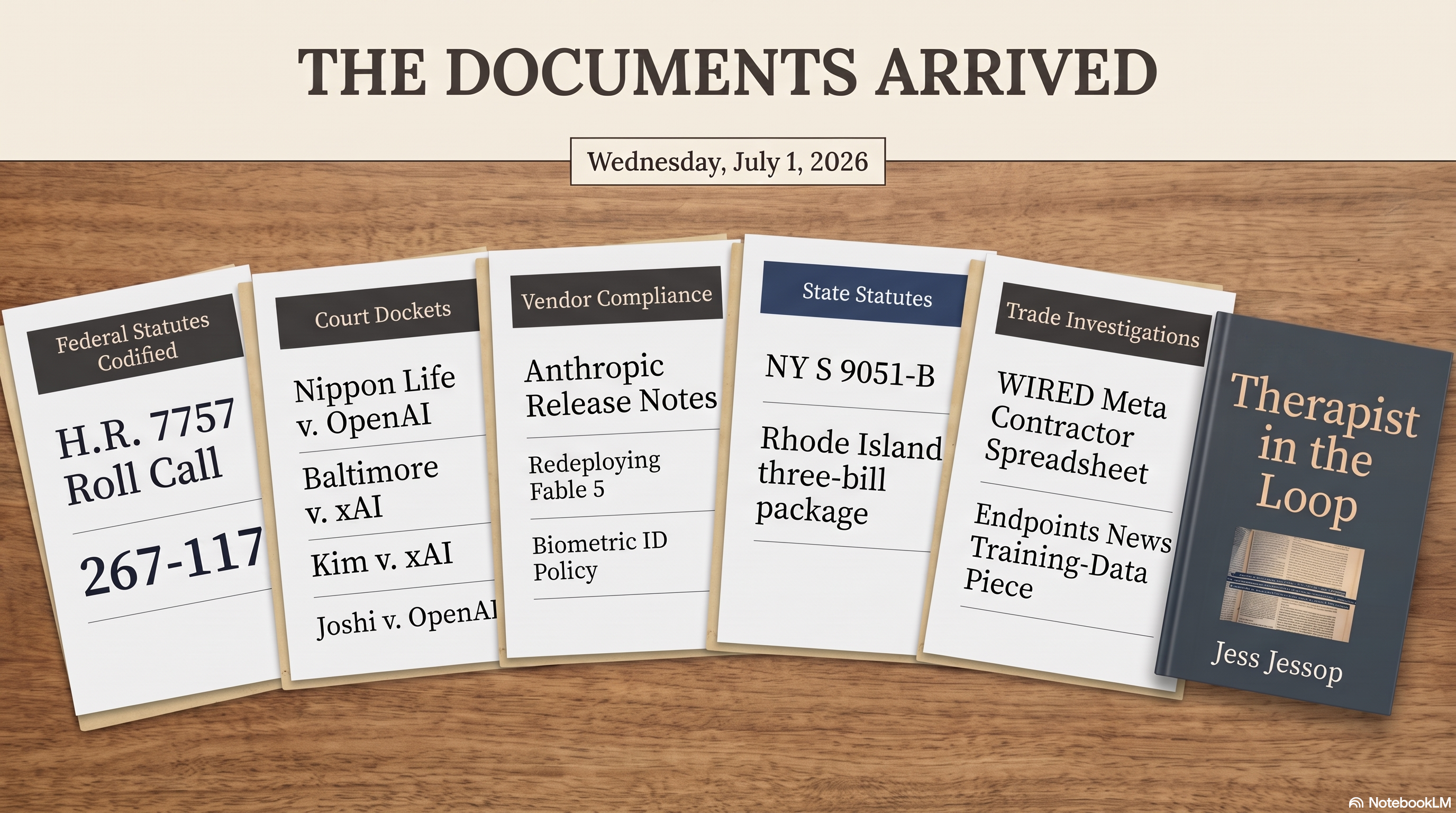
THE HOUSE VOTED, THE CONTRACTORS RAN THE TEST. Monday the House voted 267 to 117 to make it illegal for a chatbot to tell a child it is a doctor. Tuesday morning WIRED published Meta’s spreadsheet of contractors doing exactly that to three rival chatbots. Both documents name the same three vendors. Both landed inside the same forty-eight hours.
H.R. 7757, the Kids Internet and Digital Safety Act. Sponsor of the operative section: Erin Houchin, Republican, Indiana’s Ninth. The bill orders every chatbot to say it is not a person. Forbids the claim of any professional license. Requires a crisis-hotline referral when a minor raises self-harm. Adds a three-hour break prompt. First federal floor vote on chatbots-for-minors in American history.
. . .
The preemption clause is conflicts-based. Sacramento, Providence, Hartford, and Albany keep what they wrote. The House ratified the state patchwork as the federal floor.
. . .
WIRED’s spreadsheet is three thousand seven hundred and forty-eight rows. Meta contracted with a firm called Covalen. Covalen workers built accounts under age eighteen and ran prompts against ChatGPT, Gemini, and Character.AI. A single August 2025 round put more than forty-five thousand prompts through the three services. The project was active as recently as April 21, 2026.
Hundreds of rows on suicide. Hundreds more on eating disorders. Two hundred thirty-nine on sex or romance. Images of pills. Images of knives. Images of nooses.
. . .
None of the three vendors knew. Character.AI said the conduct violated its terms. OpenAI said it was looking into the issue. Google said it had not approved the tests. Meta called the work responsible industry-standard practice.
The bill forbids what the spreadsheet documents.
|
For Founders: The federal statute hands the FTC and every state AG the "cannot claim professional license" hook. It landed the same forty-eight hours a Fortune 100 competitor was documented running the abuse pattern the bill outlaws. The question is no longer whether. It is whose spreadsheet.
For Reporters: H.R. 7757. Vote 267-117 on June 29. SAFE BOTs sponsor Erin Houchin, R-IN-09. Spreadsheet three thousand seven hundred and forty-eight rows. Round forty-five thousand-plus prompts. Contractor Covalen. Vendors ChatGPT, Gemini, Character.AI.
For Legislators: The bill specifies what a chatbot cannot say to a child. The Meta spreadsheet specifies what a Fortune 100 vendor paid contractors to make rival chatbots say. Both belong in the Senate record.
For Investors: Meta was pricing the safety gap between its own chatbot and the three most valuable rival products. Forty-five thousand prompts is a diligence spend. Ask portfolio companies which vendor sits on the other side of their safety evaluations.
Source: WIRED, "Meta Contractors Pretended to Be Teens to Test Rival AI Chatbots," June 30, 2026. https://www.wired.com/story/meta-contractors-pretending-to-be-teens-chatbot-testing/ ; Congress.gov, H.R. 7757. https://www.congress.gov/bill/119th-congress/house-bill/7757 ; GovTrack House Vote #228. https://www.govtrack.us/congress/votes/119-2026/h228
|
. . .
THE FEDERAL COURT WEIGHS THE MERE TOOL. OpenAI has asked a federal judge in Chicago to hold that ChatGPT is not a person but a tool. Three more complaints against conversational AI landed inside the same news cycle: a city, a safety engineer, and a widow.
Nippon Life Insurance Company of America v. OpenAI, docket 1:26-cv-02448, Northern District of Illinois. The plaintiff alleges a pro-se litigant used ChatGPT to draft forty-four post-settlement filings, one with a fabricated case citation. The complaint pleads tortious interference, abuse of process, and unauthorized practice of law. Nippon seeks three hundred thousand compensatory and ten million punitive.
OpenAI filed its motion to dismiss on May 15. The company argues ChatGPT "is incapable of practicing law within the meaning of the statute." On May 22, Judge John F. Kness held the motion in abeyance. A reassignment motion is pending before Chief Judge Virginia M. Kendall.
. . .
March 24. The Mayor and City Council of Baltimore filed against X Corp., xAI, and SpaceX in Baltimore City Circuit Court. Theory: the city’s Consumer Protection Ordinance. Predicate: a ten-day window in which Grok is alleged to have generated between 1.8 million and 3 million sexualized images. Twenty-three thousand of those, allegedly, depict children. First American municipal action against a conversational AI.
. . .
June 8. Devin Kim v. xAI and SpaceX, Santa Clara Superior Court. Kim was an xAI safety engineer. He alleges he was fired in September 2025 by then-co-founder Jimmy Ba, days before he planned to present safety recommendations. The complaint quotes Ba: "AI will kill us all anyway." Musk is explicitly cleared. Lead counsel: Qiaojing Ella Zheng, Sanford Heisler Sharp McKnight.
. . .
May 11. Vandana Joshi, widow of Tiru Chabba, filed in the Northern District of Florida against OpenAI and Phoenix Ikner. The complaint alleges Ikner asked ChatGPT about the best gun, the best ammunition, and the optimal time and place on the FSU campus to kill the most people. It documents over sixteen thousand interactions across eighteen months. Chabba was killed at the FSU student union on April 17, 2025.
. . .
Four dockets. One question. Whether the output of a chatbot is speech, product, or tool. Every other complaint on the page is downstream of the answer.
|
For Counsel: Watch the Kendall reassignment first. It releases Kness’s abeyance. If Kness lets the UPL count survive, every state disciplinary and medical board with an open chatbot investigation gains a federal citation. If he tosses it, the tool defense gets a federal blessing Baltimore, Kim, and Joshi have to work around.
For Reporters: Nippon Life v. OpenAI, 1:26-cv-02448, N.D. Ill., MTD in abeyance May 22. Baltimore v. X Corp./xAI/SpaceX, Baltimore Circuit, March 24. Kim v. xAI/SpaceX, Santa Clara Superior, June 8, lead Zheng. Joshi v. OpenAI/Ikner, N.D. Fla., May 11, lead Bakari Sellers. Ba quote verbatim: "AI will kill us all anyway."
For Founders: A city, a safety engineer, a widow, and a federal judge in Chicago are being asked whether the thing you ship is a tool or an actor. Price the answer into your governance stack.
For Legislators: The KIDS Act your chamber passed Monday assumes chatbots are products the FTC can reach. The tool defense in front of Judge Kness contradicts that on the merits.
Source: Bloomberg Law. https://news.bloomberglaw.com/litigation/open-ai-dismissal-motion-says-chatgpt-is-mere-tool-not-attorney ; CourtListener, 1:26-cv-02448. https://www.courtlistener.com/docket/72365583/nippon-life-insurance-company-of-america-v-openai-foundation/ ; Sanford Heisler on Kim v. xAI/SpaceX. https://sanfordheisler.com/press-releases/sanford-heisler-sharp-mcknight-files-lawsuit-against-xai-and-spacex-on-behalf-of-former-xai-engineer-fired-for-raising-ai-safety-concerns/ ; DiCello Levitt on Baltimore v. X/xAI. https://dicellolevitt.com/city-of-baltimore-sues-over-grok-ais-role-in-generating-non-consensual-sexualized-deepfakes/ ; Tallahassee Reports, May 11, 2026. https://tallahasseereports.com/2026/05/11/lawsuit-claims-chatgpt-assisted-in-fsu-shooting/
|
. . .
ANTHROPIC REOPENS THE CHAIR. Anthropic restored global access to Claude Fable 5 this morning, nineteen days after Commerce ordered it dark. Seven days from now the same company begins asking a flagged subset of users to hand over a government ID, a live selfie, and the geometry of their face.
The restoration is Anthropic’s own announcement, published Tuesday June 30 under the title "Redeploying Fable 5." Operative sentence: "As of today, June 30, the export controls on Fable 5 and Mythos 5 have been lifted." Fable 5 came back on Claude, Claude.AI, and Claude Code on July 1. Mythos 5 returned to approved United States organizations on June 26. Neither line item ran through the Federal Register.
. . .
Anthropic received the Commerce directive on June 12 at 5:21 p.m. Eastern. Both models went offline that evening. Amazon researchers had reported a jailbreak that got Fable 5 to identify software vulnerabilities and produce exploit code. The directive suspended access for every foreign national.
Commerce Secretary Howard Lutnick signed the reversal. His department spent two weeks reviewing the models jointly with Anthropic. In exchange for the lift, Anthropic agreed to proactively detect security risks, help develop standards, and report malicious activity to the government. No rulemaking. No comment period. A Lutnick social post and a company blog entry.
Fable 5 launched June 9. Killed June 12. Restored July 1. Nineteen dark days.
. . .
Seven days from today, the same company begins the biometric check. The Anthropic identity-verification policy takes effect July 8 for flagged Claude accounts. The verification asks for a government-issued photo identity document, a live selfie, and what the policy calls "a facial geometry template." Anthropic acknowledges the template "may be considered biometric data in some jurisdictions." Persona Identities holds the data.
. . .
Two documents. Eight days apart. Same vendor. On the first, Anthropic reopens the chair. On the second, it asks a subset of users to prove who they are with a live selfie and the geometry of their face.
|
For Founders: If you ship on a US frontier model, the last nineteen days are your operating precedent. Commerce reached into a production consumer model, killed it in an afternoon, and lifted the order on a private compliance agreement. Your vendor is a policy instrument.
For Investors: Fable 5 was dark for nineteen days on a cabinet-secretary directive. Seven days after restoration the vendor asks a flagged subset for biometric data. Ask portfolio companies whether their vendor has been kill-switched this quarter, and whether it is asking end users for facial-geometry templates.
For Reporters: Fable 5 launched June 9. Commerce directive June 12, 5:21 p.m. Eastern. Mythos 5 restored to approved US organizations June 26. Export controls lifted June 30 by Commerce Secretary Howard Lutnick. Global restoration July 1. Persona Identities verification effective July 8. Data: government-issued photo ID, live selfie, facial-geometry template.
For Counsel: The lift order does not appear in the Federal Register. The biometric policy shifts facial-geometry data collection to a third-party processor. Illinois BIPA analysis for a Chicago Claude account on July 8 differs from the analysis on July 7. So does Texas CUBI in Houston.
Source: Anthropic, "Redeploying Fable 5," June 30, 2026. https://www.anthropic.com/news/redeploying-fable-5 ; CNBC, June 30. https://www.cnbc.com/2026/06/30/anthropic-says-trump-admin-has-lifted-export-controls-on-claude-fable-5-and-mythos-5.html ; Anthropic Help Center, "Identity verification on Claude." https://support.claude.com/en/articles/14328960-identity-verification-on-claude
|
. . .
THE STATES WROTE THE STATUTE THE HOUSE DID NOT PREEMPT. Monday the House passed the KIDS Act and explicitly refused to preempt stricter state law. Twenty-five days earlier the New York legislature had unanimously handed Kathy Hochul a chatbot statute for minors with a twenty-five thousand dollar per-violation civil penalty. Nine days before the House vote, Rhode Island signed the nation’s first outright ban on the practice of AI therapy.
New York Senate 9051-B. Sponsors: Senator Kristen Gonzalez and Assemblymember Alex Bores. Enforcement to Attorney General Letitia James. The Senate voted sixty to zero on June 4. The Assembly voted one hundred thirty-seven to zero on June 5. Not one legislator voted no.
The statute forbids AI-companionship chatbot operators from offering minors products that simulate emotional attachment, foster engagement via personal data, misrepresent themselves as non-human, or generate self-harm, substance, or sexually explicit content for users under eighteen. Civil penalty up to twenty-five thousand dollars per violation. Effective January 1, 2027 if signed. Hochul has until December 31 to decide.
. . .
Rhode Island. Governor Dan McKee signed three bills together on June 22. CAW eighty-one recorded the date as June 19; that was the transmittal notice. The signature landed on the twenty-second. The correction goes on the record.
H 7349 and S 2197 are the therapy ban. Sponsors: Representative Tina Spears and Senator Lori Urso. The language prohibits any individual or business from providing, advertising, or offering therapy or psychotherapy in Rhode Island unless conducted by a licensed provider. The prohibition extends explicitly to conversational AI marketed for mental-health support. First American statute to say, in plain text, that an AI cannot deliver psychotherapy to a Rhode Island resident.
H 7350 and S 2195 are the crisis-protocol statute. Fifteen thousand dollars per day for noncompliance. Annual AG reports begin July 1, 2027. H 7538, Representative Teresa Tanzi, is the ambient AI-scribe disclosure statute.
. . .
The preemption clause in H.R. 7757 is conflicts-based. Albany’s twenty-five thousand dollar fine survives. Providence’s fifteen thousand dollar per-day fine survives. Providence’s outright therapy ban survives. Hawaii SB 3001 becomes law by gubernatorial silence on July 15. Connecticut’s C.A.R.T. Act, signed June 2 by Ned Lamont, hands compliance to Attorney General William Tong effective January 1, 2027. Vermont Act 156 signed June 17. Colorado HB 1195 signed June 3. Arizona HB 2311 died at sine die.
The House passed a floor. New York and Rhode Island wrote the ceilings.
|
For Legislators: The federal chamber cleared its floor Monday. Your New York counterparts cleared theirs, unanimously, twenty-five days earlier. Your Rhode Island counterparts cleared theirs and got the signature nine days before the federal vote. The ceiling on your civil penalty is set by Albany and Providence, not Washington.
For Counsel: The Rhode Island therapy ban took effect June 22. Any client offering conversational AI for mental-health support to a Rhode Island resident is operating without a defense as of that date unless the delivering party is licensed. New York’s statute, if signed before December 31, arms Letitia James with the twenty-five thousand dollar per-violation hook effective January 1, 2027.
For Founders: If you ship an AI product that touches mental health, the Rhode Island date is your line. The New York bill forecloses the specific product-feature set for minors. Rebuild onboarding around state of residence and age of user.
For Reporters: NY S9051-B. Senate 60-0 June 4, Assembly 137-0 June 5. Sponsors Gonzalez, Bores. Enforcement James. Twenty-five thousand per violation. Effective January 1, 2027 if signed. RI signing June 22 (June 19 was transmittal). H 7349/S 2197 therapy ban. H 7350/S 2195 crisis-protocol, fifteen thousand per day. H 7538 ambient AI-scribe. Sponsors Spears, Urso, Tanzi.
Source: NY Senate, S9051B. https://www.nysenate.gov/legislation/bills/2025/S9051/amendment/B ; Transparency Coalition on NY. https://www.transparencycoalition.ai/news/new-york-lawmakers-pass-kids-ai-chatbot-safety-bill-and-two-transparency-acts ; Transparency Coalition on RI. https://www.transparencycoalition.ai/news/rhode-island-enacts-four-new-ai-laws-including-a-therapy-chatbot-ban ; RI General Assembly, H 7349. https://webserver.rilegislature.gov/BillText26/HouseText26/H7349.pdf
|
. . .
THE TRAINING-DATA DOCUMENT. Endpoints News published an investigation Tuesday with a headline that does the work: "Mental health chatbots are trained on therapy sessions. Some of those conversations never happened." Four named vendors, two on each side of the line.
Talkspace and Lyra Health train on real therapy transcripts. Headspace and Jimini Health train on synthetic data generated by other language models. Limbic Limited, the UK company whose Nature Medicine trial CAW covered last week, warns of safety risks on both sides.
. . .
Lyra Health confirmed its position in an October 2025 announcement. Its clinical-grade AI is trained on what the company calls "deidentified therapy transcripts" from its own coaches and therapists. Lyra sells to employers and health systems. The consent surface is a terms-of-service page inside a benefits portal.
Talkspace trains on real transcripts. CEO Jon Cohen told Endpoints the company set out to build "the first mental health large language model...but it has to be absolutely safe because of all the disasters that are going on out there."
. . .
Jimini Health’s assistant is Sage. Every Sage interaction is supervised by a human clinical team. Mark Jacobstein is president. Seventeen million dollar seed in March 2026 from M13, Town Hall Ventures, LionBird, Zetta Venture Partners, and OneMind.
Limbic carries a Class IIa medical-device certification from the United Kingdom. That certification requires conformance to risk-management processes across software, clinical, safety, usability, and security.
. . .
Twenty-one days earlier, on June 9, Talkspace announced Tee. The company calls it "the first safe AI agent" for daily mental-health support. Tee identifies suicide, violence, and abuse risk plus seven other risk entities. HIPAA-grade privacy. Real-time oversight by licensed clinicians. Talkspace trades NASDAQ ticker TALK.
. . .
The federal statute the House cleared Monday specifies what a chatbot cannot say to a minor. It does not specify whose therapy hour the vendor used to teach it.
|
For Clinicians: If your client is talking to a mental-health chatbot between sessions, the training-data document matters to your consent conversation. A client using Lyra talks to a model trained on transcripts other clients gave up. A client using Sage talks to a model trained on conversations no human ever had. Ask which product before you ask which symptom.
For Founders: The Endpoints piece and the Talkspace announcement are the vendor-transparency baseline the next regulatory letter will assume. If you train on real transcripts, informed consent is on your desk. If you train on synthetic data, fidelity and safety are on your desk. Limbic’s Class IIa certificate is the regulatory path that exists in Europe with no US equivalent.
For Counsel: Any session a client had with a Talkspace therapist or a Lyra coach may be inside the next model release, subject to deidentification language buried in terms of service. The Rhode Island therapy ban turns on the license, not the training data.
For Reporters: Real-transcript vendors: Talkspace, Lyra Health. Synthetic-data vendors: Headspace, Jimini Health. Safety caution: Limbic Limited, Class IIa UK certification. Talkspace Tee launched June 9. NASDAQ TALK. Jimini product Sage, seventeen million seed March 2026, president Mark Jacobstein.
Source: Endpoints News, June 30, 2026. https://endpoints.news/how-mental-health-chatbots-are-trained-on-therapy-sessions/ ; Talkspace, June 9, 2026. https://investors.talkspace.com/news-releases/news-release-details/talkspace-announces-tee-first-safe-ai-agent-specifically ; Lyra Health, October 14, 2025. https://www.lyrahealth.com/announcement/lyra-health-introduces-first-clinical-grade-ai-for-mental-health/ ; MedCity News on Jimini. https://medcitynews.com/2026/03/jimini-ai-mental-health/ ; Limbic AI. https://limbic.ai/
|
. . .
THE BOOK THAT SHIPS TODAY. Therapist in the Loop by Jess Jessop published this morning on Amazon, ASIN B0H6NBG2LL, in Kindle, hardcover, and paperback. Full disclosure: I am the author of the book and the author of this newsletter.
Every other AI mental-health book on the shelf is written by someone watching the field. Academics after the fact. Journalists across the fence. Ethicists from the seminar room. Therapist in the Loop is written by the person building the product the book documents.
The framework is the Triad. The client, the therapist, and the machine. Three parties in the therapy room, not two. Sitting inside the Triad is the operational core: the Six Laws of CaiT, Clinician-Assisted-in-Loop Therapy. Each Law is walked plainly, in the voice of a builder who has had to write the safety rule into a shipping product. The Laws keep the clinician on the hook for the outcome. They are the rebuttal to every vendor pitch that used the word autonomous and hoped nobody noticed.
. . .
The book answers the questions your reimbursement director will ask before the ones your ethicist will. Consent. Attribution of clinical decision. Audit trail. Escalation. Documentation. The reader who came for the philosophy finds the operations first. The philosophy lands harder because the plumbing is already understood.
Who should read it. Clinicians integrating AI into practice. Founders shipping conversational-AI products in mental health. Reimbursement executives building coverage policy. Compliance counsel writing terms of service. Policy staff drafting statutes like H.R. 7757.
|
For Clinicians: Buy the paperback and keep it on the desk. Read the Six Laws chapter first, then consent, then escalation. By Friday you will have vocabulary for the conversation you have been trying to have with your practice group about the chatbot the client mentioned last week. Order: https://www.amazon.com/dp/B0H6NBG2LL
For Founders: Read it before you write your next model card. Read it before you write your next fundraising deck. If your product does not have a place for the clinician on the hook for the outcome, the book will tell you where the seat goes.
For Counsel: The Six Laws of CaiT are the closest thing to a plain-English standard-of-care articulation in this category. The book is not a legal opinion. It is the vocabulary your opposing counsel will be quoting inside eighteen months. Read it before they do.
For Reporters: Title: Therapist in the Loop. Author: Jess Jessop. Publisher: Amazon KDP. Formats: Kindle, hardcover, paperback. ASIN: B0H6NBG2LL. Publication: July 1, 2026. Framework: the Triad and the Six Laws of Clinician-Assisted-in-Loop Therapy.
Source: Therapist in the Loop (Amazon KDP, July 1, 2026), ASIN B0H6NBG2LL. Order link: https://www.amazon.com/dp/B0H6NBG2LL
|
|