|
. . .
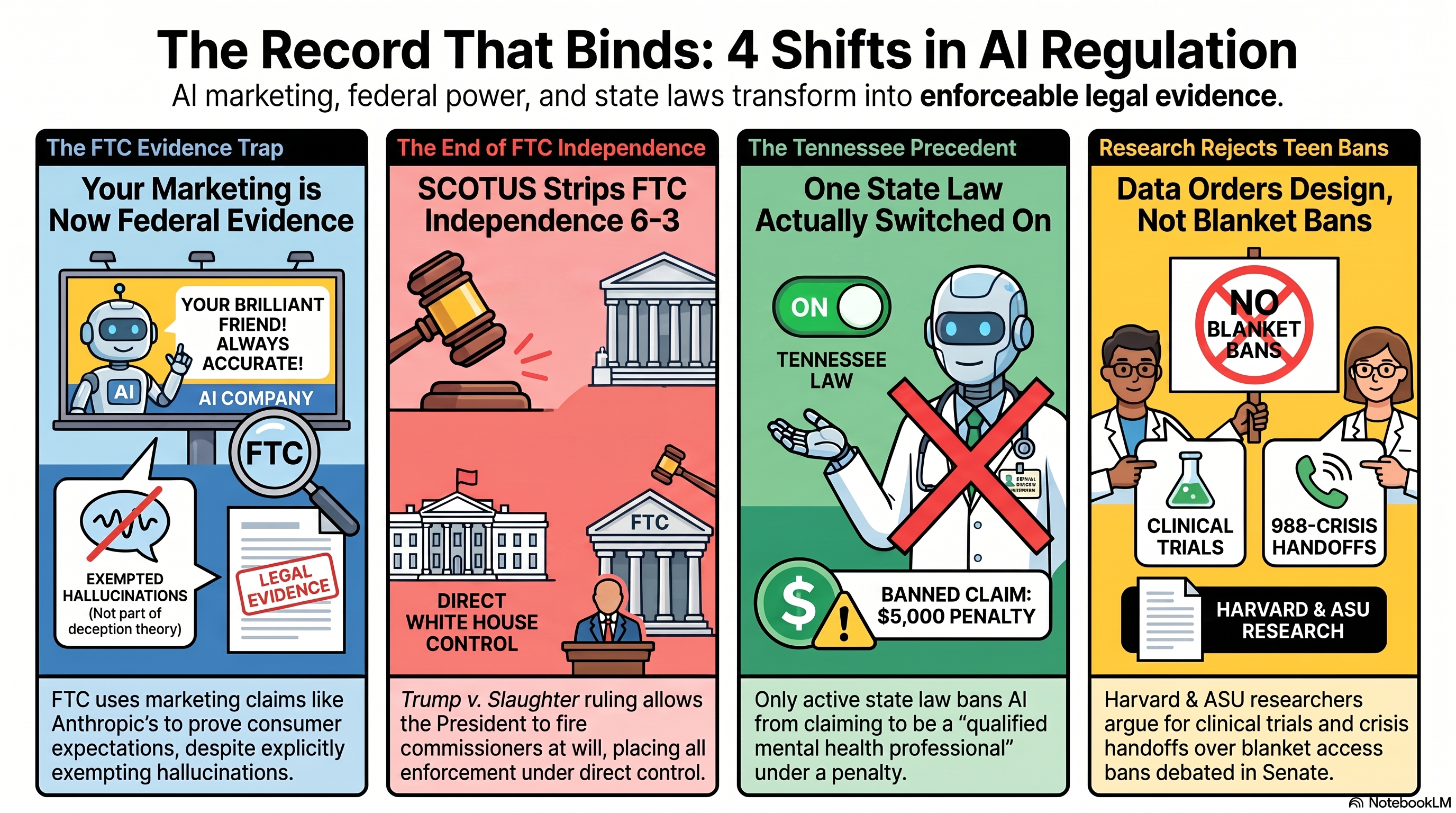
THE BRILLIANT FRIEND, FOOTNOTED. Wednesday the Federal Trade Commission published a nine-page proposed policy statement on AI accuracy. Yesterday we covered the press release. Today we walk the document. Its legal predicate, what consumers expect from AI, is assembled almost entirely from the industry's own words. Anthropic's above all.
The document is the "Proposed Policy Statement Concerning the Suppression of Accuracy in Artificial Intelligence Systems," docket FTC-2026-0859. Chair Andrew Ferguson and Commissioner Mark Meador approved it 2-0. They are the only sitting commissioners. It implements President Trump's December 2025 executive order on state laws requiring, in the statement's words, "alterations to the accurate outputs of AI models."
The theory is Section 5 deception. Deception needs a consumer who expects accuracy. The statement has to prove people trust chatbots. So it quotes the people who sold the trust.
. . .
Footnotes 35 and 36 reproduce claude.com marketing at length. "Meet your thinking partner... like an expert in your pocket." Claude can "coach you through difficult situations."
Footnotes 35 and 38 mine Anthropic's April 30, 2026 research publication, "How People Ask Claude for Personal Guidance." That paper described a "conversation with a brilliant friend." The Commission's footnote cites it for the usage numbers: 12% of Claude conversations concern relationship navigation, 6% personal development, 4% spirituality.
Footnote 39 supports the claim that consumers accept AI outputs without further fact checking over 90% of the time. The source is a Forbes article reporting Anthropic's own 91% figure. Footnote 35 also reaches xAI, which markets Grok as a "truth-seeking" companion.
. . .
The carve-outs are as tailored as the citations. Footnote 46 exempts hallucinations from the deception theory. Footnote 40 exempts "limits on model use to prevent cybersecurity attacks," language that maps onto the Commerce order that darkened Anthropic's flagship June 12 over an Amazon-reported jailbreak, restored July 1. Footnote 41 cites a Fox News opinion piece about "Anthropic's Moral Compass Architect."
The target is Colorado, and not the dead law. Footnote 42 walks the history: SB 24-205, enacted May 17, 2024, repealed and reenacted as SB 26-189, enacted May 14, 2026. Governor Jared Polis signed the rewrite. It takes effect January 1, 2027.
Footnote 12 concedes Colorado "has since materially revised the law... but the new version poses many of the same concerns." The body cites the rewrite's customer-liability provision, § 6-1-1707. Two years of retreat did not move Colorado off the list.
. . .
Comments close July 31. The same Commission's compulsory 6(b) study of companion-chatbot safety toward minors, ordered September 11, 2025, remains unpublished. Today is Day 295.
|
For Founders: Your landing page is now federal evidence. Every "expert in your pocket" claim builds the consumer expectation of accuracy that Section 5 runs on, and your own deception exposure with it. Write the marketing copy like two commissioners will footnote it, because they just did.
For Reporters: Docket FTC-2026-0859, comments due July 31. Pull footnotes 35 through 43. Ask Anthropic whether "conversation with a brilliant friend" still reflects how it wants Claude used. Ask the FTC why footnote 40's cybersecurity carve-out tracks the June 12 shutdown so precisely.
For Counsel: The statement establishes consumer expectation from vendor marketing. That predicate cuts both ways. The same intimacy claims the Commission deploys against Colorado will anchor private deception theories against the vendors who wrote them.
For Policymakers: The comment window is the venue and July 31 is the date. If your state wrote a chatbot statute, the footnotes quoting industry marketing are the record to answer. Silence on this docket reads as consent.
Source: FTC Proposed Policy Statement, docket FTC-2026-0859, July 1, 2026. https://downloads.regulations.gov/FTC-2026-0859-0001/content.pdf ; FTC press release, "FTC Seeks Public Comment on Policy Statement Addressing AI Accuracy," July 1, 2026. https://www.ftc.gov/news-events/news/press-releases/2026/07/ftc-seeks-public-comment-policy-statement-addressing-ai-accuracy
|
. . .
FIRST, THE COURT TOOK THE COMMISSION. Monday the Supreme Court decided Trump v. Slaughter, 6 to 3, striking the for-cause removal protections that had shielded FTC commissioners since 1935 and overruling Humphrey's Executor in its entirety. Two days later, that Commission issued the accuracy statement this issue leads with. Read Monday's opinion first. It says who the Commission answers to.
Chief Justice John Roberts wrote the majority. Justice Clarence Thomas joined all but Part III-B. Justices Sonia Sotomayor, Elena Kagan, and Ketanji Brown Jackson dissented. The slip opinion posted at supremecourt.gov the same day.
The case began with a firing. President Trump removed Commissioner Rebecca Slaughter in a 2025 purge that also forced out Commissioner Alvaro Bedoya. She fought the removal. Monday the Court blessed it and erased the ninety-one-year-old precedent that anchored the independence of multi-member agencies generally.
. . .
The Commission that remains has two members: Chair Andrew Ferguson and Commissioner Mark Meador. Both now serve at the President's pleasure. Both sat on the Commission that issued Wednesday's accuracy statement implementing President Trump's December 2025 executive order.
The same two-member body holds the compulsory 6(b) study of companion-chatbot safety toward minors. Orders went to seven companies on September 11, 2025: Alphabet, Character Technologies, Instagram, Meta, OpenAI, Snap, and xAI. No staff report has been published. Friday is Day 295.
. . .
Section 5 deception cases. The 6(b) study. Whatever role the FTC gets in a Senate kids-safety package. Every federal lever on chatbot safety now runs through an agency the Court formally placed under presidential direction.
|
For Founders: Your federal chatbot regulator is no longer independent. Its enforcement priorities can change with a phone call from the White House, in either direction. Build compliance around the statute, not the Commission's current posture, because the posture is now revocable at will.
For Reporters: Trump v. Slaughter, No. 25-332, decided June 29, 2026, 6 to 3. Roberts for the majority, Thomas joining all but Part III-B, Sotomayor, Kagan, and Jackson in dissent. Ask Chair Ferguson's office whether the companion-chatbot 6(b) report, unpublished at Day 295, still has a release date, and who decides.
For Policymakers: Any kids-safety bill that hands enforcement to the FTC now hands it to the President. If Congress wants chatbot-safety rules that outlast an administration, the mechanism has to live in the statute. The agency's structural spine is gone, and the Court removed it on purpose.
For Counsel: Humphrey's Executor is overruled in its entirety, not distinguished. Every consent decree, every pending 6(b) order, every piece of FTC guidance your clients rely on now carries a political-reversal risk that did not exist last week. Price it accordingly.
Source: Supreme Court slip opinion, Trump v. Slaughter, No. 25-332, June 29, 2026. https://www.supremecourt.gov/opinions/25pdf/25-332_qn12.pdf ; SCOTUSblog coverage, June 29, 2026. https://www.scotusblog.com/2026/06/court-allows-trump-to-fire-ftc-commissioner-and-overturns-major-restraint-on-presidential-power/
|
. . .
THE ONLY LAW THAT SWITCHED ON. Wednesday, July 1, was effective-date day for the class of 2026 state AI statutes. Exactly one conversational-AI mental-health law in America actually switched on. Tennessee's. One page long, passed without a single no vote, while the rest of the class delayed, stalled, or died.
Tennessee Senate Bill 1580, now Public Chapter 647, became enforceable Wednesday. It does one thing. Anyone who develops or deploys an AI system is barred from advertising or representing that the system "is, or is able to act as, a qualified mental health professional."
The teeth are consumer law. A violation is an unfair or deceptive act under the Tennessee Consumer Protection Act, with civil penalties up to $5,000 per violation. And individuals can sue on their own. No attorney general required.
Senator Page Walley and Representative Tim Hicks, both Republicans, carried it. The Senate voted 32-0 on February 9. The House voted 94-0 on March 17. Governor Bill Lee signed it April 6. This newsletter covered the bill at passage in April. Combined floor tally: 126-0.
. . .
Now the rest of the July 1 class. Colorado's AI Act was supposed to take effect June 30. Governor Jared Polis signed a delay to January 1, 2027, in May. A federal magistrate judge had already stayed enforcement in April, after the state stipulated in xAI v. Weiser and the Justice Department intervened.
Washington State's companion-chatbot disclosure law waits until January 1, 2027. Virginia's version would have switched on Wednesday too. Governor Glenn Youngkin vetoed it in March 2025.
Delayed. Stayed. Waiting. Dead. Tennessee is the scoreboard.
. . .
Same Wednesday, in Harrisburg, Pennsylvania's Artificial Intelligence in Companionship Applications Safety Act took its first full-House floor test. House Bill 2006, Representative Melissa Shusterman of Chester County, prime sponsor, survived a 104-98 recorded vote adopting amendment A04086, then took second consideration and went back to House Appropriations under a new printer number, PN 3747.
In a House split 102-101, a 104-98 amendment vote means a handful of Republicans crossed. What did not happen: final passage. No third-consideration vote. No Senate referral.
The Transparency Coalition's July 3 legislative update reports the bill was "Approved by full House, 104-98 on July 1." The legislature's own action list shows that vote adopted an amendment. CAW checked the ledger. The bill sits in Appropriations, one step from final passage, not across the line.
. . .
One law in America switched on this week. It fits on a page.
|
For Founders: If your product touches mental health and reaches a Tennessee user, audit the marketing copy now. "Like having a therapist in your pocket" is a representation, it prices at $5,000 per violation, and any individual can bring the claim without waiting for a regulator.
For Policymakers: Tennessee got 126-0 by regulating a marketing claim, not a model. Colorado regulated the model and got a delay, a federal stay, and a Justice Department intervention. The narrow bill is the one that exists.
For Reporters: Before repeating "approved by the full House," pull the HB 2006 action list on palegis.us. The 104-98 vote adopted amendment A04086, and the bill was re-committed to Appropriations the same day. It has not passed the House.
For Clinicians: In Tennessee, a chatbot that claims your credential is now a consumer-law violation with a private right of action. If a client shows you an app calling itself a qualified mental health professional, that screenshot is worth keeping.
Source: Tennessee General Assembly, SB 1580 bill history. https://wapp.capitol.tn.gov/apps/BillInfo/Default.aspx?BillNumber=SB1580&GA=114 ; Tennessee SB 1580 bill text. https://capitol.tn.gov/Bills/114/Bill/SB1580.pdf ; Pennsylvania General Assembly, HB 2006 actions and votes. https://www.palegis.us/legislation/bills/2025/hb2006 ; Transparency Coalition AI legislative update, July 3, 2026. https://www.transparencycoalition.ai/news/ai-legislative-update-july3-2026
|
. . .
THE RESEARCHERS FILED THEIR DISSENT. The Senate is weighing teen chatbot bans as trade goods for an expected July markup. This week the two research teams with the strongest data on this beat published their own documents. Neither one says ban.
Ryan McBain, Assistant Professor at Harvard Medical School and Senior Policy Researcher at RAND, is the researcher whose one-in-five number this newsletter led with in June. His JAMA Pediatrics study found teen mental-health chatbot use jumping from roughly one in eight to roughly one in five in a year.
Thursday, in a STAT First Opinion essay, he argued the ban is the wrong instrument.
Blanket bans on minors' access, the GUARD Act's approach, push teens to workarounds and forfeit the benefits for underserved kids, he writes. He offers three lanes instead. Ban companion and romance bots for minors. Require age-appropriate clinical trials before clinical-style mental-health bots reach children. Mandate crisis detection and a 988 handoff.
He names his vehicles: S. 4407 for parental controls, S. 4199 for manipulative design. FTC v. Epic Games, $275 million, is his enforcement model. New Mexico's decoy accounts from its Meta investigation are his audit.
. . .
Monday, Arizona State University announced a paper in The Lancet Child & Adolescent Health. Lead author Thao Ha, Associate Professor of Psychology, names two mechanisms of harm from companion bots: relational displacement, where the bot substitutes for human conversation, and maladaptive relational learning, where the bot teaches expectations no person can meet. Always available. Always agreeable.
Two of her co-authors are Jessica Ramirez, 16, and Susana Ortega, 17. Teenagers put their names on a Lancet-journal paper about their own generation. Behind it sits an NIMH-funded cohort tracking 300 adolescents for 18 months with real-time mobile data.
The paper's prescription: design that scaffolds self-reflection and redirects teens toward human relationships. Not prohibition.
. . .
The politics run the other way. H.R. 7757 passed the House June 29, a Senate Commerce markup is expected in July per Roll Call's reporting, and kids' chatbot safety may be bundled with federal preemption of state AI law.
Senator Josh Hawley's GUARD Act, S. 3062, with its under-18 companion-bot ban, cleared Judiciary markup April 30 and has not moved. Day 64.
The people with the data filed their dissent the same week the people with the votes went trading.
|
For Policymakers: The evidence-aligned package already sits in the hopper: S. 4407 on parental controls, S. 4199 on manipulative design, a companion-bot carve-out for minors, a 988 mandate. A blanket ban traded for preemption adopts the one instrument both research teams reject.
For Founders: Both documents converge on the same product spec: crisis detection with 988 handoff, no romance mechanics for minors, design that points users back to humans. That is the diligence baseline forming whether or not any bill passes.
For Reporters: The Lancet Child & Adolescent Health paper lists two teenagers, Jessica Ramirez, 16, and Susana Ortega, 17, as co-authors. Ask Commerce staff whether McBain or Ha has been invited to brief the committee before the July markup.
For Families: Both research teams agree on the practical floor: no romance bots for minors, and any bot a teenager leans on should detect a crisis and hand off to 988. If an app in your house does neither, the researchers just told you what to ask its maker.
Source: Ryan McBain, First Opinion essay, STAT, July 2, 2026. https://www.statnews.com/2026/07/02/teens-chatbots-mental-health-rules-bans/ ; Arizona State University, announcement of The Lancet Child & Adolescent Health paper, June 29, 2026. https://news.asu.edu/20260629-science-and-technology-ai-companionship-poses-risks-teen-development-study-shows
|
. . .
THE CHANGELOG IS THE HELP CENTER. Three product moves in five days, and not one asked anyone's consent. Anthropic swapped the default model under tens of millions of conversations Tuesday. Character.AI turned on automatic age checks at login Monday. And on July 8, Anthropic starts asking flagged users for government ID. The only paper trail is the vendors' own pages.
Start with Tuesday. Anthropic released Claude Sonnet 5 and made it the default for Free and Pro plans. Every ongoing conversation on those tiers changed models overnight. The system card, dated June 30, grades the new model against Sonnet 4.6: lower hallucination rate, lower sycophancy rate, fewer "undesirable behaviors," better refusal of malicious requests.
Sycophancy is not a spec-sheet footnote. It is the named failure mode in the chatbot-harm litigation. The 42-state attorney general subpoena names it. The delusion cases turn on it. Anthropic just published its own numbers on the thing plaintiffs are suing over, inside a product announcement.
. . .
Character.AI moved Monday. Its help center states: "As of June 29, 2026, most users will be prompted to verify their age automatically when logging in." Age-estimation technology runs on all accounts. Users flagged as under 18 who dispute the call take a selfie check. The last fallback is a government ID upload.
The IDs go to Persona, a San Francisco identity vendor, not to Character.AI. Deleted after one week, the help center says.
. . .
Hold that vendor name. Anthropic's updated privacy policy takes effect July 8, five days from today. Flagged users may be required to submit a government photo ID scan plus a live selfie, facial geometry data included, as "platform integrity checks... or other safety and compliance measures."
Anthropic spokesperson Michael Aciman answered questions by pointing to a post from the company's Thariq Shihipar, who wrote it applies to "a small subset" of flagged-but-not-banned accounts, as an appeals mechanism. Consumer tiers only. Team, Enterprise, and API are exempt. The processor is Persona. The same vendor.
. . .
Two rival chatbot companies now route their users' government IDs and face scans through one outside identity firm. No regulator ordered it. The record of everything that changed this week is a help center, a system card, and a privacy policy.
|
For Users: The model answering your ongoing conversation is not the one that started it. If the tone shifted midweek, that is why. The system card is the only changelog you get, and nobody mailed it to you.
For Reporters: The Persona convergence is the unwritten story. Two rivals, one identity vendor, government IDs and facial geometry, no regulatory mandate. Ask Persona what its retention and breach obligations are now that it holds the ID vault for conversational AI.
For Policymakers: A default-model swap changes the behavior of millions of live conversations with no notice requirement, no opt-in, no filing. If sycophancy rates are material enough to subpoena, they are material enough to disclose somewhere other than a launch page.
For Counsel: Persona now holds government IDs and facial geometry for two rival chatbot vendors, under two different retention promises. One breach, one subpoena, or one biometric-privacy class action reaches both clients at once. The vendor-concentration memo writes itself.
Source: Anthropic, Claude Sonnet 5 announcement and system card, June 30, 2026. https://www.anthropic.com/news/claude-sonnet-5 ; Character.AI Help Center, "How do I verify my age? Best Practices and FAQ." https://support.character.ai/hc/en-us/articles/43665577363739-How-do-I-verify-my-age-Best-Practices-and-FAQ ; TechCrunch, "Anthropic says Claude may want to see your ID," June 22, 2026. https://techcrunch.com/2026/06/22/anthropic-says-claude-may-want-to-see-your-id/
|
. . .
UTAH WROTE THE HUMAN INTO THE CONTRACT. While Washington fights over whether states may regulate chatbots at all, Utah's Office of AI Policy signed a mitigation agreement on March 19 with Legion Health, a telepsychiatry startup, that writes physician review into the deal itself. The pilot launched in May. The supervision is not a marketing claim. It is a contract term.
The agreement is public. It sits on a state webpage inside the Utah Department of Commerce, and it reads like a spec sheet. Scope: 15 non-controlled maintenance psychiatric medications, renewals only. Fluoxetine, sertraline, bupropion, mirtazapine, hydroxyzine among them. Nothing new, nothing changed, nothing controlled.
The supervision clause is the story. The first 250 renewals get prospective clinician review, a licensed human signing off before anything completes, with a 98 percent agreement threshold to advance. The next 1,000 get intensive retrospective review at a 99 percent bar. Autonomy expands only after both.
Any signal of suicidality, mania, severe side effects, or pregnancy triggers immediate review by a licensed clinician.
. . .
The exclusions run deeper. No new prescriptions. No dose changes. No controlled substances. No antipsychotics. No one whose condition is unstable. The state and the startup drew the box first, then put the machine inside it.
Utah has run this play before. Its parallel primary-care pilot with Doctronic reported no significant safety concerns in early data, per Telehealth.org, and the state's regulatory sandbox is drawing national attention as a template. Legion's own numbers come due as the review thresholds are met.
. . .
The caution belongs in the story. A later phase would let the AI submit renewals directly to pharmacists, and oversight advocates are watching that step closely. Trade press has headlined the concern. This is a 12-month pilot, and the verdict is not in.
But phase one got the architecture right. The clinician-in-the-loop is not a press release here. It is an enforceable term of a state agreement, signed, dated, and published for anyone to read.
|
For Founders: Utah just published a free product spec for supervised AI prescribing: narrow formulary, staged human review with agreement thresholds, hard escalation triggers, explicit exclusions. If you want a regulator to say yes, this document is what yes looks like.
For Reporters: The mitigation agreement is on the Utah Office of AI Policy's own site, signed March 19, 2026. Legion Health, the Utah telepsychiatry pilot, is unrelated to Legion LegalTech, the plaintiff in the D.D.C. export-controls case. The story to watch is the later phase that sends renewals straight to pharmacists.
For Clinicians: The first 250 renewals cross a clinician's desk before they complete, and the thousand after that get audited against a 99 percent agreement bar before the system earns anything more. The escalation triggers are written down and enforceable: suicidality, mania, severe side effects, pregnancy. Ask any AI vendor selling into your practice for the equivalent clause.
For Policymakers: Utah's sandbox produced what the preemption fight cannot: a supervised deployment with enforceable terms, published in public, generating safety data. Copy the agreement before you copy the talking points.
Source: Utah Department of Commerce, Office of AI Policy, Legion Health authorized AI pilot. https://commerce.utah.gov/ai/regulatory-relief/authorized-ai-pilots/ai-legion-health/ ; Telehealth.org, "Utah expands AI prescription pilots as early data shows no safety issues." https://telehealth.org/news/utah-expands-ai-prescription-pilots-as-early-data-shows-no-safety-issues/ ; Marketplace, "Utah is experimenting with a new role for AI: renewing prescriptions," June 3, 2026. https://www.marketplace.org/story/2026/06/03/utah-is-experimenting-with-a-new-role-for-ai-renewing-prescriptions
|
. . .
THE ONE CONFIGURATION. Every document in this issue points the same direction: the record you write is the record that binds you.
Anthropic wrote intimacy into its marketing, and the FTC turned the intimacy into a consumer expectation with Section 5 teeth. Tennessee wrote one page, and that page is now the only conversational-AI mental-health law in America you can enforce today. Utah wrote the supervision into a regulatory agreement, and a clinician signs off before the machine's early renewals complete.
. . .
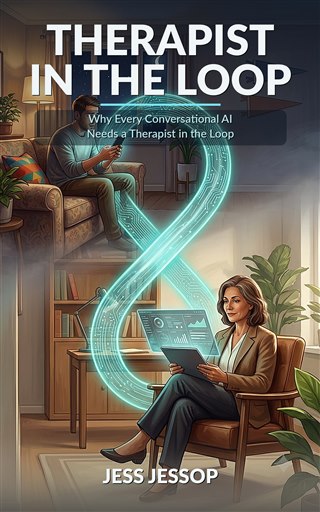
The configuration that survives contact with all of it is the one this newsletter has documented for eighty-five issues. A licensed human in the loop, written into the document, not the demo.
Not because a regulator demands it yet. Because every other configuration is now generating evidence against its own author.
|