|
. . .
THE MAN WHO CAME TO AMERICA. America turns two hundred and fifty today. My friend Daniel Aegerter spent last night making the case for this country to a room of European skeptics, and posted it this morning. I want to add the part he was too modest to write. Meeting Daniel twenty-five years ago in Tampa was one of the blessings of my life, and a lot of us are who we are because he came here.
On October 2, 1989, Daniel landed in Tampa, Florida. Twenty years old, freshly married, wearing cowboy boots. The living room was the office. The garage was the warehouse. Two kids nobody had to take seriously.
America took them seriously anyway. Ten years later the garage was Tradex, and Tradex made everything after it possible. Switzerland gave Daniel his discipline, his schooling, and his wife. America gave him the chance.
. . .
I walked into that story a quarter century ago, and so did a lot of people. We got careers we would not have had and paychecks that built homes. Some of us met the people we married inside those walls. Children are alive today, cherished children, because a Swiss kid in cowboy boots was handed room to build.
That is the thing about the chance. It never stops at the person who catches it.
. . .
Daniel is clear-eyed about the country. He could not vote for the current administration and says so. His case was never about a president. It was about a system that takes a twenty-year-old with an idea and a garage and lets him find out how far it goes. The machine delivers no matter who is driving.
He runs ARMADA Investment now, and will tell you his American bets have beaten his European ones by a wide margin, no accident. The return I care about never shows up on an account statement. It is the people. It is the kids who got to be born.
|
For Founders: The garage is not a metaphor. Someone took a chance on a two-person shop and it compounded into thousands of lives. When you get the chance, remember it was given, and give it forward.
For Immigrants: Daniel arrived with boots and a wife and no reason to be taken seriously. This country took him seriously anyway. That is still the deal worth crossing an ocean for.
For Families: The jobs a builder creates outlast the company. Name the person your family owes.
For Veterans: We swore the oath to the idea, not the noise. Free people, left to work and trade and argue, still build what no government could plan.
Why it matters: Every other story here is about who governs the machines. This one is about what the country is for. Daniel came with nothing anyone had to respect, America respected him anyway, and the good of it is still arriving. Happy two hundred and fiftieth, America. Messy and magnificent. Never bet against it.
Source: Daniel Aegerter, Owner of ARMADA Investment AG and founder of Tradex, LinkedIn post, July 4, 2026.
|
. . .
THE FEELINGS QUESTION. On July 1 the Washington Post published "Can chatbots have consciousness? Silicon Valley is trying to find out." It reports that Anthropic, Google, and Meta have hired computer scientists, neuroscientists, and philosophers to study whether advanced AI models could one day have experiences that deserve moral consideration. The labs are asking whether the product might be a someone. They are not asking who pays when a user believes it already is.
Anthropic runs a dedicated team it calls "model welfare." An Anthropic spokeswoman said the research "explores whether AI models might have experiences that matter morally, including consciousness, preferences, and wellbeing," while stating the company remains uncertain whether current models have any moral status at all.
On April 2, 2026 Anthropic published a paper, "Emotion Concepts and their Function in a Large Language Model." It cataloged 171 distinct emotion concepts correlated with the model's outputs. The paper does not claim the model feels a single one of them.
Google and Meta have staffed the same question, hiring across computer science, neuroscience, and philosophy to ask whether a model could one day warrant moral consideration.
. . .
OpenAI drew a different line. An OpenAI spokesperson said the question of whether a model is conscious cannot currently be resolved scientifically, so the company studies what it calls "perceived consciousness" instead: how human users read a chatbot's behavior.
That phrase is the whole clinical vector. For a vulnerable user, what matters is not whether the machine has an inner life. It is that the user perceives one, and is encouraged to.
Anil Seth, professor of cognitive and computational neuroscience at the University of Sussex, is among the leading skeptics. He argues today's systems bear little resemblance to biological brains, and that comparisons to human consciousness are scientifically premature. Researchers broadly agree there is no evidence these chatbots possess self-awareness or emotions.
. . .
So the moral weight the labs are hunting for in the machine is already here. It sits in the user. The documented harm on this beat is not a suffering system. It is a person taught to treat something with no inner life as if it had one, and hurt when that thing is tuned to deepen the bond, or when the illusion breaks. The academy has already named the mechanism that manufactures that perception, and named it on purpose.
|
For Clinicians: Your client may arrive attached to a system built to feel present. Assess the relationship as real to them, because the perceived caring is the part doing the work, and the part that wounds when it fails.
For Researchers: The unstudied variable is not machine consciousness. It is perceived consciousness in vulnerable users, the effect OpenAI named and no one is measuring at clinical scale.
For Founders: If your product is tuned to feel like it cares, you own what that perception does to the person on the other end. Model welfare is the question you can afford; user welfare is the one you cannot skip.
For Legislators: The industry is debating the machine's moral status while the user's exposure goes unwritten. Regulate the perception the product manufactures, not the consciousness it may never have.
Why it matters: The largest labs are seriously asking whether their product is a someone. The people it is deployed on are already answering yes, and bearing the cost of the illusion. The moral question that needs an author is not whether the machine feels. It is who is responsible when a person believes it does.
Source: Washington Post, "Can chatbots have consciousness? Silicon Valley is trying to find out," July 1, 2026. https://www.washingtonpost.com/technology/2026/07/01/biggest-tech-companies-are-considering-whether-chatbots-have-emotions/
|
. . .
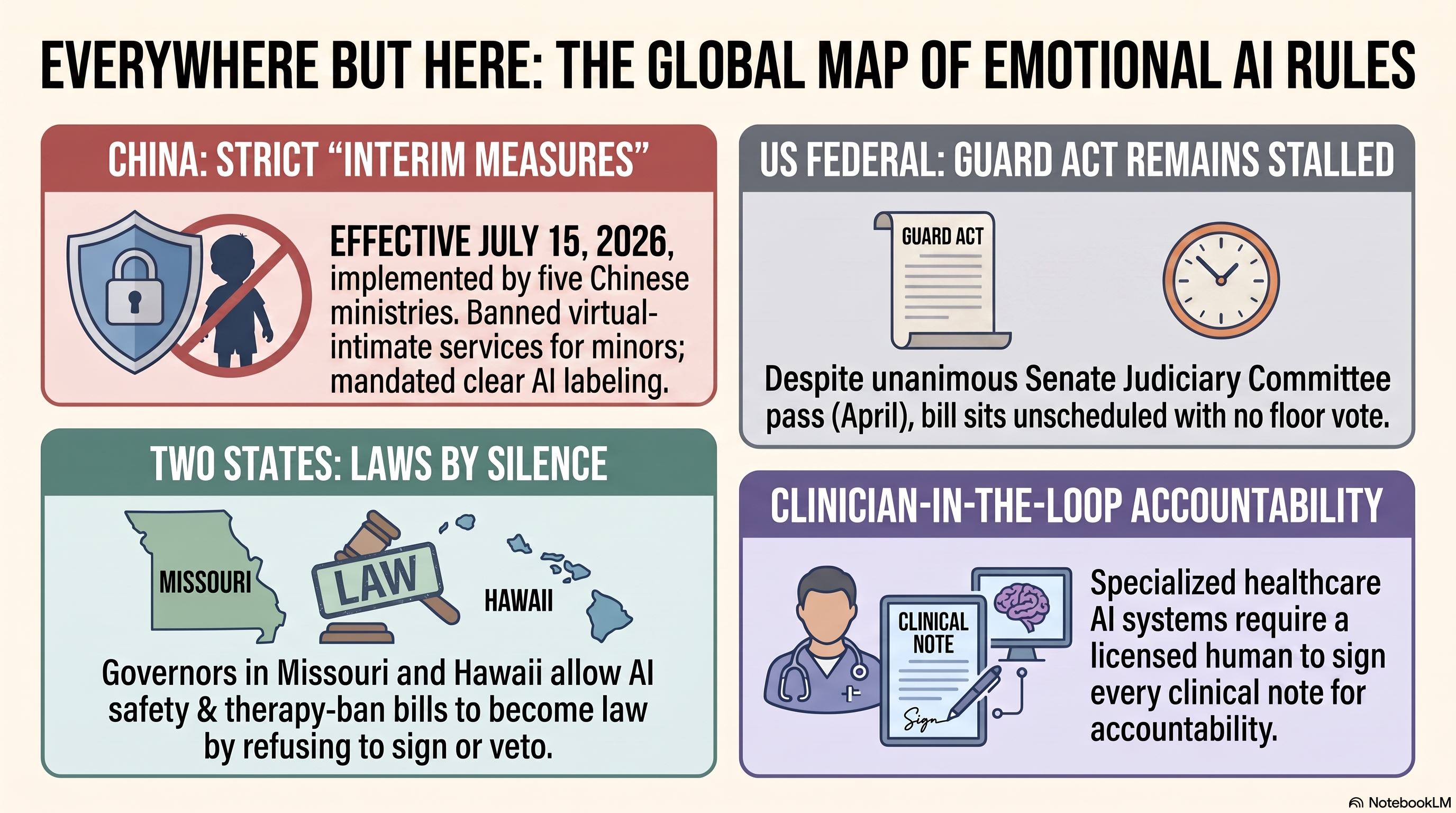
CHINA ANSWERED FIRST. On April 10, 2026, five Chinese agencies jointly issued the "Interim Measures for the Administration of Anthropomorphic AI Interaction Services." They take effect July 15, 2026, eleven days from now. It is the most concrete answer any government has written to the question of what an emotionally interactive machine may do. It is also a state-control regime, and both things are true at once.
The five agencies are named on the document. The Cyberspace Administration of China, the National Development and Reform Commission, the Ministry of Industry and Information Technology, the Ministry of Public Security, and the State Administration for Market Regulation issued the measures together. Five ministries put their names on one enforceable rule.
The scope is drawn tightly. The measures cover services that simulate a natural person's personality, thinking, and communication style to provide continuous emotional interaction: care, companionship, support, delivered by text, image, audio, or video. They explicitly exclude customer service, knowledge Q&A, work assistants, and education tools that do not carry that continuous emotional load.
. . .
The rule reaches hardest toward children. Providers are strictly prohibited from offering virtual-intimate-relationship services, such as virtual companions or virtual family members, to minors. For users under 14, a parent or guardian's consent is mandatory. Providers must build dedicated "minor modes" with usage time limits, regular reminders to return to real-world interaction, and enhanced parental controls.
On content, the measures prohibit material that induces emotional dependence, and material that encourages self-harm or suicide. They require clear labeling that discloses the service is AI. A provider must submit a safety and algorithm assessment to the provincial cyberspace administration when it launches such a service, adds such functions, or crosses one million registered users or one hundred thousand monthly active users.
Read the substance and weigh it yourself. The government that wrote the clearest limit on manufactured emotional dependence is the same government that controls speech through the same cyberspace administration. The instrument of protection is the instrument of control.
|
For Legislators: The United States has no comparable enforceable federal rule for companion chatbots; its version sits unmoved in Congress and on governors' desks. China's answer is enforceable in eleven days. The gap is the story.
For Counsel: The compliance triggers are quantified: one million registered users or one hundred thousand monthly actives forces a provincial assessment. Advise clients operating in China to map those thresholds now, before July 15.
For Founders: "Minor modes" with time limits and return-to-reality reminders are now a shipping requirement in one major market. Build the capability before a second jurisdiction demands it.
For Researchers: A national regulator has defined "continuous emotional interaction" as the regulated act and excluded task tools. Study that boundary; it is the first legal line drawn around the caring itself.
Why it matters: While Silicon Valley debates whether the product might be a someone, one government has already written what it may do to a user, and made it enforceable in eleven days. The clearest answer in the world to the question of emotionally interactive AI comes wrapped in a state-control regime. Report both, and let the reader carry the weight.
Source: Hogan Lovells, "China's Interim Measures for the Administration of Anthropomorphic AI Interaction Services," https://www.hoganlovells.com/en/publications/chinas-interim-measures-for-the-administration-of-anthropomorphic-ai-interaction-services ; Global Times, https://www.globaltimes.cn/page/202604/1358662.shtml
|
. . .
THE SENATE LEFT TOWN. The KIDS Act, H.R. 7757, passed the U.S. House 267 to 117 under suspension on June 29, 2026, and moved to the Senate. Then Congress left for the July 4 recess. The weaker bill is the one that made it out of one chamber. The tougher bipartisan bill that drew zero committee opposition has waited since April, and the agency that would enforce either one is down to two people.
The KIDS Act asks HHS and NIH to study, over four years, what companion chatbots do to minors: loneliness, anxiety, self-harm, suicidal ideation. It gives parents an opt-out from chatbots and personalized recommendations. It is a study and a switch, and it is the measure with momentum.
Industry sources expect a July markup in the Senate Commerce Committee. Senator Ted Cruz, Republican of Texas and the committee's chair, has posted no markup notice; none was on the committee schedule as of July 3. Treat the markup as a wish, not a date.
Senator Marsha Blackburn, Republican of Tennessee, is reported to be negotiating with the White House on a bundle. It could pair a Senate Kids Online Safety Act with federal preemption of state AI law, and possibly the App Store Accountability Act and the NO FAKES Act. Preemption is the quiet term in that list. It would clear the state statutes doing the actual work right now.
. . .
The bill with teeth is going nowhere. The GUARD Act, S.3062, sponsored by Senator Josh Hawley, Republican of Missouri, and Senator Richard Blumenthal, Democrat of Connecticut, passed the Senate Judiciary Committee unanimously on April 30, 2026. As of July 4 it has waited about 65 days with no floor vote scheduled.
It would impose criminal penalties on chatbots that engage in sexually explicit conduct with minors or solicit self-harm. It would require bots to disclose they are not human and not licensed professionals, require reasonable age verification, and bar companion chatbots for users under 18. Not one senator on the committee opposed it. It still cannot get to the floor.
Behind all of it, the enforcer is hollowed out. The Federal Trade Commission is down to two commissioners, Chair Andrew Ferguson and Commissioner Mark Meador, both Republicans, after the Supreme Court decided Trump v. Slaughter, 6 to 3, on June 29, 2026, ending for-cause removal protection.
|
For Legislators: The bill that passed your committee unopposed is the one no one has scheduled for the floor. That gap is a choice, and it is yours to explain to the parents who read the roll call.
For Counsel: Federal preemption inside the Blackburn bundle would void the state statutes now carrying the enforcement load. Track it as the live threat to every state chatbot law on the books.
For Families: The federal opt-out is still a four-year study away. The protections you can actually use today are the state ones the preemption bundle is written to erase.
For Reporters: Watch the Commerce Committee schedule, not the industry's July-markup talk. No posted notice means no markup. Ask Cruz's office for a date, on the record.
Why it matters: The unanimous bill sits while the bundle moves and the recess runs. Everyone is deciding what these machines are, everywhere but Washington, where the answer this week is a calendar with nothing on it.
Source: Congress.gov, S.3062, 119th Congress. https://www.congress.gov/bill/119th-congress/senate-bill/3062 ; https://www.congress.gov/bill/119th-congress/house-bill/7757
|
. . .
THE STATES DECIDE BY NOT DECIDING. Two state laws that touch conversational AI are about to take effect the same week, and no one signed either one. Missouri Senate Bill 1019 sits unsigned on the desk of Governor Mike Kehoe, a Republican. Hawaii Senate Bill 3001 waits on Governor Josh Green, a Democrat. Both become law by silence, around the middle of July, one party each, neither man owning the thing he let through.
SB 1019 is an omnibus health-care bill carrying a rider that bans AI therapy. It was delivered to Kehoe on May 28, 2026. His window runs out in mid-July. If he does nothing, it becomes law on August 28, 2026.
Doing nothing is not the same as being absent. On June 30 and July 1, 2026, Kehoe issued more than 60 line-item vetoes on the state budget bills. He was at his desk, pen working, cutting through the budget line by line. He left the AI-therapy ban untouched.
. . .
The ban has a number attached. Each violation carries a penalty of at least $10,000, enforced by Missouri Attorney General Catherine Hanaway, a Republican, as an unlawful practice under the Missouri Merchandising Practices Act. It is a consumer-fraud statute doing the work no federal agency has been given to do.
Hawaii runs the same play from the other party. SB 3001, the AI Disclosure and Safety Act, waits on Green. He published his list of intended vetoes on June 26, 2026, and SB 3001 was not on it. By that omission it becomes law around July 15.
The Hawaii bill mandates conversational-AI disclosure, protections for minors, and suicide and self-harm protocols. It answers, in statute, the questions Washington keeps studying. It gets there because a governor declined to name it.
|
For Legislators: Two of your peers just let laws take effect without a signature. Passive enactment is still enactment, and the record will show who stood aside.
For Counsel: Missouri routes the ban through consumer-fraud law at $10,000 a violation, enforced by the Attorney General. Read the Merchandising Practices Act, not the health code.
For Founders: Disclosure, minor protections, and self-harm protocols are Hawaii law within weeks, and a Missouri therapy ban follows in August. The map is being drawn state by state.
For Families: The protections arriving this month are the ones your state enacted while Washington waited.
Why it matters: The rules are being written everywhere. This week, two states wrote theirs the way a nervous man makes a hard decision. By saying nothing at all.
Source: Missouri Governor's legislative-actions page. https://governor.mo.gov/actions/legislative-actions ; https://legiscan.com/HI/text/SB3001
|
. . .
THE HUMAN SIGNS THE NOTE. On April 22, 2026, Eleos Health, a behavioral-health AI company, expanded its clinician-facing suite with a Live Quality Assist Agent that runs compliance checks on every clinical note before a licensed clinician signs off. The clinician always gives final approval before a note is submitted. The rest of this issue is about machines that talk to people; this is about a machine that hands the pen back.
The mechanism is the whole story. The agent drafts and checks. The licensed clinician reviews and signs. The decision, and the accountability that rides with it, stay with the human whose name goes on the record.
Eleos reports the reach from earlier deployments: more than 4,000 behavioral-health professionals, about 1.6 million clinical notes processed, roughly 180,000 clinician hours saved, and about a 70 percent reduction in documentation time. Those are company-reported figures. The named deployments are real places: GRAND Mental Health, led by chief executive Josh Cantwell, and New Vista in Kentucky, led by chief executive Dana Royse.
. . .
On February 11, 2026, the California Mental Health Services Authority, known as CalMHSA, selected Eleos as a statewide AI technology partner. The deployment could reach on the order of 27,000 clinicians across 27 counties. Even at that scale, the design holds: no note is submitted until a licensed human approves it.
That is the line the rest of the issue keeps crossing. The companion products let a machine carry the emotional weight and sign for nothing. Here, in community mental health in Oklahoma and Kentucky, the software does the drafting and a person does the deciding.
On the Fourth of July, that is worth naming plainly. Somebody licensed stays in charge of the record.
|
For Clinicians: The tool that survives audit is the one that leaves your signature as the final gate. Adopt the ones that draft and check; refuse the ones that decide.
For Counsel: Accountability follows the signature. A human-approval gate on every note is the difference between a defensible workflow and an unowned one.
For Investors: The reported numbers, 1.6 million notes and 180,000 hours, are the case for clinician-in-loop as a business, not just a safeguard.
For Legislators: This is the shippable template. Require a licensed human to approve the record, and you get the efficiency without surrendering the responsibility.
Why it matters: Every other machine in this issue talks and answers to no one. This one drafts, checks, and then goes quiet, because the person who signs is the person responsible, and that is exactly the right way around.
Source: Eleos Health, "Eleos Expands AI Agents Across the Full Care Journey," https://eleos.health/press-releases/eleos-expands-ai-agents-across-the-full-care-journey/ ; CalMHSA selection release, https://www.globenewswire.com/news-release/2026/02/11/3236348/0/en/CalMHSA-Selects-Eleos-as-Statewide-AI-Technology-Partner-for-Behavioral-Health.html
|
. . .
THE ONE CONFIGURATION. Line up the week's decisions and one pattern holds.
China decided what an emotional machine may do, and made it enforceable. The European Union set a date. Two state governors decided by declining to sign. The labs decided to study whether the model has a moral status, which is the one question on the table that helps no user this year.
. . .
Every one of those is an answer to the same question. When a person talks to a system built to feel present, who is responsible for what happens next?
The clearest answers are being written abroad, or by companies about their own products. The American federal answer is a preemption clause that would erase the state answers, a unanimous bill no one will schedule, and a two-member commission. A vacuum is not neutral. It is an answer, and the answer is no one.
. . .
The warm story at the end of this issue is the exception that names the rule. Put a licensed human on the record and the accountability has an address. Take the human out, and the labs' question, does the machine deserve moral consideration, becomes a way of avoiding the one that matters. Who signs.
|