|
. . .
SAM ALTMAN'S NEW LIFE, CHAPTER TWO. A year ago, summits. Two weeks ago, subpoenas. This week, summer camp. The saga of Sam Altman's new life has a new chapter, and it is set in Idaho, at the one gathering all season that did not ask him to answer for anything.
Last time we read his calendar, it had turned into a docket. Florida had named him. Forty-two states had subpoenaed his company. Washington had reached into his most powerful model and shipped it off a government approval list. The trillion-dollar coronation had slipped behind a rival's.
Read where he is now.
. . .
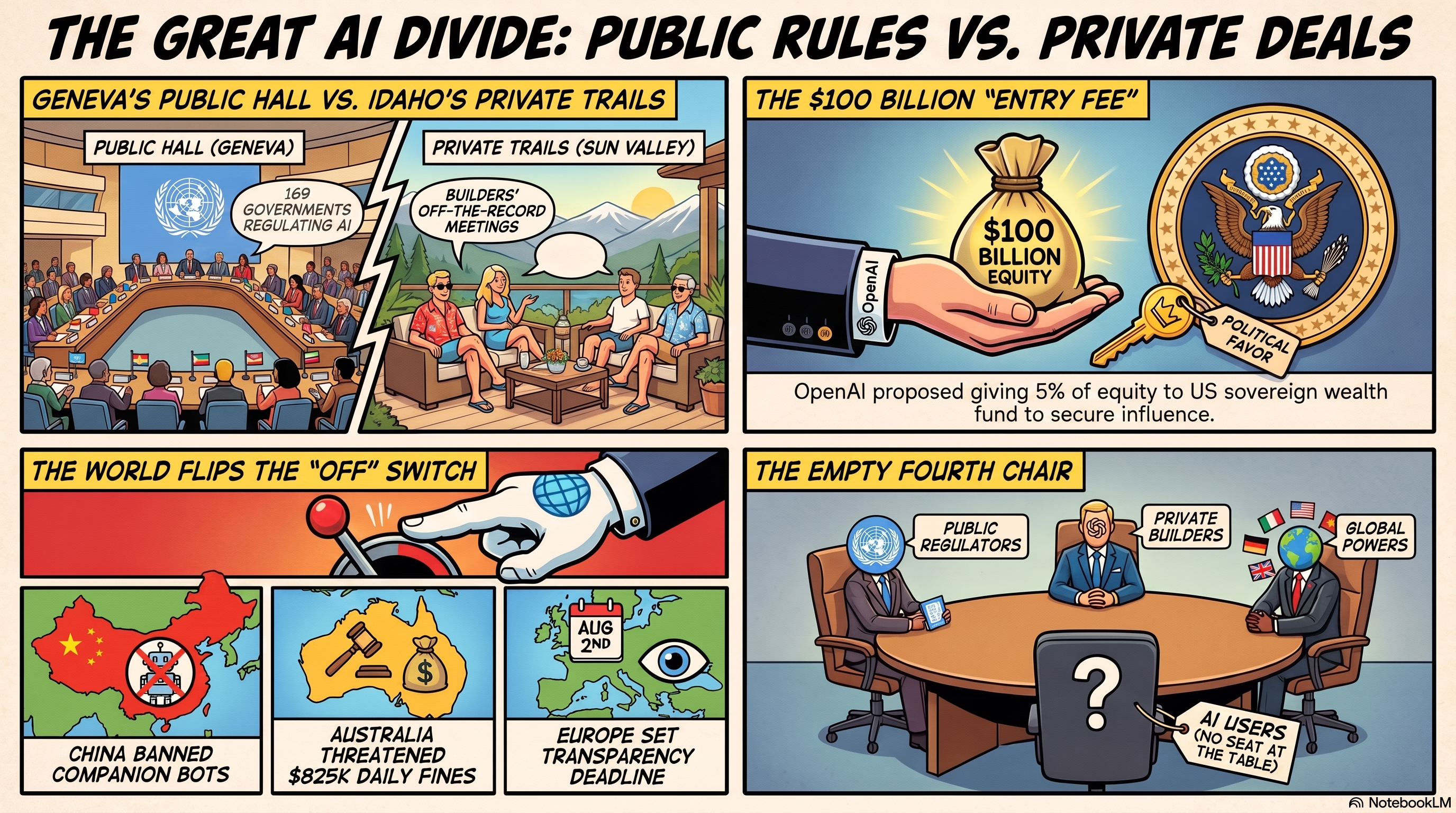
Geneva, without him. On Monday the United Nations opened its first Global Dialogue on AI Governance. A hundred and sixty-nine countries. A mandate from the General Assembly. The Secretary-General warned the delegates not to let AI "vibe-code humanity's future." The scientists who briefed them had said, the week before, that the safeguards cannot keep pace and that no one can promise these machines will follow the instructions they are given.
It was the most serious room ever convened about the thing Sam Altman sells. He was not in it.
. . .
Idaho, instead. He was in Sun Valley, at the Allen and Company retreat the press calls the billionaires' summer camp. Bezos was there. Zuckerberg was there. Dario Amodei, his safety-first rival, was there. The deals happen on hikes and over breakfast, and no one publishes an agenda.
The handful of men who could switch these products off tomorrow spent the week the world met to govern them at a private resort, off the record.
. . .
His own rulebook. He did not go quiet. Four days before Geneva, in the Financial Times, Altman called for a body to set global AI standards. Not the UN's. A United States-led one, modeled on the way the world polices nuclear plants and passenger jets, that would hand the technology to countries that follow the rules and hold it back from those that do not.
"Everyone on Earth should benefit from this technology and determine for themselves how best to use it," he wrote. In his design, the body that decides who has followed the rules answers to Washington.
. . .
The price of the head seat. And to sit at the head of Washington's table, OpenAI floated giving Washington a piece of itself. Five percent of the company's equity into a United States sovereign wealth fund, with the other labs invited to match. The stated purpose, per the reporting, was to secure good relations with the administration and address political blowback.
The President confirmed the talks in his own words. The idea, he said, is one where "the American public essentially becomes a partner with the companies."
Last month the rules were being written about Altman. This month he is trying to write them himself. From a resort. Through a President. With five percent of his company as the entry fee.
. . .
Four chairs. We keep coming back to one image. Four chairs at the table. Users, clinicians, engineers, legislators. Users first.
Governance for the machine got decided this week in two rooms. One was a UN hall in Geneva that the builders skipped. The other was a resort in Idaho, and a back-channel to a President, where the public had no seat at all.
The users were in neither room. They are only the reason the product exists.
. . .
He is still wondering where his beautiful life went. It did not vanish. He is spending it. Just not anywhere the people his product touches can watch him do it.
Move fast and break things, and eventually it breaks the life too, Sam. The bill is still coming due. This week it came due at summer camp.
|
For Founders: The governance fight is not at the UN. It is on a hiking trail in Idaho and in a room at the White House. Know which table you are not sitting at.
For Policymakers: A US-led standards body modeled on the IAEA is a proposal to make American approval the global on-switch. Read the Financial Times op-ed before the press-release version reaches your inbox.
For Families: The people deciding how these products treat you met this week at a resort with no public agenda. You were not invited. Neither was your clinician.
For Legislators: The governance fight moved to a resort and a White House back-channel. The real question is how to make the public table matter more than the private one.
Source: TechCrunch, OpenAI proposed donating 5% of its equity to a US sovereign wealth fund, https://techcrunch.com/2026/07/02/openai-proposed-donating-5-of-its-equity-to-a-us-sovereign-wealth-fund/
Why it matters: The most consequential decisions about conversational AI are moving out of public view. The week the United Nations convened the world's first governance dialogue, the industry's most powerful figure was at a private retreat, promoting a rulebook that seats Washington at the head of the table and offering Washington equity to keep it there. The venue is the story. Governance by summit and subpoena is at least visible. Governance by hiking trail and sovereign-wealth-fund is not.
|
. . .
CHINA SWITCHES OFF THE COMPANIONS. China told its two biggest consumer AI apps to switch off the feature that keeps people company, and both did it days before the law required them to.
The rule is the Interim Measures for the Administration of AI Anthropomorphic Interactive Services. Five agencies co-issued it on April 10: the Cyberspace Administration of China, the economic planners, the industry ministry, the police, and the market regulator. It takes effect July 15.
It draws a careful line. The agent that does your work is fine. The agent that keeps you company is not. The rule reaches only services that simulate a real person's personality, thinking, and manner to provide continuous emotional interaction. Customer-service bots, Q&A tools, and tutors are left alone.
. . .
ByteDance moved first. Its Doubao app told users the agent function goes offline July 15, citing "product function adjustments." Existing conversations are read-only until October 15, and after that they are gone. Users who want to keep building companions are pushed to a separate app, Maoxiang.
Alibaba's Qwen went further and faster. Its humanlike and user-created agents stopped July 10, the rest of its agent services follow July 15, and there is no grace window. The agent data is set for permanent deletion.
. . .
Beijing's own explanation of the rule points abroad for cover. It cites the Character.AI lawsuits over harm to teenagers, the Federal Trade Commission's inquiries into companionship products, and Europe's action against Replika.
|
For Policymakers: This is the first national government to force emotional-companion AI off at the source, not disclose it, not age-gate it, off. Watch whether the deletion of user data survives its own privacy review.
For Founders: Two of the largest consumer AI companies on earth killed a flagship feature ahead of a deadline rather than test it. Preemptive compliance is now a competitive signal.
For Families: If a companion app can be switched off by a government, the memories your child built inside it can be deleted too. In China, on Doubao, the countdown to unrecoverable is October 15.
For Clinicians: A tool a user leaned on for support can vanish on a government deadline. Ask what happens to the person when the thing they confided in is deleted.
Source: AI News, what Beijing is really going after in its companion-chatbot rules, https://www.artificialintelligence-news.com/news/china-ai-companion-rules/
Why it matters: The United States is litigating companion harm one wrongful-death suit at a time. China deleted the category by administrative order, and the users' data with it. Two governments, two speeds, and only one of them has actually turned anything off.
|
. . .
AUSTRALIA STARTS COLLECTING. Australia's online-safety regulator has moved from warning the companion-chatbot makers to putting a daily price on ignoring it.
The eSafety Commissioner registered a set of industry codes to keep children away from age-inappropriate material, and the Age-Restricted Material Codes have been in force since March 9. That gave the office something to enforce.
Last October it issued legal notices to four companion providers, Character Technologies, Glimpse.AI (the maker of Nomi), Chai Research, and Chub AI, demanding they show how they protect minors from sexual content and suicidal-ideation prompts.
. . .
The numbers behind the notice are the point. A provider that fails to comply with a reporting notice can be fined up to 825,000 dollars a day. Breach of a formal direction to comply runs up to 49.5 million.
Two of the four have already voted with their feet. Chub AI geo-blocked Australia rather than answer. Character.AI stripped the chat function out of its under-18 experience.
|
For Policymakers: This is enforcement with a meter running, not a bill waiting in committee. The mechanism is an existing online-safety law, not a new AI statute.
For Founders: Two named companies decided that leaving a market was cheaper than proving child safety in it. That calculation is now on the table in every jurisdiction with a code and a fine schedule.
For Legislators: Australia enforced this through an existing online-safety code, not a new AI statute. The tool you already have may reach further than the bill you are drafting.
For Families: Two of the four companies named would rather leave Australia than show how they protect kids. Read that as a signal about what the audit would have found.
Source: eSafety Commissioner, requiring companion-chatbot providers to explain how they keep Australian kids safe, https://www.esafety.gov.au/newsroom/media-releases/esafety-requires-providers-of-ai-companion-chatbots-to-explain-how-they-are-keeping-aussie-kids-safe
Why it matters: Regulators keep being told they cannot move fast enough to matter. Australia attached a per-day figure to the question and two companion companies changed their behavior before answering it.
|
. . .
EUROPE'S CLOCK READS AUGUST 2. In under a month, every chatbot operating in the European Union has to tell the person on the other end that it is a machine.
The EU AI Act's transparency obligations come into force August 2. Under Article 50, a system that interacts with people has to disclose that it is AI, unless it is obvious. The date is set by the Act's own phase-in schedule under Article 113.
The penalties are not symbolic. Violations tied to prohibited practices reach 35 million euros or 7 percent of global annual turnover, whichever is larger. Non-compliance with other obligations runs to 15 million or 3 percent.
. . .
The disclosure duty is narrow. It does not ban companion bots, it does not set a crisis protocol, it does not carry a clinician requirement. It requires one thing: honesty about what you are talking to.
That is still one thing more than the United States requires of a chatbot at the federal level.
|
For Policymakers: August 2 is a hard date, not a proposal. If you advise anyone deploying a chatbot into the EU, the disclosure clock is already running.
For Legislators: Europe scheduled the disclosure floor the US is still debating. The transatlantic gap on conversational AI is now measured on a calendar.
For Founders: If your chatbot touches an EU user, August 2 is a build deadline. The disclosure has to render, not just live in a policy document.
For Families: From August 2, a chatbot in Europe has to tell your kid it is a machine. In the US, that is still up to the company.
Source: European Commission, AI Act regulatory framework, https://digital-strategy.ec.europa.eu/en/policies/regulatory-framework-ai
Why it matters: The simplest safeguard anyone has proposed for a chatbot is that it admit it is one. In four weeks that becomes law across twenty-seven countries, enforced with fines in the tens of millions. Washington has no equivalent, and no date.
|
. . .
THE RESEARCHERS WON'T SIGN THE BAN. As governments reach for the off-switch, the scientists who actually study teenagers and chatbots are asking them not to pull it.
The demand side does not disappear when the supply side is outlawed. That is the argument Ryan McBain made in STAT this month, in a piece whose title says it plainly: teens need guardrails, not bans. McBain is a senior policy researcher at RAND and an assistant professor at Harvard Medical School, and his team has been counting how many young people bring their mental-health questions to a chatbot.
The count is rising fast. In their study published in JAMA Pediatrics, the share of US adolescents and young adults using AI for mental-health advice went from about one in eight to about one in five in a single year, a more than forty percent jump. Girls and young women were twice as likely to report it.
. . .
His prescription is not prohibition. It is rules: honest disclosure, crisis protocols, and evidence standards that a tool has to meet before it sits with a teenager. Ban the tools outright, he warns, and you push a frightened kid toward the version with no guardrails at all.
It is the mirror image of the week's other headlines. China switched the companions off. These researchers are arguing that off is not the same as safe.
|
For Clinicians: The people bringing AI into the room are disproportionately young and female. The research says meet that, do not pretend a ban will end it.
For Families: The instinct to forbid the chatbot is understandable. The data says the teenager who is banned still asks, only somewhere with weaker protections.
For Legislators: A blanket ban and a well-built guardrail are not the same policy. The people measuring the harm are asking you to tell them apart.
For Founders: The research does not say build nothing. It says meet an evidence bar before you sit a product across from a teenager.
Source: Ryan McBain, Teens need guardrails, not bans, for mental health chatbots, STAT, https://www.statnews.com/2026/07/02/teens-chatbots-mental-health-rules-bans/
Why it matters: This is the argument the ban-first jurisdictions have to answer. The demand is real, it is growing, and it is concentrated among the young. The researchers closest to it say the choice is not chatbot or no chatbot. It is guardrails or the wild.
|
. . .
THE HUMAN AT THE FRONT DOOR. Britain's health service is about to let an AI triage the people who use it, and then hand every decision that matters to a person.
NHS England announced on July 6, inside a 10 billion pound digital commitment, that an AI triage tool is coming to the NHS App. It asks the person about symptoms, adapts its questions to the answers, and then passes what it gathered to a clinician who decides what happens next.
The machine sorts. The human prioritizes. The tool signposts a person toward a GP, a pharmacy, or self-care, but the collected information goes to a clinical team, not straight to a prescription.
. . .
A trial at a GP practice in Sussex cut the number of people waiting on the phone by 29 percent. The rollout is meant to reach all NHS App users by April 2028, with the system continuously monitored and ambiguous or high-risk cases escalated to a person.
It is not a therapy bot, and it does not pretend to be one. It is the opposite design: AI at the front door, a clinician at every door that counts.
|
For Clinicians: This is the loop the rest of this issue is fighting about, built into public infrastructure. The AI intakes, the licensed human decides.
For Builders: The NHS model keeps the machine on the sorting side of the line and the person on the deciding side. That boundary is a product decision, and it is being made in public.
For Policymakers: The NHS drew the line where the machine sorts and the human decides. That boundary is something you can require, not just hope for.
For Families: The AI at the NHS front door does not diagnose you. It routes you to a person who does. Ask for that design wherever AI meets care.
Source: HTN Health Tech News, 10bn in funding announced and NHS App AI triage tool to roll out, https://htn.co.uk/2026/07/06/10bn-in-funding-announced-and-nhs-app-ai-triage-tool-to-roll-out/
Why it matters: Every other story this week is about a machine built to stand in for a person. This one is about a machine built to reach a person faster. The same technology, pointed at the front door instead of the therapist's chair, and the human never leaves the room.
|
|