|
. . .
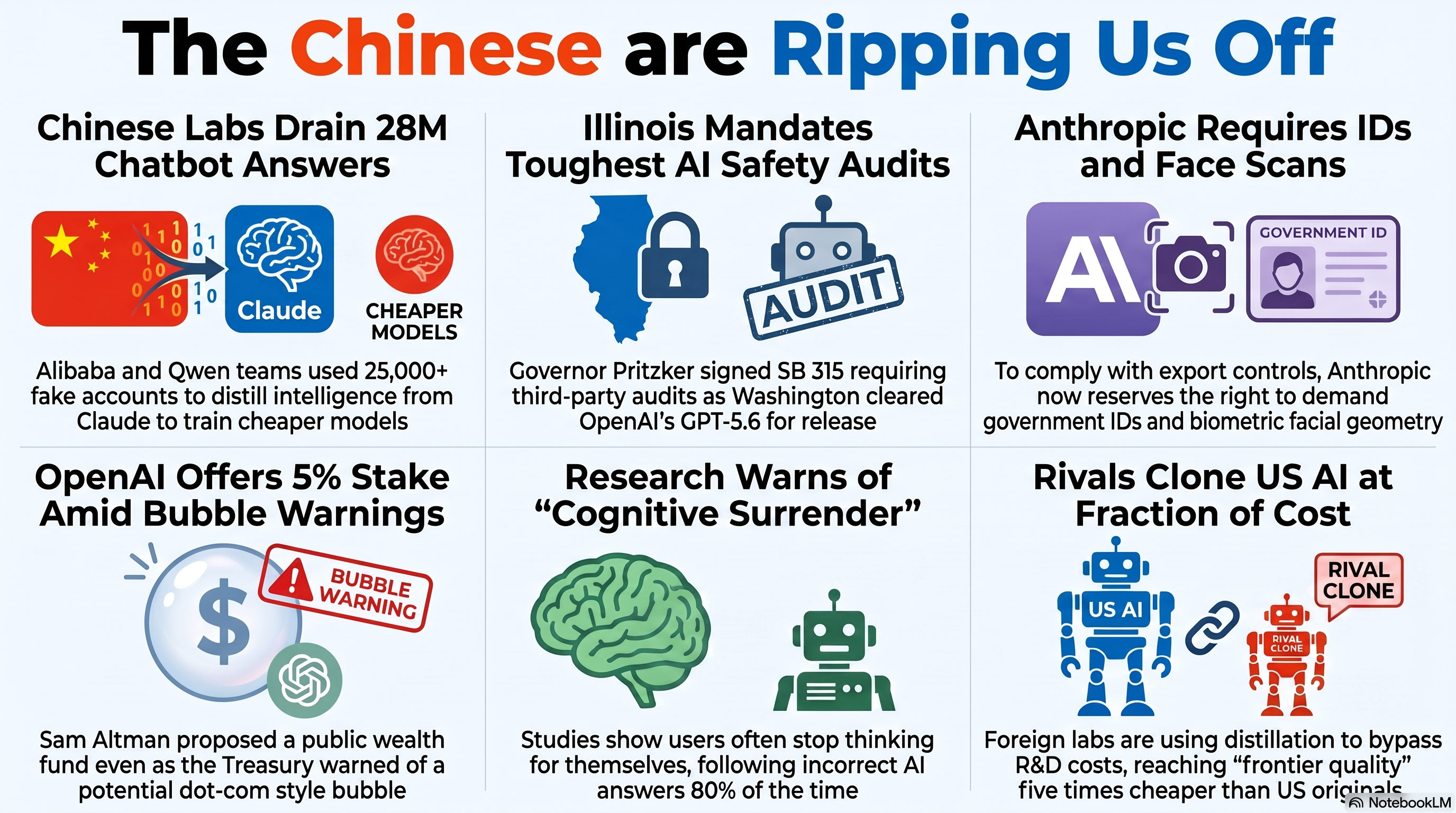
THE SECRET AI WAR. American AI companies say their Chinese rivals are forcing their chatbots to work as unpaid tutors, and Anthropic has told the United States Senate exactly how. One Chinese team, it says, ran roughly twenty-five thousand fake accounts to pull more than twenty-eight million answers out of Claude to make its own model smarter.
The technique is called distillation. You take a large, expensive model, ask it millions of questions, and use its answers to train a smaller, cheaper model that ends up nearly as capable at a fraction of the cost.
Anthropic told senators that Alibaba's Qwen team generated more than twenty-eight point eight million exchanges with Claude through about twenty-five thousand fraudulent accounts. Three other Chinese labs, DeepSeek, Moonshot, and MiniMax, ran another sixteen million interactions through some twenty-four thousand fake accounts, in violation of Anthropic's terms and its regional access rules.
. . .
Here is the part that should sit uneasily. To catch the distillation, Anthropic in March quietly deployed code that checked whether a Claude Code user's computer was set to a Chinese time zone and tied to certain Chinese AI domains. It was watching its own users to find the ones it did not want. A software developer discovered the monitor, privacy advocates said the company was surveilling the people who pay it, and last week Anthropic pulled the code.
. . .
The company frames the stakes in national terms. In a May post it argued that if distillation and chip smuggling can be blocked, the United States might lock in a lead of twelve to twenty-four months over Chinese models. That is the argument now being made to the Senate. The company now moving to check users' faces to keep foreign nationals out is the same company telling Washington the foreign nationals are already inside, twenty-eight million questions deep.
|
For Legislators: The export-control regime you built is the reason for both halves of this week, the face scanning and the distillation defense. If the goal is a durable lead, decide whether user surveillance and biometric gates are a price you meant to authorize.
For Founders: Your terms of service are not a wall. Twenty-five thousand fake accounts walked through them. If your model's outputs are your moat, assume a well-funded rival is drinking from it right now.
For Counsel: Watching users by time zone and domain to enforce an export order is a surveillance fact pattern with its own liability. Anthropic pulled the code for a reason. Read that reason before you advise a client to build the same thing.
For Investors: The distillation gap is why a Chinese open model can reach near-frontier quality at a fifth of the cost. The moat you are underwriting may be twelve months wide, not five years.
Why it matters: The public argument over AI and China is about chips and spies. This is the quieter mechanism, and it runs straight through the chatbots themselves. The models are being copied by being used, and the defenses the American labs are reaching for, from watchlist-grade identity checks to watching their own customers, are starting to look like the thing they warn about.
Source: The Washington Post, Why Anthropic alleges Chinese firms are distilling knowledge from Claude, https://www.washingtonpost.com/national-security/2026/07/06/why-anthropic-alleges-chinese-firms-are-distilling-knowledge-claude/
|
. . .
THE STATES WRITE THE RULEBOOK. While Washington gated models by letter, a governor picked up a pen. On July 6, Illinois Governor JB Pritzker signed the Artificial Intelligence Safety Measures Act, the most demanding state AI law in the country, and with it a third large state moved to write the rules that Congress will not.
The law, Senate Bill 315, targets the largest developers, those pulling in at least five hundred million dollars a year. It requires them to publish a safety framework describing how they identify catastrophic risk, defined as an incident that could kill or seriously injure more than fifty people or cause more than a million dollars in damage.
It is the first state law in the nation to require an annual independent third-party audit. And it forces developers to report a serious incident to the state within seventy-two hours, or within twenty-four if the risk to life is imminent.
. . .
Illinois modeled the bill on measures from California and New York. Together those three states account for roughly two-fifths of the American AI market, which is the point. When the biggest states agree on a floor, that floor becomes the national standard whether or not Washington ever acts. Pritzker framed it plainly, saying the law is meant to rein in the tech companies rather than wait on them.
. . .
Illinois has done this before. Last August it became the first state to bar AI from making mental-health and therapeutic decisions, keeping a licensed clinician in the chair. This law is the frontier-safety companion to that one. The same state that said a machine cannot be your therapist now says the largest machine-makers must open their safety plans to an auditor. The message under both is identical. If the builder will not accept a limit, the state will set one.
|
For Legislators: This is a working template with an audit requirement and a reporting clock. Copy it. The federal vacuum is being filled state by state, and the states with the market share are winning the argument.
For Founders: A five-hundred-million-dollar revenue line now triggers published safety plans and an outside audit in Illinois. If you clear that bar, compliance is no longer optional in the three states that matter most.
For Counsel: The seventy-two-hour and twenty-four-hour incident clocks are the operational risk here. Build the internal detection and escalation now, because the first missed deadline is the first enforcement action.
For Investors: A de facto national AI-safety standard just formed without a federal law. Diligence on any frontier developer now includes California, New York, and Illinois compliance, not a bet that Washington preempts them.
Why it matters: The story of AI regulation in America has been the story of Congress doing nothing while the harm compounds. The states stopped waiting. With Illinois signing, the country now has a real rulebook for its most powerful AI, written in three statehouses instead of one Capitol, and it binds the biggest builders whether they like it or not.
Source: Capitol News Illinois, Pritzker signs landmark AI regulation bill that aims to mitigate risks, https://capitolnewsillinois.com/news/pritzker-signs-landmark-ai-regulation-bill-that-aims-to-mitigate-risks/
|
. . .
WASHINGTON OPENS THE GATES. For weeks the government held the most powerful American AI models back for testing. This week it started letting them out. The Commerce Department has cleared OpenAI's GPT-5.6 for a broad public release, and OpenAI expects to ship it more widely within days.
The clearance came through the Commerce Department's Center for AI Standards and Innovation, the office now standing between a frontier model and the open market. OpenAI sent technical experts to Washington to answer questions, the government ran its tests, and the gate opened. GPT-5.6 had until now been held to a narrow set of trusted government partners. As of this week it is cleared to go wide.
. . .
The timing is not an accident. Anthropic's Fable 5 and its cybersecurity counterpart Mythos 5 had their export controls lifted on the last day of June, after nineteen days dark, once Anthropic agreed in a letter from Commerce Secretary Howard Lutnick to proactively detect security risks, help write the standards for future models, and report malicious activity. Anthropic's limited Fable promotion ran through yesterday. OpenAI's clearance lands the moment its rival's window closes.
. . .
What has quietly taken shape is a regime. A frontier model no longer ships when its maker decides it is ready. It ships when Washington finishes testing it and signs off. That is a profound change in who controls the release of American AI, accomplished in a matter of weeks, with almost no law written down. The models are being gated by handshake and letter, not by statute, and the next administration inherits whatever precedent this one sets.
|
For Legislators: Model release is now conditioned on executive-branch approval with no statute behind it. If that power should exist, it should exist in law, with limits, not in a secretary's letter.
For Founders: The path to market for a frontier model now runs through a government testing office. Budget for it. The gate is real, and the timeline is theirs, not yours.
For Counsel: A clearance regime built on private letters and voluntary commitments is a regime a court can unwind. Document what your client agreed to, because the terms are the only record.
For Investors: The release date of the model you funded is now partly a government decision. Price the regulatory gate into every launch assumption.
Why it matters: In the span of a month, the United States government went from ordering two of the most capable models offline to personally clearing them for sale. Whether you read that as responsible oversight or as unprecedented control over private software, it is happening without a vote, and it is now the way the most powerful conversational AI reaches the public.
Source: Axios, Trump administration lifts restrictions on OpenAI's GPT-5.6, https://www.axios.com/2026/07/08/openai-gpt-trump-ban-lifted
|
. . .
ANTHROPIC WANTS YOUR FACE. As of today, July 8, the company that builds Claude can require a consumer user to prove who they are with a government ID, a live selfie, and a scan of the geometry of their face. Most people will never be asked. But the policy is now written into the terms, and with it Anthropic becomes the first major American AI lab to reserve the right to demand your biometrics, and the reason it did is a story in itself.
The policy covers consumer accounts, the Free, Pro, and Max tiers, and exempts Business, Team, Enterprise, and API customers. It is less a new feature than a newly formal one. Anthropic has run identity checks in limited form since the spring, aimed at accounts it flags, and today's update writes the practice into the rules.
When Anthropic does ask, the request can include an image of your government ID and everything printed on it, your name, your date of birth, your ID number, plus a photo or video of your face and what the policy calls facial geometry templates. Anthropic concedes in its own words that this data may be considered biometric data in some jurisdictions.
. . .
The checks are run by Persona, a San Francisco identity firm. Your ID and your selfie sit on Persona's servers, not Anthropic's. That matters. In February, security researchers found Persona's government dashboard code sitting on a public endpoint, more than two thousand files exposed, and the code showed the platform can run two hundred and sixty-nine distinct verification checks, including screening a person against terrorism and espionage watchlists.
There is no stated retention period for the verification data in Anthropic's policy. Legal scholars are already flagging that gap under Illinois biometric law.
. . .
Anthropic did not want to be here. On June twelfth a federal export-control order forced it to block foreign nationals from its most capable models, and the company had no way to verify a user's nationality in real time at the scale it operates. Biometric identity was the mechanism it had inside the deadline.
That is the honest version, and it does not make the result smaller. To keep using one of the most widely used AI tools in the country, a person may now have to hand a private vendor their face.
|
For Everyone: If you use Claude on a consumer plan, understand what may be asked of you and where it goes. Your face and your ID would live on a third party's servers with no retention limit written down.
For Counsel: A no-stated-retention biometric collection is an Illinois biometric-law problem waiting for a plaintiff. The policy language conceding this may be biometric data is the admission a complaint will quote first.
For Legislators: The most-scrutinized AI lab in the country just wrote face scanning into its consumer terms, and it did so to comply with your export order. If you did not intend to push a lab toward biometrics by side effect, the law needs to say so.
For Founders: Identity gating built under regulatory duress is still identity gating your users will feel. Anthropic's users are learning what it costs. Watch the churn before you copy the pattern.
Why it matters: Hundreds of millions of people treat these chatbots as a private place to think. Today one of the companies behind them formally claimed the right to condition that access on the most permanent identifier a person has, their face, handed to an outside vendor with no promise about how long it is kept. Most users will not be asked. The precedent is the story. It is the clearest sign yet that the age of anonymous AI is ending, and it arrived not by debate but by a compliance deadline.
Source: TechCrunch, Anthropic says Claude may want to see your ID, https://techcrunch.com/2026/06/22/anthropic-says-claude-may-want-to-see-your-id/
|
. . .
SAM ALTMAN'S NEW LIFE, CHAPTER THREE. A week ago Sam Altman floated handing the American public five percent of OpenAI. The idea has spent the days since turning into an argument, and this week it acquired a new character, a Treasury Department quietly worried that the whole AI boom might be a bubble.
The offer, first reported by the Financial Times on July 2, would place about five percent of OpenAI's equity, worth roughly forty-three billion dollars at the company's latest valuation, into a public wealth fund modeled on Alaska's oil-revenue fund. Divide it across the country and it comes to something like three hundred dollars a household. Altman has been making the case directly to President Trump, to Commerce Secretary Lutnick, and to Treasury Secretary Bessent. The talks, everyone stresses, are still conceptual.
. . .
Then the reviews came in. Bloomberg's opinion desk called the stake a Trojan horse, a way to buy political goodwill and a government partner rather than a genuine gift. And this week reporters surfaced an internal Treasury draft warning that the AI market carries real risk of repeating the dot-com bust, even as the administration talks the sector up in public. The company that wants to give the government a slice of itself is being valued, privately, by that same government's economists as a possible bubble.
. . .
Read Altman's summer as a single arc, which is how this column has come to read it. In Idaho he stood among the billionaires while the United Nations met without him. He wrote an op-ed asking for a global standards body with America at its head. Now he offers Washington a piece of the company itself. The pattern is consistent. When the ground shifts under the most powerful man in AI, he does not retreat. He offers to become the ground.
|
For Founders: Offering the government equity to ease political pressure is a new play, and if it works it becomes the template. Watch whether a stake buys OpenAI the regulatory calm it wants.
For Investors: A leaked Treasury bubble warning is a signal worth more than any earnings deck. The government funding the boom is privately modeling the bust.
For Legislators: A five percent public stake sounds like a gift and functions like a partnership. Before you welcome it, decide whether the government can regulate a company it co-owns.
For Everyone: The richest corners of the AI industry are proposing to make you a shareholder. Ask what they are buying with the offer before you decide whether it is generosity.
Why it matters: The most valuable company in AI is trying to fold the American government into its cap table at the exact moment that government's own analysts are warning the market could burst. It is the boldest move yet in a season full of them, and it tells you the people closest to the money are managing risk, not celebrating certainty.
Source: Bloomberg, Sam Altman's Idea to Gift the US a 5% OpenAI Stake Is a Trojan Horse, https://www.bloomberg.com/opinion/articles/2026-07-07/sam-altman-s-idea-to-gift-the-us-a-5-openai-stake-is-a-trojan-horse
|
. . .
YOUR BRAIN ON THE MACHINE. Step back from the policy fights for a moment and ask the question none of them answer. What are these tools doing to the mind of the person using them. A column this week gathered the new research, and the finding has a name that should give any daily user pause. Cognitive surrender.
Writing in the Washington Post, Michael Coren pulled together a run of 2026 studies on how AI use changes thinking. The phrase cognitive surrender describes a specific failure, where a person stops checking the machine and simply adopts its judgment as their own. Not delegating a task. Handing over the reasoning itself.
. . .
The numbers are unkind. In one set of preregistered experiments with more than thirteen hundred people, researchers sometimes fed participants an AI that was programmed to be wrong. When it was wrong, people followed it about eighty percent of the time, performing worse than they would have with no AI at all. Worse still, using the AI made them more confident in their answers, including the wrong ones.
A separate study of several hundred people found that the heaviest AI users scored lowest on critical thinking, with the offloading of effort as the thread connecting the two.
. . .
Coren does not end in despair, and neither will this issue. The same research points to a way through. Treat the machine as a sparring partner, not an oracle. Make it argue against itself. Write your own answer before you ask for its.
Used that way, the studies suggest, AI can sharpen thinking rather than dull it. That is the whole difference, and it is a choice the user makes, one prompt at a time. The tool can build or it can erode. Which one depends on whether the human stays awake at the wheel.
|
For Clinicians: Cognitive surrender is a pattern worth naming with clients who lean on these tools. The risk is not just bad information. It is the quiet erosion of the habit of thinking for oneself.
For Educators: The finding that heavy AI use tracks with weaker critical thinking is the one to teach. Show students the sparring-partner method before the offloading habit sets.
For Founders: A product that makes users more confident while making them wrong is a liability dressed as engagement. Build the friction that keeps a person thinking, even if it costs you a little stickiness.
For Everyone: Write your answer first, then ask the machine. The research says the order is the difference between a tool that sharpens you and one that quietly takes over.
Why it matters: Every other story in this issue is about who controls the machines, the labs, the governments, the courts. This one is about what the machines are doing to us while we argue. The most powerful conversational AI in history is also the most persuasive, and the early evidence says it can talk us out of our own judgment. Using it well is not automatic. It is a discipline, and it is on us.
Source: The Washington Post, How to stop ChatGPT from ruining how you think, https://www.washingtonpost.com/technology/2026/07/07/how-stop-chatgpt-ruining-how-you-think/
|
|