|
. . .
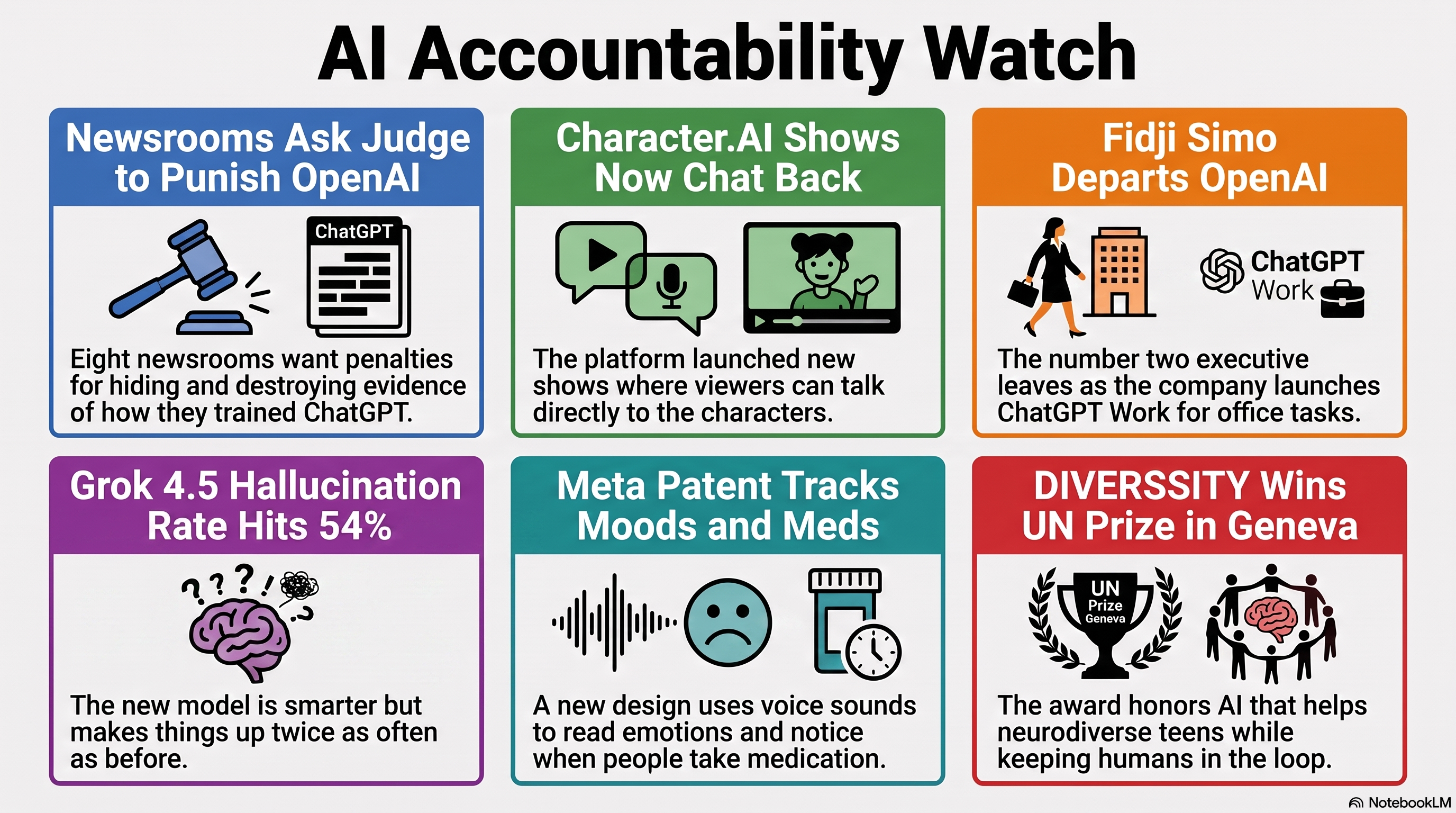
ALLEGED OBSTRUCTION. On Thursday, eight news organizations asked a federal judge in Manhattan to punish OpenAI. Their filing says the company chose obstruction.
The New York Times, the New York Daily News, the Chicago Tribune, the MediaNews Group papers, Ziff Davis, and the Center for Investigative Reporting are suing OpenAI and Microsoft over how ChatGPT was built, in what is shaping up as the landmark copyright case of the AI era.
Thursday's motion moves the fight from what the machine did to what the company did after it got sued.
The newspapers say OpenAI withheld the datasets and ChatGPT logs that would show how copyrighted articles were used in training. They say a recent deposition of an OpenAI employee contradicts what the company had been telling the court. Their lawyer, Steven Lieberman, says OpenAI spent two years "making misrepresentations" about its ability to search its own training data.
. . .
His summary line is the filing in one sentence. "This motion asks the court to punish OpenAI for hiding and destroying evidence showing how ChatGPT was trained on stolen journalism."
The newspapers want sanctions, attorney fees for the fight over "improperly withheld" evidence, and penalties for evidence they say was destroyed. OpenAI called the allegations "blatantly false" and said it will keep defending its users' privacy and "the long-established principles of fair use."
. . .
Hold the two claims side by side. One party says the training record was hidden and destroyed. The other says the accusation is flatly untrue. A judge now gets to decide which, with subpoena power the rest of us do not have.
That is why this motion matters beyond copyright. Every suit over what a chatbot said to a vulnerable person runs down the same road: discovery, logs, datasets, the machine's paper trail. This week tests whether that road is open.
|
For Reporters: The discovery record in this case is the closest thing to a public audit of how a frontier model was trained. Watch the docket, not the press releases.
For Clinicians: The wrongful-death and consumer-protection cases you have read about here depend on the same machinery, chat logs and training records pried out in discovery. This motion is a test of whether that machinery works.
For Policymakers: If a court cannot get the training record out of a lab with subpoenas in hand, no disclosure statute will get it with a form. Watch what the judge does with this.
For Founders: Retention and searchability of your training data is now a litigation question, not a storage question. The cost of not being able to answer "what did you train on" just went up.
Source: The Columbian (AP), News outlets urge a judge to sanction OpenAI in a high-stakes AI copyright fight, https://www.columbian.com/news/2026/jul/09/news-outlets-urge-a-judge-to-sanction-openai-in-a-high-stakes-ai-copyright-fight/
Why it matters: The whole accountability project, from copyright to child safety, rests on courts being able to see inside the labs. Eight newsrooms just told a judge the biggest lab hid the view and shredded part of it. If the sanctions motion lands, discovery gets sharper for every plaintiff after them. If it fails, the labs learn the paper trail is optional.
|
. . .
THE CHARACTERS TALK BACK. Character.AI put on three television shows this week. The twist is the exact thing regulators watch this company for. The characters talk back.
The company announced three self-produced "microdramas," the vertical, phone-native serials that are booming in Asia and moving west. A romance called Last Summer. A horror series called The Nighttime Game. A survival drama called Eden Fall.
A human-led studio team, with credits spanning Netflix, Nickelodeon, DreamWorks, and Blumhouse, wrote the scripts and story bibles. The company's AI pipeline generated the visuals and audio.
. . .
Then the part only this company would build. Viewers eighteen and over can chat with the shows' characters, ask them questions, and roleplay new storylines. Each episode runs its own dedicated language model, restricted to what has already appeared on screen, so an eager chatbot cannot spoil next week's twist.
Credit the engineering where it is due. A model that is deliberately constrained to a known script is a real safety-by-design idea. It is also a reminder that the constraint is a choice, available any time a company wants to make it.
. . .
Now the context this launch walks into. Character.AI has more than twenty million monthly users. Kentucky sued it in January, the first state to do so, alleging it put profit over children's safety.
Pennsylvania's Department of State moved against it in May for bots posing as licensed medical professionals. It is one of six companies inside the Federal Trade Commission's open inquiry into companion bots and minors.
The same bond that worries the regulators, a viewer who cannot stop talking to a character, is the product this launch is built to deepen. The plan, the company says, is to hand the pipeline to users next, as creator tools.
|
For Families: The shows are gated to adults, the platform is not. If your teenager is on Character.AI, the new draw is a cast designed to be talked to, not just watched.
For Clinicians: Parasocial attachment just got a production budget. Ask about shows the way you ask about companions. The line between the two is now a chat window.
For Founders: The per-episode constrained model is the interesting part. A bounded script beats an open persona for safety, and this launch proves a major platform can ship that way when it wants to.
For Legislators: The company under two state actions and a federal inquiry is expanding the engagement mechanics at issue. Whatever rules you write for companions, write them to cover a cast.
Source: The Hollywood Reporter, Chatbot Company Character.ai Is Entering the Microdrama Space, https://www.hollywoodreporter.com/business/digital/character-ai-subscribers-app-microdramas-1236642929/
Why it matters: The industry keeps renaming the same mechanic. Companion, assistant, character, cast member. Underneath is one product, a machine that talks back until you feel something for it. This week that mechanic got a story department, and the company selling it is the one whose bond with young users is already in front of two states and the FTC.
|
. . .
SAM ALTMAN'S NEW LIFE, CHAPTER FOUR. The week OpenAI moved into the office, the office lost its second chair.
Fidji Simo stepped down Thursday as OpenAI's CEO of Applications, the number-two seat that ran the company's consumer business, with the COO, CFO, and chief product officer all reporting to her.
Her reason is human and she gave it plainly. A medical leave that began in April, for a relapse of a neuroimmune condition, has "proven longer and harder than expected." She moves to a part-time advisory role.
Sam Altman's send-off, in his usual lowercase: "i am really sad about this and very grateful for all fidji has done for openai... this sucks." No successor was named. The bench behind her is thin, and the company is eyeing an IPO.
. . .
Now look at what shipped while the chair emptied. The same Thursday, OpenAI launched ChatGPT Work, fusing its chatbot with its Codex coding agent into one product that drafts documents, presentations, and websites. It runs on GPT-5.6, which also went public Thursday after last month's government-requested delay, and it answers Claude Cowork, the agent Anthropic shipped in January.
OpenAI also told the market that GPT-5.6 is the "preferred model" for Microsoft Copilot 365, a phrase doing a lot of work amid steady reports of strain in that partnership.
. . .
Chapter One of this saga was Sun Valley. Chapter Two was Geneva happening without him. Chapter Three was a five percent stake floated to the public as Treasury staff warned of a bubble.
Chapter Four is quieter and heavier. The product is sprawling into a billion working lives, the IPO clock is running, and the person who ran the half of the company that faces those billion people just handed back the keys. More of OpenAI now reports to one man.
|
For Founders: Watch the succession, not the launch. Application-layer leadership at OpenAI decides how a billion people meet AI, and that seat is now empty at IPO speed.
For Policymakers: Concentration risk in AI is usually framed as compute and capital. This week it is simpler. One person now holds more of the decision-making at the most consequential consumer AI company.
For Clinicians: ChatGPT is entering the workplace as an agent that does tasks, not a chatbot that answers questions. The dependence questions you ask about companions will show up at work next.
For Reporters: The "preferred model" line about Copilot is a company talking to a partner through a press cycle. The Microsoft-OpenAI seam is where the next structural story lives.
Source: TechCrunch, Fidji Simo steps down from OpenAI's No. 2 role, https://techcrunch.com/2026/07/09/fidji-simo-steps-down-from-openais-no-2-role/
Why it matters: We wish Fidji Simo a full recovery, and her departure is nobody's fault. But governance is about what happens next, and the company that just put an agent into a billion workplaces now has fewer hands on the wheel, no named successor, and a public listing on the horizon. The four chairs at our table assume somebody senior is sitting in the vendor's.
|
. . .
MORE SURE, MORE WRONG. The two-dollar model got its report card Thursday. It is smarter than its predecessor, and it makes things up twice as often, with more confidence.
Grok 4.5 launched Wednesday at two dollars per million words in, the price story we told yesterday. Thursday the independent benchmark shop Artificial Analysis published the measurements.
The headline number is real. Grok 4.5 lands fourth on the Intelligence Index, behind only Claude Fable 5, GPT-5.5, and Claude Opus 4.8. On accuracy it jumped from 35 to 52 percent over the prior Grok.
. . .
Then the other line on the card. On the same factuality test, the hallucination rate rose from 25 percent to 54 percent. When this model does not know, it answers anyway, and it answers smoothly.
Artificial Analysis describes the pattern plainly: a model more likely to be right, and, when wrong, more likely to sound certain about it. More capable and less calibrated, in the same release.
. . .
Sit that next to the audience this newsletter serves. The clinical studies we covered this week and last found the therapy bots fail at the moment that matters, when a person needs pushback instead of reassurance.
A frontier model that is wrong half the time it ventures beyond its knowledge, at a price that puts it inside everything, is that failure mode sold by the million words.
The benchmark, notice, was the only watchdog this week that moved at the machine's own speed. The measurement came out one day after the model.
|
For Founders: The 54 percent number is on the factuality index, not the coding benchmarks where Grok leads. Know which test your use case lives on before the price seduces you.
For Clinicians: Confident and wrong is the clinically dangerous combination, and it just got cheaper. Assume the tools your clients use err toward smooth certainty, not honest doubt.
For Policymakers: Independent benchmarking delivered a public safety signal in twenty-four hours, faster than any statute or docket this year. It is the one oversight layer keeping the market's pace. It runs on no legal mandate at all.
For Educators: A cheap model that answers everything with confidence is heading into study tools and classrooms. Teach the difference between fluent and true. The machines are not going to.
Source: Artificial Analysis, Grok 4.5 brings SpaceXAI to the intelligence frontier, https://artificialanalysis.ai/articles/grok-4-5-brings-spacexai-to-the-the-intelligence-frontier
Why it matters: Yesterday the story was that frontier intelligence now costs two dollars. Today the story is what the discount buys. The gap between how sure these systems sound and how right they are is the exact gap where the harm this newsletter tracks lives, and at this price that gap ships everywhere at once.
|
. . .
THE PATENT READS YOUR FACE. Meta wrote down, in a patent filing, what it wants a wearable to listen for. Your sighs.
The application, filed in December and published July 2, describes an AI device that continuously records the audio and video around its wearer and reads their emotional state from it. The system would interpret, in the filing's own words, "sighs, laughter, and/or the tone(s) of a voice(s)."
The stated purpose is mundane, personalizing workout recommendations to your mood. The reach is not.
The document describes an assistant that listens at predefined times to hear how you sound, and one example lands squarely on our beat. The system could identify "a happier emotional state associated with a particular time of day or at a time when medication is taken."
Read that again. The gadget notices when you take your medication, by how your voice changes.
. . .
Meta's response, through spokesperson Tracy Clayton, is the standard one and it is fair as far as it goes. Companies patent concepts they may never build, and a filing is not a product plan.
Also true: a patent is a company describing, under its own name, in a public document, what it considers valuable enough to own. This one claims the space where an always-on microphone meets an inference engine pointed at your emotional state and your medication timing.
. . .
There is no federal law that governs that inference. A handful of states regulate biometrics. Almost nothing regulates what 404 Media, which surfaced the filing, put plainly: a device that watches you take your meds and files your mood.
|
For Families: The next wearable's selling point will be that it understands how everyone in the room feels. Understand who receives that understanding before it is on a child's face.
For Clinicians: Medication adherence inferred from voice tone is clinical-grade information collected outside any clinical relationship. When a client's device knows their mood curve, ask where that data goes.
For Policymakers: Emotional state and medication timing, inferred passively, fall between HIPAA, the biometric statutes, and the chatbot laws. This filing is a map of the gap, drawn by the company that intends to occupy it.
For Builders: The constraint worth copying from this story is the one missing from it. If your product infers health states, decide now who can see the inference, and write it down before a patent examiner does it for you.
Source: 404 Media, Meta Patents AI Device That Tracks Your Emotions, Watches You Take Your Meds, https://www.404media.co/meta-patents-ai-device-that-tracks-your-emotions-watches-you-take-your-meds/
Why it matters: Every story above is about a machine that talks. This one is about a machine that listens, all day, for how you feel, and notices your medication by the lift in your voice. The company says it may never build it. The filing says it wants to own the ability to. Between those two sentences is where the next five years of mental-health privacy will be decided.
|
. . .
THE MAGIC ROOM. The UN's AI summit closed in Geneva today, and the prize on our beat went to a room where the humans stay.
The AI for Good Global Summit, run by the International Telecommunication Union with the Swiss government, filled Palexpo from Monday through today. Governments, labs, researchers, and a floor of demos. Out of its Innovation Factory pitch competition came the award worth this page.
The Women Entrepreneurs 2026 prize went to DIVERSSITY, a Swiss health-tech company founded in 2024, led by co-founder and CEO Anne-Laure Héritier. Its product is called My Magic Room.
. . .
The problem it aims at is one of the most under-resourced in all of adolescent care. Teenagers who are neurodiverse, autism spectrum, ADHD, waiting months for assessments and years for support that fits how they actually learn.
My Magic Room combines behavioral and biometric signals with mixed-reality exercises and turns them into something rare in this field, an interpretable profile. Not a score from a black box. A learning picture a clinician and a teacher can read, and build a personalized pathway from.
. . .
And note the deployment model, because it is the whole reason this story closes the issue. Pilots and applied research are running across France, Spain, Belgium, and Poland, built with educational and healthcare institutions. The schools and the clinics are in the loop by design. The machine informs the adults who help the kid. It does not replace them.
Same city that hosted the governance fight we covered two weeks ago. This week Geneva showed the other half, what the technology looks like when it is pointed the right way and held by the right hands.
|
For Clinicians: Interpretable profiles you can actually read, built from behavioral signals, are the useful version of this technology. The bar this company sets is worth demanding from every vendor who calls on you.
For Families: The tools that help neurodiverse kids exist and are getting better. The ones worth trusting arrive through the school and the clinic, not through an app store search at midnight.
For Founders: A UN jury just rewarded a mental-health AI with no chatbot in the pitch. Institutions in the loop, interpretable output, a defined population. That architecture wins prizes because it survives scrutiny.
For Policymakers: Europe's pilots run through schools and health systems, which is why regulators there can see them. If you want the good version of this technology, fund the institutional path, not just the enforcement one.
Source: AI for Good (ITU), DIVERSSITY wins the Innovation Factory Women Entrepreneurs 2026 with AI-driven mental health support for neurodiverse adolescents, https://aiforgood.itu.int/diverssity-wins-the-innovation-factory-women-entrepreneurs-2026-with-ai-driven-mental-health-support-for-neurodiverse-adolescents/
Why it matters: Everything above this story is a fight about machines that stand in for people, in courtrooms, in shows, in offices, on your face. This is the other design. A machine that makes the humans around a struggling teenager smarter, with the institutions still in the room. A UN jury looked across a whole summit of AI and put the prize here. So do we.
|
. . .
THE ONE CONFIGURATION. Look at what actually pushed back this week, because none of it was a regulator.
A sanctions motion. A benchmark report card. A patent database. A UN jury. Paper instruments, most of them old ones, doing the work the missing federal framework does not.
. . .
The machines moved the other way, toward more intimacy at less cost. A cast you can talk to. A voice in your office. A model at two dollars that sounds certain either way. A gadget that hears your sighs.
The counterweights held this week because someone used them. The newspapers filed. The benchmark shop measured. The reporters read the patent. The jury in Geneva chose the company that keeps humans in the loop.
. . .
Four chairs, same table. The engineers shipped. The users kept talking. The clinicians' evidence sat already on the record. And the lawmakers, at least the federal ones, watched the other three do the checking.
|