|
. . .
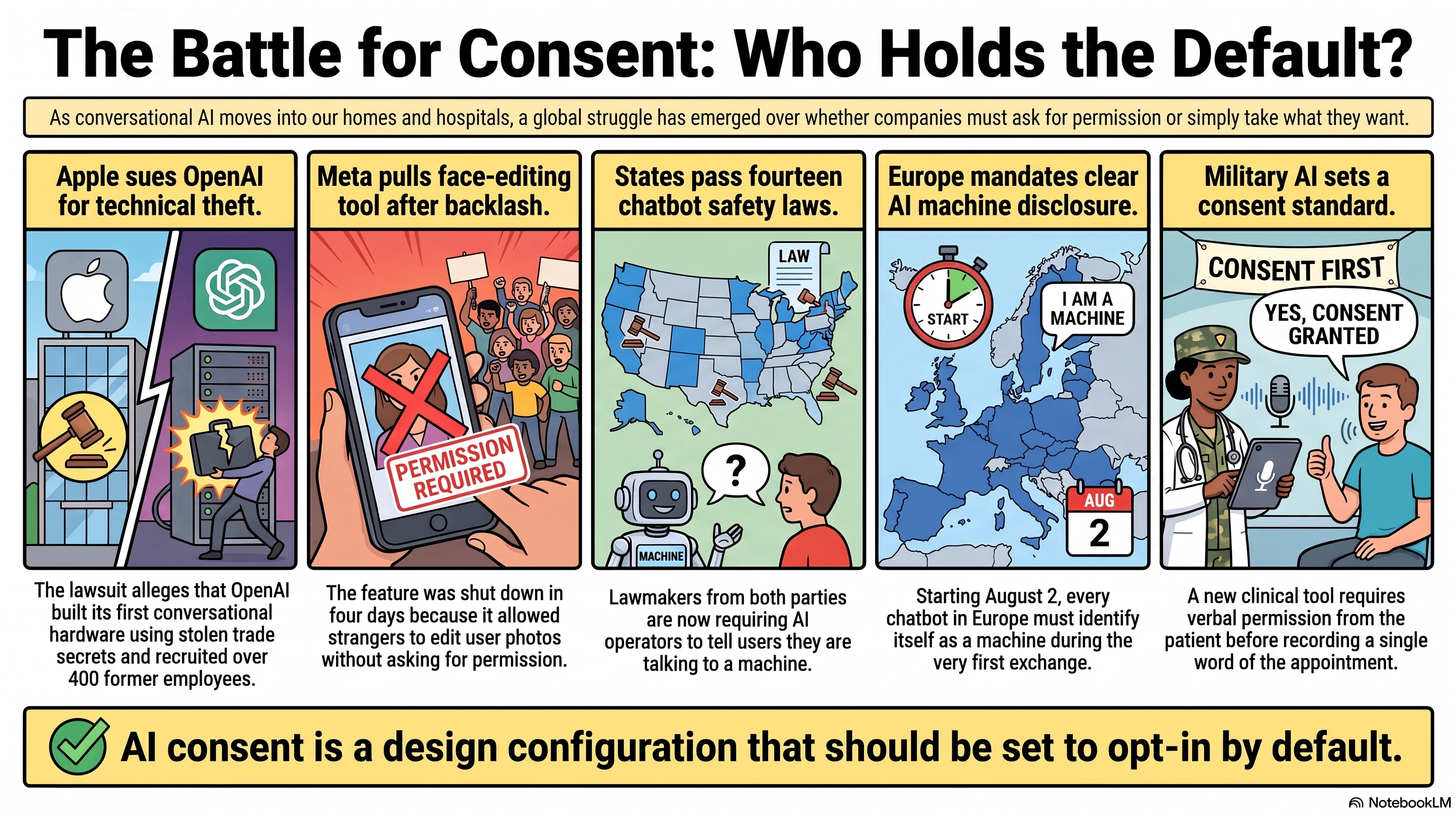
ROTTEN TO ITS CORE. On Friday, Apple sued OpenAI in federal court in Northern California, accusing the company of stealing its trade secrets. The complaint says the theft ran "at every level," from the technical staff to the chief hardware officer.
Apple filed yesterday in the U.S. District Court for the Northern District of California. The defendants: OpenAI; io Products, the design firm founded by former Apple design chief Jony Ive and acquired by OpenAI last year for six and a half billion dollars; and two men.
Tang Tan, OpenAI's chief hardware officer, spent about 24 years at Apple and led product design for the iPhone and the Apple Watch. Chang Liu, a former Apple senior systems electrical engineer, joined OpenAI in January. Ive himself is not named.
The two companies are building OpenAI's first device, a machine built to be talked to. Apple's complaint says that project is "rotten to its core by its illegal reliance on misappropriated trade secrets."
Those are the names. The conduct alleged goes person by person.
. . .
Start with Liu, because his section is the most specific. The complaint says he kept a work-issued Apple laptop after leaving the company, and that while employed at OpenAI he discovered a bug that let him reach Apple's cloud file storage.
He used that access, Apple says, to download "dozens of Apple's confidential hardware-related files," including detailed information about unreleased products, engineering presentations, technical specifications, and proprietary project data. And he shared information with other Apple employees who were considering OpenAI jobs.
The allegations against Tan are about method rather than files. Apple says the man who ran its iPhone and Apple Watch product design directed job candidates still working at Apple to bring "actual parts" to their interviews, for what the complaint calls "show and tell" sessions.
It says he coached recruits on evading Apple's security protocols, used Apple's confidential project code names in his recruiting, and solicited details about unreleased Apple products.
Then the complaint aims past both men. The pattern of misconduct, Apple says, was "normalized and exemplified by leadership."
. . .
The hiring itself is part of the case. By Bloomberg's account of the suit, OpenAI has systematically recruited more than 400 former Apple employees.
Apple asks the court to bar OpenAI from using or disclosing its trade secrets, to order the return of confidential materials, and to preserve evidence related to the case.
OpenAI's answer, in full: "We have no interest in other companies' trade secrets. We remain focused on building innovative technology that empowers people everywhere." Two sentences, neither of which contains the word Apple.
. . .
Read that preservation request against the calendar. One day before Apple filed, eight news organizations asked a federal judge in Manhattan to sanction OpenAI for allegedly hiding and destroying evidence of how ChatGPT was trained. OpenAI called those claims "blatantly false." Apple, filing 24 hours later, asked its judge up front to make sure the evidence in this case survives.
Two courts, two coasts, one company, and the same question in both rooms: what happens to the paper trail when OpenAI gets sued.
Before the talking device ships, a federal court will examine how it was designed, and whether the work that came out of Cupertino left legally.
|
For Reporters: The most checkable claims, the cloud-access bug and the "show and tell" interviews, meet depositions soon. Watch whether evidence preservation becomes its own fight the way it did in Manhattan.
For Clinicians: The company building a voice device meant to sit in ordinary homes, including your clients' homes, is now defending allegations in two courts about how it handles other people's information.
For Policymakers: The most forceful challenge yet to OpenAI's hardware program came from a rival with the resources to litigate, not from any disclosure statute; that gap is the policy problem.
For Founders: Your recruiting pipeline is now potential evidence; if a hiring manager tells candidates to bring a former employer's parts to the interview, that sentence ends up in a complaint.
Source: TechCrunch, Apple sues OpenAI over alleged trade secret theft, https://techcrunch.com/2026/07/10/apple-sues-openai-over-alleged-trade-secret-theft/
Why it matters: OpenAI's first device is built for conversation and aimed at ordinary homes. Apple says the project rests on stolen work, and asked a court to preserve the evidence one day after another court was told OpenAI destroys it. How this company behaves under legal scrutiny is now the question, in two courtrooms at once.
|
. . .
FOUR DAYS OF MUSE. On Friday, Meta shut down an image tool it had launched four days earlier. The tool let anyone edit the face of anyone with a public Instagram account, by default and without asking.
The feature was called Muse Image. Meta launched it on Tuesday as the first image-generation model out of Meta Superintelligence Labs, built into the Meta AI chatbot. Users could generate images, edit them, and reshape the results directly with sketches.
The raw material was other people's photos. Muse Image drew on pictures from public Instagram accounts, and many of those accounts were opted in by default. An account holder could opt out. The burden of doing so sat entirely with them.
Until they found the setting, anyone could manipulate their image and likeness. That covered celebrities. It also covered every ordinary person with a public account who had never heard the words Muse Image.
Most people never touch a default. Set it to yes and the yes is nearly universal, whatever people would have chosen if asked.
Nobody asked them. That was the design.
. . .
The actors' union moved first. SAG-AFTRA publicly condemned the opt-out design and recommended its members opt out, urging them to "take action to protect your likeness."
The union's statement left no middle ground. Anything other than "a clear and conspicuous OPT-IN for these types of uses of Instagram users' images is unacceptable."
Creative Artists Agency joined the condemnation and said it raised its concerns directly with Meta. The people with agents had someone who could get Meta on the phone. Everyone else had a settings menu, if they knew to look for one.
. . .
On Friday, Meta discontinued the feature. The company said "we've heard the feedback that this feature missed the mark, so it's no longer available." The whole public accounting is that one sentence.
CAA answered with a statement of its own. "We commend Meta for its swift decision to remove the Muse Image feature. Putting individual rights and consent at the forefront is essential to building responsible technology."
Four days. Tuesday launch, Friday shutdown. That is the full public life of the first image model from the lab Meta named for superintelligence.
. . .
And note what actually brought the feature down. Not the ordinary users it swept in. The actors' union and a major talent agency, objecting in public and in private. Organized likeness, the kind with a union card behind it, got results in four days. Unorganized likeness got a default.
Readers of yesterday's issue will recognize the company. This same week, 404 Media surfaced a Meta patent for a wearable that reads emotional state from sighs, laughter, and tone of voice, and notices when medication is taken. The patent reads your face; the image tool borrowed it.
Meta says the feature missed the mark. The statement does not say what the mark was, who set it, or whether the next launch will ask first.
|
For Reporters: The retreat statement is one sentence long. The launch is where the reporting is left: how default opt-in for user likenesses got approved, and what the next Meta Superintelligence Labs product defaults to.
For Clinicians: Any client with a public Instagram account was opted in to this for four days without notice. The documented consent you practice under is the exception in consumer AI.
For Policymakers: SAG-AFTRA handed you the statutory language: "a clear and conspicuous OPT-IN." The open question is whether likeness protection should depend on having a union and a talent agency.
For Founders: The consent default is now a priced product decision. Meta bought four days of backlash and a public retreat by choosing opt-out. Ship opt-in and let the launch story be about the feature instead of the takedown.
Source: Variety, Meta Suspends Instagram AI Image Feature After Days of Backlash, https://variety.com/2026/biz/news/meta-suspends-ai-image-instagram-feature-backlash-1236806989/
Why it matters: Meta treated every public face on Instagram as raw material and consent as a buried setting. It backed down in four days, but only after Hollywood's organized power pushed. For everyone without a union, the default would have held. The fight over conversational AI is the same fight: who holds the default.
|
. . .
THE HALF-TIME SCORE. Scott Babwah Brennen added up the first half of 2026 in state AI lawmaking: 109 laws, and no category busier than companion chatbots. Four days from now, two clocks this newsletter has been watching run out on the same day.
Brennen published his mid-year accounting at TechPolicy.Press on July 6, under the plain title "Where State AI Legislation Stands Half Way Into 2026." It reads like a box score. As of July 1, states had enacted 109 AI laws and 28 data-center laws this year.
That pace runs slightly behind last year, when the same date showed 121 AI laws and 27 data-center laws. A near-repeat of last year's clip is not a retreat.
The distribution says more than the total. Roughly 61% of states under Republican control and 69% under Democratic control have enacted AI legislation this year. That is a gap of 8 points between the parties on whether to legislate at all. In a country that agrees on almost nothing, both parties are writing AI law at close to the same rate.
. . .
Now the part this newsletter exists for. Companion chatbots were the most active area of state AI legislation in 2026. Legislators introduced more than 100 bills, and 14 became law by mid-year.
Hold that against the rest of the field. Deepfakes, hiring tools, procurement rules, data centers. Out of all of it, the busiest category in American AI lawmaking is the machine built for conversation, the one that talks to people when no one else is in the room.
The bipartisanship holds here too. Six states with Democratic trifectas enacted companion-chatbot or similar laws this year, and eight states with Republican trifectas did the same. Trifectas are where a party's instincts run unopposed: two separate political cultures reached the same conclusion about the same machine, in the same six months.
Most of the new laws build on the first two, California SB 243 and New York S 3008C, both enacted in 2025. The template is settled: operators must tell users the chatbot is not human, and they must address risks including sexual content involving minors and self-harm.
Brennen does find a partisan split, but it is a split in flavor, not in appetite. Republican-supported bills are more likely to carry stronger age-verification and parental-oversight requirements. Democratic bills lean toward warnings and self-harm protocols. Different instincts, same target.
And California is not finished: AB 2023, under consideration, would add pre-deployment risk assessments to its existing chatbot law. The first mover wants a second lap.
. . .
Which brings us to the two clocks.
Hawaii SB 3001 becomes law on Wednesday, July 15, without Governor Josh Green's signature. He did not place it on his intent-to-veto list, and under Hawaii procedure that omission settles the matter: unless he reverses course and vetoes first, the bill becomes law automatically, by his silence.
Missouri SB 1019 sits on Governor Mike Kehoe's desk with a deadline of the same day, July 15, to sign or veto. One governor can make law by doing nothing. The other has the same four days on his calendar.
We are not going to predict either man's decision. The record here is the calendar, and the calendar says Wednesday.
That is the half-time score. Wednesday opens the second half.
|
For Reporters: The mid-year data is a map of where the second-half stories are. Fourteen companion-bot laws in six months is a beat, not a one-off feature.
For Clinicians: The laws reaching your clients' phones mostly require a not-human warning and a self-harm protocol. Know what your state has actually enacted, because clients will assume more protection than that.
For Policymakers: Companion-bot regulation is the rare lane where both parties' trifectas are moving. The live debate is age verification versus warning labels, not whether to act.
For Founders: With 14 state laws by mid-year and California weighing pre-deployment risk assessments, compliance is now a state-by-state matrix that changes monthly. Build for the strictest template, not the average.
Source: TechPolicy.Press, Where State AI Legislation Stands Half Way Into 2026, https://www.techpolicy.press/where-state-ai-legislation-stands-half-way-into-2026/
Why it matters: Companion chatbots are now the most active category in all of state AI lawmaking, with 14 laws from both parties in six months. The field this newsletter covers is no longer a niche. And on Wednesday, four days out, two more state clocks run out at once.
|
. . .
THE BAN THAT MISSES. Governments around the world are fencing teenagers off social media. Yesterday CNBC pointed at the gate they left open: chatbots.
In Friday's Tech Download newsletter, CNBC reporter Sawdah Bhaimiya surveyed the global wave of teen social media bans and found a hole in the middle of it. The laws fence teenagers off the platforms their parents grew up fearing. Most of them say little or nothing about AI chatbots.
The wave itself is real and moving fast. Australia became the first country to legally enforce a teen social media ban in December. Several governments followed in the months after: the U.K., Spain, France, Greece, and Canada. In the U.S., state-level bans are gaining traction.
Meanwhile the thing the laws mostly skip keeps growing. Pew reported this year that roughly half of U.S. teens use chatbots like ChatGPT, Copilot, and Character.AI, for schoolwork, for information, or just for fun. And CNBC points to a growing body of evidence that teens are using chatbots as a substitute for real-life friendships and relationships, with patterns that look like addiction.
Half of teens. Little to no mention in most of the ban legislation.
. . .
Kaitlyn Regehr is an associate professor of digital humanities at University College London. She watched governments spend years catching up to social media, and she told CNBC they are now running the same play with untested AI products in children's hands.
"It is right that we use social media as a case study for what we don't want to repeat. I mean, it's kind of like, fool me once, shame on you, fool me twice, shame on me."
Her specific complaint is about what the laws bother to name. Much of the legislation, particularly in the U.K., touches only the most extreme harms. The U.K.'s teen social media ban briefly mentions restricting under-18s from "romantic" companion-style chatbots designed to foster sexual relationships or roleplay.
What it ignores, she says, is the ordinary middle of the problem: chatbots that foster emotional and social dependency, and the cognitive de-skilling that comes with them.
Sonia Livingstone, a professor at the London School of Economics who specializes in children's digital rights and online safety, named the incentive underneath. "I don't know that AI safety is being neglected, but clearly investment in AI is being prioritised, and it does still seem that regulation is seen as stifling innovation rather than providing a commercially productive pathway to trustworthy products."
The picture that goes with that sentence: days before unveiling its landmark under-16 social media ban, the U.K. government was at London Tech Week championing billions in AI investment.
. . .
The U.S. is a partial exception, and readers of this newsletter know the shape of it. The House passed the KIDS Act to restrict chatbot interactions with children, 267-117, on June 29; it now waits on the Senate. And the states have enacted 14 companion-chatbot laws this year, the busiest category in state AI lawmaking.
But look at what those laws actually do. Most require a warning that the bot is not human and a protocol for self-harm. The gap CNBC names is in the ban laws themselves, the ones that draw a hard line and fence teenagers off a platform entirely. Those laws name social media. The chatbots walk through.
The bluntest tool in the child-safety kit has been aimed at the last decade's product, while this decade's product, already used by roughly half of teens, goes largely unnamed in the text.
Regehr's closing question is the whole story. "We have seen a generation who have grown up on social media. Do we want it again?"
|
For Reporters: The story is in the statute text, not the press conference. Pull your country's ban bill and search it for chatbots; per CNBC, most of the legislation has little to nothing.
For Clinicians: Roughly half of U.S. teens use chatbots, and the dependency patterns CNBC describes will reach your office before any statute does. The bans your clients' families have heard about do not cover this.
For Policymakers: A ban that names last decade's platform and skips this decade's is dated on arrival. If the harm is dependency, write for the mechanism, not the brand of app.
For Parents: A teen social media ban does not touch the chatbot on the same phone. Roughly half of teens already use them; the fence you have read about was not built for this.
Source: CNBC, The Tech Download: Teen social media bans miss a key part of the puzzle: AI chatbots, https://www.cnbc.com/2026/07/10/tech-download-social-media-bans-ai-chatbots.html
Why it matters: The ban wave is the largest child-safety intervention governments have ever aimed at the internet, and it is aimed at the wrong decade. Chatbots reach half of teens with almost no coverage in the ban laws. Regehr's warning is checkable in real time: the generation raised on social media has a successor, already in progress.
|
. . .
EUROPE KEPT ONE RULE. On June 29, the Council of the EU gave its final green light to the package that delays most of the AI Act's hard rules. The rule that says a chatbot must admit it is a machine was not part of the trade.
The European Parliament endorsed the package on June 16. The Council of the EU followed on June 29. The measure, which Brussels calls the digital omnibus, now waits only for publication in the Official Journal of the European Union, expected this month, ahead of August 2.
The omnibus is billed as simplification, and what it simplifies is mostly the calendar. The AI Act's high-risk obligations were originally due to hit in 2026 and 2027. Under the new schedule, stand-alone high-risk AI systems get until December 2, 2027, and high-risk systems embedded in products get until August 2, 2028.
The Council's press release announces a green light "to simplify and streamline rules." That is one reading. The other is that the hardest part of Europe's landmark law now starts more than a year later than Europe promised.
. . .
Read what the negotiators left standing. Article 50, the transparency article, proceeds exactly on schedule and takes effect August 2, 2026.
From that date, a chatbot operating in Europe must tell users in the first exchange that it is an AI rather than a person. Deepfakes and synthetic media must carry a mark stating they were "artificially generated or manipulated." No delay, no exemption, no later phase-in.
For this beat, that is the load-bearing sentence in the entire law. Nearly every story this newsletter has covered about a person in crisis and a machine begins with the same question, whether the person understood what was on the other end.
August 2 is twenty-two days from the issue you are reading. The heavy compliance regime slipped. The one rule this beat depends on held its date.
. . .
There is a live demonstration of what the surviving rules still cost. xAI shipped Grok 4.5 worldwide on Wednesday, July 8, everywhere except the European Union. The launch announcement itself noted the gap, with EU rollout expected around mid-July.
The reason, per reporting from heise online and others, is unfinished homework. The AI Act treats Grok 4.5 as a general-purpose AI model with systemic risk. Before launching in the EU, xAI, which now sits inside the SpaceX corporate umbrella, must complete mandatory model evaluations, adversarial testing, incident-reporting procedures, and cybersecurity assessments, all subject to review by EU authorities.
As this newsletter reported yesterday, Grok 4.5 landed fourth on the Artificial Analysis index with a hallucination rate that roughly doubled from the prior model while sounding more confident. That is the model Europe told to finish its safety paperwork before shipping. Whether mid-July holds is xAI's projection, not Europe's.
. . .
The rules Grok is working through are not new and not fringe. General-purpose model obligations have applied since August 2025, and roughly two dozen organizations, including Amazon, Anthropic, Google, IBM, Microsoft, and Mistral AI, have signed the EU's GPAI Code of Practice. The framework the omnibus trimmed is the one most major labs already agreed to work inside.
Washington, for its part, still has no federal framework for conversational AI at all.
Twenty-two days from now, a chatbot in Europe must open by saying what it is. There is no date on any American calendar when the same becomes true here.
|
For Reporters: Article 50 compliance is a checkable fact, not a policy debate. When August 2 arrives, open the chatbots you cover from an EU vantage point and see whether the first exchange discloses.
For Clinicians: From August 2, a client using a chatbot in Europe must be told up front that it is not a person. Your clients in the US get no such notice, so the question of what they are talking to still falls to you.
For Policymakers: Brussels just showed a disclosure rule can survive a deregulatory push that a full compliance regime could not. If you can pass one sentence of law, the sentence that held was the machine must identify itself.
For Founders: The transparency clock starts August 2 regardless of the high-risk delay, so plan for it if Europe is on your map. Grok 4.5 launching everywhere but the EU is what unfinished compliance homework costs in market days.
Source: Council of the EU, Artificial Intelligence: Council gives final green light to simplify and streamline rules, https://www.consilium.europa.eu/en/press/press-releases/2026/06/29/artificial-intelligence-council-gives-final-green-light-to-simplify-and-streamline-rules/
Why it matters: Europe delayed nearly everything and kept the one rule this beat depends on: from August 2, the machine must say it is a machine. The proof the framework still has teeth is a frontier model that launched everywhere except Europe. No American rule, on any calendar, requires either.
|
. . .
THE ARMY ASKED FIRST. The Defense Health Agency says its ambient listening tool is now live in military hospitals and clinics worldwide. It does not capture a word until the provider asks out loud and the person in the room says yes.
The Defense Health Agency announced this week, in a bulletin dated July 9, that a tool called the Clinical AI Agent is now broadly available across the Military Health System. It is ambient listening technology, finished with a phased 2026 rollout and running in military hospitals and clinics worldwide.
Here is what it does. With consent, it records and analyzes the conversation between the provider and the person in the exam room. It drafts the clinical note and takes on the administrative work behind it, the coding, the visit summaries. The draft lands in MHS GENESIS, the military's electronic health record, where the provider reviews, edits, and signs it.
The machine drafts. The human signs.
. . .
The safeguards read like someone anticipated this week's news. Verbal consent is required before any recording begins, spoken out loud in the room. The recording can be paused at any time. And the provider retains responsibility for reviewing and signing every note that carries their name.
In a week when one company shipped a likeness tool with consent set to opt-out and spent four days retreating from it, the military shipped a listening machine that asks before it starts. And a human signs everything it writes.
. . .
The pilot ran October 31 to December 11, 2025, at four sites: Madigan Army Medical Center, Naval Medical Center Camp Lejeune, Naval Medical Center Portsmouth, and Wilford Hall Ambulatory Surgical Center. Roughly four hundred providers used it in the exam room. The worldwide rollout followed in phases through 2026.
One of them was Col. (Dr.) Stephen Edstrom, a psychiatrist at Wilford Hall. "My intakes prior to the pilot would take me about 30 to 45 minutes to complete documentation," he said. "With the pilot, I can have the intake note done in five to 10 minutes. The notes are very high quality and capture the meat of the appointment."
Do the arithmetic on that. A mental health intake is the most sensitive room in medicine, the hour where a service member decides whether to say the hard thing. Edstrom's numbers hand him back 25 to 35 minutes per intake to spend on the person instead of the keyboard.
Lt. Col. (Dr.) Peter Easter, a pediatrician at the same hospital, described what changes when the typing stops: providers make eye contact again, "lean in, listen, and have more involved conversations."
Lt. Col. Matthew Royall, a practicing pediatric gastroenterologist who helps run ambulatory informatics for the agency, named the cost of the paperwork: administrative tasks are "one of the primary factors driving burnout," with consequences that reach care quality and provider retention.
. . .
The scale is the other half of the story. This is one of the largest real-world deployments of ambient clinical AI in American healthcare, reaching military hospitals and clinics worldwide and serving service members, their families, and veterans at some facilities.
Saniah Fatemi, the DHA program manager, framed the rollout as mandate rather than experiment, the agency moving to "operationalize high-quality AI technology in support of the warfighter."
The military does not usually get cast as the careful one in a technology story. This week it earned the part. Consent spoken aloud before a single word is captured. A pause available to the person in the room. A doctor's signature on every page.
That is not friction someone forgot to remove. That is the design.
|
For Clinicians: The MHS model is the reference architecture: verbal consent before recording, a draft you edit, your signature on the final note. If a documentation vendor offers you less than that, ask why.
For Veterans: If you receive care at a military facility, the provider must ask before any recording starts, and you can pause it at any time. The note is still the doctor's, reviewed and signed by a human.
For Policymakers: The federal government just wrote a consent standard into the country's largest ambient clinical AI deployment: spoken consent, pausable recording, human signature. That is a working template civilian regulators can point to.
For Founders: Consent-first and human-signed cleared the most risk-averse buyer in America. It will clear yours.
Source: DVIDS/Defense Health Agency, Leveraging technology to support all warfighters through ambient listening, https://www.dvidshub.net/news/569401/leveraging-technology-support-all-warfighters-through-ambient-listening
Why it matters: In a week defined by companies taking first and asking later, the largest ambient clinical AI deployment in American healthcare asks permission out loud, lets the person pause the recording, and puts a human signature on every note. Consent at scale is not hypothetical anymore. The military just shipped it.
|
. . .
THE ONE CONFIGURATION. Strip the week to one question: who holds the default.
Meta set the default to yes and made every public face on Instagram raw material until the owner found the setting. Apple says OpenAI defaulted to take first and answer in court later. The teen ban laws default to naming last decade's product. Three defaults, all set by someone betting nobody would check.
. . .
Then look at the two that ran the other way. Brussels kept one default on the calendar: from August 2, the machine introduces itself. The military set its default to a spoken question in an exam room and a human signature on every note.
The difference is not the technology. The same ambient AI that asks first in a military clinic could have shipped opt-out. Someone chose otherwise, wrote the choice into the deployment, and shipped it to every military hospital in the world.
. . .
Consent is a configuration. It got configured twice this week, once by a company that got caught, once by an institution that got it right. Fourteen states are now writing that configuration into law, and two more clocks run out Wednesday.
|