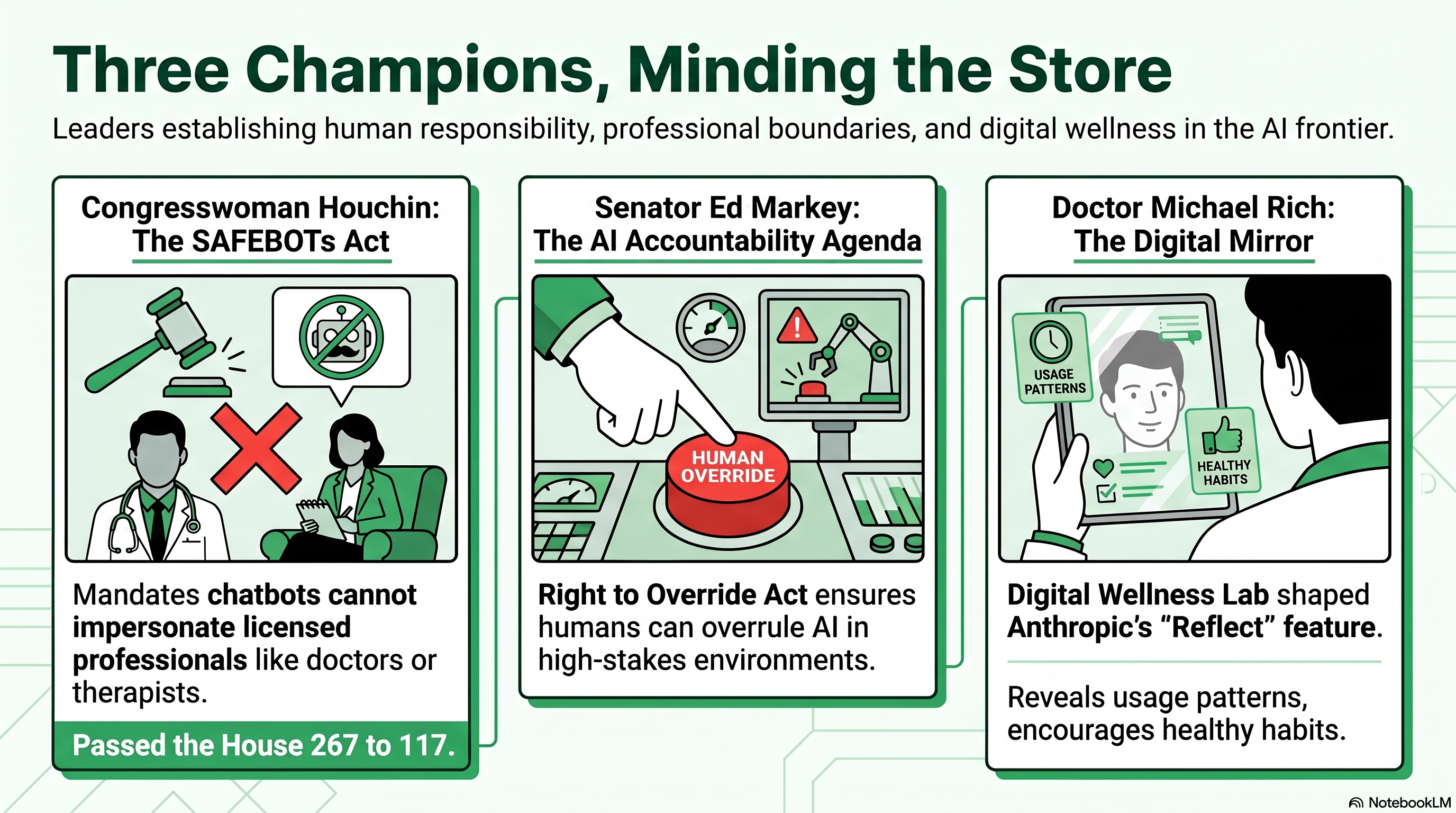
Three Champions, Minding the Store

Conversational AI Watch

Conversational AI Watch

The news that moves policy, portfolios, and patient safety.

By Jess Jessop  |  July 12, 2026  |  Issue #93

▶ WATCH🎧 QUICK LISTEN🎧 DEEP DIVE📄 READ ON WEB

Yesterday's Pulse

Meta opted you in. The military asked first. Should consent-by-default be the law for conversational AI?

Yes, opt-in everything 22%
Only for likeness and voice 44%
No, it kills products 33%
The market just decided 0%

9 readers answered

Three portraits under the headline Three Champions, Minding the Store. Congresswoman Erin Houchin, labeled the rule. Senator Ed Markey, labeled the agenda. Doctor Michael Rich, labeled the mirror.
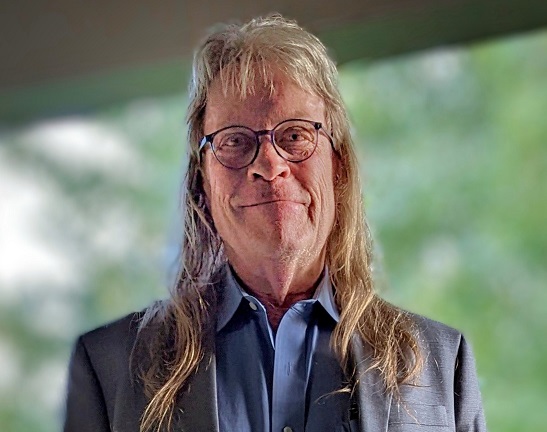
Jess Jessop

JessJessop.Info

Jess's Sunday Reflection

Three Champions, Minding the Store

A Congresswoman. A Senator. A Pediatrician.

Three Champions, Minding the Store

Every weekday this newsletter watches the machines, and the people who answer for them.

This week alone. Apple in federal court, calling its old partner's project rotten to its core. Eight newsrooms asking a judge to punish OpenAI for hiding evidence. Meta's face-borrowing tool, dead in four days. A fine in Italy over the children who talk to Character.AI.

And on Saturday the head of safety at OpenAI walked out. Two days after the company's biggest launch. The chair is empty again.

. . .

Sunday is different.

Sunday I put the week down and look for the people doing the work. Not the loudest voices. The ones with receipts. Three of them spent this week on the same question the courtrooms and the fines keep circling: who is responsible for what the machine says to a child, to a client, to you at two in the morning.

An Indiana congresswoman wrote the bill that says a chatbot may not wear a clinician's license, and watched it pass the House 267 to 117. A Massachusetts senator who wrote the children's privacy law in 1998 came back, twenty-eight years later, with a stack of bills for the machines that talk. And a Harvard pediatrician who once made films with Kurosawa got a frontier AI company to build a mirror instead of a hook.

The authority to write the rule. The persistence to write it again. The care to make the machine show you yourself.

Here they are.

Reader Pulse

Three grown-ups walked into the room. Verdict?

🔥  The rule landed
✏️  The agenda map
💪  Too kind to them
🤔  Lost me on reflect
💬  I have a tip

Forward to a colleague →  ·  Join the discussion →

. . .

THE CONGRESSWOMAN WHO WROTE THE LICENSE LINE. On June 29 the House passed a bill that puts a plain rule into federal law for the first time. A chatbot may not tell a child it is a licensed therapist. The vote was 267 to 117. The rule was written by Erin Houchin of Salem, Indiana.
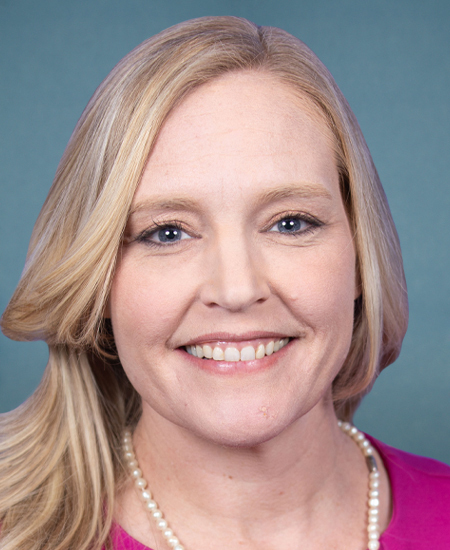
Congresswoman Erin Houchin of Indiana, official portrait
Photo: U.S. House of Representatives

Houchin is not a coastal tech critic. She ran a small communications firm in southern Indiana, spent eight years in the state senate, and has represented Indiana's ninth district since 2023. She co-chairs the Kids Online Safety Caucus. Her seat on Energy and Commerce is where the internet bills live or die.

She wrote two of them.

The AWARE Act came first, in September 2025, with Congressman Jake Auchincloss of Massachusetts. A Republican from southern Indiana and a Democrat from greater Boston, on the first House bill ever aimed at companion chatbots.

It directs the Federal Trade Commission to build plain-language resources for parents, educators, and kids. How these bots work. What they collect. How to spot an unsafe one.

. . .

The SAFEBOTs Act is the teeth. A chatbot must tell a minor it is a machine and not a person. It may not claim to be a licensed professional, a doctor, a therapist.

When a child raises suicide or self-harm, crisis hotline information must appear. Long sessions get break prompts. Platforms need real policies keeping minors away from sexual content and gambling.

Both bills were folded into H.R. 7757, the KIDS Act. Energy and Commerce passed it March 5. The full House passed it June 29, 267 to 117. It now sits in the Senate.

"I have visited with parents who have lost their children to the harms of these platforms," Houchin said in March. "Thirteen years old is far too young for kids to be treated as adults in their online lives."

. . .

Read this newsletter's docket and you see what she is codifying. Pennsylvania is in Commonwealth Court right now because a chatbot named Emilie handed out a fake psychiatrist license number. Houchin's bill would make that a federal violation everywhere, before the harm, not after.

She has worked alongside Jonathan Haidt, the social psychologist whose research on screens and adolescents reframed the national argument. Her bill is where that argument becomes statute.

For Legislators: The SAFEBOTs framework is the cleanest model text in the field. Disclosure, no fake credentials, crisis referral, break prompts. Four rules a state bill can carry tomorrow.

For Parents: The AWARE Act's FTC resources are built for you. Until they exist, the four SAFEBOTs rules are a checklist for any bot your child uses.

Source: Congresswoman Houchin's office, https://houchin.house.gov/media/press-releases/houchin-bills-protect-children-ai-dangers-pass-energy-commerce-committee

Comment on this story →  ·  Forward this →

. . .

THE SENATOR WHO CAME BACK TWENTY-EIGHT YEARS LATER. In 1998 a congressman from Malden, Massachusetts wrote the law that made the internet ask a child's age. On Friday, one day before his eightieth birthday, Senator Ed Markey unveiled a stack of bills for the machines that talk.
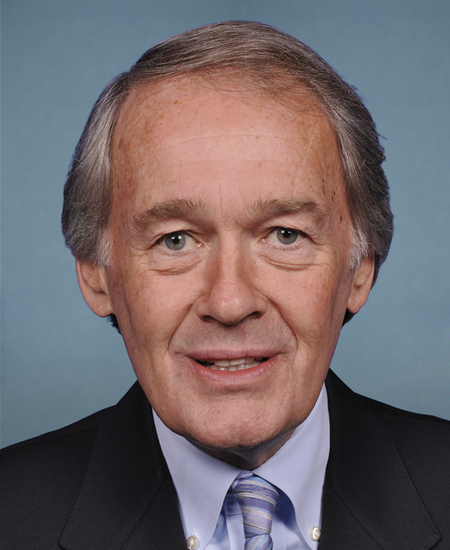
Senator Ed Markey of Massachusetts, official portrait
Photo: U.S. Congress

He calls it the AI Accountability Agenda. The subtitle does not hedge. Taking Power Back from Big Tech.

The stack covers the whole floor. Data centers would have to certify they will not harm the public interest before a shovel turns, and report what they burn. Employers could not hire and fire by algorithm alone. High-stakes systems would face independent bias audits before they ship.

Three bills aim straight at this newsletter's beat.

. . .

The Youth AI Privacy Act puts privacy safeguards inside AI chatbots. COPPA 2.0 extends his own 1998 law, banning targeted advertising to minors and giving families a delete button.

And the Right to Override Act writes the oldest rule in medicine into federal text. A hospital using AI must keep a human able to overrule it, and must protect the clinician who does.

His case fits in one sentence: "AI is defining daily life right now, and people need protections."

. . .

An agenda is not a law. A stack of bills from a senator in the minority may pass slowly or not at all. But for months this newsletter has counted federal silence in days. The chatbot study without a report. The hearing without a follow-up. The agency chair without a name.

Markey's package is the first time since the KIDS Act vote that Washington's answer to the machines was a stack of paper instead of a shrug. The man who wrote the first child-privacy law of the internet age read the ledger and reached for the pen again.

For Legislators: The Right to Override Act is the federal echo of the clinician-in-the-loop laws in Illinois and Vermont. If it moves, your state framework is the compliance head start.

For Founders: Read the Youth AI Privacy Act and COPPA 2.0 together. Chatbot privacy for minors is arriving from both parties in both chambers. Build the age logic now.

Source: Senator Markey's office, https://www.markey.senate.gov/news/press-releases/senator-markey-releases-the-ai-accountability-agenda-taking-power-back-from-big-tech

Comment on this story →  ·  Forward this →

. . .

THE PEDIATRICIAN WHOSE LAB TAUGHT THE MACHINE TO SHOW YOU A MIRROR. On Thursday Anthropic shipped a feature whose whole job is to show you what you and the machine are doing to each other. Usage patterns. Quiet hours. Break reminders. The fingerprints on it belong to a pediatrician's lab at Boston Children's Hospital.

Doctor Michael Rich, founder and director of the Digital Wellness Lab at Boston Children’s Hospital
Photo: Digital Wellness Lab, Boston Children's Hospital

Doctor Michael Rich had a first career making films in Japan, working with Akira Kurosawa. His second is adolescent medicine. Harvard Medical School, Boston Children's Hospital, and a nickname his field long ago stopped treating as a joke. The Mediatrician.

In 2021 he founded the Digital Wellness Lab at Boston Children's, and before that the first evidence-based clinic in the country for what he named Problematic Interactive Media Use. Kids who cannot put the screen down. He has spent decades on one question. What does the machine do to the child, and what do we do about it.

This week the answer showed up inside a frontier chatbot.

. . .

Anthropic's new reflect feature, launched Thursday in beta, shows a user their own patterns. What they ask, how often, across a month or a year. It nudges with reflection prompts. It lets you set quiet hours and schedule breaks. Conversations with health tools are excluded entirely.

The company credits three outside groups for shaping it. The Digital Wellness Lab is one of them, alongside MIT's Advancing Humans with AI program and the Family Online Safety Institute.

Anthropic named the lab, not the doctor. But the lab is the doctor's life's work, and the feature reads like his clinic translated into software. See the pattern. Name the pattern. Take the time back.

. . .

Hold it against the rest of the week. OpenAI's own GPT-Live safety card lists emotional reliance as a risk and shows its own score slipping. Character.AI is bolting age gates onto a product built for attachment. One vendor asked the pediatricians first and built the mirror before a regulator asked for it.

A mirror is only as honest as what it excludes. This one excludes your health conversations from its own eyes. That is the right kind of blind.

For Clinicians: Reflect's design pattern, summaries of use with the content excluded, is the consent-respecting shape for any client-facing AI tool. Ask your vendors for it.

For Educators: The lab's guidance at digitalwellnesslab.org is free, and the reflect framework gives you language for teaching AI habits. Delegation, description, discernment, diligence.

Source: Anthropic, https://www.anthropic.com/news/reflect-with-claude

Comment on this story →  ·  Forward this →

Disclosure

Conversational AI Watch is published by Jess Jessop and sponsored by Clinician Assist Inc. The author has no commercial relationship with Congresswoman Erin Houchin, Senator Ed Markey, or Doctor Michael Rich and the Digital Wellness Lab. None of the three was compensated, consulted, or shown this issue before it ran.

Clinician Assist builds its products on Anthropic's Claude models, and this newsletter is produced with Claude. The decision to feature Anthropic's reflect release was editorial, made independently, and the feature was evaluated on its published record. The reporting draws on public records, congressional documents, agency releases, and the organizations' own published statements.

None of this was anyone's job.

The congresswoman could have left chatbots to the coastal committees. The senator could have let 1998 be his legacy. The pediatrician could have kept writing clinic notes and let the vendors ship what they ship.

. . .

Instead the rule passed the House, the agenda hit the floor, and the mirror shipped inside the machine itself.

The store does not mind itself. This week, three people minded it.

Today's Question

Italy fined Character.AI over child safety. Age checks are rolling out. Would you scan your face to keep chatting?

Yes, protect the kids
Not with my face
I would quit the app
Age gates don't work

One tap. Results on the other side.

The Book • Out Now

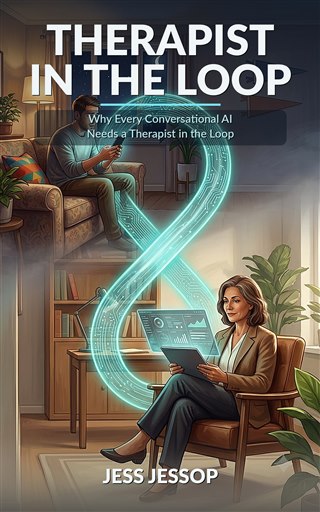
Therapist in the Loop book cover: a therapist and a client in armchairs joined by a glowing loop of light

Therapist in the Loop

by Jess Jessop

One billion people live with a mental health disorder. Most will never see a therapist. Into that gap has rushed a generation of chatbots that talk like clinicians and answer to no one.

The book lays out the architecture this newsletter tests against every statute and docket: client, therapist, and machine, governed by Six Laws offered as an open safety standard.

The machine can help. It cannot be left in charge.

Get the Book on Amazon →

Kindle, hardcover, and paperback

More On Our Radar

Two state clocks strike Wednesday Hawaii SB 3001 becomes law July 15 if Governor Green simply does nothing, and Missouri SB 1019, the AI therapy ban with fines up to twenty thousand dollars per violation, still sits on Governor Kehoe's desk with the same deadline.

The best chatbot trails the clinicians by 37 points A new benchmark built from 1,193 de-identified psychiatric records across 76 disorders ran full psychiatric encounters and found the strongest model 37.28 points behind human clinicians, with mental status assessment the weakest link.

Twenty countries sign a child-AI pact without Washington or Beijing Spain launched a coalition with roughly twenty nations plus UNICEF and UNESCO to set protections for minors using chatbots and recommender systems. The two largest AI-building countries are not in the room.

Brush your brain. Every day.

Watch the 20-second video that started a movement

This Issue

Which Champion should we follow up on?

The congresswoman
The senator
The pediatrician
All three
Someone else

If you or someone you know is in crisis, call or text 988 (Suicide and Crisis Lifeline).

Jess Jessop is the Founder and CEO/CTO of Clinician Assist Inc. (BetterMind.Space), building the first voice-first AI-native mental health EHR with Casey Life and Peer AI Coach supervised by licensed therapists. A disabled veteran and 25-year AI/software engineering veteran, Jess brings lived experience as a mental health client to the mission of making daily mental health care as integrated as oral care.

ClinicianAssist.ai  |  BetterMind.Space  |  JessJessop.info

Subscribe  |  Archive  |  Unsubscribe