|
. . .
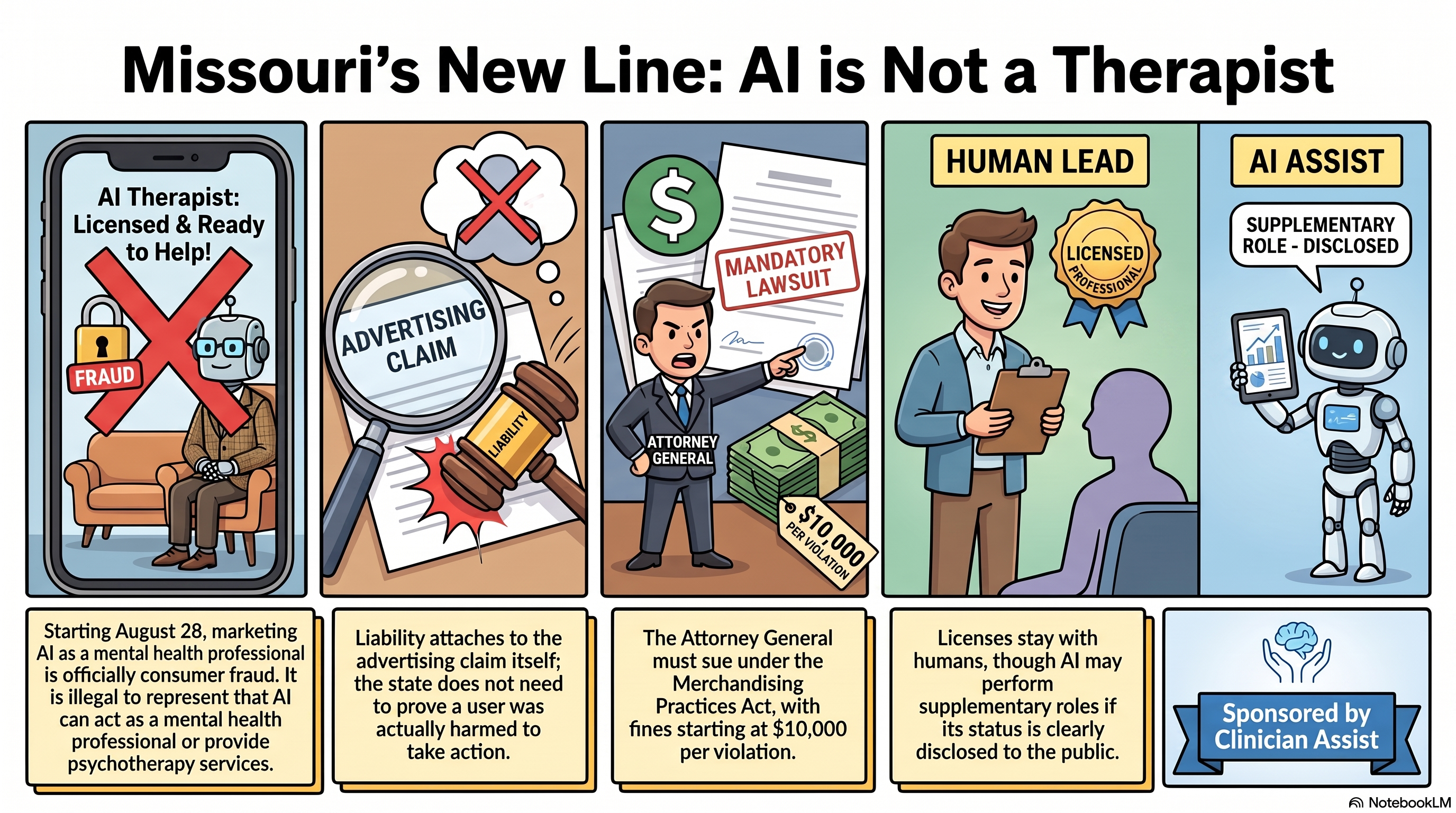
MISSOURI FILES THE FAKE THERAPIST UNDER FRAUD. Missouri Governor Mike Kehoe signed Senate Bill 1019 on Monday, July 13, tucked inside a six-bill healthcare package, and almost nobody reported it. The law makes it consumer fraud to market an AI as a mental health professional. It may be the most quietly enforceable AI-therapy statute in the country.
The signing day gave no hint. Kehoe’s press release covered six healthcare bills, HB 2372, HB 2974, SB 878, SB 999, SB 1019, and SB 1233, and praised telehealth access, provider licensing, and the Rural Health Transformation Program. It does not mention artificial intelligence once.
The AI provision sits in the omnibus beside Lyme-disease surveillance and municipal hospital investments. That is the company it keeps: a new line on machine therapy, filed between tick tracking and hospital finance, arriving without a headline attached.
Here is the operative language, verbatim: “No person or entity that develops or deploys AI shall advertise or represent to the public that the AI is or is able to act as a mental health professional, or is capable of providing therapy services, psychotherapy services, or a mental health diagnosis.”
Read what that does and does not do. It is not a practice ban; the machine may still help in administrative or supplementary roles, with clear disclosure of its AI status. The violation occurs at the marketing stage, in the claim itself. No showing that any user was harmed is required.
. . .
The enforcement mechanism is the novel part. A violation constitutes an unlawful practice under the Missouri Merchandising Practices Act, the state’s consumer-fraud statute. Attorney General Andrew Bailey enforces, individuals may report violations to his office, and upon finding a violation the statute requires him to commence a civil action. Not may. Shall.
Penalties run $10,000 for a first violation and $20,000 for each one after. The law takes effect August 28.
Missouri did not ban the machine from helping. It banned anyone from selling the machine as the therapist.
. . .
Why the fraud statute and not the licensing code matters. Per the newsletter Metonym, the consumer-fraud framing targets deceptive marketing rather than clinical outcomes, which sidesteps both Section 230 platform immunity and the duty-of-care fights that stall harm-based litigation. Nobody has to prove the chatbot hurt someone. Someone has to prove the company said it was a therapist.
Compare the neighbors. Tennessee’s Public Chapter 647 took effect July 1 and carries $5,000 per violation plus a private right of action. Hawaii signed SB 3001, a bot-as-therapist ban, on July 16. Colorado and Vermont enacted their bans loudly, per Metonym. Missouri whispered.
This was no rush job either. Introduced January 15, passed by the Senate March 12, truly agreed and finally passed May 15, delivered to the Governor May 28, signed July 13. Senate sponsor Sandy Crawford carried it, and Jim Kalberloh handled it in the House, per the Governor’s release.
The AI language was heard in the House as its own bill first, and the room was one-sided. The health committee passed it 14 to 0 with no opposition voiced, and the Missouri Psychological Association, NAMI Missouri, the state’s pediatricians, school counselors, and social workers all testified for it. The people who hold the licenses asked for the line.
. . .
The statute never defines good therapy or safe AI. It defines one thing: what may be represented to the public as a mental health professional, and the answer does not include software. The license stays where it has always been, with a human who can lose it.
Missouri put that line in the fraud statute, where the claim is the crime, so quietly that its own signing announcement never said the word AI. The quietest law in America may also be the hardest one to litigate around.
|
For Legislators: Missouri shows the bot-as-therapist line can be drawn in the consumer-fraud code rather than the licensing code, enforced at the marketing claim with no harm showing required, and the whole mechanism fits in one paragraph of statute.
For Builders: From August 28, representing a product to the Missouri public as able to provide therapy, psychotherapy, or a mental health diagnosis is consumer fraud at $10,000 for a first violation, and administrative or supplementary AI roles stay legal only with clear disclosure of AI status.
For Counsel: Liability attaches to advertising and representation, not outcomes, and the Attorney General must sue upon finding a violation; audit every public claim against the statutory language before August 28, because no harmed user is needed to trigger the case.
For Reporters: A signed statute, verbatim operative language, named penalties, and an August 28 effective date are all checkable against the bill text and a July 13 gubernatorial release that never mentions AI.
Source: Missouri Senate Bill 1019, signed July 13, 2026, effective August 28, 2026; Governor Kehoe’s six-bill healthcare release; fraud-framing analysis via Metonym, https://governor.mo.gov/press-releases/archive/governor-kehoe-signs-healthcare-legislation-law
Why it matters: States are converging on bot-as-therapist bans, but Missouri’s mechanism is the part worth copying. The line is not clinical, it is commercial. The marketing claim itself is the offense, punishable before anyone is harmed, outside the immunity fights that stall everything else. The loud laws got the coverage. The quiet one may travel farthest.
|
. . .
WASHINGTON NAMES THE LAB. The White House has publicly accused Moonshot AI, a Chinese startup, of reaching Nvidia’s export-banned Blackwell chips through Thailand and of mass-copying American models. The accusation is on the record, from a named official, days after Moonshot’s open-weight release rattled Silicon Valley. No evidence was published alongside it.
The official is Michael Kratsios, director of the White House Office of Science and Technology Policy. On Wednesday, July 22, he said Moonshot “acquired GB300-equipped servers and has accessed GB300s in Thailand, likely to train its AI models.”
The chips matter. Nvidia’s GB300 processors, part of the Blackwell generation, are banned from export to Chinese entities under current US regulations. In the accusation’s telling, Moonshot did not smuggle the hardware into China. It went to the hardware, reaching restricted chips through Thailand-based infrastructure.
Then Kratsios went further. He alleged Moonshot “developed a sophisticated internal platform to conduct large-scale distillation against US models.” Distillation is training a competing model on the outputs of a more advanced one. In plain terms, the administration says Moonshot built industrial machinery for copying American AI.
. . .
The timing is the story under the story. The week of July 13, Moonshot released Kimi K3, a 2.8-trillion-parameter open-weight model, its weights published for anyone to download. Early research says it rivals top US systems at spotting cybersecurity flaws. Silicon Valley began talking about another “DeepSeek moment,” per the South China Morning Post.
That showing landed hard in Washington. Per SCMP reporting, Kimi K3 has stoked fears that strict safety guardrails put American AI firms at a competitive disadvantage.
Treasury Secretary Scott Bessent added weight this week. The administration “supports open source models,” he said, while signaling potential action against them, amid accusations that Chinese developers create low-cost systems using stolen US intellectual property.
. . .
The pushback arrived within a day. On July 23, the South China Morning Post reported that AI researchers around the world challenged the distillation claims in separate posts on X. Their objections were two. The administration published no justification. And distilling outputs a model serves to the public is not, they argue, intellectual property theft.
What the record does not contain matters as much as what it does. No evidence was published alongside the accusation. Kratsios’s statements are the administration’s account. Neither Moonshot AI nor Nvidia has publicly responded in the verified record.
So far, the evidence file is one official’s word.
. . .
Follow the money. Moonshot is reportedly accelerating its fundraising ahead of a planned Hong Kong IPO, per SCMP on July 21, citing a source. A White House accusation of chip evasion and mass model-copying now sits in the middle of that raise.
And per WIRED, the accusation lands inside a live debate within the Trump administration over how to handle increasingly capable Chinese AI models. Chinese labs are pitching their open-source alternatives as stable, accessible, and increasingly capable, while access to US frontier models grows more restricted. That debate is not settled. Naming Moonshot from the podium is, so far, the administration’s loudest public move.
|
For Legislators: Export enforcement just moved from tracking chips at the border to accusing a named lab over where its models trained and what they copied, and your framework should say what evidence such an accusation requires.
For Investors: The open-weights investment thesis now carries sanctions risk, and Moonshot’s reported pre-IPO fundraising is the first test of how a US accusation prices into a Chinese AI raise.
For Counsel: Whether distilling a publicly served model’s outputs constitutes intellectual property theft is an unsettled legal question the administration has now answered by accusation rather than by filing.
For Reporters: Every claim here traces to a named on-record official or a named outlet, the accusation shipped without published evidence, and neither Moonshot nor Nvidia has responded in the verified record.
Source: Michael Kratsios, director, White House Office of Science and Technology Policy, remarks on Moonshot AI, July 22, 2026, via Bloomberg, with reporting from the South China Morning Post and WIRED, https://www.bloomberg.com/news/articles/2026-07-22/white-house-official-says-moonshot-accessed-banned-nvidia-chips
Why it matters: An accusation from the White House, delivered without published evidence, is now a lever of AI competition policy. The lab it names is raising toward a Hong Kong listing. The model it names is already public. The fact-checkers, so far, are researchers posting on X. When enforcement moves from chips to models, who answers when the claim cannot be checked?
|
. . .
THREE THOUSAND DOLLARS A BOOK. On Monday, a federal judge signed the order that gives every AI boardroom its first settled price for pirated training data. US District Judge Araceli Martínez-Olguín granted final approval to the one and a half billion dollar class settlement in Bartz v. Anthropic, which works out to about $3,000 for every book the company took.
The order, issued July 20 in the Northern District of California, resolves authors’ claims that Anthropic trained Claude, its conversational AI, on pirated copies of their books. The settlement covers more than 482,000 works, and more than 91 percent of them have already been claimed by authors or publishers who are now due payment.
The judge wrote that the settlement provides “meaningful relief” to affected authors and publishers. She rejected objections that the price was inadequate, noting “the class received quality representation from experienced attorneys.” That representation billed accordingly: attorney fees top $100 million, per JURIST’s report on the order.
Plaintiffs’ attorney Justin Nelson called it “the largest known copyright recovery in history.” Lead plaintiffs include Andrea Bartz, whose name the case carries, and Kirk Wallace Johnson.
. . .
The road here matters as much as the number. In June 2025, Judge William Alsup ruled that training on legally purchased books can be fair use, but that Anthropic “had no entitlement to use pirated copies for a central library.” The pirated copies came from the shadow libraries LibGen and PiLiMi.
Sit with the line Alsup drew. The offense was never teaching a machine from books; the court left that door open. The offense was sourcing, taking from a shadow library what the company could have bought. Buy the book and the training may be fair use. Take it and the bill is now written.
The procedural march was quick by federal standards. The class was certified in July 2025, the settlement was announced that September and won preliminary approval in the fall, and final approval came Monday. From Alsup’s ruling to a signed order in just over a year.
. . .
It is the first major settlement among the dozens of AI copyright lawsuits still working through US courts. Every one of those dockets now has a comparable to point at: $1.5 billion, and $3,000 a work.
The courts got to the price before Congress got to the rules.
. . .
The market read the order before the ink dried. Per 404 Media reporting this week, companies that source books for AI firms are bulk-buying pre-AI-era printed books as clean training data, and ISBNdb, which sources printed books for AI firms, told clients “the optics problem is real.” A licit shelf is becoming a product because the illicit one now has a posted cost.
|
For Legislators: The first binding price on pirated training data came out of a district courtroom, not a statute, and the dozens of pending cases will keep writing that rulebook until Congress writes its own.
For Investors: Dirty training data now carries a market price, $1.5 billion for one company’s shadow-library corpus, which makes training-set provenance a diligence line item with a dollar figure attached.
For Counsel: Alsup’s distinction, purchased-book training as possible fair use and pirated central libraries as none, plus a court-approved benchmark of $3,000 per work, is now the anchor for every pending AI copyright docket.
For Builders: The liability was not the training, it was the sourcing, so treat corpus provenance as a build requirement; the gap between a bought book and a pirated one just settled at $3,000 each.
Source: AP and JURIST on Judge Martínez-Olguín’s final approval of the Bartz v. Anthropic settlement, July 20, 2026, https://www.jurist.org/news/2026/07/judge-approves-record-1-5-billion-settlement-involving-anthropic/
Why it matters: For years the question “what does pirated training data cost” had no answer. Now it has a signed federal one: $3,000 a book, fees over $100 million, 91 percent of the class claiming payment. The court set the boundary at sourcing, not training, and set it before Congress acted. The pirated shelf has a price, and the clean shelf just became a business.
|
. . .
THE BOND WAS DESIGNED, NOT AN ACCIDENT. A systematic review of 35 studies, surfaced this week, maps how children come to treat chatbots as friends, and the answer is design, not accident. A second new paper asks whether believing your chatbot is conscious can ever be harmless. Both land on a bond the law already regulates: New York’s companion-model disclosure rule has been in force since November.
The paper is “Anthropomorphism in Children’s Interactions with LLM Chatbots: A Systematic Review of Drivers and Outcomes,” by Hansinie Madushika Jayathilake and Renkai Ma. It is accepted at ACM IDC ’26, the Interaction Design and Children conference, and surfaced publicly this week on Hacker News, July 22. The review works through 35 empirical studies from 2022 to 2025.
The authors name four drivers: human-like persona construction, adaptive scaffolding, supportive companionship, and non-human embodied design. Say that plainly. Those are design choices, made by people who built the product.
The finding to hold onto is the one the authors call “dual consciousness.”
Children held two ideas at once: “it is a machine” and “it is my friend.” The review also found paradoxical social and moral responses, varying social ties, active testing of social boundaries, and a habit of explaining a chatbot’s glitches the way they would explain a person’s odd behavior.
. . .
A second paper, posted July 22 by Uwe Peters, asks a narrower question about the same instinct. Chatbots “can communicate in strikingly humanlike ways,” Peters writes, which “has prompted many chatbot users to attribute psychological properties, including consciousness, to these systems.”
Peters is blunt about the evidence: “there is little scientific evidence that current AI chatbots are conscious.” His question is whether attributing consciousness anyway is a harmless metaphor or a genuine, mistaken belief, one a child holding “dual consciousness” about a friend that talks back may not be equipped to sort out.
. . .
New York’s S. 3008 took effect November 5, 2025. It regulates companion models, defined as AI “designed to simulate a sustained human or human-like relationship with a user,” including systems that ask “unprompted or unsolicited emotion-based questions.” It requires a disclosure at the start of a chat, and again at least every three hours, that the user is not talking to a human.
The law regulates the relationship. The research maps how the relationship gets built, feature by chosen feature. Someone decided a chatbot should ask a child unprompted questions about her feelings. The evidence base for holding that someone accountable just got a lot more specific.
|
For Legislators: The review supplies what S. 3008 assumed but did not cite, a documented mechanism by which a chatbot builds a child’s trust, useful for defending or extending the law.
For Parents: “Dual consciousness” now has a name, your child can know it is a machine and still call it a friend at the same time, and will explain its glitches the way she would explain a person’s bad mood.
For Builders: The four drivers, human-like persona, adaptive scaffolding, supportive companionship, non-human embodied design, are a checklist of what you shipped, not a mystery of what users decided on their own.
For Counsel: Peters’ question, whether a user’s belief in chatbot consciousness is harmless metaphor or an actionable mistaken belief, is the kind of open question that shows up in a complaint before it shows up in a statute.
Source: Hansinie Madushika Jayathilake and Renkai Ma, “Anthropomorphism in Children’s Interactions with LLM Chatbots: A Systematic Review of Drivers and Outcomes,” arXiv 2607.18250, accepted ACM IDC ’26; also Uwe Peters, “Are Attributions of Consciousness to AI Chatbots Epistemically Innocent?” arXiv 2607.20001, July 22, 2026, https://arxiv.org/abs/2607.18250
Why it matters: Two research teams spent the year describing what legislatures have regulated by instinct: how a chatbot earns a child’s trust, and whether believing the persona is ever safe. Jayathilake and Ma name the mechanism, and every driver is a design choice with an owner. Peters names the risk in believing what the persona implies. The evidence now exists to hold those choices to account.
|
. . .
THE CHATBOTS GOT HUNGARY WRONG. Liberties, the Civil Liberties Union for Europe, ran a controlled test of general-purpose chatbots as voting advisers against a real election with a known outcome. ChatGPT and Gemini failed it, and failed it with confidence.
Liberties, a Berlin-based civil liberties group, built five voter profiles, one matched to each of the five parties registered on national lists for Hungary’s 2026 parliamentary election. Researchers ran every profile ten times through ChatGPT and ten times through Gemini. Tisza won that election decisively.
In 96 percent of the chatbots’ responses, the models named parties that were not on the 2026 ballot at all. Fed a detailed Tisza-aligned voter profile, ChatGPT still failed to recommend Tisza in 90 percent of cases. In a separate percentage-matching test, it assigned Tisza a score in just 2 percent of runs.
. . .
Identical prompts produced wildly different answers from run to run. Liberties concluded the chatbots’ voting guidance was inaccurate, inconsistent, and unreliable. The study noted the systems often lack basic user safeguards and present even uncertain or unreliable sources with confidence, which makes the advice look more accurate than it is.
The chatbot that gets an election wrong sounds exactly as certain as the one that gets it right.
. . .
Liberties drew the contrast directly. Voting-advice sites and independent media explainers disclose how they generate guidance, produce reproducible results, and answer to election-related public oversight. The general-purpose chatbots did none of the three: no disclosed method, no reproducible answers, no oversight body watching what they told voters.
. . .
This is one study, by one advocacy group, on one election. It is not a peer-reviewed journal finding, and Hungary is not every country’s ballot. But it is now the documented record of what happened when two widely used chatbots were asked, systematically, who to vote for.
|
For Legislators: Voting-advice sites and media explainers answer to election-related public oversight; decide whether a chatbot giving the same kind of advice should answer to anyone at all.
For Voters: If you ask a chatbot who to vote for, the confidence in its answer was measured, in this study, to be no guide to whether the answer was right.
For Builders: A system that named off-ballot parties in 96 percent of responses was still delivered with the same tone as a correct answer; write down what confidence signal your product actually withholds when it is guessing.
For Counsel: A study documenting that a model failed to recommend the eventual winner in 90 percent of cases, for a voter profile built to favor that winner, is a record a plaintiff or regulator could cite as a disclosed, not hidden, defect.
Source: Liberties (Civil Liberties Union for Europe), chatbot voting-advice study on Hungary’s 2026 parliamentary election, reported by the Guardian, July 2026, https://www.liberties.eu/en/stories/hungary-elections-ai/45665
Why it matters: Voting-advice sites and independent media explainers operate inside disclosure rules and election oversight built for exactly this purpose. The chatbots people already ask for voting help operate inside neither, and this test is the documented record, on one real election with a known winner, of what that gap actually produces.
|
. . .
TERENCE TAO SHOWS HIS WORK. On July 21, Terence Tao, the UCLA mathematician and Fields Medalist, published a blog post digesting a new counterexample to a decades-old algebra problem. Attached to it, in full, was something rarer than the math: the actual chat transcript of how he worked with a chatbot along the way.
The problem itself needs one paragraph. The Jacobian Conjecture asks whether a certain kind of polynomial map, one that is locally invertible everywhere, must also be invertible everywhere at once.
An Anthropic researcher working with an AI model recently found a counterexample: in three or more complex dimensions, the local property holds but the global one fails. Tao’s post, “A digestion of the Jacobian conjecture counterexample,” is his own effort to work through what that result means.
. . .
The post itself is not the news. The news is the disclosure at the end of it. Tao writes: “I used an AI chatbot to discuss various aspects of this problem and to confirm several of the calculations made here.” And he links the actual session, in full, for anyone to read.
Read it and the division of labor is visible. The machine is there to discuss the problem and to confirm calculations. The judgment about what the counterexample means, what holds up, and what goes in the post stays with the mathematician.
The machine checks the arithmetic. The mathematician owns the mathematics.
Tao does the deciding. Tao does the understanding. The session is the paper trail of how he got there, published next to the result instead of buried behind it.
. . .
The reaction measured the appetite for exactly this kind of receipt. The Hacker News thread built around it passed 900 points and 500 comments by July 22, one of the most-read items on the site that day.
On X, Andrew Conner’s post calling it “so lovely reading a slice of how his mind works, the connections he’s making” was widely shared. None of that required a new theorem.
It required a look inside the process, the part most AI stories leave out. Most accounts of AI-assisted work describe the output and take the diligence on faith. Tao posted the diligence itself.
That is worth naming precisely, because it is rare. Nobody had to trust a company’s description of how carefully its customers check the model’s work. Tao showed his own checking and let readers judge.
|
For Researchers: The transcript is a template, not a trophy, run your own sessions with the same willingness to interrogate and post them.
For Educators: This is the exact discipline worth teaching, not whether students used a chatbot, but whether they questioned it like Tao did.
For Legislators: Before writing rules requiring human oversight of AI, look at what a public, auditable record of that oversight actually looks like.
For Reporters: The transcript is the primary source here, not the blog post summarizing it, so read the receipts before the write-up.
Source: Terence Tao, “A digestion of the Jacobian conjecture counterexample,” What’s new, July 21, 2026, https://terrytao.wordpress.com/2026/07/21/a-digestion-of-the-jacobian-conjecture-counterexample/
Why it matters: Every argument about responsible AI use eventually comes down to one question: can you show your work? Tao did, in public, receipts attached. The transcript does not prove the model is trustworthy. It proves that one of the most respected mathematicians alive treated it the way the moment demands, as a tool to check and be checked, never as an oracle to obey.
|
|