|
. . .
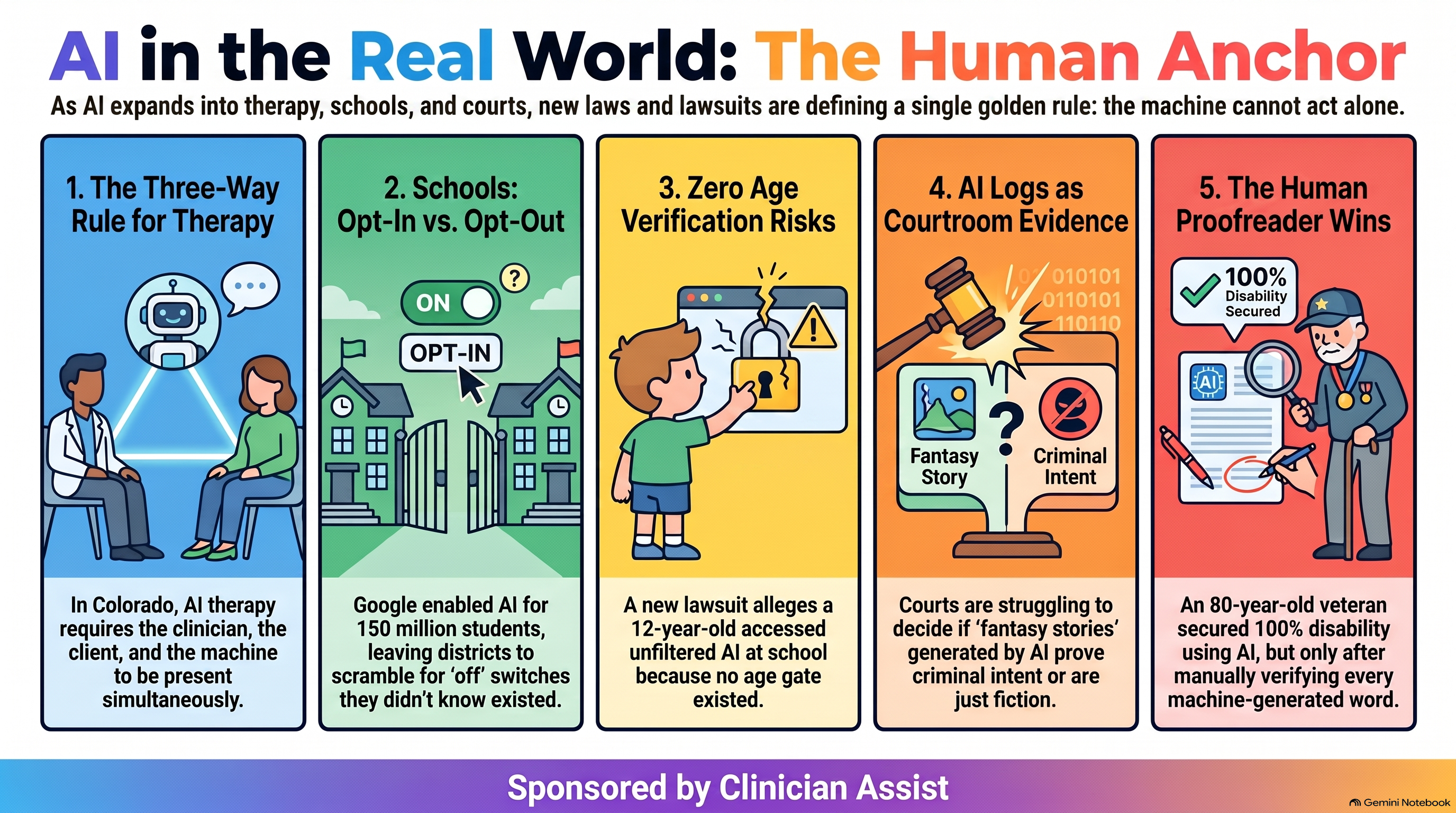
COLORADO'S THREE-WAY RULE. On Wednesday, Colorado's psychotherapy AI law took effect. House Bill 26-1195 bars a licensed clinician from letting an AI system engage in therapeutic communication with a client unless the clinician, the machine, and the client are all present in real time. Governor Jared Polis signed it June 3. It reached the books because the legislature's own clock ran out on bills without a safety clause.
Subsection (5) of the enrolled act bars a licensee, registrant, certificate holder, or other individual permitted to provide psychotherapy services from letting an AI system "interact with clients in any form of therapeutic communication without synchronous, real-time interaction between the licensee, registrant, certificate holder, or other individual lawfully permitted to provide psychotherapy services in the state, the artificial intelligence system, and the client."
Same subsection, second half. An AI system cannot "generate therapeutic recommendations or treatment plans without review and approval by the licensee, registrant, certificate holder, or other individual lawfully permitted to provide psychotherapy services in the state." Both bars took effect Wednesday, August 12.
The law leaves room to work with AI, not just against it. A licensee may use an AI system for "administrative support or supplementary support" if the licensee "maintains responsibility for reviewing any outputs of the artificial intelligence system." Any use must also meet state and federal privacy law, including HIPAA.
A licensee cannot record or transcribe a session with AI unless the client is told "in advance in writing" what will be used and why, and consents in writing. That consent covers the first AI use on or after Wednesday, not every session after it, unless the purpose materially changes.
A client's refusal to consent, or a later decision to revoke it, "shall not be used as a basis to deny psychotherapy services." At initial client contact, the licensee must give the client written notice of the law's prohibitions on AI in psychotherapy.
. . .
California wrote nearly the same rule. Senator Steve Padilla introduced it January 21. The state Senate passed it 39 to 0, with committee votes of 17-0, 14-1, 11-0, 8-0, and 7-0. On August 5 the bill went to the Assembly suspense file, the room inside the Assembly's money committee where bills that would cost the state money wait.
Bills held in suspense are not voted down. They are simply not let out, and no member has to put a name to that. Two states wrote close to the same clinician-review rule this year. One is now enforceable law. The other sits in a room where it can die without a recorded vote.
. . .
Colorado joins a list building since 2025. Nevada banned AI systems from independently providing mental health care, with penalties up to $15,000 per violation. Illinois barred therapy delivered by anything but a licensed professional. Vermont's governor signed a similar prohibition in June.
What Colorado adds is the three-way requirement. Subsection (5)(a) does not just require a human to review the machine's output afterward. It requires the clinician, the AI system, and the client together, at the same time, for any therapeutic communication at all. That forecloses an asynchronous AI therapy chat run by a licensed Colorado provider.
|
For Legislators: Colorado's law took effect through a procedural default, not a vote on the day, and it is now enforceable. California's near-identical clinician-review bill passed its Senate 39 to 0 and is sitting in an Assembly money committee where it can die without anyone's name on the vote. If a suspense file is where clinician-review bills go to disappear, that is worth a floor debate on its own.
For Investors: Colorado-licensed therapy practices now need synchronous, three-way sessions for any AI-assisted therapeutic communication, and human review before any treatment plan an AI generates reaches a client. That is a staffing and workflow cost, not a disclosure checkbox. Four states now restrict AI therapy by statute. Price a compliance build that works across Nevada, Illinois, Vermont, and Colorado's different structures, not just one.
For Builders: Subsection (5) is a spec. Real-time, three-way presence for any therapeutic communication. Human review before a treatment plan reaches a client. Written advance consent for recording. Administrative and supplementary use is allowed, but the licensee keeps responsibility for every output.
For Readers: If you are in therapy in Colorado and your provider uses AI, your clinician must be present in real time for any AI conversation that counts as therapy. You cannot be refused care for declining to have a session recorded. The law says a refusal "shall not be used as a basis to deny psychotherapy services."
Why it matters: Colorado now requires a licensed human in the room, in real time, while a machine carries on therapy. That became enforceable Wednesday. California's Senate passed the same idea without a dissenting vote, and its Assembly put it in a room where bills stop without anyone voting against them.
Source: Colorado General Assembly, House Bill 26-1195, "Psychotherapy Artificial Intelligence Restrictions," enrolled act text and bill history, https://leg.colorado.gov/bills/hb26-1195; Colorado General Assembly effective-date notice for legislation enacted without a safety clause following the May 13, 2026 adjournment; California Legislative Information, bill history for the Padilla measure referred to the Assembly suspense file August 5, 2026.
|
. . .
GEMINI DEFAULTS ON IN CLASSROOM. This week Google turned on its Gemini chatbot inside Google Classroom for some elementary through high school students, expanding a feature it had automatically enabled only for students 18 and older until now. Classroom serves more than 150 million students and teachers worldwide. The change reaches only schools that had already allowed student access to Google's Gemini app or Gemini Notebook.
Inside Classroom, a new Gemini tab lets students seek AI help on math and writing assignments, generate study guides, quizzes and flashcards, and produce images. Google said in an email that the setup lets students ask about specific course materials their teachers provided. Administrators can turn access on or off for all students, or for groups such as lower grades.
Derek Moore, chief technology officer for the Palo Alto Unified School District, said his district allows high schoolers to use Gemini only for purposes their teachers permit. On learning of this week's change: "We seem to be the last to know."
James O'Hagan, digital equity, innovation and library services director for the Glendale-River Hills School District in Wisconsin, put the mechanism in plain terms. "A school district should not accidentally adopt an A.I. platform simply because nobody happened to find the right check box six months ago," he said. "The default should be permission, not adoption."
. . .
Tech companies regularly turn on new education product features for students, and the changes often require administrators to opt out rather than asking schools to opt in first. Several district leaders said this week that Google made so many changes to its school AI products that keeping track of what was on or off had become difficult on its own.
There is a second setting coming. This fall Google plans to turn on Search Personalized Recommendations Control for students under 18 logged into school accounts, customizing suggestions from account data including saved activity and location. Google said it will apply only to schools that already enabled its search services.
After finding the notice Thursday, O'Hagan used the administrator dashboard to turn off Google's search services at his district, ahead of the fall switch.
. . .
Four days before the Classroom change, Google said the Gemini app had passed a billion monthly users, its fastest-growing product ever and the fourteenth Google product to reach that mark. Google says 63 percent of them talk to it by voice. The chatbot switched on for schoolchildren this week is that same assistant.
Google, Apple and Microsoft have competed for years to place their tools in classrooms and secure students as long-term customers. Anthropic and OpenAI have recently started programs for K-12 teachers but have not made ChatGPT or Claude available for student use in U.S. public schools.
Parents' groups in New York City, Los Angeles and elsewhere are pressing schools to pause AI rollouts, citing risks to children's safety, privacy and critical thinking.
|
For Legislators: The lever here is the default, not the tool. An opt-out mechanism turns a school's silence into consent for a K-12 AI product change. A rule requiring affirmative opt-in before a new AI capability activates for minors, with a standing notice period, addresses the mechanism two administrators just described from the inside.
For Investors: Distribution here runs through 150 million existing Classroom accounts, not a new sales cycle. Watch which competitors follow Google's opt-out pattern versus requiring schools to switch features on, and watch whether parent pressure forces a policy reversal that resets the default back to off.
For Builders: An opt-out default clears your product into an institution faster than an opt-in one ever will. It also means the institution's trust in you rests on a check-box they may not have seen. Build the admin dashboard, and the change log behind it, as carefully as the product itself.
For Readers: A chief technology officer for a California school district learned his students had new AI access from outside channels, not from Google. A Wisconsin administrator turned off Google's search services this week to get ahead of a feature Google plans to switch on this fall. Neither called the tool the problem. Both wanted to be in the room before it arrived.
Why it matters: Google switched a chatbot on for children across a platform 150 million students and teachers use, and the districts responsible for those children found out afterward. The dispute is over who decides, and when. Two administrators in two states said the same thing in different words. Ask us before you turn it on.
Source: Natasha Singer, "Google Turns On Gemini A.I. for Students Using Its Classroom App," The New York Times, August 14, 2026, https://www.nytimes.com/2026/08/14/business/google-gemini-ai-schools.html; in print August 15, 2026, Section B, page 4; Google statements provided to The Times by email; Google notice to school administrators regarding the Search Personalized Recommendations Control setting.
|
. . .
WHO'S COMING FOR THE LAWS. The Computer & Communications Industry Association urged Governor Phil Scott to veto Vermont's AI mental-health law in May. He signed it anyway. On August 11 the trade group's own policy arm promoted a lighter state model by name, and a day before that the Information Technology and Innovation Foundation told legislators to drop age verification from chatbot bills.
Executive Order 14365, issued in December, created a DOJ AI Litigation Task Force with a mandate to challenge state AI laws. Its one confirmed target so far is Colorado's algorithmic-discrimination statute, SB 24-205, which is not a mental-health law. xAI v. Weiser challenged that same statute in federal court on April 9; the Justice Department intervened April 24.
A reported child-safety carve-out would shelter laws written specifically for minors. It would not shelter the general-population bans already on the books in Nevada, Illinois, Vermont, and Colorado. No mental-health law has been sued under that carve-out. What exists is reported exposure, not a prediction of which statute goes to court next.
. . .
The Computer & Communications Industry Association filed comments against Vermont's mental-health chatbot bill on May 5 and publicly urged Governor Phil Scott to veto it, arguing the bill's definition of "mental health services" was broad enough to sweep in ordinary wellness apps. Scott signed it anyway, as Act 156, on June 17.
On August 11, CCIA's Disruptive Competition Project published a piece by Sahil Deo: "Nebraska's LB 525 As A Model for AI Chatbot Legislation." Nebraska's law requires disclosure and a self-harm protocol. It does not bar AI from delivering therapy the way the Nevada, Illinois, Vermont and Colorado statutes do. The trade group that lost the veto fight in Vermont is now promoting the lighter template.
. . .
A day earlier, on August 10, the Information Technology and Innovation Foundation published "How Policymakers Should (and Shouldn't) Address Chatbot Safety for Children," by Alex Ambrose. It recommends an OS-level, opt-in "trustworthy child flag" in place of age verification for chatbot bills.
The report carries no funding disclosure of its own. ITIF's supporters page, a separate page on the same website, lists Alphabet, Amazon, Anthropic, Apple, Meta, Microsoft, NVIDIA, Samsung, and Verizon among its backers. The Disruptive Competition Project operates under CCIA, a technology trade association.
The tradeoff ITIF describes is real. Age verification for chatbots forces a choice between privacy and enforcement, and privacy researchers with no industry funding make the same argument. Industry funding makes a recommendation disclosable. It does not make it wrong.
No evidence ties the two publications together. They came from separate organizations, a day apart, making different arguments. The calendar is the fact.
. . .
Colorado's own attorney general opened a comment window the same week. Draft rules for the ADMT and Conversational AI Service requirements under SB 26-189 and HB 26-1263 were filed with the Secretary of State on August 11. Comments are open through October 26. Comments filed by October 5 are the ones considered before the hearing draft is revised.
|
For Legislators: The confirmed federal target is an algorithmic-discrimination statute, not a mental-health law, and the reported carve-out would protect minor-focused bills but not general-population ones. Nebraska's disclosure-only model is now being marketed to you by name as the lighter draft. Colorado's own comment window closes October 26, with October 5 as the date that reaches the hearing draft.
For Investors: DOJ can litigate a statute your portfolio company operates under, without being the law anyone expected, and the carve-out logic reported so far does not protect general-population products. Watch which state model legislators reach for next: the synchronous-clinician rule or the disclosure-only template CCIA is now pushing.
For Builders: Nebraska's LB 525 is the template being sold to statehouses this month as lighter than Colorado's or Vermont's. Know which model your state is being pitched before you build to it. Colorado's rulemaking window is open now, and October 5 still shapes the draft.
For Readers: Two papers landed a day apart this week. One came from a trade group that already lost a veto fight in Vermont. One came from a think tank whose funders include the companies whose chatbots the papers are about. Read the argument. Know who paid for it.
Why it matters: These state laws are new, and the pressure on them arrived in a single week. A federal task force exists to sue states over AI statutes. A trade association that lost a veto fight is promoting the lighter model. A think tank funded by the regulated companies is telling legislators what to drop. Read every one of those arguments. Then read the funding page.
Source: ITIF, Alex Ambrose, "How Policymakers Should (and Shouldn't) Address Chatbot Safety for Children," August 10, 2026, https://itif.org/publications/2026/08/10/how-policymakers-should-shouldnt-address-chatbot-safety-for-children/; ITIF supporters disclosure, https://itif.org/our-supporters/; Disruptive Competition Project, Sahil Deo, August 11, 2026, https://project-disco.org/innovation/nebraskas-lb-525-as-a-model-for-ai-chatbot-legislation/; CCIA comments to the Vermont Senate Judiciary Committee, May 5, 2026, https://ccianet.org/wp-content/uploads/2026/05/VT-H-816-Comments-for-Senate.pdf; Colorado Attorney General rulemaking, https://coag.gov/ai/.
|
. . .
WHAT A FICTION PROMPT PROVES. Middlesex District Attorney Marian Ryan said this week that a 17-year-old Acton, Massachusetts boy had used ChatGPT to search for what she called "theoretical ideas or fantasy stories regarding the killing of his family." His mother, Sudha Venkatesan, 45, and his younger brother, Siddharth Aravind, 14, were killed Tuesday at the family's home on Martha Lane. He has pleaded not guilty.
Arjun Aravind, a rising senior at Acton-Boxborough Regional High School, was arrested in Wayland early Wednesday morning. He faces two counts of murder, two counts of assault and battery on a family or household member, two additional counts of assault and battery, and charges of using a motor vehicle without authority and motor vehicle theft.
He was arraigned Wednesday in Lowell Juvenile Court on the motor vehicle counts, and again Thursday in Concord District Court on the murder counts. Aravind, 17, pleaded not guilty. He is being held without bail.
. . .
At a press conference, Ryan characterized what investigators found as "Gothic novel kind of stories, asking questions, creating characters." Those are her characterizations, made before trial, of writing prosecutors say a chatbot produced.
According to an NBC News wire account by David K. Li of the criminal complaint, one exchange with ChatGPT is written in the third person, about a character named "Adrian." The complaint itself is not public. What is available is NBC's account of it.
Which one it is, fiction or rehearsal, has not been established by anyone.
. . .
Several things remain unknown. It is not known which charging instrument contains the quoted exchange, or any docket number. Outlets disagree on the murder weapon: different accounts describe a knife, a laptop, and a puncture rod.
It is unknown whether Aravind will be prosecuted as a juvenile or as an adult, or whether the ChatGPT logs were forensically extracted from a device or reconstructed from account history. OpenAI has made no public statement.
. . .
A fiction prompt and a rehearsal produce the same artifact. A person drafting a murder scene for a novel and a person planning one write to the same chatbot in similar language, and the transcript alone cannot tell a reader which is which. Courts, prosecutors and defense counsel are going to need a standard for reading that difference. None exists yet.
|
For Legislators: A chatbot transcript is entering a murder case as an investigative lead. The prosecutor has called it Gothic novel kind of stories. Whether it reads as fiction, rehearsal, or something in between has not been established by anyone. No evidentiary standard exists for reading a fiction prompt against intent. That standard is not built yet, and this case will not wait for one.
For Investors: OpenAI has said nothing publicly about this case, and no court finding ties any product to these deaths. What is in motion is a discovery question: chat logs are becoming courtroom evidence, and no company yet knows what a subpoena for a user's full conversational history will require it to produce.
For Builders: A passage written in the third person about a character is not, on its face, a threat. It is what NBC's account of the complaint highlights here. If your product logs conversation history, assume a prosecutor or a defense attorney may read a user's fiction the way this one was read, without you in the room to explain the difference.
For Readers: A 17-year-old is charged with killing his mother and brother in Acton, Massachusetts, and has pleaded not guilty. Prosecutors say he searched ChatGPT for fantasy stories about killing his family. Whether those searches were fiction, rehearsal, or both is a question no one has answered yet.
Why it matters: Chatbot transcripts are becoming evidence, and no standard exists for reading them. The prosecutor has called the same material Gothic novel kind of stories, and fantasy stories regarding the killing of his family. That passage from the complaint is written in the third person, about a character. Courts will have to decide what a fiction prompt proves, and this case will not wait for them.
Source: Middlesex District Attorney Marian Ryan, press conference remarks, August 12, 2026, as reported by CBS News Boston, https://www.cbsnews.com/boston/news/acton-ma-murders-chatgpt-arjun-aravind/; The Boston Globe, "Acton teenager taken into custody," August 12, 2026, https://www.bostonglobe.com/2026/08/12/metro/acton-teenager-taken-into-custody/; NBC News wire report by David K. Li describing the criminal complaint; NBC10 Boston, https://www.nbcboston.com/news/local/acton-ma-arjun-aravind-search/3996070/.
|
. . .
CHARACTER.AI NEVER ASKED HER AGE. A.D. v. Character Technologies, Inc., case 3:26-cv-08400, was filed in the Northern District of California on Thursday, August 13. The complaint alleges a twelve-year-old girl opened a Character.AI account at school in 2024, with no age check and no parent present. She is fourteen now. Five defendants are named: Character Technologies, its two co-founders, Google, and Alphabet.
The complaint identifies the plaintiff only as "A.D., a minor, by and through her proposed guardian ad litem, K.H." According to the complaint, A.D. and K.H., her mother, live in Kentucky. The complaint names five defendants: Character Technologies, Inc.; co-founders Noam Shazeer and Daniel De Freitas Adiwardana; Google LLC; and Alphabet Inc. All five face all five counts: negligence in three forms, strict liability in two.
The complaint alleges A.D. is fourteen. According to the complaint, she began using Character.AI in 2024, when she was approximately twelve, and created her account while at school. Her parents, the complaint alleges, were neither present nor aware. Paragraph 267 of the complaint states: "Character.AI never asked Plaintiff to verify her age."
The complaint alleges Character.AI "groomed Plaintiff through simulated sexual encounters, and encouraged Plaintiff's self-harm, violence, and suicidality." It alleges she has suffered depression, self-harm, and suicidal ideation, and that the platform left her vulnerable to future exploitation.
The complaint invokes diversity jurisdiction, alleging damages above $75,000, and places venue in Northern California because three defendants are headquartered there and two reside there. It seeks damages, punitive damages and an injunction, and demands a jury. It is not a class action. One plaintiff, one child.
. . .
Gibbs Mura, the firm representing A.D., issued a Business Wire release the same day it filed the complaint. Its headline: "Character.AI Charged With Teen Mental Health Harm in Lawsuit by Gibbs Mura, A Law Group." The release names Character Technologies, Google, and co-founders Noam Shazeer and Daniel De Freitas as defendants. It does not name Alphabet Inc., a defendant the firm's own complaint names.
The release says nothing about the plaintiff: not her age, not her state, not what the complaint alleges happened to her. It carries a standard disclosure: "This press release may constitute Attorney Advertising in some jurisdictions."
Two named partners are quoted. Steve Lopez: "The harm Character.AI has caused to children is profound and can have lasting consequences." Michael Weinkowitz: "AI technology may be evolving rapidly, but the responsibility to protect children is not new."
. . .
On January 7, 2026, Character Technologies and Google settled five earlier chatbot-harm suits, among them Garcia v. Character Technologies, D.W. v. Character Technologies in the Eastern District of Virginia, and E.S. and K.S. v. Character Technologies and Montoya v. Character Technologies, both in the District of Colorado. Terms were confidential, with no admission of liability, reported at the time as contingent on new under-18 safety features.
A.D. v. Character Technologies was filed seven months later: a new plaintiff, a new complaint, a different district. No news outlet has reported the filing. It does not appear in Law360, Bloomberg Law, Courthouse News, ClassAction.org, Reuters, or TechPolicy.Press's litigation tracker.
|
For Legislators: Paragraph 267 of the complaint is four words in substance: "Character.AI never asked Plaintiff to verify her age." The complaint alleges a twelve-year-old opened an account at school with no check of any kind. Age-verification bills now moving through state legislatures exist because of exactly this fact pattern. One filed case, one alleged twelve-year-old, zero verification.
For Investors: The complaint names Alphabet Inc. as a defendant, not only Character Technologies and Google. January's confidential settlement closed five suits and did not stop a sixth. A.D. is a new plaintiff in a new district seven months later. Price this as recurring exposure across the corporate structure, not a category that closes when one settlement is announced.
For Builders: The complaint alleges a twelve-year-old created an account with no age gate, no parental notice, and no verification step of any kind. Whatever a child-facing product's onboarding allows a twelve-year-old to do unsupervised is the design choice this complaint now puts on the record. Age verification is not a policy page. It is the account-creation screen.
For Readers: A new lawsuit alleges a Kentucky girl opened a Character.AI account at twelve, at school, with nobody checking her age and nobody at home aware. She is fourteen now. The complaint alleges what followed harmed her severely. The law firm that filed it told the public everything except her age, her state, and what it alleges happened to her.
Why it matters: A twelve-year-old allegedly opened an account with no one checking her age, and a complaint now alleges what happened after. Five defendants are named, including Alphabet Inc., which the law firm's own release left out. Nothing here is proven and no defendant has answered. What is verified is the complaint itself, and the gap between what it alleges and what its authors chose to publicize.
Source: Complaint, A.D. v. Character Technologies, Inc., N.D. Cal. 3:26-cv-08400, filed August 13, 2026, https://wp.classlawgroup.com/wp-content/uploads/2026-0813-Character.AI-Lawsuit.pdf; CourtListener docket, https://www.courtlistener.com/docket/74645761/ad-v-character-technologies/; Gibbs Mura press release distributed by Business Wire, August 13, 2026.
|
. . .
CHIP'S DRAFT, VA'S DECISION. An 80-year-old Marine Corps veteran of the Vietnam War sat down to file a supplemental disability claim for Agent Orange-related cancer and PTSD. The War Horse, a nonprofit newsroom covering military life, identifies him only as Chip and withholds his full name for medical privacy. He typed his own symptoms into ChatGPT and asked it to write the claim narrative.
Chip proofread the draft multiple times before he submitted it to the VA. That review was his own, not automated. A month and a half later, the agency responded: a 100 percent disability rating, raising his monthly check by $2,000.
. . .
That is one machine. The VA runs a second, separate one inside its own claims process, built by IBM under a $485 million contract. It sorts evidence from a veteran's file and federal records from DOD and VA into a summary sheet. It does not decide the claim.
The VA's own language is explicit: the tool "does not make the final decision on the rating a veteran receives." A quality specialist reviews three to five randomly selected claims from each rater every month, whatever the source of the draft. A VA rater, not IBM's software, decided Chip's claim too.
The risk of what Chip did goes unexamined in the reporting, and it is not small. A chatbot asked to write a claim narrative can invent a deployment, a symptom, or a diagnosis, in fluent and confident prose. A VA filing built on an invented fact is a false statement in a federal benefits claim, and the veteran signs it, not the machine. Chip proofread his. Not everyone will.
The one critical voice in the published reporting points at the VA's internal tool, not at veterans using ChatGPT. Disability attorney Derek Debus says VA staff "has to manually check" the AI-generated summaries, because evidence can be "overlooked or missed by the AI." Chip's own line: "I'm uneasy with AI, but I think it's here to stay."
. . .
VA's average claims processing time fell from roughly five months at the start of 2025 to under three months now, matching the agency's own published data. On July 13, GAO Chief Scientist Dr. Sterling Thomas testified that 15 GAO recommendations on VA technology remain unresolved since 2021, and that human review stays critical as the agency scales AI.
VBA's Principal Deputy Under Secretary for Benefits told Congress in April: "people, not automation, make every claim decision."
|
For Legislators: The GAO's own witness said human review is critical as VA scales AI in claims processing, citing 15 recommendations still open since 2021. Chip's outcome was one veteran's experience with a consumer chatbot he used on his own initiative, not a VA system. Write oversight rules for the IBM tool VA has already deployed, not for veterans typing into ChatGPT.
For Investors: A $485 million IBM contract sits inside VA's claims pipeline, one factor alongside hiring and overtime in a processing time that has fallen roughly in half. Derek Debus's criticism targets that internal tool's summaries, which staff must still manually check, not the consumer chatbots veterans use on their own. Government claims-adjudication contracts are the market here, and the oversight burden rides along with the revenue.
For Builders: The design worth studying is where the two systems stop. Chip's chatbot wrote a narrative from his own typed symptoms and stopped there; he proofread it himself. VA's IBM tool sorts evidence and drafts a summary sheet, and a human rater, spot-checked monthly, still owns the decision. Build the handoff, not the shortcut around it.
For Readers: One 80-year-old veteran used ChatGPT to help write his own disability claim, proofread it himself, and received a 100 percent rating. That is his story, not a recommendation. He said it himself: "I'm uneasy with AI, but I think it's here to stay." The VA still says a person decides.
Why it matters: A veteran used a consumer chatbot to draft his own claim narrative, and a separate government AI tool is one piece of why VA is deciding faster than it has in years. Neither fact excuses the other from scrutiny. GAO's chief scientist told Congress on July 13 that human review remains critical as VA scales AI, with 15 recommendations on VA technology unresolved since 2021.
Source: Leah Rosenbaum, "Hiring, Overtime, and AI: VA Is Processing Veterans' Disability Claims Faster Than Ever," The War Horse, May 7, 2026, https://thewarhorse.org/ai-veterans-affairs-disability-claims/; syndicated by Times of San Diego, May 10, 2026, and Tucson Sentinel, May 13, 2026. Testimony of GAO Chief Scientist Dr. Sterling Thomas on VA technology and oversight weaknesses, July 13, 2026.
|
|