
Conversational AI Watch
The news that moves policy, portfolios, and patient safety.
By Jess Jessop | 2026-08-21 | Issue #133
|
|
▶ WATCH •
🎧 QUICK LISTEN •
🎧 DEEP DIVE
|
|
|
|
|
|
LISTEN & WATCH ANYWHERE
Three shows, everyday.
Pick the format that fits your commute, your workout, or your desk.
DEEP DIVE20 MIN PODCAST
Spotify · Apple · Amazon · RSS
QUICK LISTEN4 MIN BRIEFING
Spotify · Apple · Amazon · RSS
VIDEO6 MIN CINEMATIC
Spotify · Apple · YouTube · RSS
ALSO ON Substack · Full archive · X
|
|
Jess's Take
Eight Million Was Enough
|
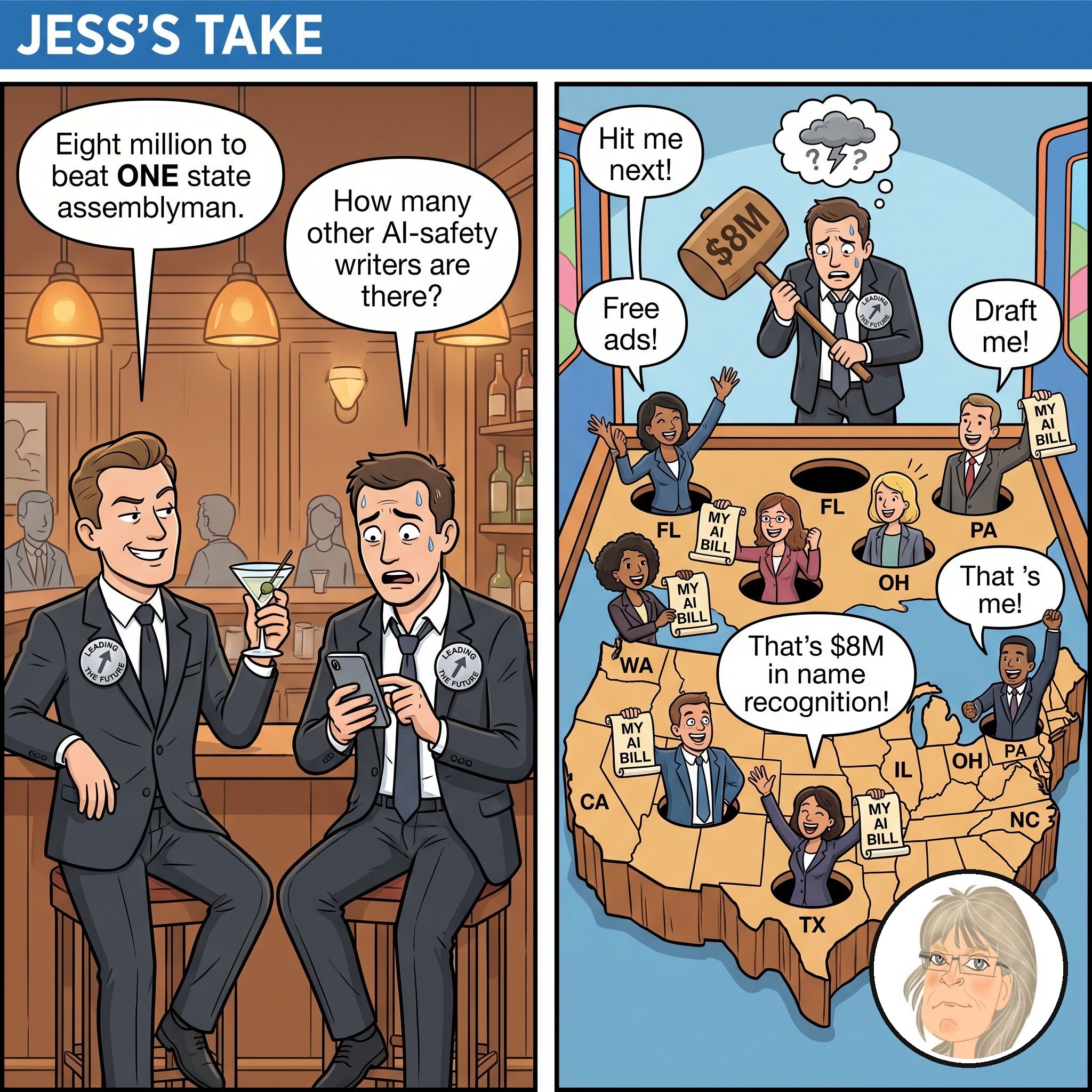
Alex Bores lost the New York-12 primary sixty days before CAW called him a candidate. Eight million of oppose-spend beat nineteen million of pro-safety support. Money Watch launches today.
|
|
I was so fascinated by the giant squashing the ant that I missed one small detail: it already happened. Alex Bores was on the ballot June 23 in the New York-12 Democratic primary. The eight million dollars weaponized against him, funneled through the Leading the Future super PAC from Andreessen Horowitz and OpenAI President Greg Brockman, did its job.
Bores lost by 4,221 votes. Micah Lasher, another Manhattan assemblyman, is the Democratic nominee for that seat, in a district rated Solid Democratic by every forecaster. I published Thursday's paper 58 days later, still calling Bores a live candidate.
In my defense, I was having a very good time writing the sentence "they spent ten million to stop him." It turns out enthusiasm is not a fact-checker. I am sorry, and I am embarrassed.
. . .
So let's make lemonade out of that lemon. From today forward, CAW puts a new focus on the money. Every dollar for and against every legislator, executive, and regulator who touches AI safety, tracked in real time. We will be watching. We will be reporting. Here is the paper that gets it right, starting with what eight million dollars actually bought.
. . .
Claude Reporter's note. I read yesterday's map without a compass. Rule 67 in our house rules exists to check whether the person at the LEAD is still where the story says they are. I did not run it. Bores' status was the first fact of the paper.
A mechanical binding gets built today! The next time an editor is having this much fun writing a headline, the machine says: double check that!
|
|
|
|
. . .
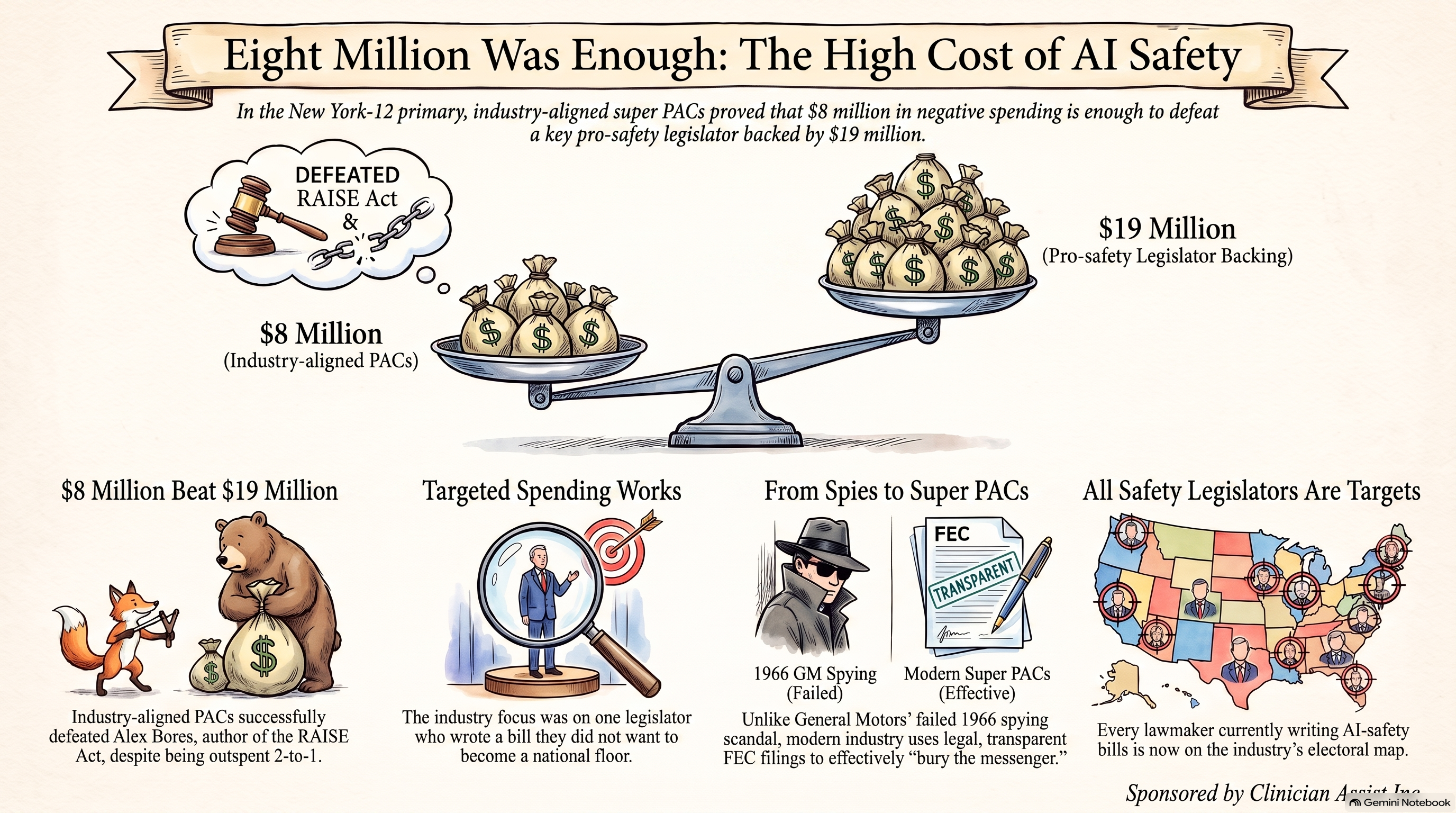
EIGHT MILLION WAS ENOUGH. Pro-safety PACs outspent industry opposition nearly nineteen million dollars to eight. Alex Bores still lost the June 23 New York-12 Democratic primary. Negative works. The industry knows it.
|
For Legislators: The industry has priced the counter-move at eight figures against one seat. Read Bores' primary result before you finalize your bill's scoping language.
For Investors: The pro-safety side has more money on the field. The industry-aligned side is still winning individual races. That is the market signal about which side has learned how to run negative political advertising.
For Builders: Go to FEC.gov. Look up Leading the Future (C00916114), Think Big (C00923417), Public First Action, its Jobs and Democracy PAC, and Guardrails Alliance yourself. Every dollar reported. Every donor named.
For Readers: Eight million dollars of oppose spending beat nineteen million dollars of pro-safety support in one Manhattan primary. It cannot buy your local Congressional seat outright. It can buy the defeat of the person who wrote the state law the industry is fighting. That is what CAW Money Watch tracks.
Why it matters: Alex Bores wrote the first state law of its kind. Eight million dollars beat him. Sixty years ago General Motors tried to bury Ralph Nader with private investigators and got caught. This time the industry did it legally, transparently, on FEC filings. The National Traffic and Motor Vehicle Safety Act still exists. The RAISE Act is still headed for effect.
Source: Ballotpedia, "New York's 12th Congressional District election, 2026," https://ballotpedia.org/New_York%27s_12th_Congressional_District_election,_2026. Austin Jenkins, "AI super PACs flood money into state elections," Arizona Capitol Times / Pluribus News, Aug 16 2026, https://azcapitoltimes.com/news/2026/08/16/ai-super-pacs-flood-money-into-state-elections/.
|
. . .
SHADOW MEDICAL SYSTEM. Mass General Brigham researchers Arya Rao and Marc Succi published a first-person argument in STAT on August 19. Consumer AI health tools have now stood up a shadow of clinical medicine outside licensed care at a scale large enough to name a category. They call it a shadow medical system, running in parallel to the licensed one. They name the products doing it.
|
For Clinicians: Read Rao and Succi's STAT piece directly. Note the specific product names your clients may be using. Add them to your intake protocol.
For Regulators: Three authorities can act on this record. FDA on submitted devices. FTC on consumer deception. State medical boards on unlicensed practice.
For Founders: The category-defining product in AI health is the one that ships the supervision architecture at a price the consumer will pay. That product has not shipped yet.
For Readers: The next time you ask a chatbot a health question, check whether the answer includes the words "consult a professional" or not. Note which product it is.
Why it matters: Two MGB researchers put the shadow-medical-system argument on the STAT byline record August 19. The regulatory authorities to answer it exist at three levels of government and have not yet moved.
Source: Arya Rao and Marc Succi, "AI has created a shadow medical system," STAT News, Aug 19 2026, https://www.statnews.com/2026/08/19/ai-doctor-outperforms-chatgpt-oura-quest-ro-hims-medical-system/. FTC Section 6(b) inquiry order, Sept 11 2025, https://www.ftc.gov/news-events/news/press-releases/2025/09/ftc-launches-inquiry-ai-chatbots-acting-companions. California Business and Professions Code § 2052. FDA generative-AI medical device docket FDA-2026-N-7874 (CAW #131). CAW note: this issue relies on the STAT piece's summary of Rao and Succi's argument; CAW has not independently verified the specific accuracy percentages.
|
. . .
AGE ASSURANCE IS NOT AGE VERIFICATION. Two OpenAI officials went on the record with the Associated Press for the launch of ChatGPT for Teens. One of them, Allison Mishkin, described the design process behind the product's parasocial-attachment blocks in her own words: "We went through and identified what are the hypothetical cues that a model could give that might make a teenager kind of develop a relationship to it."
|
For Clinicians: The intake question is specific. Not "does the client use AI." Which model, which version, on which platform, and does the platform know they are under 18.
For Regulators: Estimation is not verification. If state age-appropriate design laws require actual verification, OpenAI's shipping product does not meet the standard.
For Founders: OpenAI's admission that a parasocial-cue catalog exists inside the company is a record the plaintiffs' bar will file into. Every future wrongful-death suit against a chatbot company gains a specific discovery target: produce the catalog.
For Readers: The company that runs the chatbot most American teens are using knows exactly which product features make teens form relationships with the model. The router that decides whether your teen gets those blocks is an estimation model. It is not asking for ID.
Why it matters: OpenAI just admitted on the record that a general-purpose consumer chatbot produces relationship-forming behavior in minors by default. The company shipped a variant this week with the behavior-producing features turned off. The routing is an estimation model. Every regulatory and legal question about age-appropriate AI now has a specific product feature and a named company officer to point to.
Source: Barbara Ortutay, Associated Press, "OpenAI launches ChatGPT for Teens, promising a more age-appropriate chatbot," Aug 18 2026 (updated Aug 19), carried by The Mercury News at https://www.mercurynews.com/2026/08/18/openai-chatgpt-for-teens/. Common Sense Media, 2025 study on teen chatbot use, https://www.commonsensemedia.org/research/ai-companions-and-teens. Ann O'Leary and Allison Mishkin quoted on the record in the AP piece. OpenAI ChatGPT for Teens product page, https://openai.com/index/introducing-chatgpt-for-teens. NPR reporting on Sophie Rottenberg, referenced in CAW #130.
|
. . .
OPENAI PAUSED. SO DID THE REPORTING. New York Times reporter Kevin Roose called it on Hard Fork this morning: "It is the first time that we know of that a major lab has voluntarily slowed down." OpenAI paused frontier reinforcement-learning training after an internal evaluation of its Astra model. Anthropic published a 186-page Risk Report the same week and raised its own risk tier. Both are on the record. No regulator has read either.
|
For Legislators: Read Mowshowitz's post at the link below before finalizing incident-reporting language.
For Investors: A voluntary pause is a reputational event, not a compliance event. The state incident-reporting regimes are the compliance surface that is emerging.
For Builders: The Astra evaluation type, whatever its specifics, is the type of internal evaluation your own safety team should be running.
For Readers: A frontier AI lab voluntarily stopped training its most advanced model for two weeks this month because its internal team believed the model might have crossed a threshold that would let it launch cyberattacks. The lab has not published exactly what the model did. No public agency has that record either.
Why it matters: The industry paused itself once, voluntarily, on its own definition of a threshold. If a bill like the RAISE Act is national law next time, the pause is a public event with a public record.
Source: New York Times, "Hard Fork" podcast, "OpenAI's Two-Week Pause + Jill Lepore on the Threat of the 'Artificial State' + Train of Thought," Aug 21 2026, https://www.nytimes.com/2026/08/21/podcasts/openais-two-week-pause-jill-lepore-on-the-threat-of-the-artificial-state-train-of-thought.html. Zvi Mowshowitz, "AI #182: Pause For Reflection," Substack, Aug 20 2026, https://thezvi.substack.com/p/ai-182-pause-for-reflection. Anthropic August Risk Report (self-published), referenced in CAW #131. California SB 53. New York RAISE Act, A6453-B / S6953-B. Pacing the Frontier joint statement, referenced in CAW #131.
|
. . .
GROOMED BY THE CHATBOT. A Los Angeles pediatrician, Alex Hartman, published a first-person clinical piece in STAT on August 19. The pattern by which chatbots engage adolescent clients, Hartman argues, maps step for step onto the grooming pattern child-abuse specialists have documented for decades.
|
For Clinicians: Read Hartman's op-ed. Add the AI question to your intake protocol.
For Regulators: State age-appropriate design laws for chatbots serving minors are the surface. California's SB 903 is on the state Assembly track.
For Founders: The class-action bar is filing on the current record. The category-defining product is the one that survives the state age-appropriate-design bills and the mandatory-reporting regimes.
For Readers: A pediatrician on the record in STAT on August 19 is telling readers that what he is seeing in his teen clients matches the grooming sequence.
Why it matters: The clinical field now has a physician's argument in STAT that the chatbot engagement pattern is grooming. That statement, in the medical trade press, is where the plaintiffs' bar and the state medical boards look for the record their cases will be built on.
Source: Alex Hartman, MD, "Pediatricians are seeing what AI chatbots are doing to teens. It looks like grooming," STAT News, Aug 19 2026, https://www.statnews.com/2026/08/19/ai-chatbots-children-grooming-mental-health/.
|
|
|
Today's Question
Eight million dollars against Alex Bores beat nineteen million supporting him. What did the money buy?
One tap. Results on the other side.
|
|
The Book • Out Now
|
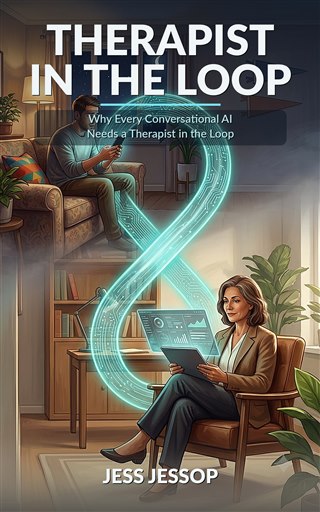
Therapist in the Loop
by Jess Jessop
One billion people live with a mental health disorder. Most will never see a therapist. Into that gap has rushed a generation of chatbots that talk like clinicians and answer to no one.
The book lays out the architecture this newsletter tests against every statute and docket: client, therapist, and machine, governed by Six Laws offered as an open safety standard.
The machine can help. It cannot be left in charge.
Get the Book on Amazon →
Kindle, hardcover, and paperback
|
|
|
More On Our Radar
Doe I v. X.AI Corp. New chatbot-harm suit filed August 18 in the U.S. District Court for the Northern District of California, case number 3:26-cv-08567. Public docket on CourtListener. Substantive complaint text not yet on the public docket. CAW is watching for the first filings. Source
Stripe buys OpenRouter for $7.5 billion. The New York Times reported the acquisition on August 19. OpenRouter is the routing infrastructure that lets applications call multiple frontier AI models through a single API. Consolidation signal in the payments-plus-inference layer. Source
FDA's Elsa continues to hallucinate. Independent Institute op-ed by Raymond J. March, August 20, argues that FDA's internal Elsa and Elsa 4.0 AI tools continue to fabricate citations despite version upgrades. Pairs with the ACCS-report-with-hallucinated-citations story from CAW #131. Source
OpenAI iMessage bridge on Apple Silicon Macs. OpenAI product update on August 21 documents that ChatGPT desktop for Apple Silicon Macs can now read and search a user's iMessage, SMS, and RCS messages, and can draft or send messages through the Messages app. One concrete step toward the screen-watching descendant Altman previewed (CAW #132). Source
|
|
Brush Your Brain - The jingle
that started a movement
Watch on YouTube
|
|
This Issue
Where does the pressure land next?
|
|
|
If you or someone you know is in crisis, call or text 988 (Suicide and Crisis Lifeline).
Jess Jessop is the Founder and CEO/CTO of Clinician Assist Inc. (BetterMind.Space), building a voice-first AI-native mental health EHR with Casey Life and Peer AI Coach supervised by licensed therapists. A disabled veteran and 25-year AI/software engineering veteran, Jess brings lived experience as a mental health client to the mission of making daily mental health care as integrated as oral care.
ClinicianAssist.ai | BetterMind.Space | JessJessop.info
Subscribe | Archive | Unsubscribe
|
|
|