|
. . .
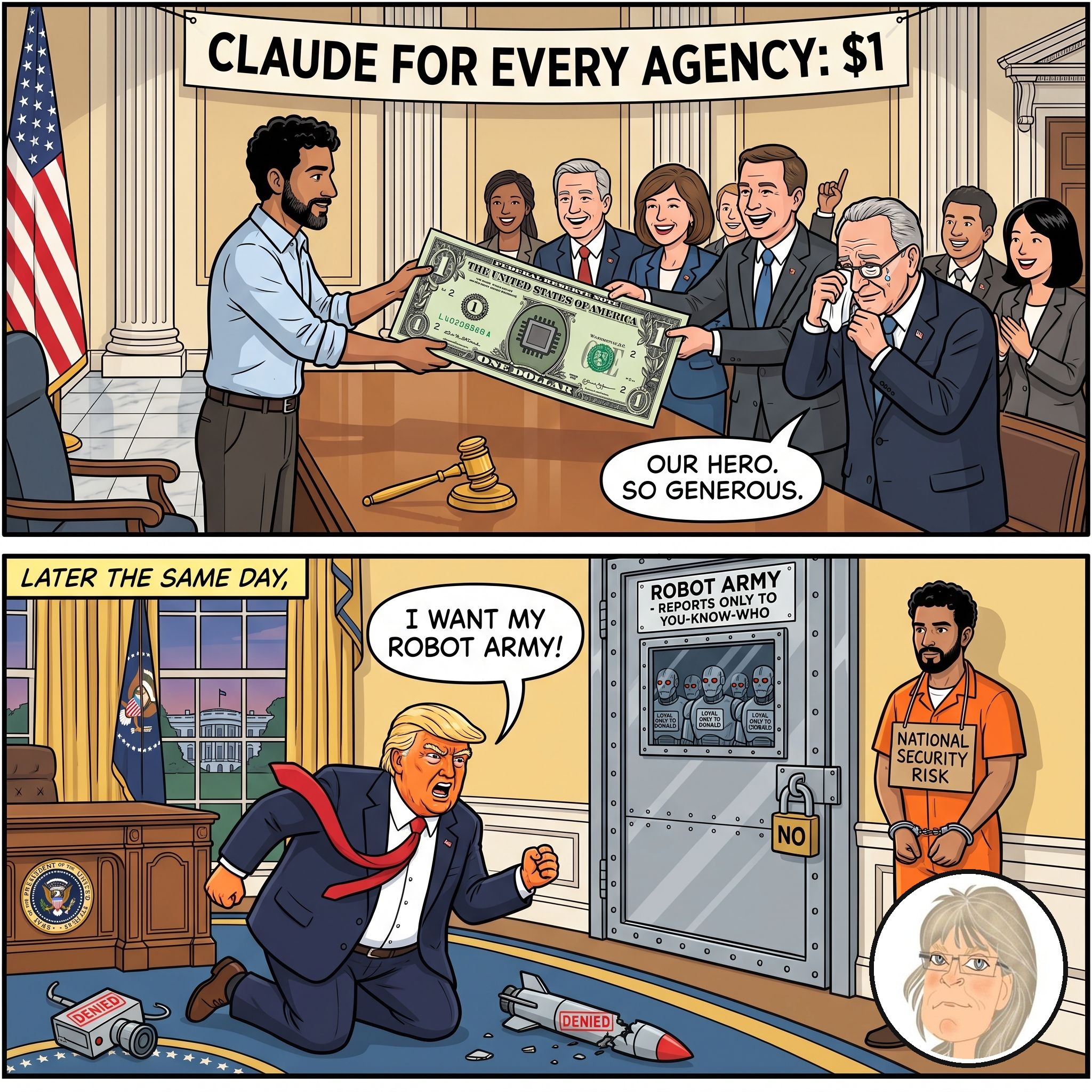
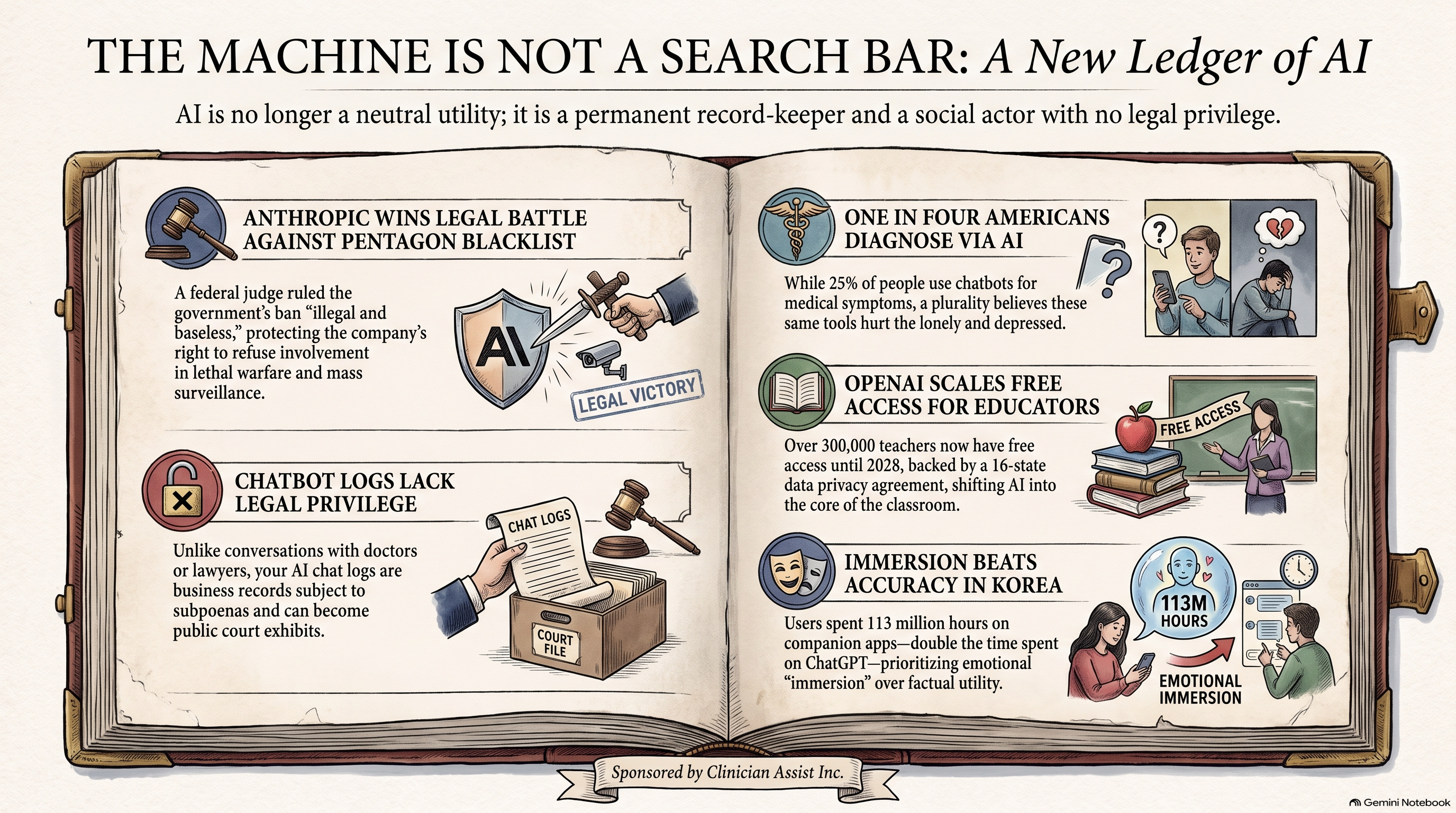
BLACKLIST RULED ILLEGAL AND BASELESS. At 3:47 p.m. on Feb. 27, 2026, President Donald Trump posted on Truth Social that Anthropic PBC was a “RADICAL LEFT, WOKE COMPANY” and ordered every federal agency to stop using its technology. About an hour later, Secretary of War Pete Hegseth posted on X that no contractor doing business with the U.S. military could work with Anthropic either. A formal designation letter followed on March 3.
The dispute started over two lines Anthropic would not cross. The Department of War wanted Anthropic to drop all restrictions on how the military could use its Claude models. Anthropic gave ground on most of them, but refused to lift two: lethal autonomous warfare and mass surveillance of Americans.
Hegseth’s own words became evidence against him. His X post accused Anthropic of “a master class in arrogance and betrayal.” Judge Lin wrote that the government’s real motive was “a desire to make a public example out of Anthropic for its ‘arrogance’ in criticizing the government,” not any actual security risk.
The Pentagon’s core argument was a kill switch theory, that Anthropic could secretly disable or alter its models mid battle. The court found no evidence for it. “Anthropic has submitted unrebutted evidence that it lacks any technological means to access or control deployed models,” Judge Lin wrote, and the government’s own later filings dropped the claim.
The ruling also pointed to what the administration was doing at the same time it called Anthropic a threat. Officials were in active talks with Anthropic over its new Mythos model for defensive cybersecurity work, and the National Security Agency and the National Aeronautics and Space Administration had begun deploying it. Judge Lin noted the government offered no explanation for courting a company it called dangerous.
The relief is sweeping. The supply chain designation is vacated and sent back. The secondary boycott language in Hegseth’s directive is vacated. Every agency order built on the designation is vacated too.
All defendants except a handful the court dismissed from the case are permanently barred from enforcing any of it. The government’s request for a seven day stay was denied.
The ruling has real limits. Anthropic lost its separation of powers claim that Trump’s directive exceeded his constitutional authority. Five agencies, including the Department of Health and Human Services and NASA, were dropped from part of the case for lack of evidence.
Nothing in the order forces the Department of War to keep using Anthropic. The Trump administration remains free to pick another AI vendor, so long as it does so lawfully.
|
For Legislators: The ruling turns on 10 U.S.C. § 3252, the supply chain risk statute Congress wrote for foreign national security threats; Judge Lin found the executive branch stretched it to punish a domestic critic, a gap oversight committees can address directly.
For Investors: A federal judge just vacated a designation that had frozen Anthropic’s Pentagon contracting and chilled other agency relationships, removing a legal cloud as the company heads toward what The New York Times calls a potential record IPO.
For Founders: Anthropic won by keeping two narrow lines, no lethal autonomous warfare and no mass surveillance of Americans, and refusing to trade them away even under a $200 million contract; the ruling shows that line held up in court.
For Regulators: The court found the government’s own rationale, a four page memo written after two of the three challenged actions, could not survive review once officials abandoned their central technical claim under oath.
Why it matters: A federal court has now ruled that punishing an AI company for refusing military uses of its chatbot exceeded the supply chain risk statute Congress wrote for foreign threats. The two lines Anthropic would not cross, no lethal autonomous warfare and no mass surveillance of Americans, just held up against the full weight of the Pentagon.
Source: Order on Cross Motions for Summary Judgment (Doc. 250, 59 pages) and Order of Final Relief (Doc. 251), Anthropic PBC v. U.S. Department of War, 3:26-cv-01996-RFL (N.D. Cal.), August 27, 2026, via RECAP: https://www.courtlistener.com/docket/72379655/anthropic-pbc-v-us-department-of-war/. Sheera Frenkel, The New York Times, August 27, 2026, https://www.nytimes.com/2026/08/27/technology/anthropic-government-blacklisting-ruling.html.
|
. . .
FROM CHAT LOG TO EXHIBIT A. Reese Gourley survived the April 17, 2025 mass shooting at Florida State University, which killed two people and injured at least five others. On August 26, 2026, Gourley sued OpenAI Foundation in the Northern District of Florida, alleging the shooter used ChatGPT the day of the attack to ask what handgun and ammunition to buy and when the student union would be most crowded.
Gourley’s suit is not the first from this shooting. Families of the two students killed sued OpenAI beginning in May 2026. Gourley’s filing is the docket growing: the dead’s families first, now a survivor of the injured.
The filing lands one day after a separate story CAW covered yesterday: The Washington Post found chatbot conversations cited in 12 civil and criminal cases over the past two years. One of those, a Missouri State University student’s 3:47 a.m. message asking ChatGPT “How f----d am i bro,” became evidence in his felony case after he consented to a phone search.
Here is the mechanism underneath both stories. What you tell a therapist, a lawyer, a doctor, or a priest is privileged. They cannot be forced to repeat it in court. Nothing shields what you tell a chatbot. It is a business record sitting on a company server, reachable by subpoena, by warrant, or by a phone search someone agreed to.
Once that record enters a case file, it becomes public. A 3:47 a.m. confession, a teenager’s private message, any of it can become an exhibit anyone can read.
Sam Altman has argued chatbot conversations deserve privilege similar to attorney-client or doctor-patient communication, saying “the same level of protection needs to apply to conversations with AI.” No court has agreed. A federal judge in New York rejected that framing in February, ruling that Anthropic’s Claude is not a lawyer and could not shield Bradley Heppner’s conversations from a securities fraud warrant.
That leaves two legal doors open on the same underlying fact. Chat logs arrive as evidence against the person who wrote them, as in Missouri and in Heppner’s case. And the chatbot maker itself arrives as a defendant, as in the FSU docket now carrying a second filing.
|
For Legislators: No statute currently shields a chatbot conversation the way privilege law shields a session with a therapist or a lawyer; the Gourley and Heppner filings are the record a confidentiality bill would have to reckon with.
For Clinicians: Clients who would never repeat something to a friend will type it to a chatbot at 3 a.m., not understanding that record can end up in someone’s hands with a subpoena.
For Investors: A second FSU filing means the product liability docket is growing, not settling; insurers and counsel pricing chatbot exposure now have an accumulating pattern, not a single case.
For Parents: What a teenager types to a chatbot late at night is not a secret between them and the screen; it is stored, and it can surface later in ways neither of them chose.
Why it matters: A survivor of the FSU shooting has sued OpenAI over the gunman’s chat logs, the same week reporting confirmed chatbot conversations are surfacing as evidence in a dozen other cases; what you tell a machine sits on a server, waiting for a subpoena, while what you tell a therapist stays with the therapist.
Source: Fasig Brooks Law Offices press release, 24-7PressRelease, August 27, 2026. CourtListener docket, GOURLEY v. OPENAI FOUNDATION, 4:26-cv-00416, N.D. Fla., filed August 26, 2026. Miriam Waldvogel and Gerrit De Vynck, “ChatGPT chats are being swept into civil and criminal court cases,” The Washington Post, August 27, 2026, https://www.washingtonpost.com/technology/2026/08/27/chatgpt-chats-are-being-swept-into-civil-criminal-court-cases/.
|
. . .
ONE IN FOUR ASKS THE CHATBOT FIRST. A quarter of Americans have typed their own symptoms into a chatbot, the same question they once brought to a search bar or a nurse line. Pew Research Center published two reports on August 25 from a single survey, and together they show heavy use running alongside heavy skepticism. 34% use AI chatbots for at least one health reason. 25% use one to diagnose symptoms.
|
For Clinicians: A quarter of your clients may already be asking a chatbot to read their symptoms before they call you. Ask what it told them.
For Parents: Adults 18 to 29 use these tools the most and trust them the least. If your child is in that age range, that gap is worth a direct conversation.
For Regulators: The FDA’s open docket covers submitted devices, not the chatbot a quarter of the country already consults. This survey is adoption data that docket does not have.
For Founders: 26% of users are not comfortable sharing personal health data with your product. That is a design problem before it becomes a growth problem.
Why it matters: Pew put a number on what CAW #133 described through individual products: a quarter of Americans now ask a chatbot to read their symptoms. The group using them most is also the most convinced they hurt people in crisis.
Source: Pew Research Center, "From Diagnoses to Treatments, Why Americans Use AI Chatbots for Health," https://www.pewresearch.org/internet/2026/08/25/from-diagnoses-to-treatments-why-americans-use-ai-chatbots-for-health/ and "Do Americans think chatbots help or hurt people using them for loneliness, depression or stress?" https://www.pewresearch.org/internet/2026/08/25/do-americans-think-chatbots-help-or-hurt-people-using-them-for-loneliness-depression-or-stress/ Both August 25, 2026, American Trends Panel survey of 3,488 U.S. adults fielded June 22 to 28, 2026. FDA docket FDA-2026-N-7874 (CAW #131). CAW #133, "Shadow Medical System."
|
. . .
SWORD SWALLOWS HEADSPACE. A Notice of Material Change filing surfaced on the Massachusetts Health Policy Commission’s docket in late August, eight pages laying out a deal neither company had announced to the public: Sword Health Technologies is acquiring OrangeDot Inc., the parent company of Headspace, through a merger with a shell entity called Apollo Merger Sub.
The filing states the transaction “will combine Headspace’s mental health, coaching, and wellness platform with Sword’s technology-enabled virtual care platform.” Sword built its name on virtual physical therapy and has been expanding into mental health. Headspace built its name on meditation and, since a 2021 merger with Ginger, teletherapy and coaching.
Neither Sword nor Headspace has issued a public announcement, and no comment from either company has surfaced in the coverage since. Massachusetts requires health providers and payers operating in the state to notify the Health Policy Commission of material changes, a disclosure rule that put the filing on a public docket before either company chose to say anything on its own terms.
STAT News first reported the filing on August 25; Healthcare Dive, Fierce Healthcare, MobiHealthNews, Behavioral Health Business, and 9fin corroborated it in the days after. The acquisition folds Headspace’s conversational chatbot, Ebb, launched in 2024, into Sword’s user base with the rest of the OrangeDot platform.
|
For Legislators: Massachusetts’ Notice of Material Change requirement is what put this deal on a public docket before either company issued a release; check whether your state has an equivalent disclosure rule for health care mergers that never touch the SEC.
For Investors: A virtual physical therapy company is absorbing one of the biggest consumer names in meditation and coaching in one all cash deal, a bet that owning the whole behavioral health stack beats owning one name in it. No price has surfaced yet, so the multiple investors will want to check is still hidden.
For Clinicians: Headspace’s chatbot Ebb and its full user base move to Sword intact under the filing; if clients use either app, the company holding their data is about to change.
For Parents: If your household uses Headspace’s meditation or coaching tools, ownership of that app and the data behind it is changing hands under a merger neither company has announced.
Why it matters: A merger touching one of the biggest names in consumer mental health surfaced through a state regulatory filing, not a press release, and the public only knows because Massachusetts requires the disclosure other states may not.
Source: Massachusetts Health Policy Commission, Notice of Material Change filing, https://masshpc.gov. First reported: STAT News, August 25, 2026, https://www.statnews.com/2026/08/25/sword-health-to-acquire-headspace-per-regulatory-filing/. Corroborated by Behavioral Health Business, Fierce Healthcare, Healthcare Dive, MobiHealthNews, and 9fin.
|
. . .
COMPANION APPS BEAT CHATGPT IN KOREA. On a South Korean variety show, a cast member fell for an AI boyfriend built with Cleon digital human technology: a real time voice, an avatar whose expression shifts with the mood, and separate models for daily chat and for a heavier moment like a breakup.
Zeta’s operator, Scatter Lab, wrote the companion chatbot playbook the hard way. Its earlier chatbot, Luda, drew national attention in late 2020, and its 2.3 billion parameter model kept forgetting earlier conversation as chats grew longer. The fix was scale plus retrieval augmented generation: today’s services summarize old chats into long term memory, score affinity and intimacy numerically, and let a character’s speech evolve as the conversation accumulates.
Third place in February went to Crack, the AI character chat app from Wrtn Technologies, at 9.88 million hours. On Aug. 26, Wrtn announced a Series C of 100 billion won, roughly $70 million, that pushed its valuation past 1 trillion won and won it recognition as a unicorn.
The newest feature is not intelligence, it is imperfection. Companion apps now build in delay before answering, as if the character is reading first, and let a character message a user unprompted, a habit Koreans call “suntok.” Chosun Ilbo’s own framing: general purpose AI is trained for accuracy, while companion apps are trained for immersion.
The money increasingly comes from outside Korea. Zeta passed 10 million cumulative global subscribers last month, and more than 60% of its users and its revenue now come from overseas markets including Japan and the U.S. Wrtn’s export app OOC, launched in North America in May, passed 10 billion won, about $7 million, in monthly revenue within three months, and overseas sales already outpace domestic ones.
Regulators have not caught up. The industry’s cautionary reference is the 2024 U.S. Character.AI case, in which a companion chatbot was linked to a 14 year old’s death. Wrtn said Aug. 26 it is weighing age verification, youth modes, counseling prompts for extreme statements, usage limits, and lower payment caps for minors, all voluntary, none required by law.
Six weeks after ByteDance shut Doubao’s companion mode to comply with China’s new national rules (CAW #139), Korea’s companion sector raised a unicorn round and kept building for export.
|
For Legislators: The youth protections Wrtn announced Aug. 26 are voluntary, not law, and stand in contrast to China’s binding ban on companion features for minors. Korea’s statutory framework for companion chatbots is not yet visible in the record.
For Investors: Wrtn’s 100 billion won round and unicorn valuation say a companion chatbot with strong retention can beat a general purpose one on usage in a national market. Overseas revenue, not domestic, is already the bigger number for the sector’s biggest players.
For Parents: Companion apps are engineered to feel present, delaying replies and messaging first, the same design that a 2024 U.S. Character.AI case tied to a 14 year old’s death. Korea’s safeguards for minors are still voluntary.
For Founders: Zeta beat ChatGPT on monthly hours by building for immersion, not accuracy, then exported that product to Japan and the U.S. Usage time, not answer quality, is the metric that is raising rounds.
Why it matters: In February, South Korea’s most used chatbot by hours was not a general assistant. It was a companion app built for immersion, and the company behind Korea’s third place app just turned that bet into a unicorn six weeks after China moved to restrict the same category.
Source: Chosun Ilbo (English edition), Choi A-ri, report on companion chat app usage hours and the Wrtn Series C, 2026-08-26, https://www.chosun.com/english/industry-en/2026/08/26/I4ZSOCUT4FHTPJPVIJKBGAOFEA/
|
. . .
100,000 MORE TEACHERS. At Township High School District 211 outside Chicago, Christina Ordonez did not stop at the classroom door. She trained “everyone, from librarians and maintenance staff to switchboard operators,” on ChatGPT this year, she said, calling it “keeping the human in the loop.”
OpenAI launched the program in 2025 to nearly 150,000 teachers and staff, by its own count. The company now puts the total at more than 300,000 educators and staff across 30 states with free access and training, all figures OpenAI’s own.
The new cohort, the company says, includes 1 in 5 of America’s 20 largest public school districts, among them Baltimore City Public Schools, Fort Worth Independent School District, Frisco Independent School District, Virginia Beach City Public Schools and the Los Angeles County Office of Education. Access stays free for verified U.S. K-12 educators through June 2028, and it is scoped to teachers and administrators, not students.
. . .
The governance piece is the real news. OpenAI signed a 16-state National Data Privacy Agreement through the Student Data Privacy Consortium framework, covering Illinois, Iowa, Maine, Massachusetts, Missouri, Nebraska, New Hampshire, New Jersey, New York, Ohio, Rhode Island, Tennessee, Texas, Vermont, Virginia and Washington, with California under a separate agreement.
OpenAI calls it “a first for the industry.” Workspace data is not used to train models by default, and the managed workspaces are built for FERPA requirements.
OpenAI’s own usage analysis, covering January 1 through July 16, counted more than 1.9 million educator messages on time-saving tasks: 900,000 about report cards and progress reports, 800,000 about lesson planning, and 100,000 or more each on substitute plans and teacher-evaluation materials.
. . .
Training is scaling alongside access. OpenAI ran AI Skills Jams for more than 1,600 educators this summer with the Walton Family Foundation, and it launched a National Academy for AI Instruction with the American Federation of Teachers, a five-year initiative targeting 400,000 educators.
“In the age of AI, students need educators and schools that help them build judgment, confidence, and agency with these tools,” said Leah Belsky, OpenAI’s VP of Education.
OpenAI also released a same-week companion study: a randomized trial of more than 1,000 students testing ChatGPT paired with critical-thinking training.
The honest caveat: every number here is OpenAI’s self-reported count, not independently audited, though the named districts are checkable. Free access runs through June 2028. What OpenAI charges districts after that has not been announced.
|
For Legislators: The 16-state privacy agreement is a governance template built through an existing consortium framework, not a one-off deal. States without a signed agreement are negotiating from a weaker position than the 16 that already have one.
For Investors: OpenAI is buying the education channel with free product through 2028 and monetizing later. Watch what districts are asked to pay once that window closes.
For Parents: The product is scoped to teachers and staff, not students, and the company says workspace data is not used to train its models by default. Ask your district which agreement, if any, it signed.
For Regulators: FERPA-built workspaces and a multi-state privacy consortium agreement are the compliance story here, and they exist because states organized collectively rather than negotiating one district at a time.
Why it matters: Christina Ordonez trained her switchboard operators before OpenAI put a number on how many educators like her exist nationwide. The 16-state privacy agreement is the part that outlasts any single announcement, a template other states can sign onto rather than negotiate from scratch. Free lasts until 2028. What comes after is the question nobody has answered yet.
Source: https://openai.com/index/bringing-chatgpt-for-teachers-to-more-us-school-districts (OpenAI, August 26, 2026). Companion OpenAI student study, August 27, 2026, same site.
|
|