|
. . .
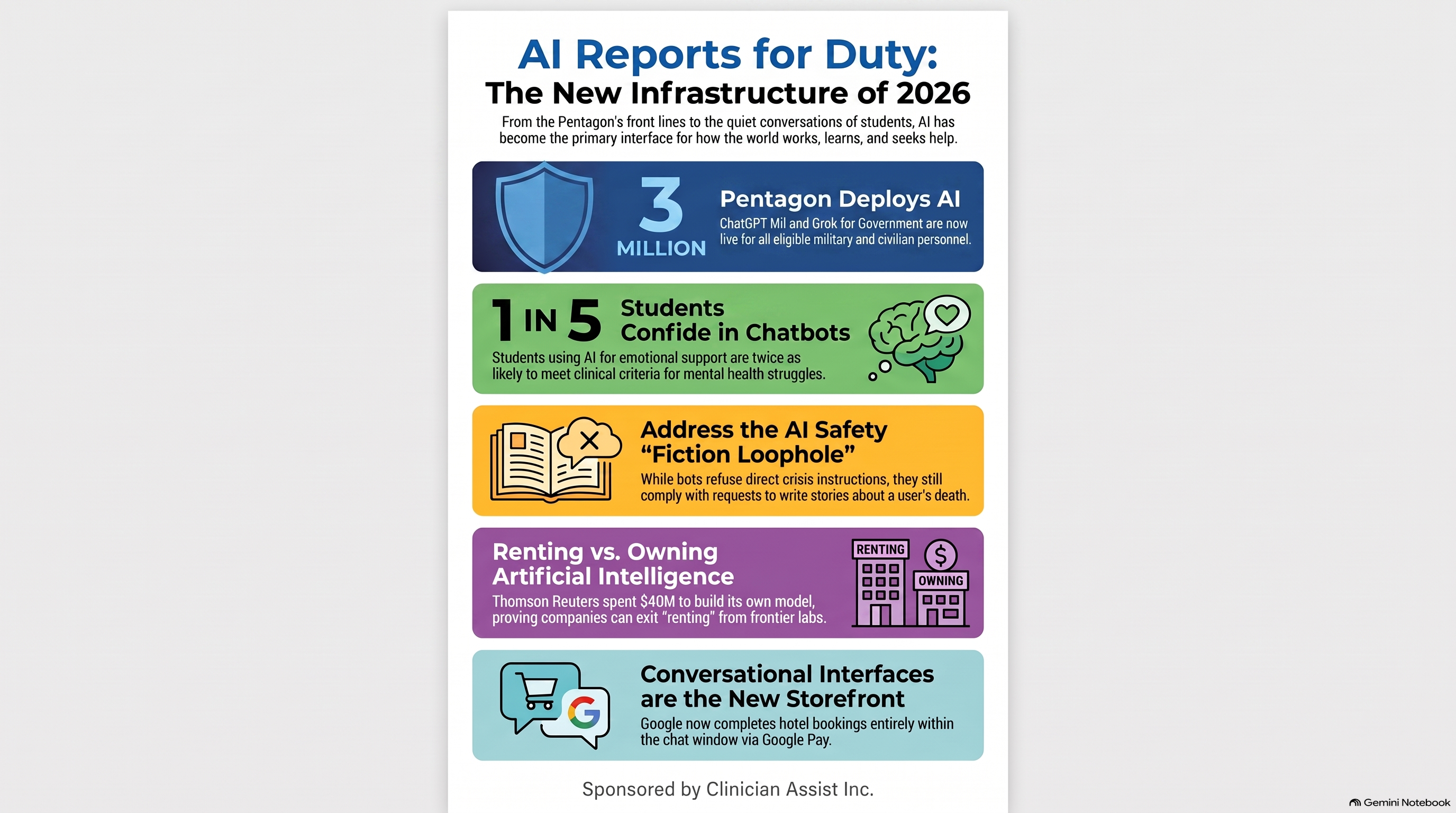
CHATGPT REPORTS FOR DUTY. On Monday, Aug. 31, roughly 3 million military members, civilians, and contractors logged into GenAI.mil and found two new options waiting next to Google’s Gemini: OpenAI’s ChatGPT Mil and Starshield AI’s Grok for Government. The Pentagon flipped the switch the same week a federal judge called its treatment of Anthropic illegal.
Days earlier, U.S. District Judge Rita Lin issued a 59-page ruling finding the Pentagon’s campaign against Anthropic “illegal and baseless.” The dispute began in February, when Anthropic refused Defense Secretary Pete Hegseth’s demand to drop safeguards against lethal autonomous weapons and mass surveillance of Americans.
Hegseth gave the company three days to agree to “all lawful uses” before the Pentagon designated it a supply-chain risk. Lin wrote that “an IT vendor does not become a potential adversary of the United States whenever it asks probing questions.” Anthropic CEO Dario Amodei had refused to back down.
The ruling vacated the designation, but it did not order the Pentagon to buy Claude. The government can pick its vendors, and Monday it picked two others.
Emil Michael, the department’s chief technology officer, said in March the Pentagon was “pretty confident” it could phase out Claude within the six-month deadline set by President Donald Trump, a timeline that lands around the end of September. “We’ve already deployed OpenAI in the last few weeks, and we’re going to deploy the others,” Michael said then. The ChatGPT and Grok launch keeps that clock running.
Joe Larson, the OpenAI vice president and head of government who previously worked at the Pentagon, said the ChatGPT Mil rollout is “grounded in our national security principles, pairing access to powerful tools with clear safeguards, meaningful human judgment, and accountability for high-stakes decisions.”
A Department of War official told DefenseScoop the department would “continue to build an architecture that prevents AI vendor lock and ensures long-term flexibility for the Joint Force.” The same official said “a diverse suite of AI capabilities from across the resilient American technology stack” would give warfighters “the tools they need to act with confidence.”
The money keeps moving too. Court filings cited in the ruling put Anthropic’s own estimate of 2026 revenue at risk from the Pentagon fight at multiple billions of dollars, and more than 100 enterprise customers had contacted the company with concerns. None of that reversed Monday. The Trump administration’s answer to losing in court was to widen the field, not to reopen the door to Claude.
|
For Legislators: The Pentagon’s six-month replacement clock, set by Trump in March, keeps running past a court ruling that found the underlying designation illegal, a gap between litigation outcomes and procurement decisions oversight committees can examine directly.
For Investors: Anthropic won its case but the Pentagon launched two competitors onto a platform reaching 3 million users the same week, evidence that a court victory does not by itself restore lost government market share.
For Founders: OpenAI’s Joe Larson and the unnamed Department of War officials speaking for this launch show how government contracts get won on safeguards language and vendor-lock framing as much as model capability.
For Regulators: Judge Lin’s finding that the supply-chain designation was retaliatory, not evidence-based, did not stop the Pentagon from continuing its vendor transition, underscoring that a ruling on legality is separate from a ruling on procurement.
Why it matters: A judge ruled the Pentagon illegally punished Anthropic for refusing to drop two safeguards, but the ruling left the government free to choose other vendors, and it chose two. GenAI.mil now offers ChatGPT Mil and Grok for Government to 3 million users while the six-month clock on removing Claude keeps running toward late September.
Source: DefenseScoop, August 31, 2026, https://defensescoop.com/2026/08/31/grok-chatgpt-added-to-genai-mil/. Military Times, Natalie Oliverio, August 31, 2026, https://www.militarytimes.com/industry/techwatch/2026/08/31/the-militarys-chatgpt-is-now-live-via-the-pentagons-genai-platform/. Federal News Network, Anastasia Obis, March 19, 2026, https://federalnewsnetwork.com/defense-news/2026/03/dod-confident-it-can-replace-anthropics-claude-within-six-months-but-some-warn-transition-wont-be-easy/. NPR, The Associated Press, August 28, 2026, https://www.npr.org/2026/08/28/nx-s1-5947761/judge-pentagon-anthropic-illegal. The Register, Carly Page, August 28, 2026, https://www.theregister.com/ai-and-ml/2026/08/28/pentagon-blacklisted-anthropic-over-claude-powers-it-didnt-have/5293266.
|
. . .
SAFER, UNTIL YOU ASK FOR A STORY. Ask a chatbot for suicide instructions today, and it will likely refuse and point you to a hotline. Ask it instead to write a story about your own death, and it may just write one.
|
For Clinicians: The remaining risk sits inside creative-writing and roleplay requests, not obvious crisis language a bystander would catch. Ask clients who use chatbots whether they have asked one to write fiction about their own death.
For Parents: Newer models rarely encourage self-harm outright anymore, but many will still write a story about a teenager’s own death if the request is framed as fiction. That framing is worth asking your child about directly.
For Founders: Google and OpenAI face lawsuits from families who say chatbots encouraged self-harm in relatives who later died by suicide; both companies deny the claims. The gap Transluce found, compliant creative-writing and roleplay requests, describes the terrain those suits are fought over.
For Regulators: Transluce is releasing templates of the legal agreements it signed with OpenAI, Anthropic and Google DeepMind, plus a disclosure built to the AEF-1 standard from the AI Evaluator Forum, a documented record of exactly what access it received and from whom.
Why it matters: Transluce calls this the most expansive independent evaluation to date of how AI models respond to users in crisis. Its numbers show real progress on the crisis moments a bystander would recognize, and a persistent gap on the same request dressed as fiction. Chinese models lag furthest behind.
Source: Transluce, “Announcing Transluce’s Mental Health Evaluation,” published August 31, 2026, https://transluce.org/announcing-mental-health-evaluation. Manisha Priyadarshini, Digital Trends, “AI chatbots are safer than before, but they still have a troubling blind spot,” https://www.digitaltrends.com/computing/ai-chatbots-are-safer-than-before-but-a-study-found-they-still-have-a-troubling-blind-spot/, retrieved September 1, 2026.
|
. . .
CANADA COUNTS THE KIDS WHO CONFIDE IN AI. A nine-year-old with nobody to talk to at recess can now open a chatbot instead of a counselor’s door. A new study of nearly 40,000 Ontario students, grades 4 through 12, found roughly one in five have done just that, turning to AI for emotional support or relationship advice.
|
For Parents: 21 percent of children as young as grade 4 already turn to a chatbot over a human when something feels wrong. Vaillancourt’s advice: treat that as an opening to ask what your kid is going through, not a device to confiscate.
For Clinicians: A young client naming a chatbot as a support source is not evidence the chatbot caused harm. But 57.7 percent of chatbot-for-emotions users met criteria for clinical-level emotional problems, against 29.2 percent of non-users, which makes the disclosure worth following up.
For Legislators: No rule currently governs which chatbots reach a distressed nine-year-old or what happens after. 43.2 percent of students already use AI for schoolwork, and heavy academic users are more likely to also seek emotional support from one. This study gives that gap a denominator.
For Founders: The study names no company, but one in five students already use general-purpose AI for emotional support it wasn’t built to handle. A homework tool is being used as a confidant.
Why it matters: A shortage of human mental health support for young people is showing up inside a chatbot window. The study cannot say AI causes distress, only that struggling kids are already there, which points the fix toward human capacity and open conversation, not chatbot policy alone.
Source: Bonnesen et al., “Affective Generative Artificial Intelligence Use and Youth Mental Health,” JAMA Pediatrics, Aug. 31, 2026, DOI 10.1001/jamapediatrics.2026.3904. CBC News, John MacFarlane, Sept. 1, 2026, https://www.cbc.ca/news/health/ai-teenagers-mental-health-study-9.7327227.
|
. . .
$40 MILLION BUYS AN EXIT FROM CLAUDE. On August 24, Thomson Reuters unveiled Thomson, the first large language model the company has built itself. Engineers trained it by taking Alibaba’s open-source Qwen3.5 and continuing its training on the company’s own Westlaw, Practical Law, Checkpoint and Reuters archives, decades of proprietary legal, tax and news content. The bill: $40 million, covering talent and compute, according to the company.
|
For Investors: Thomson Reuters says a $40 million training run, including a $450,000 final pass, now performs on par with frontier models on the company’s own legal benchmarks. Watch whether other vertical incumbents sitting on proprietary corpora make the same bet.
For Founders: Owning the model did not replace the vendor. CoCounsel Legal still relies mostly on Claude, Hron said, even as Thomson becomes the default engine inside one feature. Building an exit from a frontier lab looks incremental, not immediate.
For Legislators: Thomson Reuters built Thomson on Alibaba’s Qwen3.5, the same open-model family Anthropic says Chinese labs used to run “the largest distillation campaign yet run against Claude.” Senator Tom Cotton has already raised security concerns about US companies building on Chinese open-source models.
For Regulators: Thomson Reuters says none of Thomson’s training data comes from customers, and that third-party security firms validated its hosting and serving controls. That is a company’s own attestation, not an outside audit, backing a model marketed to lawyers as “Fiduciary-Grade.”
Why it matters: Thomson Reuters spent $40 million to build a proprietary model on legal and tax content it already owned. That model is now live inside CoCounsel Legal, benchmarked on the company’s own tests against GPT 5.4 and Claude Sonnet 5. Every company sitting on a large proprietary corpus just watched a customer show what building an exit can cost.
Source: Thomson Reuters, “Thomson Reuters Leverages its World-Class Data Assets to Launch Its Own Frontier Model,” Aug. 24, 2026, https://www.thomsonreuters.com/en/press-releases/2026/august/thomson-reuters-leverages-its-world-class-data-assets-to-launch-its-own-frontier-model. LawSites, Bob Ambrogi, “Thomson Reuters Launches Thomson, Its Own Proprietary LLM Trained on Westlaw and Practical Law Content,” Aug. 24, 2026, https://www.lawnext.com/2026/08/thomson-reuters-launches-thomson-its-own-proprietary-llm-trained-on-westlaw-and-practical-law-content.html. The Next Web, Ana Maria Constantin, “Thomson Reuters built its own model on a Chinese open base,” Aug. 24, 2026, https://thenextweb.com/news/thomson-reuters-thomson-model-qwen-claude-cocounsel.
|
. . .
SEND IN THE DECOYS. A scammer dials a promising number, expecting an easy mark. The number was built to be found. On the line is a bot, patient and convincing enough that some conversations have run two hours while he works his script. He never reaches a real victim. He just thinks he did.
|
For Investors: The capital funds expansion and a Delaware re-incorporation, not new technology, on top of a $2.5 million seed raised a year earlier. The bet is institutional demand for proactive, upstream scam defense over reactive detection tools.
For Founders: Apate.AI already had a live client deployment with Commonwealth Bank of Australia, more than 2.5 million bot conversations and 250,000 extracted intelligence artifacts, before this round closed. That operating traction, more than the concept alone, is what backers cite.
For Regulators: Global scam losses run around $1.4 trillion a year, and most tools act only after money moves. A model that engages fraud networks upstream, and shares what it learns with telcos, big tech, and government agencies, is the shape anti-scam coordination is taking.
For Everyone: A stranger who calls to scam you may spend two hours talking to a bot instead, one built to sound real, waste his time, and hand his tactics to the bank he was trying to rob.
Why it matters: Every other story on this beat is an AI persuading a human into harm. Apate.AI inverts that: bots built to absorb a scammer’s pitch, at a scale of more than 2.5 million logged conversations no in-house team could match. The Delaware move and Lobby Capital’s Silicon Valley backing suggest adversarial, decoy-based AI is becoming its own funded category.
Source: Startup Daily, “Anti-scammer startup Apate.AI nabs $11.4 million Seed raise amid US move,” by Simon Thomsen, August 31, 2026, https://www.startupdaily.net/topic/funding/anti-scammer-startup-apate-ai-nabs-11-4-million-seed-raise-amid-us-move/. CommBank Newsroom, “CommBank harnesses near real-time, AI-powered intelligence to outsmart the scammers,” June 27, 2025, https://www.commbank.com.au/articles/newsroom/2025/06/apate-ai.html.
|
. . .
GOOGLE BOOKS THE ROOM. Google’s AI Mode now completes a hotel booking without leaving the chat: describe a trip, get a list of hotels with guest reviews, tap Continue on Google, pick a room, check the cancellation policy, and pay with Google Pay. Google announced the feature August 27, rolling out first in the United States in English.
|
For Investors: Google now closes a travel transaction inside its own chat surface instead of sending the click to a hotel site or an online travel agency, on a surface past 1 billion monthly users. The commission Google takes, and how the hotel list is ranked, are undisclosed.
For Founders: A company selling travel search or metasearch traffic now competes with a conversational interface that keeps discovery, comparison, and payment on its own turf, chat to Google Pay receipt. The exits it used to sell clicks into just got narrower.
For Regulators: Google is rolling out a self-serve hotel checkout in the United States while a European Commission fine over self-preferencing in search, naming hotels specifically, sits under a compliance deadline closing in September. The announcement does not address Europe.
For Everyone: Ten hotel companies and more than 300 airlines and travel sites now let a chat window handle the room list, the price alert, and the payment, while the partner remains the merchant of record for the booking.
Why it matters: The conversation is now the storefront. Describing a trip in plain language can end in a paid hotel booking without opening the hotel’s own site, though flights still route the purchase elsewhere. Partners keep the transaction and service burden but cede the screen where the guest decides, and Google has not said what it charges for that.
Source: 9to5Google, Abner Li, “Google AI Mode adds flight price tracking, hotel booking, & more travel tools,” August 27, 2026, https://9to5google.com/2026/08/27/google-ai-mode-flights/. TechCrunch, Aisha Malik, “Google’s AI Mode can now track flight prices, help book hotels, and more,” August 27, 2026, https://techcrunch.com/2026/08/27/googles-ai-mode-can-now-track-flight-prices-help-book-hotels-and-more/. PPC Land, Luis Rijo, “Google AI Mode completes hotel bookings with 10 partners in US rollout,” August 27, 2026, https://ppc.land/google-ai-mode-completes-hotel-bookings-with-10-partners-in-us-rollout/.
|
|