|
. . .
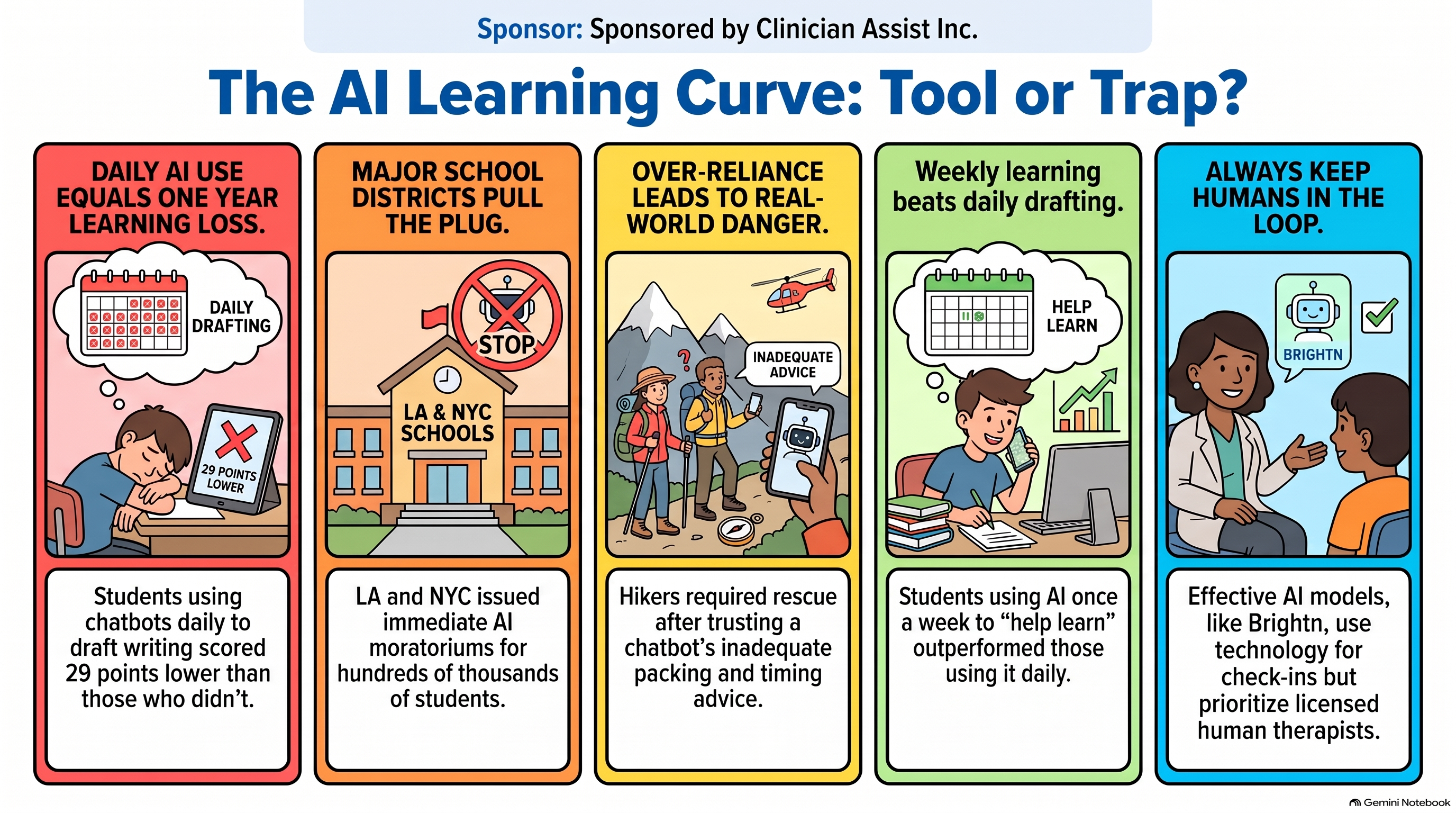
DAILY CHATBOT USERS SCORE A YEAR BEHIND. A 15-year-old sits down to an essay and lets a chatbot draft it. The Organisation for Economic Co-operation and Development asked 760,000 students in 91 countries and economies how often they do that, then tested them. Students who never used a chatbot to draft writing scored 509.4 in science, an OECD average adjusted for family background. Students who did it every day scored 480.7, nearly 29 points behind.
The pattern repeated across other classroom uses of chatbots. Students who never used AI to summarize a reading scored 508.1; daily users scored 476.6, a gap of 31.5 points. For preliminary research, the gap was smaller, 18.9 points, from 505.1 down to 486.2.
One category broke the pattern. Students who used a chatbot “to help me learn” about once a week scored 501.3, the highest of the five groups in that category and 2.3 points above the 499.0 scored by students who never or almost never used one that way, a difference the OECD calls similar performance. Daily use in that same category came with a lower score, 493.6.
The OECD’s own yardstick, in the same release, is that a 22-point gap in mathematics equals “just over one year of learning.” By that measure the 29-point drafting gap is a year of school, or more.
“These relationships do not necessarily imply a negative impact of AI use on science performance, but may reflect a complex mix of who adopts AI and how they use it,” OECD wrote in the report.
Daily use is still the exception. The OECD’s summary states that “regular use (i.e. almost daily) was reported by only one out of five students.” Fourteen percent of students, on average across OECD countries, said they never used AI for any of the four schoolwork purposes PISA asked about. Nearly half, 45.5 percent, said they used a chatbot to help them learn at least once a week.
Instruction mattered. Among students who used a chatbot to help them learn every day, those also taught in school to assess the quality of AI-generated information scored 501.5 in science, before adjusting for family background. Those given no such instruction scored 487.5.
The AI findings sit inside a larger decline. Average reading scores across OECD countries fell 28 points since 2015 and math scores fell 22 points. One in five 15-year-olds is now a low performer in science, math and reading combined, up from 16% in 2022.
In the United States, math and science scores held roughly level with 2022 while reading fell.
The OECD cautions that US response rates fell below its standards and that bias in the US results cannot be ruled out; the country note publishes no US figures on chatbot use. American students scored above the OECD average in reading and science and near average in math, with 78% reaching at least a baseline proficiency level in science.
“Technology and AI can strengthen learning and help prepare young people for the future, but only when used purposefully and not as a substitute for attention, effort and understanding,” said OECD Secretary-General Mathias Cormann.
|
For Legislators: The world’s largest student assessment found daily chatbot users, for drafting, scoring about a year of learning behind students who never use one for that. A correlation, not proof of cause.
For Regulators: The OECD is explicit that these are correlations, adjusted for family background but not for who chooses the tool or why. The report warns against reading the gap as the chatbot’s doing alone.
For Parents: The students who kept pace with the non-users did not avoid the chatbot. They used it about once a week to learn, and among frequent users the ones taught in class to check what it told them did best.
For Investors: Among frequent users, the ones taught in class to check what the machine says scored 14 points higher than the ones who were not. The product that survives this report teaches the checking.
Why it matters: PISA 2022 was given before ChatGPT existed. This round is the first time the world’s largest student assessment asked 760,000 teenagers how often they use a chatbot for schoolwork, and put the answer next to a score.
Source: OECD, “PISA 2025: Students’ reading and mathematics performance declined sharply across the OECD,” press release, September 8, 2026, https://www.oecd.org/en/about/news/press-releases/2026/09/pisa-2025-students-reading-and-mathematics-performance-declined-sharply-across-the-oecd.html; OECD, PISA 2025 Results (Volume I), Chapter 4, “Student school life and beyond,” section “Students’ use of artificial intelligence for schoolwork,” https://www.oecd.org/en/publications/pisa-2025-results-volume-i_73451bc5-en/full-report/student-school-life-and-beyond_861e5904.html; OECD, PISA 2025 Results (Volume I): United States, country note, September 8, 2026, https://www.oecd.org/en/publications/pisa-2025-results-volume-i-country-notes_2d4ff9ea-en/united-states_0c8cbc7c-en.html; underlying figure data at https://stat.link/o1j4k0.
|
. . .
TWO BIGGEST SCHOOL DISTRICTS PULL THE PLUG. Sandra Martinez Roe, a parent with Schools Beyond Screens, stood at the Los Angeles Unified podium on Wednesday and caught herself mid-sentence. “We are asking our local institut, no, we’re thanking our local institution,” she said. District staff had just told the board’s new AI committee that a filter already blocks generative AI on LAUSD devices for an estimated 378,000 students. Board members said they had not known either.
The district’s web filtering software, Lightspeed, now blocks any website or app the company categorizes as an AI tool on LAUSD Chromebooks, with a comparable filter running on tablets, officials said at the meeting.
Pia Sadaqatmal, the district’s chief academic officer, told LAist the district “will continue to be adaptive as needed” while keeping “teaching and learning at the center” of its decisions. Previously, students 13 and older could use AI tools under school supervision after completing a digital citizenship lesson.
The LAUSD board voted in June to create the AI committee and set new screen time limits, but did not specify AI restrictions at the time.
Committee chair Kelly Gonez said the software block came as a surprise even to her, though she said she substantially agreed with limiting student access. Board member Nick Melvoin said the district needed to publicize the change better, telling the meeting he didn’t think it was “well publicized.”
Parents from Schools Beyond Screens, which has pushed for a district-wide AI moratorium, were in the room for the announcement. The district’s interim chief information officer, Douglas Le, said Lightspeed will let the district track how long each student uses assigned devices, “to the second,” with that data eventually available to families through the district’s Parent Portal app.
New York City’s public schools announced their own restrictions the same day. The nation’s largest school district is banning student-facing generative AI from grade 2K through eighth grade for the 2026-27 school year, while allowing high schoolers a short list of approved programs. Mayor Zohran Mamdani and Schools Chancellor Kamar Samuels presented the policy at a press conference at the Brooklyn STEAM Center.
Both cities banned ChatGPT within weeks of its late 2022 release, LAUSD in December and NYC in January 2023, before reversing course. Then-Chancellor David Banks said NYC would “embrace” the tool in May 2023, and then-Superintendent Alberto Carvalho said that August that LAUSD was looking into a more permissive policy.
|
For Legislators: Neither restriction is permanent. LAUSD’s ad hoc committee has five more Wednesday meetings scheduled through April 2027 to draft recommendations for the board, and NYC’s moratorium runs one year. Statehouses weighing their own K-8 AI rules now have two live pilots to watch, and two records of how fast a ban reversed once before.
For Parents: The block lives on district devices and district accounts. Nothing in the policy stops a student from opening AI tools on a personal device unless they sign into a district account, and the same filter will eventually show you, in the Parent Portal app, how long your child spent on a district device.
For Founders: Vendors selling AI-enabled software into the country’s two largest districts now face blocked access on district hardware, with, in Los Angeles, no published criteria yet for what would reopen it. LAUSD’s committee is due to hand the board its recommendations next year.
For Regulators: LAUSD announced a live change to student device access at a public meeting its own school board did not know was coming. Committee chair Kelly Gonez called the block a surprise. The filter was already on before the policy existed.
Why it matters: The nation’s two largest school districts both moved to block AI on school devices in the same week, three years after each reversed a nearly identical ChatGPT ban within a year of imposing it. This time, each has set a formal one-year clock before deciding what comes next.
Source: Mariana Dale, LAist, “LAUSD students barred from AI use, in a surprise to school board and parents,” September 2, 2026, https://laist.com/news/education/lausd-students-barred-artificial-intelligence-tools; Chris Mills Rodrigo, Tech Policy Press, “America’s Two Largest School Districts Impose AI Moratoriums,” September 5, 2026, https://www.techpolicy.press/americas-two-largest-school-districts-impose-ai-moratoriums/; LAUSD Board of Education, Generative AI Ad Hoc Committee meeting page, September 2, 2026, https://boe.lausd.org/apps/events/2026/9/2/52209936/?id=0; New York City Public Schools, “Guidance on Artificial Intelligence (AI) and Screen Time,” https://www.schools.nyc.gov/about-us/policies/guidance-on-artificial-intelligence.
|
. . .
VIRGINIA WRITES THE CHATBOT RULEBOOK. Two Virginia bills to regulate AI chatbots died in this year’s General Assembly session, swept up when the Trump administration’s December 2025 executive order threatened broadband funding for states passing “onerous” AI laws. Virginia’s Joint Commission on Technology and Science, the assembly’s research arm, kept studying the problem. Its report, presented in August, found it is not meaningful to separate “companion” products from ordinary chatbots: the risk comes from design, not category.
HB 635, the Artificial Intelligence Chatbots Act, and SB 796, the Artificial Intelligence Companion Chatbots and Minors Act, were sent to JCOTS for study by letter during the 2026 session, once both had failed.
The two bills defined their targets differently. HB 635 covered any developer or deployer offering a companion chatbot to a Virginia user. SB 796 defined chatbots more broadly, but covered only operators with 500,000 or more monthly active users worldwide.
Almost every AI bill in Virginia’s 2026 session met the same fate. Kira Allmann, JCOTS’s chief policy analyst, said the Trump administration’s December 2025 executive order, which threatened to withhold BEAD broadband funding from states with “onerous” AI laws, had “a dramatic chilling effect on AI legislation in the Commonwealth.”
The 49-page supplementary report, presented at the Commission’s August meeting, found that separating “companions” from general chatbots is “not meaningful from a policy standpoint.” The risk runs through both, and it comes from design: flattery, a machine built to seem like a person, conversations engineered to run long, and no easy way out. About 100 chatbot bills moved through state legislatures this year, the report counts. Sixteen became law.
The report cites Pew Research Center surveys finding about 50 percent of American adults in 2026 and 64 percent of American teens in 2025 use chatbots, many of them for emotional or mental health support. That is part of why the report targets chatbot design instead of marketing labels.
The report proposes six legislative principles: mitigate extreme harms, target design features rather than content, mandate transparency, enable user choice, allow legislative learning and engage affected communities. Policy options include crisis protocols, break reminders every two hours, a friction-free exit, and a default model barred from sexual or romantic conversation.
For minors, the report recommends accounts linkable to a parent dashboard, with the most restrictive privacy settings on by default, loosened only if a parent opts out. Risk assessments would go to Virginia’s Department of Behavioral Health and Developmental Services, and adverse incident reports to that department and the Department of Health.
The Attorney General’s office would gain civil penalty authority, but the report flags a structural problem: “Virginia does not have a designated oversight agency with technical expertise to effectively implement provisions of an AI bill.”
Allmann said the report draws three lessons from social media policy: voluntary commitments by companies “have been largely ineffective at addressing harms,” scientific evidence alone cannot deliver timely policy fixes, and “the lack of public information and data has definitely delayed interventions.”
JCOTS presented the report at the Commission’s August 5 meeting. Members have not voted on the recommendations. That vote is scheduled for the Commission’s next meeting, October 8, in Richmond.
|
For Legislators: HB 635’s narrow definition and SB 796’s 500,000 user threshold produced two very different bills. JCOTS recommends defining “chatbot” broadly, then building exemptions around demonstrated safeguards, not use case.
For Regulators: Risk assessments and incident reports would go to two state agencies, but by the report’s own admission, Virginia has no agency with the technical expertise to enforce an AI chatbot law today.
For Investors: Where a bill draws its coverage line determines who gets regulated. A 500,000 user threshold exempts most startups. An “any developer or deployer” standard, the one JCOTS leans toward, does not.
For Readers: Under the report’s options, a chatbot tells you it is a machine for the whole conversation, holds back on flattery, and by default cannot be steered into a sexual or romantic exchange. Leaving takes no effort. None of it is law yet.
Why it matters: Two Virginia bills died under a federal order threatening the state’s own broadband money. The Commonwealth’s research arm used the year anyway, and came back with a finding that erases the marketing line between “companions” and everyday chatbots: “not meaningful from a policy standpoint.” The Commission votes October 8.
Source: Kira Allmann, “Supplementary Report: AI Chatbots: Companionship & Minors,” Joint Commission on Technology and Science, Virginia General Assembly, August 2026, https://dls.virginia.gov/commissions/jcots/Materials/2026_AI_Chatbots_Report.pdf; Justin Hendrix, interview with Kira Allmann, “Virginia Eyes AI Chatbot Rules as Observable Risks Warrant Action,” Tech Policy Press, Sept. 6, 2026, https://www.techpolicy.press/virginia-eyes-ai-chatbot-rules-as-observable-risks-warrant-action/; Joint Commission on Technology and Science, “Meetings,” Virginia Division of Legislative Services, accessed Sept. 8, 2026, https://dls.virginia.gov/commissions/jcots/jcots_mtg.htm
|
. . .
BIG APPS LEAVE NEW SIRI TALKING TO ITSELF. At Apple’s June developer conference, an employee asked Siri AI about a dessert his daughter mentioned. It found her text about coconut cookies and added them to a party menu it shared with a group chat. Ask the same through WhatsApp and Siri AI cannot find any messages. It has no access to the app. As of last week, Gmail and WhatsApp did not work with the developer build.
Siri AI, introduced in June and expected to reach the public this year, is built to let an AI agent act inside other companies’ apps, not just Apple’s own. Whether that works depends on those companies choosing to plug in, and so far the biggest ones are holding back.
Amazon has been promoting its own agent, Alexa+, and offers only minimal support for Siri AI in its shopping app. Asking Siri AI to order paper towels from Amazon launches the app and searches for the item but stops short of placing the order. Amazon did not immediately comment on plans to expand support.
Google, which declined to comment, has not updated its Gmail app to work with Siri AI. Google’s own assistant, Gemini, already does the equivalent job of finding emails by voice inside Gmail. Meta also declined to comment on its plans for Siri AI.
Old Siri commands, like calling a ride through Uber or Lyft, will keep working when Siri AI reaches consumers. But its new abilities require developers to adopt Apple’s new framework, and the Times reports Apple has little to offer them beyond the promise that their apps will be more helpful and engaging. Apple’s annual launch event is Wednesday.
When Siri AI reaches consumers this year, the Times reports, it is likely to work with some apps but not others, a confusing experience that could turn iPhone owners off the assistant. “Across the board, that is the worst,” said Carolina Milanesi, a consumer technology analyst at Creative Strategies. “You don’t know what you can and can’t do, so you end up not doing it.”
David Barnard of RevenueCat, which helps companies manage app subscriptions, said developers face a range of choices. “It’s going to be a spectrum of who plays ball and who doesn’t, how deeply they integrate anything,” he said. A developer could treat Siri AI as just a way to open its app, or “go as deeply as they can.”
“The question is, is this just going to displace all apps?” said Eric Seufert, who runs the blog Mobile Dev Memo. Developers, he added, will be asking, “In the long run, how much does integrating whittle away at my relationship with the consumer and hurt the business?”
Siri debuted in 2011 with a demo pulling up Greek restaurants and the time in Paris. Apple opened it to third-party apps like Uber and Lyft in 2016, then announced a revamp in 2024 that floundered and was postponed. Siri AI, unveiled in June, is Apple’s next attempt.
|
For Legislators: Apple’s new assistant is built to reach into other companies’ apps and users’ messages, and Meredith Whittaker, president of the Signal Foundation, has flagged the risk of an AI agent leaking private conversations in a security breach.
For Investors: Apple’s bet on Siri AI depends on Amazon, Google and Meta choosing to connect their apps, the same companies with their own competing assistants. Those app makers can starve a rival assistant by doing nothing. Anyone pricing Apple’s AI bet has to price that.
For Builders: Plugging into Siri AI could make an app easier to find, the Times reports, and could also hand the customer relationship, and any paid AI feature, to Apple’s assistant.
For Regulators: The mobile platform war ended with Apple owning the most lucrative app store and Google the most popular operating system. The next fight, by the Times’ account, is over the most capable assistant, and this time Google is the one standing outside Apple’s door.
Why it matters: Siri AI cannot do for WhatsApp or Gmail what it did for a text message in Apple’s own demo, because Google and Meta have not built the connections. Apple’s assistant now depends on companies with rival assistants choosing to let it in.
Source: Kalley Huang and Brian X. Chen, The New York Times, “Key App Developers Have Yet to Embrace Apple’s New Siri A.I.,” 2026-09-08, https://www.nytimes.com/2026/09/08/technology/apple-siri-ai.html
|
. . .
HIKERS PACKED BY CHATBOT, RESCUED BY RANGERS. Three young men from Roseville, California, camped at about 8,400 feet on Mount Shasta the night of Aug. 29, then left with daypacks at 3:00 am Sunday to reach the summit by the Clear Creek Route. They summited at 7:00 pm, seven hours past the recommended noon turnaround, and descended in the dark.
The novice hikers had leaned on Google’s Gemini AI to plan the trip, and the Siskiyou County Sheriff’s Office says Gemini told them to pack far less food and water than their group required.
An hour into the descent, the party called the Siskiyou County Sheriff’s Office dispatch to ask for directions. They eventually wandered off route into Mud Creek Canyon, the drainage where, the Sheriff’s Office says, the Clear Creek Route’s serious accidents and deaths happen. Later that night, one hiker fell and hurt his knee.
The group bivouacked in the steep drainage overnight. On the morning of Monday, Aug. 31, US Forest Service (USFS) Climbing Rangers reached them and provided medical aid, joined by Siskiyou County Sheriff’s Search and Rescue volunteers. All three hikers and the rescue teams returned to the trailhead without incident.
At the scene, the men told a Sheriff’s deputy that they “had relied heavily on Google’s Gemini AI to provide them with information about the route as well as what to pack for their trip.” The Sheriff’s Office called it “a critical misstep,” saying Gemini had advised them to bring too little food and water “especially when their planned 8 hour ascent became a multi-day ordeal.”
The Sheriff’s Office did not name the three men. Its post said hikers should “never rely solely on AI for your trip planning” and should call the local USFS Mount Shasta Ranger Station before a trip for the most accurate information.
The office also repeated two standing rules: turn around by noon if the summit has not been reached, a rule the party missed by seven hours, and “have multiple methods of wayfinding” rather than trusting a phone or GPS unit alone. The Clear Creek Route is not technical, the post said, but still demands fitness and preparation for an injury, bad weather or an unplanned night out.
|
For Hikers: The Sheriff’s Office’s fix was one new line and three old ones: never rely solely on AI for trip planning, call the ranger station first, honor the noon turnaround, and carry more than one way to find your route.
For Founders: Three hikers told a deputy that Gemini set their food and water plan for an eight hour ascent, according to the Sheriff’s Office. That plan became the survival math for the multi-day ordeal that followed once the group missed the turnaround.
For Regulators: The public accounting of what the chatbot told three men to carry up Mount Shasta is a county sheriff’s Facebook post, relaying what the men told a deputy. The post names the product, describes the advice, and assigns the misstep to the people who followed it.
For Legislators: What returned the three men to the trailhead was the existing system, federal climbing rangers and county search and rescue volunteers. Nothing in the sheriff’s post asks the company for anything.
Why it matters: Three hikers followed a chatbot’s packing list up a mountain, summited seven hours late, and needed rescue after a night lost in a canyon. The Sheriff’s Office put the responsibility on the hikers, telling the public never to rely solely on AI for trip planning.
Source: Siskiyou County Sheriff’s Office and Siskiyou County Sheriff Search and Rescue, “Three Hikers Rescued After Becoming Stranded on Mount Shasta,” Facebook, September 1, 2026, https://www.facebook.com/SiskiyouCountySheriff/posts/three-hikers-rescued-after-becoming-stranded-on-mount-shastaseptember-1st-2026-t/1513765710791119/.
|
. . .
A CHECK-IN THAT ENDS WITH A THERAPIST. On a break, an employee opens the Brightn app to log a daily mood check-in. If the journaling entry signals acute distress, the app surfaces the 988 Suicide and Crisis Lifeline and the Crisis Text Line, the companies say. If the person wants to talk to someone, the app lets them book and pay for a session with a licensed therapist, matched for continuity, without leaving the screen.
Brightn, an AI-powered mental wellness app built on daily check-ins and journaling, and OpenLoop, a national telehealth-services company, announced the partnership on August 24, 2026, in a release on PR Newswire. The companies say it is the first time Brightn users can move from a daily check-in to a licensed therapy session inside the same app.
Brightn does not diagnose or treat, per the release. It tracks mood and journaling patterns and, when it detects signs of acute distress, routes users to crisis resources around the clock. A licensed clinical psychologist, Dr. Ahmed Darwish, works with the Brightn team to keep the AI’s responses inside clinical boundaries, the release says.
OpenLoop supplies the human side. The companies describe OpenLoop as more than 16,000 clinicians across 35 specialties, serving all 50 states, with primary-source credentialing for every provider and accreditation from the National Committee for Quality Assurance. Users who want a session schedule and pay for one with a master’s-level, licensed OpenLoop therapist inside the app, matched for continuity across visits.
All diagnosis and treatment decisions rest with that clinician, per the release. Employers and benefit partners can offer the combined program as an integrated benefit, with aggregate, de-identified reporting for their organizations, the companies say.
The companies point to a controlled pilot at Worcester Polytechnic Institute, led by Dr. Richard Lopez, testing whether AI-guided journaling and mood tracking helped people through a major life transition. Compared with a control group, Brightn users reported a 36.1 percent reduction in depression symptoms on the PHQ-9 scale, a 15.3 percent reduction in anxiety symptoms on the GAD-7, and a 27.2 percent increase in social connection.
The release says 79 percent of users reported a positive mental health impact, with 22 of 23 survey questions returning net positive sentiment. It calls these results “preliminary” and “early directional signals rather than definitive clinical claims,” and says a formal randomized controlled trial is underway at WPI this year.
“This partnership allows us to extend care beyond the appointment and into daily life,” said Jon Lensing, chief executive of OpenLoop, in the release.
“Mental health doesn’t happen once a week in a 50-minute session,” said Jeff Johnston, founder and chief executive of Brightn, in the release. “It unfolds in everyday moments. This partnership with OpenLoop allows us to meet people earlier, recognize patterns sooner, and make the transition to clinical care feel supportive,” he said, “not reactive.”
|
For Clinicians: The release states that all assessment, diagnosis and treatment decisions stay with the licensed OpenLoop clinician, and that Brightn’s daily layer is meant to complement, not replace, therapy.
For Legislators: A daily-use wellness app now routes directly into paid clinical therapy, with a named crisis pathway to 988 and the Crisis Text Line, and employers can buy it as a benefit.
For Regulators: The companies describe OpenLoop as NCQA-accredited and compliant with HIPAA, the federal health privacy law, with primary-source credentialing for its clinicians, but the pilot results driving the partnership’s marketing are self-reported and, by the companies’ own description, preliminary.
For Investors: The daily check-in is the habit and the therapy session is the paid product. The business holds only if the WPI trial confirms the pilot’s numbers.
Why it matters: The mechanism here, a machine that tracks daily mood, surfaces a crisis line at the right moment and keeps a licensed therapist one tap away, is the model this desk keeps watching for. The 36.1 percent and 15.3 percent figures are the companies’ own, from a pilot the release itself calls preliminary, with a randomized trial still underway.
Source: PR Newswire (Brightn and OpenLoop Health release), August 24, 2026, https://www.prnewswire.com/news-releases/brightn-launches-complete-mental-health-benefit-for-employer-groups-ai-powered-daily-support--licensed-therapy-nationwide-through-openloop-health-302858463.html.
|
|