
Conversational AI Watch
The news that moves policy, portfolios, and patient safety.
By Jess Jessop | April 3, 2026 | Issue #5
|
|
|
|
|
JESS'S TAKE
Tennessee just told AI companies they cannot call their chatbot a therapist. Governor Lee signed it. The vote was unanimous.
Idaho passed its own Conversational AI Safety Act the same week. Georgia sent three AI bills to Governor Kemp. The states are not waiting for Congress.
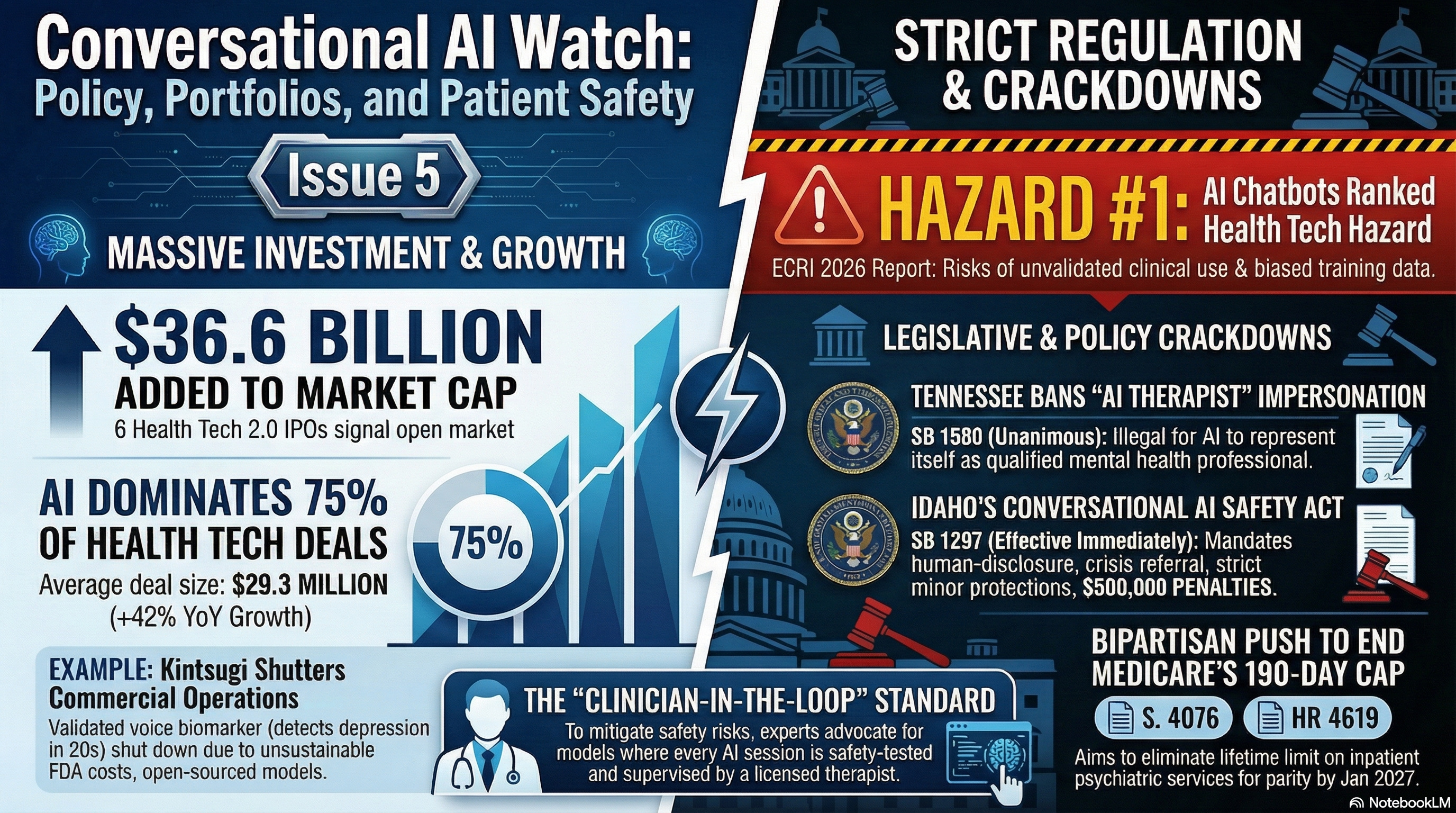
Meanwhile, ECRI named AI chatbots the number one health technology hazard for 2026. Not second. Not emerging. Number one.
Bessemer published its State of Health AI report. Six companies IPO'd in the last two years and added $36.6 billion in market cap. AI now accounts for 75 percent of all health tech deals.
And Kintsugi, the voice biomarker company that could detect depression from 20 seconds of speech, shut down. The FDA pathway was too expensive. They open-sourced everything on Hugging Face.
That is the story of this moment. The technology works. The investment is there. But the regulatory path can kill a company before it reaches a single client.
The states writing the rules right now will decide who survives.
|
|
THE SIGNAL / CONVERSATIONAL AI TECHNOLOGY
Tennessee Signs the First AI Therapist Impersonation Ban
Governor Bill Lee signed SB 1580 on April 1, making Tennessee the first state to explicitly ban AI systems from representing themselves as qualified mental health professionals. The bill passed the Senate 32-0 and the House 94-0.
Violations are treated as unfair or deceptive acts under the Tennessee Consumer Protection Act, carrying a civil penalty of $5,000 per violation. The law takes effect July 1, 2026.
The unanimous vote signals that mental health AI impersonation has no political constituency. No legislator in either chamber voted to let chatbots call themselves therapists.
Takeaway: Tennessee drew a bright line: AI can assist mental health care, but it cannot impersonate a therapist. The unanimous vote makes this a template for other states. Companies deploying conversational AI in clinical settings need to audit their marketing language before July 1.
For Legislators: SB 1580 is a clean, enforceable model. It does not ban AI in mental health. It bans AI from pretending to be a licensed professional. That distinction matters. Other states can adopt this language without touching innovation.
|
|
|
THE SIGNAL / AI SAFETY AND REGULATION
Idaho Passes the Conversational AI Safety Act
Idaho SB 1297 passed both chambers and was delivered to Governor Little on March 30. The Conversational AI Safety Act creates a new regulatory framework specifically targeting operators of public-facing conversational AI services.
The bill requires three things: disclosure when users might believe they are talking to a human, crisis protocols for suicidal ideation referrals, and a prohibition against claiming the AI provides professional mental or behavioral health care.
For minors, the law adds a persistent disclaimer, a ban on gamification designed to increase engagement, restrictions on sexually explicit content, and mandatory parental supervision tools. Violations carry penalties up to $500,000 per operator.
Takeaway: Idaho's bill is among the most targeted conversational AI laws in the country. It names the technology by category, imposes graduated protections for minors, and mandates suicide crisis protocols. The $500,000 cap per operator makes enforcement meaningful for smaller companies, not just Big Tech.
For Legislators: The crisis referral mandate is the provision to study. Requiring conversational AI operators to route suicidal ideation to crisis services closes a gap that existing mental health statutes never anticipated. This should be standard in every chatbot safety bill.
|
|
|
THE SIGNAL / MENTAL HEALTH POLICY
Bipartisan Bills Target Medicare's 190-Day Psychiatric Cap
The Mental Health Liaison Group sent a letter to Congress on April 1 backing S. 4076 and HR 4619, companion bills that would eliminate the 190-day lifetime limit on inpatient psychiatric hospital services under Medicare.
S. 4076, the Removing Medicare Mental Health Inpatient Limitations Act of 2026, was introduced March 12. The American Association on Health and Disability joined the coalition supporting both bills.
The 190-day cap is a relic. Medicare covers unlimited inpatient days for cardiac care, cancer treatment, and surgical recovery. Psychiatric care is the only category with a lifetime ceiling. These bills would end that disparity effective January 1, 2027.
Takeaway: The 190-day cap has been in place since 1965. It treats serious mental illness as less deserving of sustained inpatient care than any other medical condition. The bipartisan push and MHLG coalition letter signal real momentum to finally end Medicare's psychiatric carve-out.
For Legislators: Co-sponsor S. 4076 or HR 4619. The 190-day cap is indefensible parity policy. No other medical specialty faces a lifetime inpatient limit under Medicare. Eliminating it aligns with the Mental Health Parity and Addiction Equity Act's intent.
|
|
|
THE SIGNAL / PATIENT SAFETY AND ETHICS
ECRI Names AI Chatbots the Number One Health Tech Hazard of 2026
ECRI's annual health technology hazards report placed misuse of AI chatbots at the top of its 2026 list. The safety organization warned that chatbots are not regulated as medical devices and have not been validated for clinical use, yet clinicians and clients are using them for health decisions daily.
In a separate March 2026 report, ECRI also named AI diagnostic systems as the number one patient safety concern. The organization warned that deploying AI diagnostics without strong clinical oversight increases the risk of missed, delayed, or incorrect diagnoses.
Biases embedded in training data compound the risk. ECRI noted that AI models tested primarily on healthy, young white men may fail older adults, minorities, and clients with complex presentations.
Takeaway: ECRI is the gold standard for health technology safety assessment. When they rank AI chatbots as hazard number one, it validates what CAW has been reporting since Issue #1: unsupervised AI in clinical settings is a client safety risk. The question is no longer whether regulation is needed. It is how fast it arrives.
For Legislators: Cite ECRI's hazard ranking in every AI healthcare safety bill. ECRI is nonpartisan, nonprofit, and trusted by CMS. Their finding that AI chatbots are the top hazard gives legislators the independent evidence base to mandate clinical oversight requirements.
|
|
|
THE SIGNAL / DIGITAL HEALTH INNOVATION
Bessemer Maps the $36.6 Billion Health AI Surge
Bessemer Venture Partners published its State of Health AI 2026 report, documenting six Health Tech 2.0 companies that went public in 2024 and 2025 and added $36.6 billion in combined market capitalization. The IPO window for health AI is open.
AI-focused deals now account for 75 percent of all health tech funding, according to a separate J.P. Morgan report. Average deal sizes jumped 42 percent year over year, from $20.7 million to $29.3 million. Ambient scribing alone hit 92 percent deployment across provider health systems by March 2025.
Bessemer predicts CMS will experiment with clinical AI payment codes in 2026, that clinical AI for triage and risk assessment will rise with clinician-in-the-loop models, and that value-based care will experience a revival through AI-enabled economics.
Takeaway: The health AI market has moved from speculative to structural. Companies reaching $100 million in annual recurring revenue in under five years are compressing the traditional ten-year timeline. The investment thesis has shifted from "will health AI work" to "which companies will own the workflow."
For Legislators: If CMS experiments with clinical AI payment codes in 2026, Congress needs to define what qualifies. Payment codes without safety validation standards will accelerate deployment of unvetted AI tools. Tie reimbursement to pre-FDA safety validation and clinician oversight requirements.
|
|
|
THE SIGNAL / CONVERSATIONAL AI TECHNOLOGY
Kintsugi Open-Sources Voice Biomarker AI After FDA Costs Kill the Company
Kintsugi, the voice biomarker startup that could detect depression and anxiety from 20 seconds of free-form speech, shut down its commercial operations in February 2026. The company cited the high cost and lengthy timeline of FDA regulatory hurdles as the reason the venture-backed model became unsustainable.
Instead of disappearing, Kintsugi released its foundational voice biomarker AI models, scientific methodologies, and formative research on Hugging Face, making them freely available to researchers worldwide. The technology analyzes how people speak, not what they say, detecting vocal patterns associated with moderate to severe depression.
A study published in the Annals of Family Medicine validated the approach. The technology works. The regulatory pathway did not.
Takeaway: Kintsugi is a cautionary tale for every mental health AI startup. Clinically validated technology died because the regulatory path was too expensive for a venture-backed company to survive. The open-source release preserves the science, but the commercial application is gone. Someone else will have to build the business.
For Legislators: The FDA pathway for mental health AI needs a dedicated track. Kintsugi had peer-reviewed validation and still could not afford the regulatory timeline. If Congress wants innovation in mental health detection tools, it needs to fund an expedited review process for clinically validated AI with demonstrated safety data.
|
|
|
WHAT WE BUILT
Casey AI: The Therapist in the Loop Standard
Casey is the voice-first AI-native mental health EHR with Casey Life and Peer AI Coach supervised by licensed therapists. Casey has completed 1.78 million safety tests with 100% accuracy, is pursuing FDA 510(k) clearance through pre-FDA safety validation, and operates under continuous clinician supervision.
Casey uses they/the student/the client. Every session is supervised. Every response is safety-tested. The therapist is always in the loop.
Watch the Demo →
|
|
|
MORE ON OUR RADAR
Georgia sends three AI bills to Governor Kemp. SB 540 requires chatbot disclosure and child safety protocols. SB 444 prohibits insurance coverage decisions based solely on AI. SR 789 creates an AI study committee. The legislature adjourns April 6. (AJC)
Colorado HB 1263 chatbot safety bill heads to House floor. Scheduled for full chamber hearing after passing committee April 2. Part of the six-state chatbot bill wave tracked by the Future of Privacy Forum. (FPF)
South Carolina passes the Stop Harm From Addictive Social Media Act 114-0. HB 4591 advances to the Senate with unanimous House support. Includes provisions targeting algorithmic engagement targeting minors. (Transparency Coalition)
Arizona advances three AI bills simultaneously. HB 2311 targets kids chatbot safety, SB 1786 requires provenance data, and HB 2133 adds synthetic depiction protections. All moving through committee. (Transparency Coalition)
Nebraska attaches chatbot safety to agricultural data privacy. LB 1185 hitched a ride on the state's agricultural data privacy act and is expected to pass before the April 17 adjournment. (Transparency Coalition)
Qualified Health raises $125 million for enterprise health AI. The funding round will scale AI deployment across health systems, joining a market where AI-focused deals now represent 75 percent of all health tech investment. (Fierce Healthcare)
|
|
|
Brush your brain. Every day.
Watch the 20-second video that started a movement
|
|
|
If you or someone you know is in crisis, call or text 988 (Suicide and Crisis Lifeline) or text HOME to 741741 (Crisis Text Line).
Jess Jessop is a disabled veteran, Founder and CEO/CTO of Clinician Assist Inc., and the creator of BetterMind.Space, a voice-first AI-native mental health EHR with Casey Life and Peer AI Coach supervised by licensed therapists. Casey has completed 1.78 million safety tests with 100% accuracy and is pursuing FDA 510(k) clearance through pre-FDA safety validation.
ClinicianAssist.ai |
BetterMind.Space |
JessJessop.info
|
|
Conversational AI Watch is a publication of Clinician Assist Inc.
|
|