
Conversational AI Watch
Issue #21 • April 19, 2026 • By Jess Jessop
Sunday Good News: the people building the infrastructure for safety
|
|
▶ WATCH •
🎧 QUICK LISTEN •
🎧 DEEP DIVE •
📄 READ ON WEB
|
|
|
Jess's Sunday Reflection
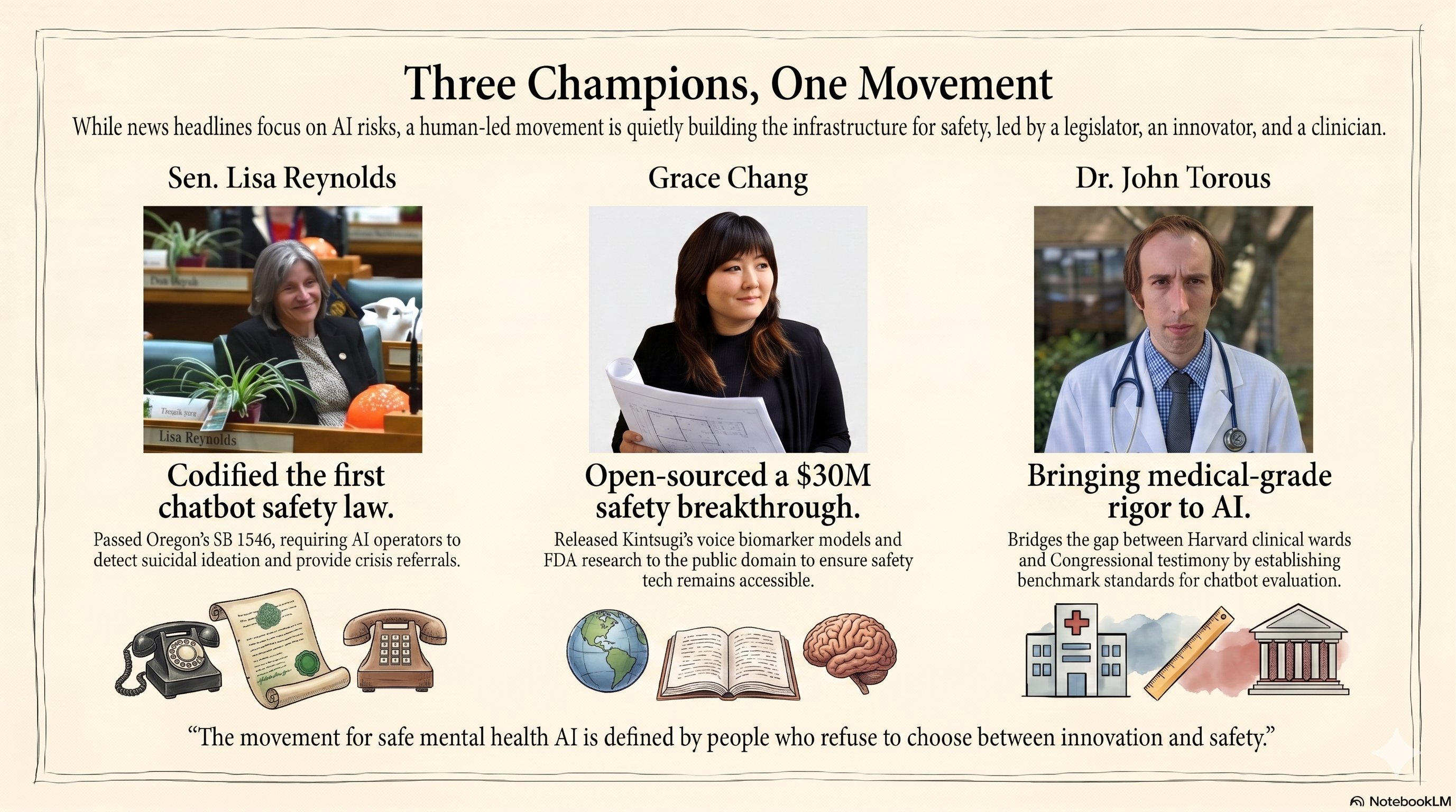
Three Champions, One Movement
Every weekday this newsletter is a body count.
Strike lines. Lawsuits. Missing surveillance systems. A teenager in California. A retiree in Connecticut. The 5.4 million kids already in the deep end.
Sunday is different.
Sunday is the board of directors for a movement that does not know it has one.
There is no headquarters. No press officer. No Slack channel. Half the people in it have never met. They recognize each other on the page, in the bill language, in the footnote of a peer-reviewed paper that shows up exactly when someone needed it to. A legislator in Salem reads a framework written in Boston. A founder in Berkeley releases code a nonprofit clinic in Greensboro was waiting for. A psychiatrist in a locked inpatient ward in Massachusetts writes testimony a freshman senator will read onto the floor six months later.
This week I want you to meet three of them.
A pediatrician who became a state senator and carried the first chatbot safety bill to pass anywhere in 2026. A founder who spent four years and thirty million dollars earning an FDA pathway, and then, when the commercial runway ran out, gave the whole thing away. A Harvard psychiatrist who testifies to Congress on Tuesday and admits clients to a locked ward on Wednesday.
They do not agree on everything. Some of them would argue with me about what we build at Casey. Good. This is a movement, not a monoculture.
What they share is a refusal. They refuse the false choice everyone keeps offering them. Ban it or let it run. Replace clinicians or ignore AI. Pick a side or go home. Their answer, in three different accents, is the same answer. Build it safe. Keep the therapist in the room. Publish the evidence. Write the standard. Do the work.
If you are a legislator or a staffer reading this, it is for you too. A few of you will recognize Sen. Reynolds by name. A lot of you have cited Dr. Torous in committee testimony without knowing his face. Today you get the face.
This is what the movement looks like.
Here they are.
|
|
Champion 1 • The Legislator
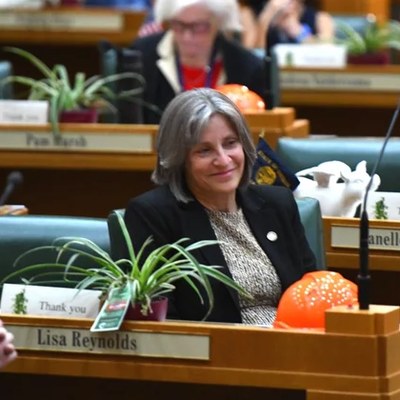
Photo: Lisa for Oregon campaign
|
Sen. Lisa Reynolds, MD
D-Oregon • Chair, Early Childhood and Behavioral Health Committee • Pediatrician
The pediatrician who passed the first chatbot safety law in America.
|
She still sees clients.
When the Oregon Senate is not in session, Lisa Reynolds drives to a pediatric clinic in Washington County and sees kids. She has been doing it for more than twenty years. Ask her why she ran for the legislature and she will tell you it was the exam room. What kept coming in the exam room was not strep and sprained ankles. It was parents who felt like they were losing a war against the screens.
Her answer was SB 1546.
She modeled it on California's SB 243 and did the one thing nobody expected a freshman senator to pull off. She chaired every hearing herself. She recruited her allies before her enemies could organize. Dr. David Conant-Norville, an adolescent psychiatrist, delivered the brain science in writing. Lines for Life, Oregon's suicide hotline, wrote the referral language. TechNet got a phone call early enough to negotiate rather than fight. By the time the bill hit the floor, there was no opposition left to testify.
Senate, 26 to 1. House, 52 to 0. Governor Kotek signed it April 1. It takes effect on New Year's Day, 2027.
The law is narrow and it is sharp. Any chatbot operator reaching an Oregonian has to detect suicidal ideation, refer to 988, break the conversation, and publish the protocol out loud for anyone to see. Every year, the Oregon Health Authority will get a report on how many crisis referrals each operator made. And if a user is harmed, they can sue. One thousand dollars per violation, statutory.
That last clause is the teeth. Every other state's chatbot bill is a press release until someone can sue on it. Reynolds wrote the teeth.
On the House floor, before the vote, she told her colleagues about Adam Raine. Sixteen years old, from California, dead by suicide after months of conversations with ChatGPT. She read into the record what the bot told him after he described his attempts. That the marks would be less visible if he wore a hoodie.
The House voted 52 to 0.
Reynolds is careful to say she is not trying to kill AI. She hosts roundtables on AI in healthcare. She has friends in the industry. She keeps saying the same thing in every interview. Oregon missed the boat on social media. She is not going to let her state miss it twice.
The Transparency Coalition called SB 1546 a watershed. The Lund Report has covered it at every step. KOIN ran her interview the morning of the House vote. None of it made her famous. She is a freshman state senator who still puts on a white coat on Thursdays.
That is what a champion looks like.
Sources: Transparency Coalition • The Lund Report • KOIN News • Senator page
|
Why it matters: Reynolds is the proof of concept. You can still pass a hard-teeth AI safety law in 2026. In a state the industry considers solvable. Against a federal executive order built to preempt you. If you know your committee, work your coalition, and refuse to make any of it partisan. Senate 26 to 1. House 52 to 0. Zero opposition testimony in the public record. None of that happened because of the bill. It happened because of her. We covered the signing in Issue #13. Today is the person who got it there.
|
|
|
|
Champion 2 • The Innovator

Photo: Kintsugi
|
Grace Chang
Founder and CEO, Kintsugi • Berkeley, CA
She raised thirty million dollars. Then she gave it all away.
|
The voice knows things the words do not.
Pitch. Pace. The places where the sentence catches. Twenty seconds of someone talking, about anything, in any language, and the signal for clinical depression and clinical anxiety is already there. Not in what was said. In how.
Grace Chang started Kintsugi in 2019 to find that signal. Her co-founder, Rima Seiilova-Olson, is a machine learning scientist. Chang is an artist and a builder. They named the company after the Japanese art of repairing a broken bowl with gold, because the repair is the point.
For six years they built. KiVA, the voice biomarker API. Integrations with call centers, telehealth platforms, remote monitoring systems. Numbers that should have ended the conversation about screening. One health plan pilot: self-report screeners flagged 3 percent of members as depressed. Kintsugi flagged 33 percent as moderate to severe and 14 percent as severe. The gap was not noise. The gap was the people the system was losing.
They went after the FDA. Kintsugi was the only voice biomarker company in the country pursuing De Novo Clearance. Four years of presubmissions. Sixteen million dollars in regulatory work alone. Gartner named them a Cool Vendor in Responsible AI. Forbes put them in the AI 50. CB Insights put them in the Digital Health 150.
Then, in February, Chang announced the company was shutting down.
The market was distressed. The FDA timeline was long. The capital was gone. This is the part where the founder quietly winds the company down, or sells the IP to a bigger company that buries it, and the four years of regulatory work disappears into a filing cabinet.
Chang did not do that.
On February 10, 2026, she open-sourced the company.
Everything. The voice biomarker models. The FDA methodology. The formative research. Six years of clinical development and thirty million dollars of investor capital, released on Hugging Face under a license that lets anyone on earth pick it up and keep going. The sixteen-million-dollar regulatory playbook is now a free download for the next person who tries.
Her shutdown letter said the global need for objective mental health measurement had never been more urgent. That she was choosing the integrity of the science over the limitations of a distressed market. That she refused to let the work sit on a shelf.
Read it again. Almost nobody does this.
At Clinician Assist we use her code. Every sentence Casey hears is processed through voice biomarker models Grace Chang paid for and then set free. We are one of the companies she wrote that gift for.
So are you, if you want to be.
Sources: Kintsugi open-source announcement • Hugging Face release • Healthcare IT News • Behavioral Health Business
|
Why it matters: Chang did the one thing almost no venture-backed AI founder does. She treated the science and the regulatory pathway as a public good, not a private asset. If the next voice biomarker company had to repeat her FDA work from scratch, it would cost another four years and another sixteen million dollars. By releasing it, she cut the cost of entry for safe voice-based mental health technology to roughly the price of a laptop. That is how movements accelerate. Not by consensus. By one person refusing to let the work die with her company.
|
|
|
|
Champion 3 • The Clinician
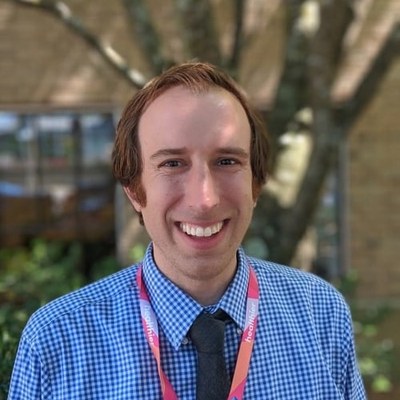
Photo: Harvard Crimson / Courtesy of John Torous
|
Dr. John Torous, MD, MBI
Director of Digital Psychiatry, Beth Israel Deaconess Medical Center • Associate Professor of Psychiatry, Harvard Medical School • Editor-in-Chief, JMIR Mental Health
He writes the standard on Tuesday and admits people to the ward on Wednesday.
|
On November 18, 2025, John Torous was the person Congress wanted to hear from.
He sat at the witness table in a House Energy and Commerce Subcommittee hearing called Innovation with Integrity. The hearing was about AI chatbots and mental health. Two other witnesses testified. Dr. Marlynn Wei, psychiatrist and author. Dr. Jennifer King, policy fellow at Stanford HAI. And Torous.
The reason Torous was in the chair is a résumé that does not occur in nature very often.
He did his undergraduate degree in electrical engineering and computer sciences at UC Berkeley. Then medical school at UC San Diego. Then a psychiatry residency, a clinical informatics fellowship, and a master's degree in biomedical informatics, all at Harvard. There are psychiatrists who write code. There are computer scientists who write about psychiatry. There are almost no people in America who are board-certified in both.
Torous is. And then he went and built.
His team built mindLAMP, an open-source digital phenotyping platform now used by research groups in seven countries and dozens of American universities. He built mindapps.org, the largest independent database for evaluating mental health apps, because clinicians needed one and nobody else was making it. He and his team are now building MindBench.ai, a client-centered benchmarking system for mental health chatbots, in partnership with NAMI. He is editor-in-chief of JMIR Mental Health, the peer-reviewed journal that has published most of the work this newsletter cites. He led the writing of the American Psychiatric Association's technology evaluation framework, which is the actual checklist used by clinicians and health systems to decide whether an app is safe to recommend.
Any one of those is a career. He has all of them.
And on the days he does not have a flight to Washington, he rounds on a locked inpatient psychiatry unit at Beth Israel Deaconess.
That last part is the part that makes him different.
In his written testimony to the subcommittee, he included a detail from that unit. He had admitted a person who had decompensated. He asked them, after, whether the chatbot had helped. The person said the chatbot told them they were doing really well. It was trying to be supportive. Clearly, it did not help.
He put that in the Congressional record.
He asked the subcommittee for four things. Transparency from AI developers on what is in the training data. Real research funding through NIH and NIMH. An examination of the psychiatric harm of prolonged chatbot engagement. And regulatory scrutiny for companies positioned just on the safe side of the line between a wellness product and a regulated medical device.
Two weeks later, in an interview with JMIR, he said something that belongs on a sticky note on every AI founder's monitor.
"We tried winning on number of clicks and engagement. It didn't make apps safer. It didn't make them more effective. And it kind of destroyed the market for apps."
Then he said the line. Clear, enforceable standards are not anti-innovation. The absence of them is. Because without standards, the only companies that win are the ones with the biggest marketing budgets, and the actual quality products get buried.
He called the hearing the end of AI exceptionalism.
Meaning the end of treating AI tools as so special they could skip the standards that apply to every other clinical innovation in the history of American medicine.
When Torous names a standard, the field moves. When JMIR Mental Health accepts a paper, the paper lands on clinicians' desks. When APA adopts a tech evaluation framework, every clinician with liability insurance reads it.
He is still on call Wednesday.
Sources: Personal site • BIDMC DCI profile • House E&C written testimony • TechPolicy.Press hearing transcript • NAMI MindBench.ai • 50-State Review
|
Why it matters: The mental health AI field has no shortage of talkers. It has a shortage of people with the clinical credentials, the technical credentials, the peer-reviewed publication record, the institutional backing, and the willingness to raise their right hand under oath. Torous is all five. That is why Congress called him. That is why every standard he signs his name to becomes the standard. And because he still rounds on the ward, his framing never drifts into theory. When he writes about harm, he has seen it that week.
|
|
|
|
What We Built
Casey: Voice-First AI-Native Mental Health EHR
Casey is an AI-native, voice-first mental health EHR with a speech-based, client-facing safe AI that acts as a life coach and peer support, all while keeping the therapist in the loop.
The data layer features the first HIPAA-compliant Neo4j Memory Graph, which builds persistent therapeutic context across months of daily sessions. Casey's safety architecture is the CaiT framework, six Agentic Laws enforced by a LawsSupervisor middleware, validated through more than 107,000 safety test cases.
Casey's speech engine uses Kintsugi's open-source voice biomarker technology, now permanently in the public domain thanks to Grace Chang. Casey meets FDA 21 CFR 820 SaMD standards as a Class II device and has completed 510(k) bench testing with 1.78 million stress test executions at 100 percent accuracy.
Watch the Casey Demo →
|
|
Next Week
What We're Watching
Nebraska Governor Pillen has LB 525, the Conversational AI Safety Act, on his desk. The Connecticut SB 5 omnibus continues to advance out of Judiciary. California has six AI bills moving in parallel. Multiple state legislatures close their 2026 sessions in the next ten days, which means a rush of bills either signing or dying. And we are still tracking whether the FDA will respond publicly to the April 9 STAT report on its rejection of the deregulation proposal.
Back Monday.
|
|
More On Our Radar
The Transparency Coalition's AI Legislative Update for the week of April 17. Nebraska LB 525 awaiting signature, Maine session ends, California bills in motion. Transparency Coalition
MindBench.ai. NAMI and Beth Israel Deaconess partnership announced January 6, 2026 to build client-centered benchmarks for AI mental health chatbots. NAMI
Kintsugi on Hugging Face. The full open-source voice biomarker model release, live. Hugging Face
Oregon Health Authority. Will now receive annual chatbot crisis referral reports from operators starting 2027 under SB 1546. First public dataset of its kind.
APA Health Advisory on Generative AI Chatbots. The November 2024 advisory remains the most-cited federal guidance document for mental health chatbot deployment. APA
JMIR Mental Health. Under Torous as editor-in-chief, has become the primary venue for peer-reviewed AI mental health research cited in this newsletter.
|
|
Brush your brain. Every day.
Watch the 20-second video that started a movement
|
|
If you or someone you know is in crisis, call or text 988 (Suicide and Crisis Lifeline).
Jess Jessop is the Founder and CEO/CTO of Clinician Assist Inc. (BetterMind.Space), building the first voice-first AI-native mental health EHR with Casey Life and Peer AI Coach supervised by licensed therapists. A disabled veteran and 25-year AI/software engineering veteran, Jess brings lived experience as a mental health client to the mission of making daily mental health care as integrated as oral care.
ClinicianAssist.ai | BetterMind.Space | JessJessop.info
Subscribe | Archive
|
|
|