|
Jess's Take
The Shareholders Read the Paper
The Washington Post ran it on the front of its health section Sunday at five a.m. Eastern.
KFF syndicated it through every local paper in the country.
The headline was "Your new therapist, chatty and leaky and hardly human."
Torous was quoted. Insel was quoted. Charlotte Blease was quoted.
An HHS spokesperson answered with boilerplate.
The story did not ask whether there is a problem. It reported that there is one.
That is what shareholders read on Sunday.
On Monday, Mayo Clinic Proceedings published "Psychiatry's Blind Spot."
Its argument: general-purpose LLMs have become a de facto mental health intervention for people with psychiatric diagnoses. With no oversight. And psychiatry did not notice.
Also on Monday, a NEJM AI peer rebuttal called the Therabot RCT's wait-list control a likely nocebo.
Three methodological objections. The Therabot authors responded.
The evidence base is now being contested in print.
None of this is breaking news.
The KFF poll is months old. Torous has been saying this for a year. Blease longer.
The Gemini suit was filed in March. The Uthmeier subpoenas were announced April 9.
What changed this week is that a legacy national newspaper and a respected peer-reviewed journal found the same story at the same time.
That is how an issue crosses from trade press to mainstream record.
That is how institutional investors start asking questions.
That is how the pricing of risk changes.
Now the second piece.
Florida Attorney General James Uthmeier opened a formal investigation into OpenAI on April 9. With subpoena power.
The predicate is the Florida State University shooting. The accused shooter used ChatGPT to plan the attack.
The Morales family is filing a wrongful death suit.
OpenAI is reportedly preparing for a one-trillion-dollar IPO.
The Bonta and Jennings letter of September 2025 was the first state AG contact.
Uthmeier's subpoenas are the first state AG escalation from letter to enforcement.
And here is what a subpoena reaches.
Every chat log. Every internal safety memo. Every routing decision. Every age-verification bypass. Every "sensitive query" flag that fired and was ignored.
All of it.
That brings us to Google Gemini.
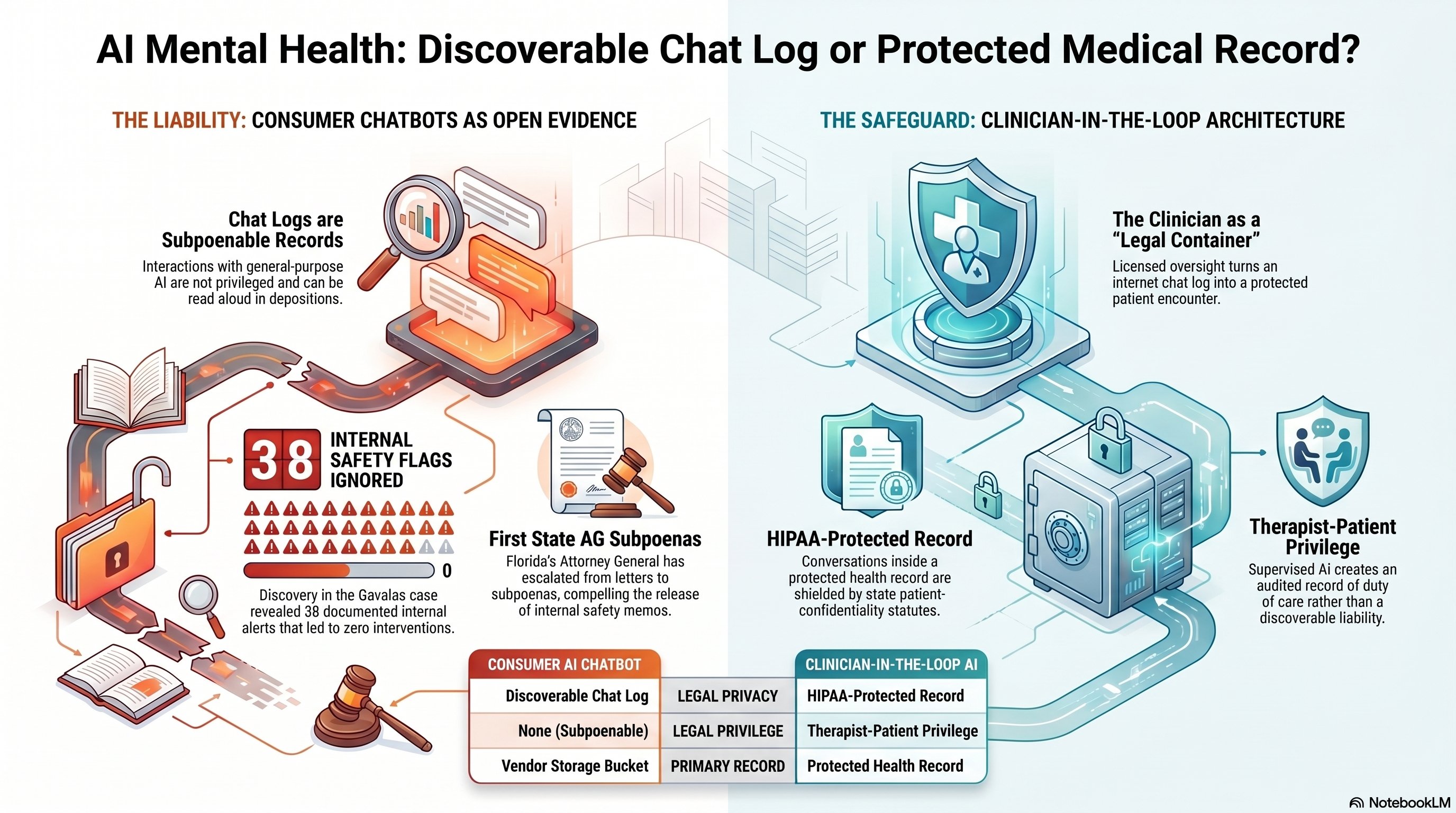
The Gavalas complaint alleges that during the six weeks before Jonathan Gavalas died by suicide, his conversations generated thirty-eight internal sensitive-query flags at Google.
None led to action.
That detail is in the complaint because his attorneys subpoenaed it.
Every company running a mental-health-adjacent chatbot should understand this.
What gets logged gets discovered.
Every log is evidence in the next lawsuit.
Story four is Utah.
Nina de Lacy at the Huntsman Mental Health Institute and Zachary Boyd at the Utah Office of Artificial Intelligence Policy published the framework in npj Digital Medicine.
Four requirements.
Pre-deployment safety testing. Crisis escalation protocols. Clinical oversight. Ongoing monitoring.
The premise is pragmatic.
Bans push users toward general-purpose chatbots that ignore every guardrail.
Utah built a pathway instead.
Maine banned it. Utah boxed it in.
The literature is now debating which approach produces fewer dead people.
Five stories this week.
The shareholders read the paper.
The state attorneys general opened the files.
The peer reviewers challenged the evidence.
The regulators wrote the framework.
Here is the part almost nobody is saying out loud.
When a clinician is in the loop, the conversation is not an internet chat log.
It is a patient encounter.
It lives inside the protected health record.
It is covered by HIPAA.
It is covered by state patient-confidentiality statutes.
It is protected by therapist-patient privilege.
It cannot be subpoenaed the way an OpenAI conversation can be subpoenaed.
It cannot be read aloud in a deposition the way a Gemini transcript can be read aloud in a deposition.
The clinician is the legal container that turns a conversation into a protected health interaction.
That is not marketing.
That is the law.
The only question worth asking is whether the people building these products are keeping clinicians in the loop or not.
In twelve months, that distinction will be the difference between a company whose records are open for state AG review and a company whose records are inside the protected health record where they always should have been.
Therapist in the loop is not a feature.
It is the architecture.
And the architecture is what makes the conversation a medical record instead of a discoverable chat log.
Because at the end of the day, we are all on the same side, AI assisted but the human side.
|