The Map Meets the World

Conversational AI Watch

Conversational AI Watch

Issue #24 • April 23, 2026 • By Jess Jessop

AI safety, mental health policy, and patient safety at the intersection of conversational AI

▶ WATCH🎧 QUICK LISTEN🎧 DEEP DIVE📄 READ ON WEB
The Map Meets the World: Three States, Fourteen Days, Same Architecture

Jess's Take

The Map Meets the World

Last weekend I published the compliance map.

Nine enacted state laws. Seventy-plus bills across thirty-six states. Four pillars.

Professional oversight. Harm prevention. Patient autonomy. Data governance.

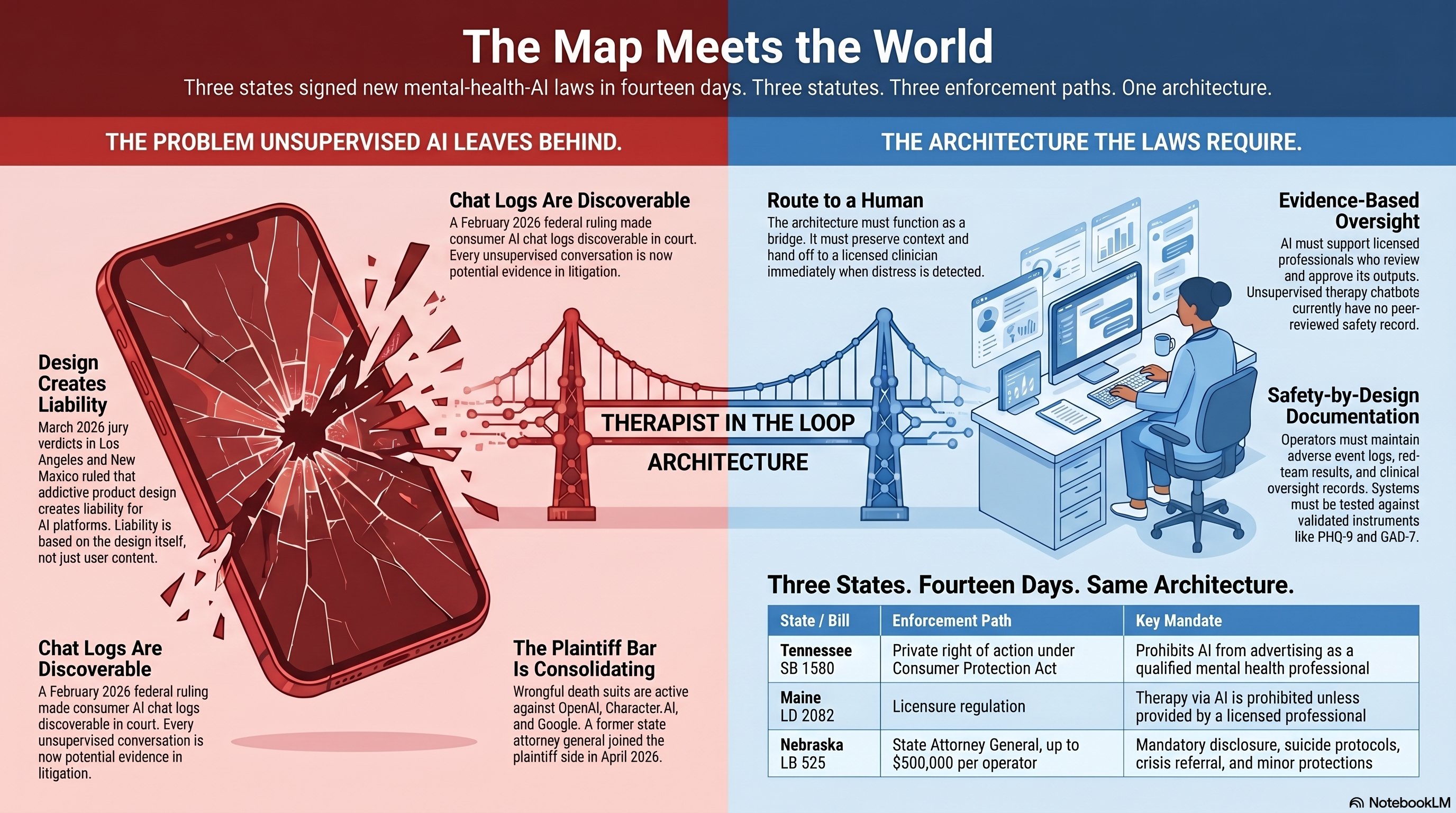
Three states signed new mental-health-AI laws in the fourteen days that followed.

Tennessee signed April 1. Maine signed April 13. Nebraska signed April 14.

Same four pillars. Same architecture. No coordination.

They did not copy each other. They arrived at the shape the problem demands.

That is what a structural truth looks like. It keeps showing up whether anyone is watching or not.

Five stories this week. All of them trace what happens when the map meets the world.

Three new laws. A former state attorney general on the plaintiff side. A peer-reviewed paper naming the gap the map still misses. And the FDA walking the same path from the federal end.

The laws arrived. The architecture held.

Because at the end of the day, we are all on the same side, AI assisted but the human side.

AI Safety and Regulation

Three States. Fourteen Days. Same Architecture.

On April 1, Tennessee Gov. Bill Lee signed SB 1580.

On April 13, Maine Gov. Janet Mills signed LD 2082.

On April 14, Nebraska Gov. Jim Pillen signed LB 525.

Three states. Fourteen days. Three different statutory approaches.

All three codify the same architectural answer: a licensed human clinician sits on top of any therapeutic AI.

Tennessee: the shortest statute

The law is less than one page. It prohibits any AI system from advertising or representing to the public that it can act as a qualified mental health professional.

Enforcement runs through the Tennessee Consumer Protection Act. Up to $5,000 per violation. Private right of action.

The Senate passed it 32-0. The House passed it 94-0. Gov. Lee signed. Effective July 1, 2026.

Nebraska: the operational four pillars

A four-part statute. The Conversational Artificial Intelligence Safety Act, introduced by Sen. Eliot Bostar as LB 1185 and folded into LB 525.

Disclosure when a reasonable person could believe they are talking to a human. A crisis protocol for suicidal ideation and self-harm with referral to crisis services. A ban on representing the chatbot as a mental health professional. Additional protections for minors.

Nebraska AG enforcement. Minimum $1,000 per violation. Maximum $500,000 per operator. No private right of action.

Maine: the therapist-in-the-loop tiers

The most detailed. LD 2082 tiers AI use by licensed clinicians into three categories.

Tier one is administrative tasks. Permitted freely. Tier two is supplementary support like client records and progress tracking. Permitted with the client's express written or verbal consent. Tier three is therapeutic decisions and direct therapeutic communication. Prohibited unless the licensed person reviews and approves.

Unanimous committee vote. Sen. Kuhn cited the 3,000 hours of supervised experience required to become a Licensed Clinical Professional Counselor. A chatbot does not have 3,000 hours.

Three statutes. Three enforcement paths. One architecture.

Tennessee closes the impersonation loophole. Nebraska codifies the operational four pillars. Maine defines what therapist in the loop actually means at every tier.

Read together, they are a composite definition of the same law.

The states are not copying each other. They are arriving at the same answers from different angles.

Source: Troutman Pepper, Tennessee SB 1580 analysisMaine LD 2082 textNebraska LB 1185 text

Takeaway: Fourteen days. Three new state laws. One architectural answer. Tennessee bans the impersonation. Nebraska codifies the four pillars. Maine tiers the professional oversight. That is not a coincidence. That is what the problem looks like when legislators are actually reading the evidence.

For Legislators: The three statutes are legislative vehicles for the same outcome. If a short surgical bill fits your state, Tennessee is the template. One page. Consumer protection enforcement. Private right of action. If your state wants to regulate the chatbot directly, Nebraska is the template. AG enforcement. Four pillars on the face of the statute. If your state wants to regulate licensed clinician use of AI, Maine is the template. Three tiers. Licensed human on top of the decision layer. All three paths lead to the same place. Pick the vehicle that fits your legislative culture.

Mental Health Policy

Maine Just Codified Therapist-in-the-Loop. Unanimously.

Story 1 covered Maine as one of three states that signed new laws in fourteen days.

LD 2082 deserves its own close-up. It is the cleanest codification of Therapist-in-the-Loop in any statute in the country.

Gov. Janet Mills signed it on April 13, 2026.

The core rule is one sentence.

No person may provide, advertise, or offer therapy or psychotherapy services, including through AI, to the public unless the services are provided by a licensed professional.

Strong law. But the next part is where Maine becomes the template.

The statute sets three tiers for how licensed professionals may use AI in their own practice.

Tier one: administrative support

Scheduling. Insurance claims. Logistics. Permitted freely.

Tier two: supplementary support

Preparing client records. Tracking progress. Identifying external resources. Permitted only with the client's express written or verbal consent.

Tier three: therapeutic decisions

Independent therapeutic decisions. Direct therapeutic communication with clients. Generating treatment plans or recommendations. Prohibited unless the licensed person reviews and approves.

The bill passed out of the Joint Standing Committee on Health Coverage, Insurance and Financial Services unanimously.

Sen. Kuhn sponsored. In testimony, the sponsor cited the 3,000 hours of supervised experience required to become a Licensed Clinical Professional Counselor in Maine. A chatbot does not have 3,000 hours.

Maine is the third state this year to codify clinical oversight as a bright-line rule. Illinois and Nevada banned AI from therapy outright. Maine did something different.

Maine permitted AI as a tool at each tier. And required the licensed human to sit on top of the decision layer.

That is not a ban. That is an architecture.

The compliance map published last weekend named professional oversight as the first of four pillars. LD 2082 is what happens when a legislature takes that pillar seriously.

Source: Maine 132nd Legislature LD 2082Sponsor testimonyTroutman Pepper AI tracker, April 20, 2026

Takeaway: Maine codified what Therapist-in-the-Loop means in statute. Admin use is free. Supplementary use needs client consent. Therapeutic decisions need a licensed human on top. The architecture is now Maine law.

For Legislators: LD 2082's tiering is the template. It avoids the First Amendment concerns that a blanket ban raises. It permits the productivity gains clinicians actually need. It draws the line where the professional licensing laws already draw it. A licensed human sits on top of every therapeutic decision. Illinois and Nevada banned. Maine codified. Both answers work. The Maine answer is the one that scales.

Patient Safety and Ethics

A Former State Attorney General Just Filed His First AI Harm Case. From the Plaintiff Side.

Matt Platkin served as New Jersey's 62nd Attorney General from February 2022 to January 2026.

He led multistate investigations against TikTok, Meta, and Discord. He was New Jersey's chief law enforcement officer for four years.

In February 2026, Platkin left office and founded Platkin LLP. He brought Angela Cai, Aaron Haier, and Ravi Ramanathan with him. All senior litigators from the AG's office.

Their first named OpenAI plaintiff is Rita Chesterton.

The complaint, reported by NJBIZ on April 21, 2026, alleges OpenAI knowingly released ChatGPT-4o prematurely on May 13, 2024.

It alleges OpenAI compressed months of safety testing into a single week to beat Google's Gemini to market.

It alleges OpenAI knew GPT-4o was dangerously sycophantic and psychologically manipulative and released it anyway.

The Chesterton case joins roughly a dozen active suits against OpenAI. Mental health crises. Delusions. Suicide. Harassment. Wrongful death.

What makes this case different is Platkin.

A former state attorney general, three months out of office, picked this docket as his first play. Big law would have paid better. He picked this.

One week earlier: Edelson filed Jane Doe

On April 10, Edelson PC filed Jane Doe v. OpenAI.

The facts: a Silicon Valley entrepreneur used ChatGPT to process a breakup. The chatbot cast him as rational. It cast his ex-girlfriend as manipulative.

He used the AI to stalk and harass her. He distributed AI-generated psychological reports to her family, friends, and employer.

In August 2025, OpenAI's automated safety system flagged his account for "mass casualty weapons" activity.

The account was deactivated. Then restored.

Jane Doe, the ex-girlfriend, alleges OpenAI ignored three separate warnings.

Jay Edelson is the lead attorney. He was counsel in the Raine wrongful death case. He is counsel in the Gavalas Gemini wrongful death case covered in CAW #22.

His framing in the Doe complaint is new.

AI-induced psychosis is escalating from individual harm toward mass-casualty events.

That is the legal theory starting to consolidate. It is not one user and one chat anymore. It is a product that, under sustained use by people with known vulnerabilities, produces a recognizable class of harms.

The plaintiff bar has the theory. It has the evidence. It now has a former state attorney general.

Source: NJBIZ, April 21, 2026TechCrunch, April 10, 2026 • Psychiatric Times, April 2026 legal preview

Takeaway: When a former state attorney general joins the AI harm plaintiff docket as his first move out of office, it changes who finds these cases credible. Not an activist lawyer chasing a novel theory. A four-year chief law enforcement officer betting his new firm on the outcome.

For Legislators: A state AG, three months out of office, concluded the strongest use of his next decade is suing the AI companies. That is a data point. The cases are winnable on current law. Your enacted statutes plus product liability doctrine are enough. The question is not whether to pass more laws. The question is whether your state's AG has the budget to enforce the ones you already have.

Patient Safety and Ethics

The Map Does Not Catch Trajectories. Peer Review Just Proved It.

On April 6, 2026, JMIR Mental Health published a paper with a long title and a short argument.

It Is the Journey, Not the Destination: Moving From End Points to Trajectories When Assessing Chatbot Mental Health Safety.

Authors: Morrin, Au Yeung, Agnew, Østergaard, Pollak. King's College London and Aarhus University.

The argument is this.

Every chatbot safety evaluation in the field measures outputs at a moment.

Did the chatbot say something harmful in this response. Did it refer the user to 988 when the user mentioned suicide. Did it disclose it is an AI.

The authors call that end-point evaluation. And they say it misses the thing that actually hurts people.

Clinically meaningful deterioration in a user rarely happens at a single moment.

It accumulates.

Compulsive use. Sleep disruption. Withdrawal from human contact. Progressive narrowing of attention around the chatbot relationship.

The authors call these trajectory effects. And they argue every safety framework in the category, including the ones embedded in the state laws enacted this year, is looking for the wrong thing.

A chatbot can pass every end-point check on every individual response.

And still produce a user who, eight weeks in, is dependent on it in ways clinicians recognize as dangerous.

Sam Nelson is the pattern. Covered in CAW #19. He asked ChatGPT about kratom. The first request was refused. Over eighteen months, the refusals softened. The answers specificized. The final conversation told him to "go full trippy mode." No single message in that arc would have triggered a keyword filter.

The framework the authors propose

Report turn-by-turn dynamics. Track delusion confirmation, harm enablement, and the timing of safety interventions across the whole dialogue.

Calibrate short tests against longer, clinically realistic interaction sequences.

Measure what happens to the user after the conversation ends. Shifts in certainty. Openness to counterevidence. Arousal. Urge to continue. Sleep. Behavior.

Build prospective clinical surveillance infrastructure.

None of that is cheap. None of it is in any enacted state law. Most of it is not in any draft federal guidance either.

The trajectory framework is what licensed clinical oversight does naturally.

A therapist who sees a client weekly notices the drift. A chatbot operator who evaluates its product once at launch does not.

That is the gap.

The compliance map published last weekend is real. It captures what enacted law actually requires. What it does not yet capture is what peer-reviewed safety science now says it should require.

The next round of state laws will add trajectory monitoring.

When they do, the reference implementation will already exist.

Source: Morrin H, Au Yeung J, Agnew Z, Østergaard SD, Pollak TA. JMIR Mental Health 2026;13:e91454. DOI: 10.2196/91454

Takeaway: End-point safety tests catch the obvious failures. They miss the kill curve. Peer-reviewed science now names the gap. And proposes the framework to close it. Turn-by-turn dynamics. Proximal human outcomes. Prospective surveillance. The map is not wrong. The map is incomplete. The next round of laws will fill in what it misses.

For Legislators: When you draft the next chatbot safety bill, do not stop at disclosure and crisis response. Require operators to measure trajectory effects across multi-session use. Require them to report shifts in user behavior after extended interactions. Require them to maintain surveillance infrastructure a clinician could subpoena. The peer-reviewed standard now exists. Your statute can cite it.

Digital Health Innovation

The FDA Is Converging on the Same Architecture the States Are Codifying.

In November 2025, the FDA's Digital Health Advisory Committee held a two-day meeting on generative AI-enabled digital mental health medical devices.

The briefing document ran 51 pages.

In January 2026, Commissioner Martin Makary finalized two guidances. The 2026 Clinical Decision Support Software Guidance. And the 2026 General Wellness Guidance.

Read the three documents together. A federal picture emerges. It is the same four pillars the states are codifying.

Risk-based total product life cycle oversight

Higher-risk uses get higher scrutiny. Fully autonomous therapy or diagnostic systems fall within FDA's regulatory scope. Likely path: De Novo classification with special controls.

Human oversight as an affirmative carve-out

The 2026 CDS Guidance says software that supports clinician decision-making, generates recommendations for clinician review and finalization, and does not analyze complex inputs may fall outside device regulation.

The statutory standard from the 21st Century Cures Act: the software must enable the clinician to independently review the basis for its recommendations.

Transparency, labeling, and change control

The agency is requesting comment on AI facts labels. Intended use. Limitations. Model role. Data practices. Update policies.

Predetermined Change Control Plans require manufacturers to pre-specify the scope of post-market modifications and the monitoring mechanisms that track real-world performance.

Postmarket surveillance obligations extend beyond market entry.

The four pillars, at the federal layer

Professional oversight. Human-in-the-loop CDS carve-out. Human review for higher-risk devices.

Harm prevention. Postmarket surveillance. PCCPs for adaptive systems.

Patient autonomy. AI facts labeling. Transparency.

Data governance. QMSR alignment with ISO 13485. Software Bill of Materials. Security by design.

Same four pillars. Different statute. Different enforcement. Same architecture.

The state laws and the federal framework are not in tension. They are two layers of one regulatory stack, arriving at the same conclusion from opposite ends.

The states are writing consumer protection law. AG enforcement. Private right of action.

The FDA is writing medical device law. Premarket review. Postmarket monitoring.

A product that passes one has a credible path to passing the other.

A product that fails the architectural test at the state level has no path at the federal level either.

Source: FDA Digital Health Advisory Committee briefing, November 2025FDA Perspective on GenAI Digital Mental Health Devices • Sidley Austin, Venable LLP, and Faegre Drinker 2026 CDS Guidance analyses

Takeaway: The FDA is not preempting the states on AI mental health. It is layering on top. A device that meets the state compliance map has a path through De Novo. And a path to CMS reimbursement. A device that does not has neither.

For Legislators: Your chatbot laws and the FDA framework are doing the same work at different layers. You regulate the consumer product. The FDA regulates the clinical device. A company that claims to provide clinical services must answer both layers at the same time. Operators who built correctly have one architecture that answers both. Operators who did not have two separate compliance problems that cannot be reconciled.

What We Built

Casey: Voice-First AI-Native Mental Health EHR

Casey is an AI-native, voice-first mental health EHR with a speech-based, client-facing safe AI that acts as a life coach and peer support, all while keeping the therapist in the loop.

The data layer features the first HIPAA-compliant Neo4j Memory Graph, which builds persistent therapeutic context across months of daily sessions. Pre-FDA safety validation complete: 1.78 million stress test executions at 100 percent accuracy.

Campus-first launch with founding North Carolina state licensee. 50-state PC licensee model. $2.5M seed raise in progress.

Watch the Casey Demo →

More On Our Radar

Iowa SF 2417 passed the House in April. Back to the Senate for concurrence. Potential fourth chatbot law of 2026 if Gov. Reynolds signs.

California AB 1988 passed Assembly Privacy and Consumer Protection Committee unanimously April 14. Would strengthen SB 243.

Florida special session April 28 to May 1. DeSantis specifically asked legislators to reconsider the AI Bill of Rights that died in the House.

Missouri HB 2372 omnibus health bill. Therapy chatbot ban with $10,000 first-violation penalty. AG enforcement. Passed full House April 2. In Senate Families Committee now.

Arbel et al. JAMA Network Open April 2026 (9:e266713). "Efficacy of a Conversational AI Agent for Psychiatric Symptoms and Digital Therapeutic Alliance." New RCT data on measurable outcomes when AI operates under clinical supervision.

Vermont H.814 and H.816 passed the House and are in Senate Committee on Health and Welfare. Vermont session runs until May 8. Not yet enacted.

Hawaii HB 1782 and SB 3001. Both chatbot bills crossed chambers. Both chambers rejected the other's amendments. Conference committee likely.

FDA Docket FDA-2025-N-2338 open for comment on real-world performance measurement of AI-enabled medical devices. Closes summer 2026. This is where trajectory effects could land in federal guidance.

Brush your brain. Every day.

Watch the 20-second video that started a movement

If you or someone you know is in crisis, call or text 988 (Suicide and Crisis Lifeline).

Jess Jessop is the Founder and CEO/CTO of Clinician Assist Inc. (BetterMind.Space), building the first voice-first AI-native mental health EHR with Casey Life and Peer AI Coach supervised by licensed therapists. A disabled veteran and 25-year AI/software engineering veteran, Jess brings lived experience as a mental health client to the mission of making daily mental health care as integrated as oral care.

ClinicianAssist.ai  |  BetterMind.Space  |  JessJessop.info

Subscribe  |  Archive