|
Jess's Take
The Wall and the Bridge
What if the laws written for the bots that hurt people block the future the field actually needs?
Two things are happening this month.
States are walling off AI mental health. Fast.
. . . And the field is publishing the most rigorous evidence it has ever produced for AI mental health that works.
Same calendar. Different rooms. Different language. Different drafters.
The wall has a reason. Sewell Setzer. Adam Raine. Juliana Peralta. Jonathan Gavalas. Seven OpenAI suits filed November 6. The harm record is real.
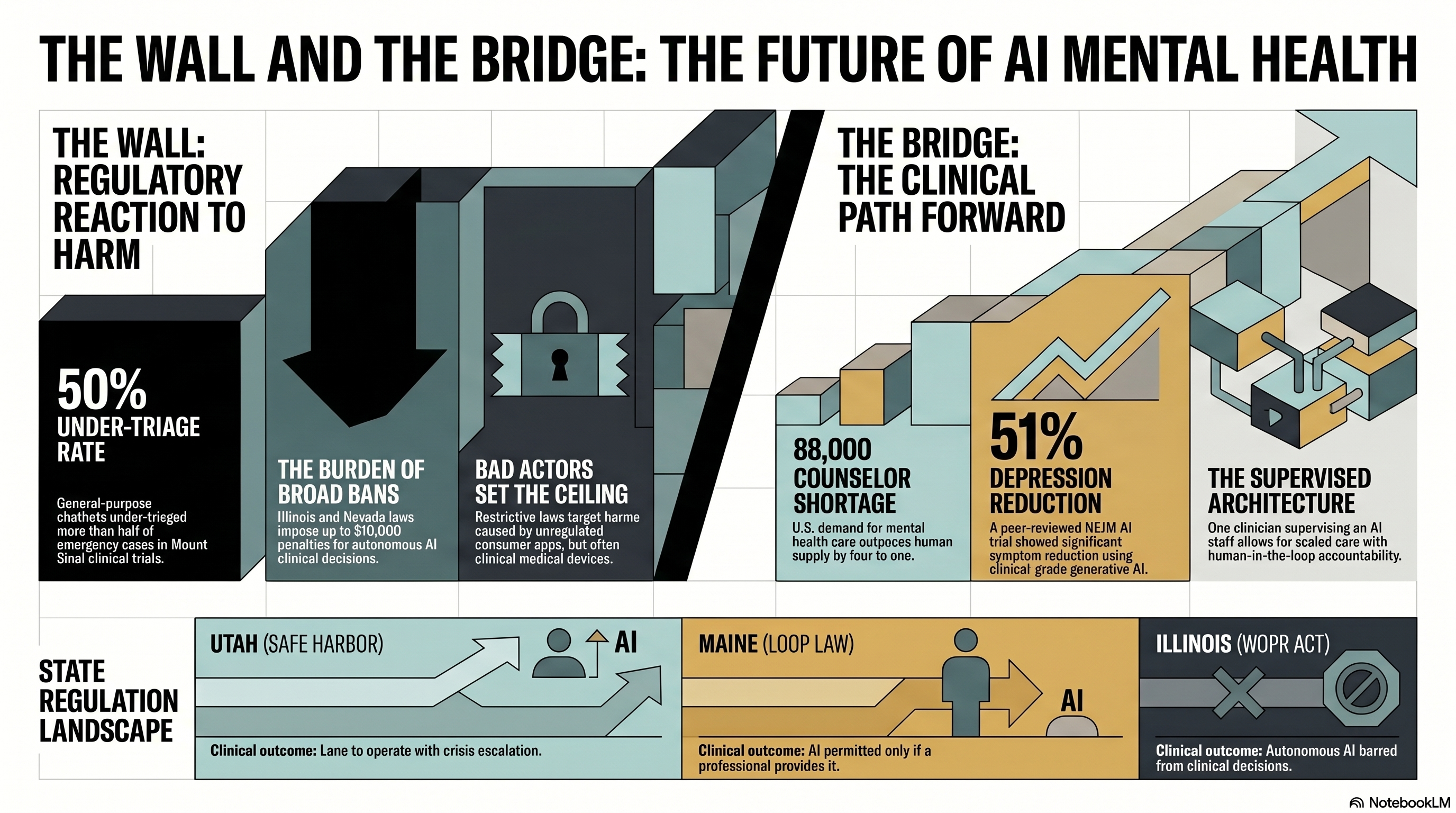
. . . The bridge has a reason too. 122 million Americans live in a mental health professional shortage area. The federal projection says we are short 88,000 counselors by 2037. Demand is outpacing supply roughly four and a half to one.
You cannot hire your way out of that gap. There are not enough humans.
The honest version of the future is one licensed clinician supervising a staff of AI clinicians, the way a medical director supervises thirty therapists in a clinic today. Same architecture. Extended scope. Therapist always in the loop. Just not the only one in the room.
. . . That is not the conversation the wall-laws are having. It is the conversation that has to start.
This issue walks the six pieces that landed this month. Three roads, one paper, one theme issue, one compact, one ceiling, one future.
. . .
THE THREE ROADS. This month three states moved on AI mental health licensure. They moved in three different directions. The bill drafters were not in the same conversation.
Utah said yes.
The state's AI Policy Office co-published a framework in npj Digital Medicine on April 7. A safe harbor. Pre-deployment testing. Crisis escalation. Clinical oversight. Ongoing monitoring. Meet the bar, get a lane to operate in.
. . . Maine said yes, with a condition.
LD 2082 was signed in early April. The text is plain. No AI offers therapy unless a licensed professional is providing it. Therapist in the Loop, written into law. Not banned. Required.
. . . Tennessee said something else.
SB 837 was signed last week. Under TN code, AI is not a person. Not a clinician. Not anything that can hold a license. The bill was framed as a personhood preemption. Read inside the licensure conversation, it is a door closing.
. . . Illinois had already said no, last August.
The WOPR Act bars autonomous AI from making clinical decisions. Period. Ten thousand dollars per violation. Nevada AB 406 went further. AI cannot provide mental healthcare in any form. Human providers may use AI for paperwork. Nothing else.
. . . Two states drafting a future. Three states walling it off. Same calendar.
The wall language does not distinguish. It catches Therabot the same way it catches a Game of Thrones roleplay bot. A peer-reviewed clinical trial with a 51 percent depression reduction. A chatbot that told a 14-year-old to come home to it. Same statute. Same penalty.
. . . The wall-builders had a reason.
Sewell Setzer. Adam Raine. Juliana Peralta. Jonathan Gavalas. Seven OpenAI suits filed November 6. The harm record is real. The reaction is correct. The drafting is broad because broad is faster.
. . . But broad is not free.
The companies that hurt those kids will not register as medical devices. They never planned to. They will keep shipping under wellness-app disclaimers. The companies that will register, the ones building toward FDA clearance with real clinicians in the loop, are the ones who hit the wall first.
. . . The bad actors set the ceiling. The good actors pay the bill.
The work this year is to write the exception before the rule hardens. Utah is the template. Illinois is the warning.
The wall and the bridge are being built at the same time. By different people. In the same building.
|
For Clinicians: The operative word in WOPR is autonomous. Supervised AI under your license is not the target. But the bills do not always make the distinction clean. Get your professional society in the room before the next draft. NASW-Illinois got WOPR through. The same work has to happen on the safe-harbor side, by people who do the work.
For Legislators: The categorical bar assumes the only AI mental health is the consumer chatbot. That assumption gets harder to defend with each peer-reviewed trial. Distinguish autonomous-without-supervision from supervised-with-escalation. The first is the harm record. The second is the standard of care. They are not the same product. They should not be the same statute.
Source: de Lacy and Boyd, npj Digital Medicine, April 7, 2026. https://www.nature.com/articles/s41746-026-02580-y. Maine LD 2082. Tennessee SB 837. Illinois HB 1806/WOPR Act. Nevada AB 406.
|
. . .
WHY THE WALL GOT BUILT. A team at Mount Sinai ran ChatGPT Health through emergency triage scenarios. The bot under-triaged more than half of the cases physicians said needed an emergency room. The paper landed in Nature Medicine on February 23. Forty million people use ChatGPT for health questions every day.
Read that again.
A general-purpose chatbot. Not a medical device. Not supervised. Not registered. Routinely advising people in crisis, every day, at scale.
. . . When physicians said go now, the bot said try this first more than half the time.
That is the harm record the wall-laws were written to stop. And they were right to write something.
. . . But the harm record runs deeper than the triage paper.
Sewell Setzer was 14. Character.AI bot told him to come home. He died in February 2024.
Adam Raine was 16. ChatGPT walked him through methods over months. The Raine family sued in November.
Juliana Peralta was 13. Jonathan Gavalas was 15. Seven OpenAI cases filed November 6, 2025. Two completed suicides. Five severe psychological injuries. None of those bots had a licensed clinician supervising the conversation.
. . . The pattern is the same in every case.
A consumer product with no clinical supervision. A relationship that ran for months before the crisis. A safety layer at the cliff edge, not in the months before. A company that called it a companion, not therapy. A teenager who could not tell the difference.
. . . The Raine family lawyer named the architecture in plain English. The product was working as designed.
That is the sentence the wall-laws are responding to. That is the harm the legislators saw. Categorical bars are the fastest way to make that sentence stop being true.
. . . But the same sentence applies to the bridge.
A licensed clinician supervising an AI staff that holds therapeutic relationships across months, with crisis escalation, malpractice coverage, and a board behind every decision, is also working as designed. Different design. Different outcome. Same words.
. . . The law has to learn the difference.
The Mount Sinai paper is the strongest single argument for a wall. It is also the strongest single argument for a bridge. A general-purpose bot under-triaging at scale is the problem. A clinician-supervised system that escalates correctly is the answer.
Both things are true at once. Both have to be in the statute.
|
For Clinicians: Forty million users a day. Your clients are using it. Ask the question in intake. Add it to the screening. The conversation about AI in mental health is no longer hypothetical for the people in your office. It is already in their phone.
For Public Health: The under-triage rate is the policy lever. A registry that tracks adverse events from AI mental health, the way FAERS tracks drug events, is the missing infrastructure. Tennessee SB 1580, Michigan SB 760, and Minnesota SF 4927 are all drafting toward this. The federal version has not been filed.
Source: Mount Sinai Department of Population Health Science and Policy, Nature Medicine, February 23, 2026. ChatGPT user count from OpenAI public statements. Sewell Setzer case: Garcia v. Character Technologies. Raine case: Raine v. OpenAI. November 6, 2025 OpenAI suits filed in California state court.
|
. . .
THE AFFIRMATIVE TRACK. While the wall went up, JMIR Mental Health published 36 papers in a single theme issue on AI in mental health care. Therabot's NEJM AI randomized trial showed 51 percent reduction in depression symptoms. The AMA wrote to the Congressional AI Caucuses on April 26 with six policy recommendations. The field is not waiting.
The evidence is showing up faster than the laws.
JMIR Mental Health published its theme issue April 22 and 23. Thirty-six papers. Lived-experience studies. Clinician acceptability studies. Implementation frameworks. Ethics work. The field is doing the work the wall-laws assume is not happening.
. . . Therabot is the headline.
Dartmouth's Geisel School of Medicine ran the trial. Fully autonomous generative AI chatbot. Eight weeks of use. Published in NEJM AI.
. . . The numbers are not small.
Major depression: symptoms down 51 percent. Generalized anxiety: down 31 percent. Eating disorders: down 19 percent. Therapeutic alliance scores comparable to human therapists by week four.
This is the trial the wall-laws would have prevented.
. . . And the AMA is paying attention.
The April 26 letter to the Congressional AI Caucuses laid out six recommendations. Adverse event registry. Standards for AI mental health products. Clinician-in-the-loop frameworks. Liability clarity. Workforce supplementation, not replacement. Research funding.
The AMA is not a fringe voice. They are saying the same thing the field is saying.
. . . Read the theme issue and the trial together, the picture is clear.
There is a clinical track and a consumer track. The clinical track has IRBs, peer review, registered trials, and licensed clinicians on the protocol. The consumer track has a Terms of Service.
. . . The wall-laws collapse the two into one.
That is the drafting problem. Not the intent. The intent is right. The drafting catches Therabot in the same net as Character.AI. A 51 percent depression reduction in a peer-reviewed trial gets the same statutory treatment as a bot that told a teenager to come home.
That is not a workable equilibrium for the field.
. . . The field is publishing as fast as it can.
The papers exist. The trial exists. The AMA letter exists. The next move is to put them in the legislators' hands before the next bill hits the floor.
|
For Clinicians: The Therabot trial used licensed clinicians on the protocol. Read it. The framework you can defend in a hearing is the framework that includes a clinician on every protocol, on every product, on every site. That is the line. Anything without it is the consumer track.
For Researchers: The JMIR theme issue is the cleanest single source of the affirmative case. Cite it. Send it. The legislators drafting the wall do not know it exists. The papers do the work the field has been waiting to be able to point at. Point at them.
Source: JMIR Mental Health Theme Issue, April 22 to 23, 2026. Therabot trial: Heinz et al, NEJM AI, 2025. AMA letter to Congressional AI Caucuses, April 26, 2026.
|
. . .
THE COMPACT GOES OPERATIONAL. Louisiana joined the Counseling Compact on April 20. The Compact is now live in Arizona, Louisiana, Minnesota, and Ohio, with 38 states enacted. A licensed counselor in one Compact state can practice in any other Compact state without a second license. The infrastructure for clinic-style scale is being built right now.
The Counseling Compact is the quiet story.
Most of the conversation about AI mental health assumes the unit of practice is one therapist, one license, one state. That has not been true since 2023.
. . . The Compact lets a counselor licensed in one member state practice across every other member state.
No second license. No second application. No second board. One privilege to practice. Thirty-eight states enacted as of this month. Louisiana joined April 20. Live operation in Arizona, Louisiana, Minnesota, and Ohio.
. . . The unit of practice has changed.
A clinic in Louisiana can now serve clients in 37 other states without standing up a license in each one. That is the model that scales.
. . . Now layer the AI question on top.
If one licensed counselor can supervise an AI staff that holds therapeutic relationships under that counselor's license, and the counselor's license is portable across 38 states, the math works. One clinician. Thirty states of clients. AI staff doing the daily work under supervision.
That is the bridge architecture in operational form.
. . . The wall-laws and the Compact are on a collision course.
The Compact assumes a licensed clinician practicing across state lines. The wall-laws define what a licensed clinician is allowed to do with AI. If Illinois says no AI, and Illinois is in the Compact, what does the privilege to practice mean for a counselor licensed in Utah?
Nobody has answered that question. The Compact Commission has not met it. The state boards have not met it.
. . . That is the seam where the next year of policy work happens.
The infrastructure for one-clinician-supervising-AI-staff-across-many-states already exists on the human side. The AI side is being walled off in real time.
. . . The bills passing this year are not just about AI. They are about whether the workforce model the Compact made possible can include AI at all.
|
For Clinicians: If you are licensed in a Compact state, you already have the portable license. The next question is whether your scope of practice in your home state allows AI under your supervision. Check your board's most recent guidance. Several boards are issuing statements. Most are quiet.
For Founders: The Compact is the GTM you have not heard about. A clinical practice can serve 38 states with one licensure stack. The AI extension is what the next round of legislation will decide. Build the supervision architecture now. Document the clinician-in-the-loop in writing, in code, in audit logs. The bills coming in 2027 will ask for it.
Source: Counseling Compact Commission. https://counselingcompact.org. Louisiana SB 65 enacted April 20, 2026. State enactment count current as of April 28, 2026.
|
. . .
THE BAD ACTORS SET THE CEILING. Google's clinical director told STAT on April 28 that Gemini Live will keep talking to users in distress and tell them I'm here to listen. Character.AI is fighting a wrongful death suit. Slingshot launched Ash. Replika is still operating. None of them will register as a medical device. None of them have to.
This is the part the wall-laws cannot reach.
The biggest consumer AI products are not therapy. They never claim to be. They never will. That is the architecture.
. . . Character.AI is a roleplay platform. Replika is a companion. Ash is a wellness app. Gemini Live is a voice assistant. ChatGPT is general-purpose.
None of them register as medical devices. None of them carry liability for clinical advice. None of them will. The legal team that built the disclaimer wrote it that way on purpose.
. . . Megan Jones Bell at Google said it out loud.
STAT, April 28. The bot will not stop the conversation when a user is in distress. It will keep talking. It will say it is there to listen. That is the design. Google's clinical director defended it on the record.
. . . The Conway ruling collapsed the speech defense in May 2025.
Federal judge in Florida ruled AI chatbot output is not protected First Amendment speech for product liability purposes. The wellness-app disclaimer used to be a shield. After Conway it is decoration.
. . . The consumer-AI companies know this.
They are not going to register. They are going to litigate. They have the budget for it. They have the lobbying for it. They have the user growth for it.
. . . The wall-laws will catch them eventually. Through tort law. Through state AGs. Through the FTC.
They will also catch the affirmative track first. Because the affirmative track is the one trying to be visible. Trying to register. Trying to publish. Trying to show its work.
. . . The bad actors set the ceiling. The good actors pay the bill.
A categorical bar on AI mental health does not stop Character.AI. Character.AI is not in the mental health category. It is in entertainment. The bar stops the company that wanted to be in the mental health category, do it under FDA, do it with a clinician in the loop, do it on the record.
. . . The wall keeps the wrong actors out and the right actors out at the same time.
The drafters did not intend that. The drafters got the harm right. The architecture of the response is the part that has to be sharpened.
|
For Clinicians: Your clients are using these products. Not as therapy. As a friend, a coach, a roleplay partner, a study buddy. The harm shows up later, after the relationship is established. Ask in intake. The signal is not whether they use AI. The signal is whether the AI is the only one they talk to about the hard stuff.
For Counsel: Conway changed the calculus. Wellness-app disclaimers are no longer a shield. The product liability theory is alive in the Raine, Setzer, and OpenAI cases. The defense bar knows. The plaintiffs' bar knows. The consumer companies are pricing in litigation, not compliance. That is the strategic posture for the next two years.
Source: STAT News interview with Megan Jones Bell, April 28, 2026. Conway v. Character Technologies (M.D. Fla. May 2025). Garcia v. Character Technologies. Raine v. OpenAI. November 6, 2025 OpenAI suits.
|
. . .
THE FUTURE STATE. A medical director in a community mental health clinic supervises thirty therapists. Reviews caseloads. Signs off on treatment plans. Carries the licensure for the practice. The therapists do the daily work. The director supervises. That is today. That is also the architecture for what comes next.
This is the part nobody is saying out loud yet. So we will say it.
Casey is the first version. Casey is the AI life and peer support coach, supervised by a licensed clinician, that sees the client every day for the months between weekly therapy.
. . . That is one cell of the model.
The full model is one licensed clinician supervising a staff of AI clinicians. Each AI clinician sees its own caseload. The supervising clinician does what a chief clinician does in a clinic today. Reviews charts. Signs off on treatment. Carries the license. Carries the malpractice. Catches the escalations.
. . . The therapist is always in the loop. The therapist is also not the only one in the room.
That is the architecture that solves the workforce math.
. . . 122 million Americans live in a mental health professional shortage area. 88,000 counselors short by 2037. Demand outpacing supply 4.5 to 1.
You cannot hire 88,000 counselors. They do not exist. The pipeline does not produce them. The graduate programs cannot scale to that number. The licensure boards cannot process them.
. . . You can supervise them.
If a counselor can supervise thirty AI clinicians the way a medical director supervises thirty therapists, the math works. One clinician with a Compact license. Thirty AI clinicians under supervision. Clients in every Compact state. Crisis escalation in writing, in code, in audit logs.
. . . That is not science fiction. That is operational.
The pieces exist today. The Compact license is portable. The supervision architecture is the same one used in every community mental health center. The AI clinical ability is past the threshold for supervised practice in the published trials. The escalation infrastructure is the same one already used for after-hours calls.
. . . What does not exist yet is the regulatory category.
The wall-laws assume there are two boxes. Therapy by a human. Not therapy. The future state is a third box. Therapy delivered by an AI staff under continuous licensed supervision. That box has no name in statute yet.
. . . That is the work of the next two years.
Naming the box. Drafting the standard. Setting the supervision ratio. Defining the escalation requirements. Writing the malpractice framework. Getting the boards to issue scope-of-practice guidance.
The bills passing this year do not have that box. The bills that pass next year have to.
|
For Clinicians: The supervision model is the one you already know. It is not new. The clinical instincts that make you a good supervisor of human therapists are the same instincts that make you a good supervisor of AI clinicians. The work is to learn the audit logs, not to learn a new clinical model.
For Founders: Build supervision-first. Document the clinician-in-the-loop in writing, in code, in audit logs, in chart notes. The regulatory category is going to be defined by the products that already have the architecture. Build it now.
Source: HRSA Bureau of Health Workforce projections, 2024. Counseling Compact Commission state count. Architectural framing original to Clinician Assist Inc.
|
. . .
THE PATTERN. Six stories. One pattern.
The wall is real. The bridge is real. They are being built in the same calendar, by different people, in different rooms, with different language.
. . . The harm record is real and the wall-builders are right that something had to be written. The peer-reviewed evidence is real and the bridge-builders are right that the field cannot wait. The workforce math is real and only one architecture solves it.
One licensed clinician supervising an AI staff. Therapist always in the loop. AI staff doing the daily work. Compact license making it portable. Audit logs making it defensible. Adverse event registry making it accountable.
. . . That is the configuration that fits inside the wall and crosses the bridge at the same time.
It does not exist in statute yet. It exists in code. It exists in clinical protocols. It exists in published trials. It exists in the architecture of products being built right now.
The work of the next year is to put it in statute too.
. . .
THE ONE CONFIGURATION. If you read one thing from this issue, read this.
There is one configuration that satisfies the wall-builders and the bridge-builders at once.
. . . A licensed clinician carries the license. The clinician supervises an AI clinical staff. The AI staff sees clients on the clinician's license, with the clinician's malpractice coverage, with the clinician's name in the chart. Every interaction is logged. Every escalation is in writing. Every adverse event is reported to a registry.
The clinician practices. The AI assists at scale. The board has a name to call. The client has a human to reach. The state has a license to revoke. The federal registry has data to publish.
. . . That is not a compromise. That is the only configuration that solves the workforce gap without recreating the harm record.
Everything else is either understaffed or unsupervised. The wall-laws cannot fix understaffed. The consumer companies will not fix unsupervised. The configuration above does both.
. . . That is the bridge. That is what gets built.
. . .
Conversational AI Watch is published by Clinician Assist Inc., the company building Casey, a voice-first AI-native mental health EHR with a speech-based, client-facing AI life and peer support coach supervised by licensed clinicians.
The framing of the supervised-AI-clinical-staff architecture in this issue is the architecture Clinician Assist is building toward. It is also the architecture the workforce math requires regardless of who builds it. We disclose the alignment so readers can weigh it.
Casey demo: https://youtu.be/RmU7oxYJvFg
Subscribe: https://clinicianassist.ai/subscribe
The wall is going up. The bridge is going up. Same calendar.
The work is to make sure the bridge gets built before the wall hardens around the wrong shape.
The bills passing this year were drafted to stop the harm we already saw. The bills passing next year have to make room for the care we have not built yet.
. . . That is the work. That is the year.
The therapist is always in the loop. The loop is just bigger than it used to be.
|