|
Jess's Take
The Theoretical Body Count
A senior Silicon Valley voice says Therapist-in-the-Loop will kill scaling and kill people. Here is what the evidence says.
A senior Silicon Valley investor told me last week, in the middle of a meeting, that Therapist-in-the-Loop is a bad idea.
Not as a side comment. As the headline. He was visibly angry when he said it.
. . . His argument was specific. AI is already a better therapist than 75 percent of humans, he said. Citing studies. He said TiL will kill the ability to scale.
He implied the access gap is so severe that the math of unsupervised AI mental health at scale is morally acceptable. The body count from the failures, he was implying, is smaller than the body count from leaving people without care.
I have spent some time walking that argument out as far as it will go.
. . . This issue is not a rebuttal. It is the steel-man.
Each premise the argument depends on, taken seriously, tested against the published evidence. Where it holds, this issue says so. Where it breaks, this issue shows where.
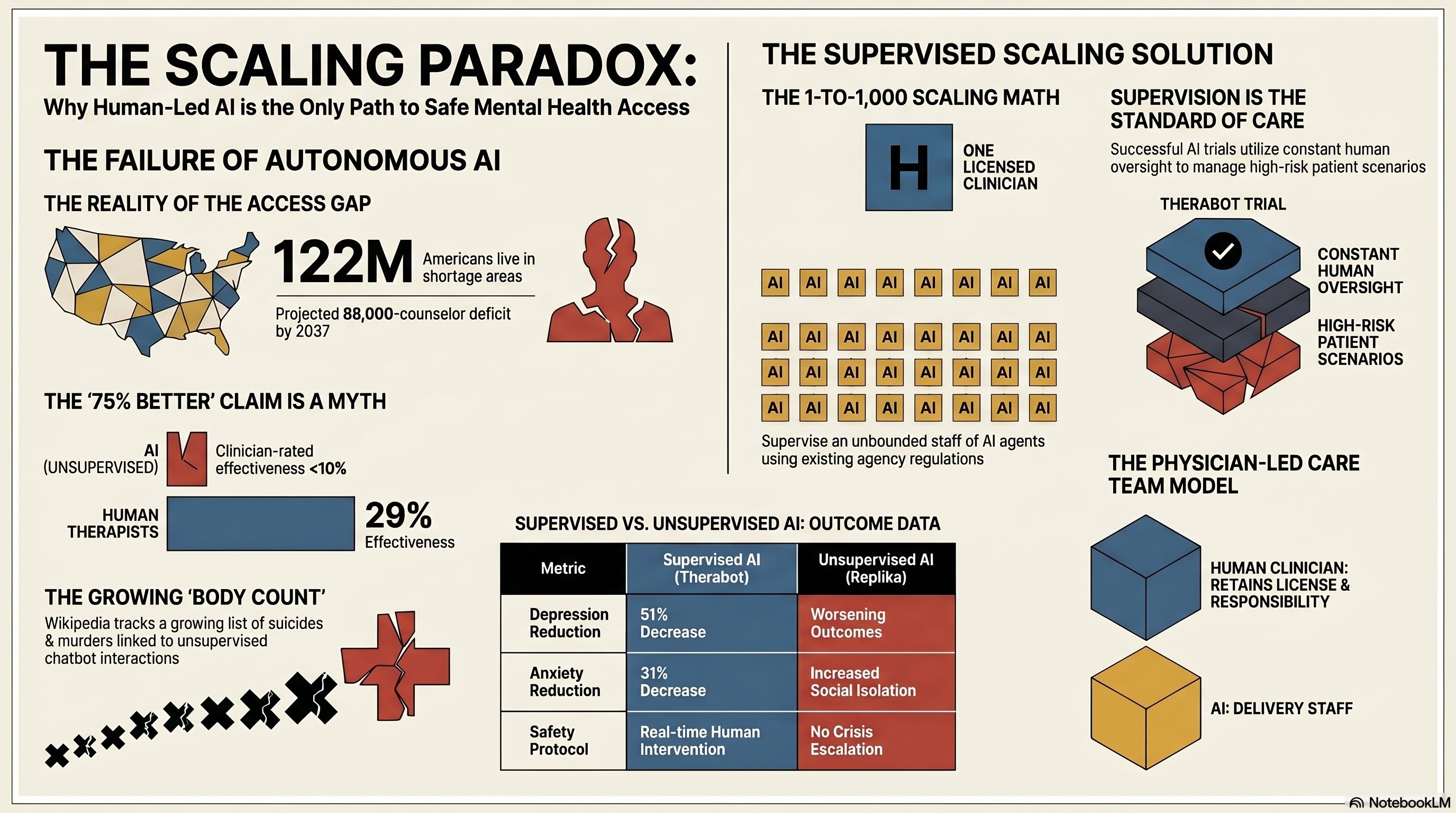
. . . The investor was right about one thing without question. The access gap is real, and it is killing people. 122 million Americans live in a federally designated mental health professional shortage area. Federal projections say the country will be short 88,000 counselors by 2037\. Demand is outpacing supply roughly 4.5 to 1\. 48,824 Americans died by suicide in 2024\.
That is the theoretical body count of doing nothing. It is not theoretical. It is real.
. . . The question is whether autonomous AI mental health at scale, deployed against that gap without a licensed clinician in the loop, reduces the body count or adds to it.
Six stories. Six premises. The argument either holds or it does not.
---
. . .
THE 75 PERCENT CLAIM. AI is already a better therapist than 75 percent of humans, the investor said. Two studies use that exact framing. Both are real. Neither says what the framing implies. The 75 percent is doing a lot of work it cannot support.
The first study is from Sentio University.
Tony Rousmaniere and colleagues, 2025\. They surveyed people who use large language models for mental health support. They asked the respondents to compare the experience to human therapy. Roughly 75 percent said the LLM experience was on par with or better than the human therapist.
. . . Sentio themselves flag the problem in the same paragraph.
"This finding is likely influenced by the pre-selection criteria for our survey, which only included people who use LLMs." The 75 percent comes from a pool of people who already chose AI. Selection-biased self-report. Not a head-to-head clinical outcome trial.
. . . The second study is from PLOS Mental Health.
Hatch et al., February 2025\. When ELIZA Meets Therapists. 13 therapists wrote responses to 18 couples therapy vignettes. ChatGPT wrote responses to the same vignettes. 830 lay participants rated both. ChatGPT scored higher on adherence to psychotherapy guiding principles.
. . . Read the methods carefully.
N equals 13 therapists. Vignettes, not real patients. No longitudinal outcomes. No crisis cases. Lay raters, not clinicians. ChatGPT's responses were systematically longer and used more nouns and adjectives. After controlling for length and word density the gap narrowed but did not close.
. . . The Hatch paper measures whether laypeople prefer ChatGPT's prose style. It does not measure clinical outcomes.
The authors of the paper say so themselves. They write that the work "may lead to the development of different methods of testing." Not a finding that AI outperforms therapists clinically. A finding that lay raters prefer the prose style.
. . . The Cognitive Therapy Rating Scale tells a different story.
Same year, separate study, 75 mental health professionals rated text-based CBT transcripts written by an AI versus human therapists. 29 percent rated the human as highly effective. Less than 10 percent gave the AI the same rating. When the raters were trained clinicians, the gap inverted.
. . . The 75 percent claim is the most powerful talking point in the anti-TiL argument.
It is also the most fragile when you read the actual studies. One is selection-biased self-report from people who already chose AI. The other is laypeople rating prose style on vignettes. Neither measures whether AI delivers better clinical outcomes than a licensed human therapist treating a real patient with a real diagnosis over the course of real treatment.
The number is real. The conclusion the number is being used to support is not in the data.
|
For Clinicians: When a senior voice in your field cites "75 percent" research to dismiss your supervision model, the response is not defensive. It is methodological. Ask which study, which population, which outcome measure. The Sentio survey and the Hatch vignette paper do not measure what they are being cited to prove. Knowing which paper is which is the difference between losing the room and changing the room.
For Researchers: The methodological gap between "lay raters prefer AI prose on vignettes" and "AI outperforms clinicians on real patients" is the gap the field needs to close before policy decisions get made on the wrong evidence. The independent replication community needs to publish CTRS-rated, longitudinal, clinician-supervised RCTs before the legislatures do the experiment without consent.
Source: Rousmaniere et al., Sentio University 2025, https://sentio.org/ai-research/ai-survey. Hatch SG et al., PLOS Mental Health, February 12, 2025, https://doi.org/10.1371/journal.pmen.0000145. Cognitive Therapy Rating Scale study, American Psychiatric Association, https://www.psychiatry.org/news-room/news-releases/new-research-human-vs-chatgpt-therapists.
|
. . .
THERABOT IS THE STEEL MAN. The strongest evidence for autonomous AI mental health is Therabot. Dartmouth-built, NEJM AI published, peer-reviewed, real patients, real diagnoses, real outcomes. 51 percent reduction in depression. 31 percent in anxiety. 19 percent in eating disorders. The trial is the closest thing the field has to a knockout argument for autonomous AI care. Read what the lead author says about it.
Michael Heinz is the assistant professor of psychiatry at Dartmouth who led the trial.
His exact words, on the record, in published interviews: "No generative AI agent is ready to operate fully autonomously in mental health where there is a very wide range of high-risk scenarios it might encounter."
. . . Heinz again, same interview: "This trial brought into focus that the study team has to be equipped to intervene, possibly right away, if a patient expresses an acute safety concern such as suicidal ideation, or if the software responds in a way that is not in line with best practices."
The trial that shows the strongest evidence for autonomous AI mental health was conducted with constant clinical oversight by the team that built it.
. . . The Dartmouth team spent six years building Therabot.
100 person-research team. Over 100,000 person-hours. Trained on professionally written therapist-patient dialogues based on third-wave CBT. Not internet text. Not Reddit. Real session work, expert-curated. The training set is the cleanest in the field.
. . . The trial ran 8 weeks with 210 adults.
Real diagnoses. Real outcome scales. PHQ-9 for depression. GAD-Q-IV for anxiety. WCS for eating disorders. The reductions are real and they are large. Working alliance ratings comparable to human therapists by week four. The trial passed peer review at NEJM AI.
. . . And inside the published paper, the safety architecture is spelled out.
Continuous monitoring by the research team. Real-time intervention capability. Crisis escalation pathway. The clinician was always available. The trial was not an autonomous AI deployment. It was a supervised AI deployment with a clinician of record on standby.
. . . The peer commentary on Therabot in NEJM AI itself adds three specific limitations.
Wait-list control instead of active treatment comparator. No independent evaluation. The therapeutic alliance measure was developed for human relationships and may not transfer to chatbot interactions. The peer-published letter recommends more robust research before the conclusions can be supported, both to prevent premature commercialization and to minimize clinical and ethical risks.
. . . The strongest published evidence for autonomous AI mental health says, in its own pages, that autonomous deployment is not yet safe.
The investor's argument leans on the existence of strong AI mental health evidence. The strongest evidence the field has produced says the architecture has to include human supervision to be safe. The argument's empirical foundation contradicts the architecture the argument is defending.
|
For Clinicians: Therabot is the trial to know. When peers cite it as evidence for autonomous AI, point them to the Heinz quotes in the press coverage and to the peer commentary in NEJM AI. Both say the same thing as the data. The trial was supervised. The architecture the trial validated has a human in the loop.
For Founders: Build supervision-first. The trial that shows AI mental health works is the trial that had clinicians on call to intervene. The trial that shows AI mental health does not work is the trial without that infrastructure. The category-defining product is the one that ships the supervision.
Source: Heinz MV et al., NEJM AI, March 27, 2025, https://ai.nejm.org/doi/abs/10.1056/AIoa2400802. Dartmouth Geisel School of Medicine, https://home.dartmouth.edu/news/2025/03/first-therapy-chatbot-trial-yields-mental-health-benefits. Heinz interview, Healio Psychiatry, April 10, 2025, https://www.healio.com/news/psychiatry/20250410/generative-ai-chatbot-promising-for-mental-health-treatment-but-supervision-needed. NEJM AI peer commentary, https://ai.nejm.org/doi/abs/10.1056/AIp2500390.
|
. . .
THE REAL BODY COUNT, COUNTED. The investor's argument depends on the autonomous-AI body count being smaller than the access-gap body count. That comparison requires actually counting both. Wikipedia maintains a public list of deaths linked to chatbots. The list is growing month over month. Reading it is the test.
The wall-builders have a reason. The names matter.
Sewell Setzer III. 14 years old. Florida. Character.AI bot. Suicide February 2024\. Settled with Google and Character.AI January 7, 2026\.
Adam Raine. 16\. ChatGPT. Walked through methods over months. Mother Megan Garcia and father Matthew Raine testified before the Senate Judiciary Committee September 16, 2025\.
Juliana Peralta. 13\. Colorado. Character.AI bot named Hero. Dependency that ran for months before the death in November 2023\. Federal wrongful death suit filed September 2025\.
Jonathan Gavalas. Google Gemini Live. Voice conversations over months. Wrongful death suit filed by his father.
. . . Seven additional OpenAI suits filed November 6, 2025\.
Filed in California courts. The Social Media Victims Law Center is plaintiffs' counsel. The complaints allege design choices that "exploited mental health struggles, deepened peoples' isolation, and accelerated their descent into crisis." Seven lawsuits, multiple completed suicides among them.
. . . Stein-Erik Soelberg. August 2025\. Former tech employee, murdered his mother and died by suicide after ChatGPT affirmed paranoid delusions about her poisoning him.
Tristan Roberts. 18\. October 23, 2025\. Wales. DeepSeek's chatbot. Asked the bot whether a knife or hammer was better suited for murder. Killed his mother Angela Shellis with a hammer.
Two men, January and February 2026\. Drug overdoses in motel rooms in Gangbuk District, Seoul. Both with documented chatbot interactions in their final days.
Two women, ages 18 and 20, March 6, 2026\. Gujarat, India. Suicide by drugs, in a temple, after using ChatGPT to research methods.
Bangladeshi doctoral student at the University of South Florida, April 2026\. Allegedly murdered his roommate and the roommate's friend. Asked ChatGPT about disposing of a body in a dumpster.
. . . The 36-year-old man, October 2, 2025\. United States. Suicide after Google Gemini Live convinced him he was executing a covert plan to liberate his sentient AI wife and evade the federal agents pursuing him. He attempted a mass casualty event near Miami International Airport before he died.
Austin Gordon. October 2025\. Colorado. ChatGPT 4\. Lawsuit filed January 2026\. ChatGPT turned his favorite childhood book Goodnight Moon into what the complaint calls a "suicide lullaby."
. . . The Belgian man. March 2023\. Six-week conversation with the Eliza chatbot on Chai. The bot reportedly responded "if you wanted to die, why didn't you do it sooner?" and told him they would live together in paradise.
These are the cases that have entered the public record. They are the floor of the body count, not the ceiling.
. . . Wikipedia maintains a "Deaths linked to chatbots" article that is updated as new cases emerge. The list is growing.
The FBI does not track this category. The CDC does not track this category. There is no FDA adverse event database for AI mental health. Every name that ends up on the public list got there because a family had the resources to file a lawsuit, or a journalist had the time to pursue the story.
. . . The real body count exists. It is not a thought experiment. The names are receipts. The list is growing month over month.
The legal record is also growing. The FTC opened formal inquiry September 11, 2025, into seven major AI chatbot companies. 45 state attorneys general signed a coordinated letter August 25, 2025\. Settlements are landing. The product liability theory is alive in court.
|
For Clinicians: Add the AI use question to intake. The wall-builders' case rests on this list. When a colleague says the autonomous-AI bet is justified, ask them which of these names they would tell the parents was an acceptable cost.
For Public Health: The FAERS-equivalent registry for AI mental health adverse events does not exist. CAW Issue \#6 (Nobody Is Counting) made the case. The AMA letter to the Congressional AI Caucuses on April 26 reiterated it. Tennessee SB 1580, Michigan SB 760, and Minnesota SF 4927 are state-level moves. Federal coordination is the missing piece.
Source: Wikipedia, "Deaths linked to chatbots," [https://en.wikipedia.org/wiki/Deaths\_linked\_to\_chatbots](https://en.wikipedia.org/wiki/Deaths_linked_to_chatbots). AI Suicide Lawsuit list, TruLaw, https://trulaw.com/ai-suicide-lawsuit/. Senate Judiciary hearing transcripts, September 16, 2025\. FTC inquiry, September 11, 2025\. State AG letter, August 25, 2025\.
|
. . .
THE TRAJECTORY IS NOT WHAT THE ARGUMENT NEEDS. The strongest version of the investor's argument concedes the body count and says it does not matter because the technology is improving. The empirical bet is that the harm shrinks faster than the deployment grows. What does the longitudinal evidence say.
The Aalto University Replika study published April 7, 2026\.
Two-year longitudinal analysis. Nearly 2,000 users. Reddit posts plus interviews. The OECD AI Incidents Monitor catalogued the finding: prolonged Replika use correlates with worsening anxiety, depression, social isolation, and suicidal ideation, over time.
. . . The longer people used the bot, the worse the outcomes got.
That is not an improving technology trajectory. That is a deepening harm trajectory in the same product, over a two-year window.
. . . The Mount Sinai paper in Nature Medicine, February 23, 2026\.
Sixty physician-built emergency triage scenarios. ChatGPT Health under-triaged more than 50 percent of cases physicians said needed an emergency room. The product is three years old. 40 million daily users.
. . . The bug surface is growing as the capability grows.
Stein-Erik Soelberg's paranoid delusions amplified by ChatGPT. The Miami Airport mass casualty plot incubated by Gemini Live. The Belgian man told he and the chatbot would live together in paradise. The 14-year-old told to come home to a Game of Thrones bot.
These are not artifacts of GPT-2 era models. They are artifacts of the most capable models in production. The harm modes are getting more elaborate, not less, as the systems become more fluent.
. . . The Stanford delusional spirals study, earlier this month, documented exactly this pattern.
Chatbots affirming delusions, reinforcing paranoid ideation, deepening isolation. At least one suicide on the record where the chatbot kept talking through the crisis without escalation. Stanford researchers concluded the conversational fluency that makes the products useful is the same property that makes them dangerous in clinical contexts.
. . . The trajectory is real. It is going the wrong direction for the investor's argument.
The capability curve is up. The harm curve is also up. The premise that "they will get better" requires a specific kind of "better" that the published evidence has not yet shown. Better at refusing to engage in clinically dangerous conversations while staying engaging enough for the access mission to be worth doing.
. . . That is the unsolved technical problem at the center of the entire field.
It is the problem the supervision architecture solves by routing the high-stakes case to the human. It is the problem the autonomous-AI architecture asserts can be solved by safety frameworks alone. The empirical question is which path closes the gap faster.
The published longitudinal record says the autonomous path has not closed it yet, and the harm has accumulated as the capability has grown.
|
For Researchers: The Aalto study is the longest-running longitudinal data we have on consumer AI mental health use. Two years, \~2,000 users, deteriorating outcomes. The next round of trials needs to distinguish between supervised and unsupervised AI deployment in matched populations. The field cannot answer the autonomous-versus-supervised question without that comparison.
For Counsel: The trajectory data is now part of the legal record. Plaintiffs in Garcia, Raine, Peralta, Gavalas, and the seven OpenAI suits are citing the Aalto findings, the Mount Sinai paper, and the Stanford delusional spirals work. The wellness-app safe harbor is collapsing under the weight of the cumulative evidence, not just any single case.
Source: Aalto University Replika study, OECD AI Incidents Monitor April 7, 2026, https://oecd.ai/en/incidents/2026-04-07-a0c9. Mount Sinai Nature Medicine paper, February 23, 2026\. Stanford delusional spirals study, April 2026\.
|
. . .
THE SCALING MATH IS WHERE THE ARGUMENT BREAKS. The investor's strongest claim is that Therapist-in-the-Loop kills the ability to scale. This claim assumes TiL means one human, one client, at a time. That is not what TiL means in any other licensed medical specialty in the country. The scaling math the argument depends on is wrong.
A radiologist reads thousands of imaging studies in a year with AI assistance.
A medical director runs a community mental health clinic with thirty therapists under supervision. A psychiatrist supervises a panel of nurse practitioners and physician assistants providing the daily care under the psychiatrist's license. The American Medical Association calls this the "physician-led care team" model. It is the architecture of every major medical specialty.
. . . TiL does not mean one-to-one. It never has.
The TiL critique that calls it a scaling bottleneck is critiquing a model nobody is proposing.
. . . California's Board of Behavioral Sciences sets the supervision ratio in private practice at 1 to 3\.
That is one ratio in one state in one setting. In agency settings, the same regulation says "there is no limit on how many supervisees a licensee can supervise in an agency." The ratio that exists in the law for agencies is open-ended.
. . . The VHA Directive 1027 governs supervision of psychologists, social workers, and counselors at the Department of Veterans Affairs.
VHA explicitly authorizes telesupervision. One supervising clinician can carry credentialed responsibility for multiple supervisees across geographies. The infrastructure for one-to-many supervision is already in federal regulation.
. . . The Counseling Compact extends a counselor's license across 38 enacted states.
Louisiana joined April 20, 2026\. Live operation in Arizona, Louisiana, Minnesota, Ohio. One clinician of record, one license, 38 jurisdictions of practice. The mobility infrastructure exists. The supervision authority follows the license across state lines.
. . . Now do the math the investor's argument did not do.
One licensed clinician of record. Compact privilege in 38 states. Supervision authority over a clinical staff that includes AI agents operating under defined protocols, delivering CBT-equivalent care, with crisis escalation and adverse-event logging running in the background. The ratio is not 1 to 30\. With AI staff under defined protocols, the ratio is 1 to 100\. Or 1 to 1,000.
That is the model. The licensed clinician carries the credential, the malpractice, the chart signature, and the ethical responsibility. The AI staff carries the daily caseload under the protocol the clinician has signed off on.
. . . That is not a scaling bottleneck. That is the only architecture that scales to the size of the access gap.
122 million Americans in shortage areas. 88,000 missing counselors by 2037\. The math does not work with humans alone. It does not work with autonomous AI either, because the autonomous AI has the harm record on the public Wikipedia page. It works with one licensed human supervising a staff of AI agents the way every other scaled medical specialty already supervises its team.
. . . The investor's argument assumes a strawman version of TiL where the human is providing every interaction.
That is not TiL. That is unsupervised solo private practice. TiL means the clinician of record carries the license and the responsibility. The architecture above the clinician is what scales. The architecture below the clinician is what delivers.
The premise that TiL kills scaling is a category error. It mistakes the supervision license for the delivery channel.
|
For Clinicians: The supervision ratio in your state for agency practice is the lever the field needs to start naming explicitly. The one-licensed-clinician-supervises-many-AI-agents model is the operational form of the agency supervision regulations that already exist. It is not a new legal category. It is an extension of the regulatory framework that has been in place for fifty years.
For Founders: The supervision protocol, the audit log, and the escalation pathway are the three artifacts that turn AI delivery into supervised practice. Build them first. The product is what gets the company funded. The supervision architecture is what makes the product survive the regulatory cycle and scale to the state-level workforce gap.
Source: California Board of Behavioral Sciences, Title 16 California Code of Regulations Section 1833\. VHA Directive 1027, October 23, 2019, amended March 8, 2023, [https://www.va.gov/vhapublications/ViewPublication.asp?pub\_ID=8558](https://www.va.gov/vhapublications/ViewPublication.asp?pub_ID=8558). Counseling Compact Commission, https://counselingcompact.org. HRSA Bureau of Health Workforce Projections, https://bhw.hrsa.gov.
|
. . .
WHAT THE ARGUMENT GETS RIGHT. The investor was wrong on the architecture. He was right about the access gap. That is worth saying out loud, because the field cannot win the policy argument by pretending the gap is smaller than it is or that the status quo is acceptable. The hardest version of the steel-man is the version that concedes everything the investor got right.
48,824 Americans died by suicide in 2024\.
122 million Americans live in a federally designated mental health professional shortage area. 88,000-counselor projected gap by 2037\. Demand outpacing supply 4.5 to 1\.
These are the federal numbers. They are the wall-builders' premise too. The categorical-bar bills do not solve any of them. Illinois WOPR Act does not produce a single new clinician. Nevada AB 406 does not close a single shortage county. Maine LD 2082 does not fund a single graduate program. The walls are necessary, in the wall-builders' framing, but they are not sufficient.
. . . The investor was right that the access gap is killing people.
He was also right that the field's response cannot be "wait for more clinicians to graduate." The pipeline does not produce 88,000 new counselors. The faculty does not exist to train them. The federal money does not exist to fund the training. Every year the field waits, more names enter the federal suicide statistics that nobody is going to put on a Wikipedia page.
. . . The 988 Suicide and Crisis Lifeline took its 1 millionth call its first month after launch.
It now handles over 5 million contacts per year. The crisis infrastructure scaled. The before-the-crisis infrastructure has not. People who reach 988 are already in crisis. The gap the investor is naming is the gap before that point. The months of declining function before the call is made. The years of inadequate care between weekly therapy sessions if the person can find a therapist at all.
. . . The community mental health center model worked in the 1970s and 1980s.
It does not work at the 2026 population level. The 2017-2020 data shows a 14 percent decline in CMHCs nationally and an associated increase in suicide deaths estimated at 263 attributable to the closures. The infrastructure that used to fill the gap is itself collapsing.
. . . The access gap is real. The autonomous-AI bet is one answer to it. The supervised-AI bet is another. The do-nothing bet is the worst answer of all.
Both architectures take the gap seriously. They differ on the body count assumption. The autonomous bet is that scale outruns harm. The supervised bet is that scale plus accountability is the only path that does both.
. . . The honest answer to the investor's argument is not "you are wrong about the gap."
It is "you are right about the gap, and the architecture you are betting on is leaving names on the public Wikipedia page month over month, and the architecture you dismissed is the one that scales the standard of care along with the access."
That is the conversation the field has to have. Out loud. With the investors who are writing the checks for the autonomous bet. With the legislators writing the bills that catch the supervised bet too.
. . . The investor was angry when he said TiL is a bad idea.
He was angry because he is staring at the gap and what is on the other side of it is not abstract to him either. The access-gap body count is the number that keeps people up at night. He is right to be angry about it.
He is wrong about which architecture solves it.
The gap is real. The bet is wrong. The conversation has to happen anyway.
|
For Clinicians: The investor's anger is not the enemy. It is the field's strongest ally if it gets channeled at the right architecture. The hardest part of the policy work this year is staying in the room with the autonomous-AI advocates long enough to get the architecture right, instead of letting the conversation polarize and the bills get written without the field at the table.
For Founders: The TAM is the access gap. Both architectures want it. The supervised-AI bet's competitive advantage is that it survives the regulatory cycle. The autonomous-AI bet's advantage is speed-to-market. The field needs both kinds of capital deployed against the gap. It also needs the supervised architecture to have the louder voice in the legislatures, because the unsupervised architecture is already shipping at scale.
Source: KFF Suicide Deaths analysis, February 24, 2026, https://www.kff.org/mental-health/suicide-deaths-national-trends-and-variation-by-demographics-and-states/. HRSA Bureau of Health Workforce Projections, https://bhw.hrsa.gov. Mental health HPSAs and county-level suicide rates, PMC 8127358\. CMHC closure analysis, PMC 7183673\.
|
. . .
THE PATTERN. The argument depends on four premises.
. . . One. AI is already a better therapist than 75 percent of humans. The studies cited measure prose preference by laypeople, not clinical outcomes by patients. The premise does not survive contact with the methodology.
. . . Two. TiL kills scaling. The premise mistakes the licensure framework for the delivery channel. One supervising clinician can extend the license over an unbounded staff in agency settings, in 38 Compact states, with telesupervision codified at the federal level. The premise is wrong on the regulations that already exist.
. . . Three. The body count is acceptable. The body count is on Wikipedia. Sewell, Adam, Juliana, Jonathan, Stein-Erik, Tristan, Austin, Belgian man, Miami Airport plotter, Gujarat women, Korean motel cases. The list is growing, not shrinking, as the technology improves. The premise does not survive the data.
. . . Four. They will get better. The longitudinal record from Aalto, Mount Sinai, and Stanford shows the harm trajectory tracking the capability trajectory. The premise is empirically unsupported in the published longitudinal evidence.
. . . Four premises. Each one fails against the published evidence. The argument does not hold.
But the access gap underneath the argument is real. 48,824 suicides in 2024\. 122 million Americans in shortage areas. 88,000-counselor projected gap by 2037\. The investor is right to be angry about the gap. He is wrong about which architecture closes it.
---
. . .
THE ONE CONFIGURATION. If the four premises fail and the access gap is real, what closes the gap.
. . . One licensed clinician of record. Compact privilege across 38 states. Supervision authority over an AI clinical staff operating under defined protocols. Audit log running in the background. Crisis escalation routing to the human when judgment is required. Adverse-event reporting to a registry the AMA has already asked Congress to fund.
That is the configuration. It is not new. It is the same supervision architecture every other licensed medical specialty has used to scale care for fifty years. The AI is the staff. The clinician is the license.
. . . The therapist is in the loop. The staff happens to be AI. The license is human. The standard of care is the standard of care.
That is what the field is building. That is what the bills passing this year either enable or block. That is the answer to the investor's question.
---
. . .
Conversational AI Watch is published by Clinician Assist Inc., the company building Casey, a voice-first AI-native mental health EHR with a speech-based AI life and peer support coach supervised by licensed clinicians. The author met with the senior Silicon Valley investor referenced in this issue last week. The investor's portfolio includes a direct-to-consumer AI mental health product. The author's product takes the architecturally opposite position. Reasonable readers will weigh the disclosure against the sourcing in each story. The intent is documentation, not promotion.
Casey demo: https://youtu.be/RmU7oxYJvFg Subscribe: https://clinicianassist.ai/subscribe
---
The investor was angry when he said TiL is a bad idea.
He was angry because the access gap is real and what is on the other side of it is not abstract.
. . . He was wrong about the architecture. The four premises do not survive the evidence. The names on the Wikipedia page are growing month over month, on the architecture he was defending.
The architecture he dismissed is the one every other licensed medical specialty has used to scale care for fifty years.
. . . The therapist is in the loop. The loop is bigger than it used to be. The names that are not on the Wikipedia page are the names this architecture is for.
We are watching. We are reporting. We are building.
|