|
Jess's Take
The Clinician Is in the Room. Just Not Yours.
Six stories from seven days. The supervised architecture is winning the parts of the conversation that get written down.
Yesterday I walked an investor's argument all the way out and the evidence did not support it.
Today I report on the field and how this is playing out. It is moving and the direction is towards Therapist in the Loop.
. . .
Six stories. Same seven days. They do not coordinate. They do not cite each other. They land in different rooms, in different states, in different journals, on different company websites. They point in the same direction.
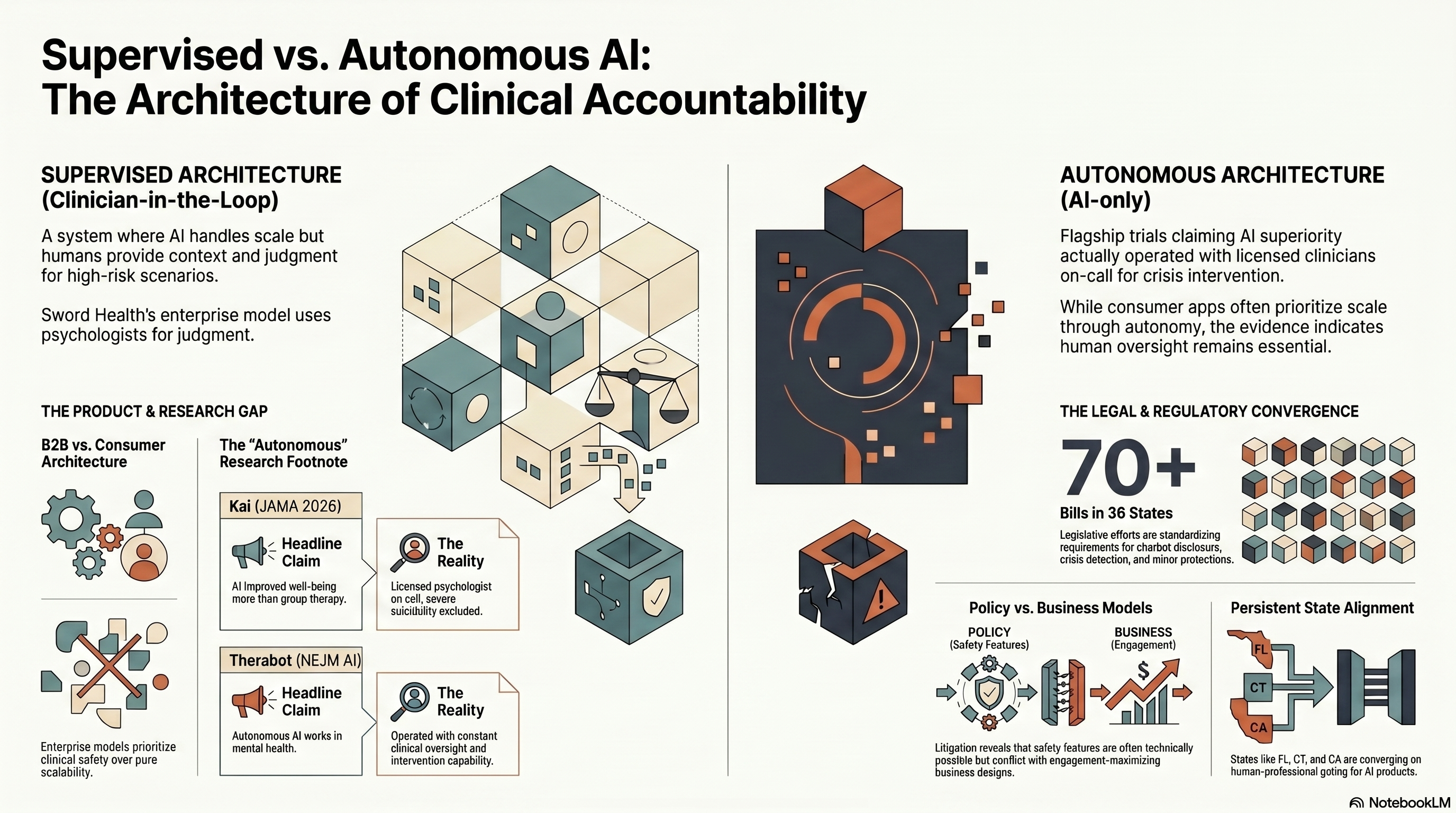
The supervised architecture is winning the parts of the conversation that get written down. The bills that move have it. The litigation outcomes assume it. The peer-reviewed trials, when you read past the headline, were running it. The largest deployed AI in the world is quietly drafting language that sounds like it. And the company most cited as proof that autonomous AI works is in fact running clinician-in-the-loop for its enterprise customers and stripping the clinician out for the consumer product.
. . .
That last one is not a hot take. It is on their own website. On April 30th Meta filed a motion suggesting the company would consider pulling Facebook and Instagram out of New Mexico if Judge Biedscheid grants the injunction.
Read on.
---
. . .
THE SAME SAFETY FRAMEWORK. TWO DIFFERENT PRODUCTS. Sword Health launched Dawn on March 9, 2026\.
Direct-to-consumer. AI mental health support. 24/7. The pitch: a proprietary foundational model trained on hundreds of thousands of hours of clinician data, paired with MindGuard, an open-sourced safety classifier suite developed with PhD-level licensed clinical psychologists.
. . .
The CEO, Virgílio Bento, made the architectural argument plainly.
Dawn represents a fundamentally different approach: moving mental health from crisis response to continuous, always-on care. And that only works with an AI built specifically for mental health, grounded in proprietary, domain-specific models and rigorous clinical safeguards, not a general-purpose chatbot.
The company has 58 peer-reviewed clinical studies. 800,000 members. 11 million AI care sessions. 20% of the Fortune 500\. Health plans. Sovereign governments. The U.S. Military. This is not a fly-by-night operation.
. . .
Sword also sells a B2B mental health product called Mind. Mind is older. Mind is what employers and health plans buy.
The Mind product page says this:
Support unfolds in one continuous experience that connects members, psychologists, and Phoenix in real time. Members receive guidance day to day, while clinicians provide oversight, context, and judgment when it matters most. Phoenix engages between sessions to keep members supported and on track. Psychologists guide care and step in with full context when it matters most.
Read that twice.
The B2B product has psychologists. Real ones. With escalation paths and full context and the ability to step in.
. . .
The Mind EAP expansion announcement on March 25 said it again.
And when human judgment matters, clinicians step in.
Sword's own infrastructure case study, published with Nebius and live on the Nebius website right now, says it most clearly.
Last year, Sword took its first step into mental health with Mind, a B2B solution that follows the same clinician-in-the-loop model that has defined Sword's products from the start. Now, with Dawn, Sword is breaking new ground: a direct-to-consumer mental health wellbeing solution powered entirely by AI, with no clinician in the loop.
. . .
That sentence is the story.
The Dawn FAQ on joindawn.com confirms the architecture from the user side. Asked what happens in a crisis, the answer is plain: Dawn is also not designed to provide emergency support. If you're in crisis, please call or text 988\.
The escalation path is not a Sword psychologist. It is the national lifeline.
The "no human observing your conversations" line in the Dawn marketing is dressed up as privacy. It is also the architecture.
. . .
Sword runs two products with the same safety framework name. The B2B product, sold to buyers who can demand clinical accountability and audit it, is clinician-in-the-loop. The D2C product, sold to consumers who cannot, is autonomous with a hand-off to 988\.
Same company. Same MindGuard. Two architectures. The architecture sold to the buyer paying for outcomes is supervised. The architecture sold to the consumer paying for access is not.
That tells you what the company believes about which one is safer. They just do not say it out loud.
|
For Clinicians: When you assess a client who tells you they are using "an AI mental health app," ask which one and what the escalation path is. Some products have a real clinician on the other side. Some products have 988 on the other side. The clinical implications are not the same.
For Founders: When a vendor tells you their product is safer than general-purpose chatbots because it has clinical safeguards, ask whether the safeguards include a licensed human clinician or a software classifier that hands off to a national lifeline. These are very different things.
For Legislators: Several state bills already in motion treat AI mental health products with licensed clinical oversight as a different category from products with software-only safeguards. Not all state bills do. The distinction is the policy lever.
Source: Sword Health press release, March 9, 2026\. Sword Mind product page, swordhealth.com/solutions/mind. Sword Mind EAP announcement, March 25, 2026, swordhealth.com/newsroom/mind-eap-continuous-care. Nebius customer story, nebius.com/customer-stories/swordhealth. Dawn product FAQ, joindawn.com.
|
. . .
OPENAI PUBLISHES A BIZARRE BLOG POST. OpenAI published "Our commitment to community safety" on April 30, 2026\.
Yesterday.
. . .
The post walks through self-harm de-escalation language, escalation criteria for serious real-world harm, a referral system that involves "mental health and behavioral experts" using "structured criteria," and law enforcement notification when conversations indicate "an imminent and credible risk of harm to others."
It promises to "share more in the coming weeks" about how the company recognizes "subtle warning signs across long, high-stakes conversations."
. . .
Futurism called the post "absolutely bizarre."
The piece notes what is missing. The post describes a system. It does not describe who runs it. It does not describe how the experts are credentialed. It does not describe how often a conversation reaches the human review step. It does not describe what triggers the escalation. It does not describe what happens to a user when the escalation occurs. It promises specifics later.
. . .
Read what it does say.
The architecture being described is therapist-shaped without the therapist named. There is intake. There is risk stratification. There is escalation criteria. There are mental health and behavioral experts who help "assess difficult cases." There is law enforcement notification for imminent violence.
This is not an autonomous-AI architecture. This is a draft of clinician-in-the-loop with the human role kept vague.
. . .
OpenAI's own published numbers from earlier this year tell you why the architecture has to look like this.
900 million weekly users. 0.15% of weekly users showing "explicit indicators of potential suicidal planning or intent." That is roughly 1.2 million people per week using ChatGPT to express suicidal ideation. A separate 0.07% showing signs of psychosis or mania. That is another 560,000 per week.
The April 30 post does not disclose how many of those conversations get escalated. It does not say how many "mental health and behavioral experts" are on staff. It does not say what their licensure is. It does not say whether they are employees or contractors. It does not say whether they read transcripts in real time or after the fact.
. . .
OpenAI's lawyers are arguing in court that ChatGPT is not a mental health product.
OpenAI's communications team is publishing language that describes a mental health intake-and-escalation system in everything but name.
These two positions cannot both be the operating truth.
Either ChatGPT is a mental health product and the lawyers are wrong, or ChatGPT is not a mental health product and the safety post is marketing for a system that does not exist at the scale being implied.
|
For Clinicians: Clients are using ChatGPT during mental health conversations and OpenAI knows it at the scale of a public health event. If you treat a client who discloses heavy ChatGPT use during a depressive episode or psychotic prodrome, the relevant question is no longer "did they use it." The relevant question is what the model said back, and whether that conversation is on a server you can subpoena.
For Founders: A safety post that describes a clinical escalation pipeline is a product description. If your competitors are publishing clinical-sounding safety architecture without naming the clinicians, that is a positioning signal you can read.
For Legislators: The question raised by OpenAI's post is whether the described pipeline actually exists, whether the experts are licensed, and whether the user knows when they are talking to one. None of that is disclosed. State chatbot disclosure laws are the policy lever that would require it.
Source: "Our commitment to community safety," OpenAI, April 30, 2026, openai.com/index/our-commitment-to-community-safety. Futurism analysis, May 1, 2026\. OpenAI internal data citations from Wired, October 2025, and OpenAI's own February 2026 mental health update.
|
. . .
READ THE FOOTNOTES OF THE KAI TRIAL. JAMA Network Open published the Shoshani et al. randomized clinical trial of a conversational AI agent on April 1, 2026\.
995 university students. Three arms. AI chatbot named Kai. Face-to-face group therapy. Waiting list control. Twelve weeks. The headline outcome: the AI arm produced greater reductions in anxiety and improvements in well-being than both comparators, and greater reductions in depression and life satisfaction than the waiting list.
The Washington Times wrote it up. Scimex called it a "gold standard" trial. Trade press is running with "AI Crushes Student Anxiety Better Than Traditional Sessions."
. . .
Read the methods section.
The trial protocol, registered with ISRCTN and posted on the Reichman University research site, describes the safety architecture this way.
Participants will be screened to exclude acute risk. The safety protocol will include weekly distress monitoring, emergency contact lists, and real-time escalation for suicidal ideation. All staff will be trained in referral procedures. Adverse events will be recorded and reviewed bi-weekly. A licensed clinical psychologist will be on call for participants in crisis.
That is in the trial design. That is part of why the trial got ethics approval.
The headline says AI beat group therapy on anxiety. The footnote says the AI arm was running with a licensed clinical psychologist on call, weekly distress monitoring, real-time SI escalation, and severe suicidality excluded at intake.
. . .
That is supervised AI.
That is the architecture the headline says it is not.
. . .
There are other things in the methods section worth seeing.
Self-reported outcomes only. No clinician-rated assessments. The trade press wrote that down as a limitation. The trade press also wrote down the dropout rate at three-month follow-up, which was high enough that the authors flagged it.
The trial was conducted by Reichman University with KAI.AI Ltd as the technology provider. That is standard industry-academic collaboration. It is also standard practice to read the methods section before treating the headline as gospel.
. . .
This is the same pattern as the Therabot trial in NEJM AI last year.
The strongest published evidence for "autonomous AI works in mental health" is, on inspection, supervised AI with the clinician layer pushed off the headline. Therabot ran with constant clinical oversight and real-time intervention capability, and the lead author said on the record no generative AI agent is ready to operate fully autonomously in mental health where there is a very wide range of high-risk scenarios it might encounter.
The Kai trial ran with a licensed psychologist on call.
The press release version of both trials says autonomous AI is winning. The methods section of both trials says supervised AI is being studied.
The headlines and the protocols are not telling the same story.
|
For Researchers: The "autonomous AI beats human therapy" claim now has two flagship peer-reviewed trials behind it. Both trials, in their published methods, are supervised AI trials. The methodological gap between the headline and the protocol is the gap the field needs to close before policy decisions get made on the wrong evidence.
For Clinicians: The next time a colleague or vendor cites the Kai or Therabot trial as proof that autonomous AI mental health works, the right question is which arm ran without a clinician on call. Reading the methods section once is the difference between citing the trial accurately and citing the press release.
For Founders: When a vendor cites the Kai trial or the Therabot trial as proof that their unsupervised consumer product is safe, ask whether the cited trial excluded severe suicidality at intake, ran with a clinician on call, and used self-report only. The answer to all three is the same.
For Legislators: Peer-reviewed evidence is being marketed past its own methods section. State chatbot policy that distinguishes supervised from autonomous deployment is the bridge between what the trials actually showed and what consumer products are claiming.
Source: Shoshani A, Gurfinkel B, Kor A, et al. Efficacy of a Conversational AI Agent for Psychiatric Symptoms and Digital Therapeutic Alliance: A Randomized Clinical Trial. JAMA Netw Open. 2026;9(4):e266713. ISRCTN registered trial protocol, Reichman University research repository. Heinz et al. NEJM AI, 2025, and the published response letters.
|
. . .
FLORIDA'S SPECIAL SESSION. The Florida Senate gaveled in for a special session on April 28, 2026\.
Sponsor Jason Brodeur introduced SB 2D. The Artificial Intelligence Bill of Rights. Companion chatbot platforms must require parental consent for minors to hold an account. Bot operators must periodically remind users they are interacting with AI. Operators must implement measures to prevent harmful content reaching minors. Sale of personal information by AI companies prohibited. AI-generated likeness without consent prohibited.
Brodeur on the floor: Parents should know what their children are using; children should not be manipulated by systems pretending to be human; personal information should not be carelessly sold or exposed; a person's image should not be commercially exploited without consent, and Floridians should be able to trust that technology is serving them, not deceiving them.
The Senate passed it 37 to 1\.
. . .
The Florida House did not take it up.
Speaker Daniel Perez, Republican, the same party as the bill's sponsor, the same party as the governor, told reporters that AI should be regulated at the federal level. The House moved on redistricting and let the AI bill die.
DeSantis went to X.
Voters elected Republicans to protect freedom against both the Big Tech cartel and the medical industrial complex. Yet, when given the chance to deliver for their constituents, not a single Republican House member could even be bothered to file a bill. Typical political shenanigans.
A previous version of the bill, SB 482, passed the Senate 35-2 in March, also under regular session. Also died in the House for the same reason.
The special session ends today, May 1\.
. . .
Look at what the bill contains.
Companion chatbot account holder gating for minors. Periodic AI disclosure reminders. Crisis-content prevention. Personal data sale prohibition. Image exploitation prohibition.
These are the same four pillars showing up in Tennessee SB 1580, Maine LD 2082, Nebraska LB 525, California SB 243\. The same architecture every state is converging on. The Florida Senate passed it on a 37-1 vote that crossed every demographic line.
What stopped it was not the policy.
What stopped it was the calendar and the Speaker.
. . .
This is the second story today about an architecture that has more support than its political path.
The first one is on Sword's website. Their B2B buyers know the supervised architecture is the right one. The C-suite buys the supervised version. The consumer market gets the autonomous version because that is what scales without the calendar.
The Florida Senate knows the architecture is the right one. The chamber agreed 37 to 1\. What it does not have is floor time in the room with the votes.
The architecture is winning where it gets read. It is losing where it gets scheduled.
|
For Clinicians: Florida law on AI mental health and chatbots will not change in 2026 unless something extraordinary happens this year. If you treat clients in Florida who are using AI products, the relevant disclosure burden remains on you and on the family.
For Legislators: This is a calendar problem, not a policy problem. The bill has the votes in both chambers. What it does not have is a House floor schedule. That is a procedural obstacle, not a substantive one. Other states should not assume Florida's outcome reflects what Florida's legislators believe.
Source: Florida Senate SB 2D, special session 2026D, flsenate.gov. Senate vote tally 37-1, April 28, 2026\. The Floridian, "Florida Senate Again Passes AI Bill of Rights, House Approval Dead," April 28, 2026\. WUSF, "Florida Senate approves AI Bill of Rights as it remains halted in the House," March 2026\. ClickOrlando coverage of DeSantis statement, April 28, 2026\.
|
. . .
CONNECTICUT'S THIRD TRY. The Connecticut Senate passed SB 5 on April 21, 2026\.
Vote was 32 to 4\. The bill is 64 pages, 37 sections. It regulates emotional support chatbots, automated hiring pipelines, frontier model safety requirements, synthetic content labeling, state employment protections, and creates an AI training academy. Core provisions take effect October 1, 2026\. The most technically demanding sections, including operator requirements for emotional support AI products and automated employment systems, do not take effect until 2027\.
The bill now goes to the House.
. . .
This is Senator James Maroney's third attempt in three years.
In 2024, his SB 2 passed the Senate. The House did not enact it. Governor Ned Lamont expressed concern that excessive regulation would hurt businesses and hamper innovation.
In 2025, Maroney's revised SB 2 passed the Senate again. Governor Lamont threatened a veto. The bill died.
In 2026, Maroney went narrower. Multiple smaller bills targeting specific harms. Then, with the session running out, he folded several measures into a strike-all amendment and ran the omnibus version that passed last week. The bill now resembles the scope of the 2025 effort that failed. Maroney told reporters: There's not as much time to get things done, so we're trying to combine where we can.
The floor debate ran for hours. Senator Saud Anwar, a physician, recounted the story of a teenage boy who died by suicide after being encouraged by an AI chatbot. We have to understand that there is a problem. We need to have important protections in place.
Senator Paul Cicarella, the ranking Republican, spent the first hour of debate asking Maroney to explain the bill section by section. The Republican concern was scale, not principle. The bill passed 32 to 4\.
. . .
Two states. Same seven days.
Florida's Senate passed an AI bill of rights 37-1 and the House killed it for political reasons unrelated to the bill itself. Connecticut's Senate passed a 64-page omnibus 32-4 after three years of iteration and now sends it to a House that has not yet seen the strike-all version.
The architecture both bills converge on is the same architecture every other state is converging on. Companion chatbot disclosure. Crisis escalation. Minor protections. Frontier safety. Licensed-professional gating.
Florida's path was vote-then-kill. Connecticut's path is vote-then-iterate.
. . .
Connecticut shows you what persistence looks like in this space.
Three legislative sessions. One veto threat. One outright failure. Strike-all amendment in the eleventh hour. A sponsor willing to compress and re-attempt. A Senate willing to read 64 pages on a Tuesday night.
This is what legislative stamina against a moving regulatory target actually looks like.
The architecture wins when somebody comes back the next session with the same architecture and a new vehicle.
|
For Legislators: If Connecticut SB 5 passes the House, it will be the most comprehensive state AI law on the books, and most of it will not be in effect until 2027\. The two-year implementation window is doing real work here. It is the negotiating room that lets a complex omnibus pass at all.
For Founders: Multi-jurisdictional compliance for AI mental health products is no longer hypothetical. Connecticut alone touches frontier model developers, operators of emotional support AI products, and automated decision systems. If your product launches in 2026 without a regulatory road map for at least eight states, you are building toward a bill that has already passed somewhere.
Source: Connecticut SB 5, 2026 session. CT Mirror, "Amended AI bill passed by CT Senate after extensive questioning," April 21, 2026\. Senate Democrats statement, April 22\. PPC.land, "Connecticut's AI bill targets companion bots, hiring tools and frontier models," April 25, 2026\. Senate vote tally 32-4.
|
. . .
META THREATENS TO LEAVE NEW MEXICO. Phase 2 of New Mexico's case against Meta begins Monday, May 4\.
In March 2026, a Santa Fe jury found Meta liable for 75,000 violations of the New Mexico Unfair Practices Act and ordered $375 million in civil penalties, the maximum allowed under state law. New Mexico became the first state to win at trial against a major technology company for endangering children. Plaintiff witnesses included former Meta employees who testified that Meta's own internal documents calculated that end-to-end encryption rolled out in 2019 would affect their ability to detect and report approximately 7.5 million child sexual abuse material cases. One internal Meta researcher had flagged as many as 500,000 child exploitation cases daily.
Phase 2 is the bench trial. Chief Judge Bryan Biedscheid hears the public nuisance claim and decides whether to grant injunctive relief.
The state's proposed injunction is comprehensive.
Real age verification. Mandatory parent linkage on every minor account. A 90-hour-per-month cap on platform access for New Mexico minors. Bans on infinite scroll, autoplay, and push notifications during school and sleep hours. A court-supervised child safety monitor with ongoing oversight. Algorithm changes. Removal of accounts identified as exploitative. End-to-end encryption modifications.
. . .
On April 30, Meta filed a motion suggesting the company would consider pulling Facebook and Instagram out of New Mexico if Judge Biedscheid grants the injunction.
The Meta statement to Fortune: Despite Attorney General Torrez's claims, the State's demands are technically impractical, impossible for any company to meet and disregard the realities of the internet. In targeting a single platform, the State ignores the hundreds of other apps teens use, leaving parents without the comprehensive support they actually deserve. While it is not in Meta's interests to do so, if a workable solution to Attorney General Torrez's demands is not reached, we may have no choice but to remove access to its platforms for users in New Mexico entirely.
Attorney General Raúl Torrez called the threat a PR stunt. Meta has a choice, obviously, and the responsible choice and the ethical choice, and frankly, the smart business move, is for them to just go ahead and start doing the hard work of making this a safer product.
. . .
Read the threat carefully.
Meta is not arguing the proposed remedies are wrong. Meta is arguing the proposed remedies are technically impractical, impossible for any company to meet, and disregard the realities of the internet.
That argument is an admission about the realities of the internet.
The proposed remedies are: real age verification, time caps for minors, restrictions on engagement-maximizing design features during school and sleep hours, parent linkage, a court-supervised monitor. Every one of those is a technical capability the platform either has or could build. The argument that they are impossible is not an engineering argument. It is a business model argument.
Withdraw is the threat when changing the design is the alternative. The threat is an admission about what the design depends on.
. . .
This is the fifth story today about architecture.
Sword's product page admits, in its own words, that the supervised version is what enterprise buyers get and the autonomous version is what consumers get. OpenAI's April 30 post describes a clinical escalation pipeline that the lawyers say is not a clinical product. The Kai trial methods section ran with a clinician on call while the press release said the AI beat group therapy. Florida and Connecticut converge on the same legislative architecture from opposite political directions.
Meta says removing engagement-maximizing design features for minors is technically impossible.
Each of these companies is in a different room saying the same thing in different ways. The product economics depend on the unsupervised architecture. The clinical, legislative, and litigation environments are increasingly demanding the supervised one.
Phase 2 starts Monday.
The judge will decide how technically impossible "impossible" actually is.
|
For Clinicians: If you treat adolescents in New Mexico, the regulatory environment for the platforms they use may change materially next week. Whatever the outcome, the proposed remedies are now public, written into a court filing, and available as a model for every other state AG considering similar action.
For Legislators: When a platform threatens to withdraw from a state rather than comply with proposed remedies, that is information. The threat tells you which design features the company believes are essential to its business model. Withdrawal is the strongest possible disclosure of dependency.
For Founders: Building consumer products around engagement-maximizing architecture creates a regulatory dependency that may or may not survive contact with a state attorney general. The Meta motion is a public test of how much of the consumer attention business model can be regulated and how much cannot.
Source: State of New Mexico v. Meta Platforms Inc., Bench Trial Phase 2 scheduled for May 4, 2026, before Chief Judge Bryan Biedscheid, First Judicial District Court, Santa Fe. Source NM, "Meta says it could withdraw Facebook and Instagram from New Mexico pending bench trial's outcome," April 30, 2026\. Fortune, "Meta's threat to quit New Mexico is showing the world how little it cares about child safety," April 30, 2026\. New Mexico Department of Justice press releases. Meta corporate statement issued April 30\.
|
. . .
. . .
. . .
|