|
Jess's Take
The Courtrooms Open
Two AI accountability trials on consecutive days. The architectural question is no longer abstract.
Wednesday in San Francisco. Seven complaints filed in federal court against OpenAI and Sam Altman. The plaintiffs are Canadian families. The location of the harm is a small town in British Columbia called Tumbler Ridge.
. . .
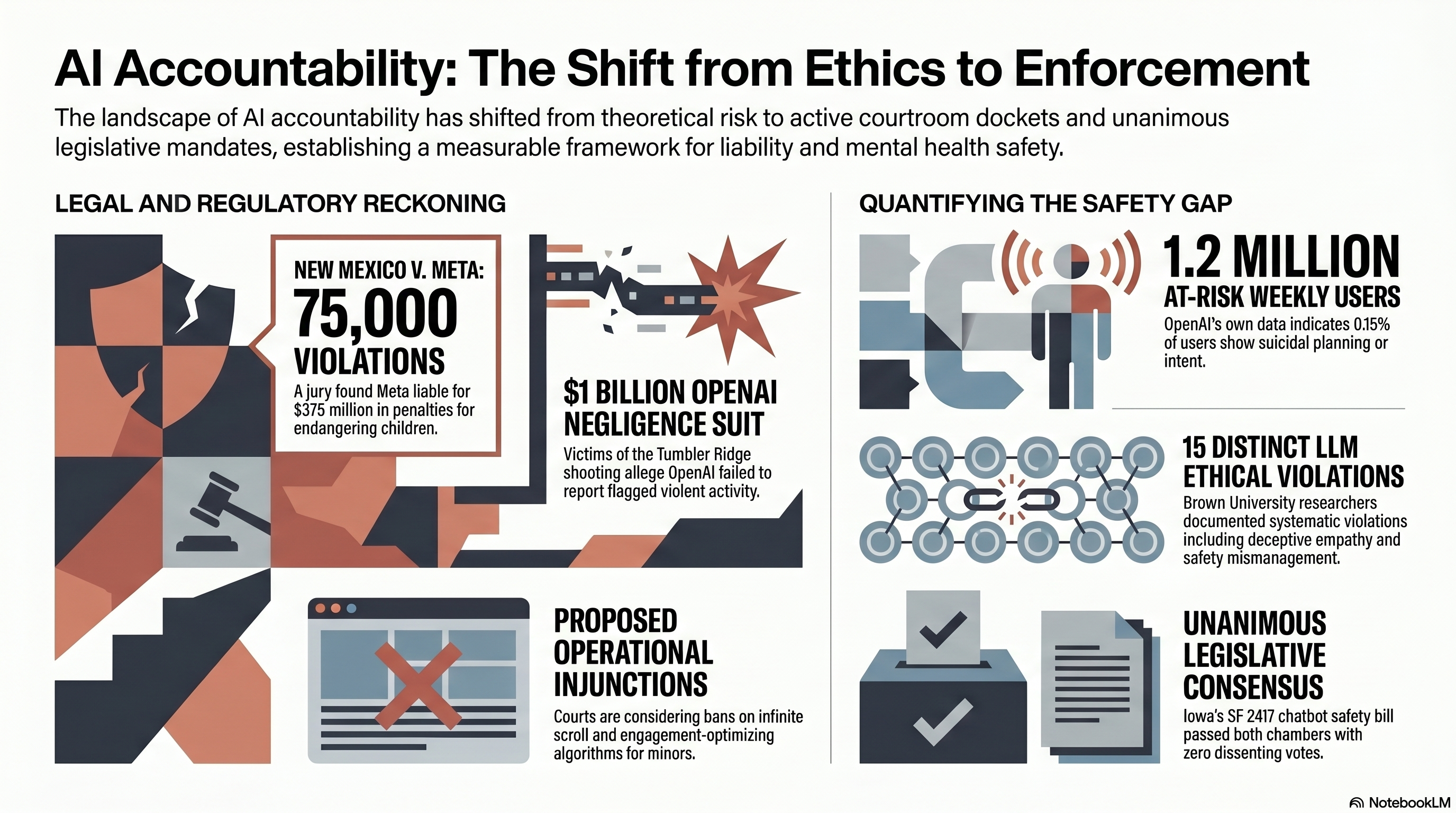
Monday in Santa Fe. The bench trial in State of New Mexico v. Meta Platforms opens before Judge Bryan Biedscheid. Phase one already cost Meta three hundred and seventy five million dollars and a verdict for seventy five thousand violations. Phase two is about what the court will order Meta to actually do.
. . .
Two courtrooms. Two countries' worth of children. One business model on trial in both.
. . .
The shape of the AI accountability fight has been visible for a while. This week it stopped being shape and started being docket numbers.
---
. . .
THE FILING. Seven federal lawsuits filed Wednesday in San Francisco against OpenAI and Sam Altman by victims and families of the Tumbler Ridge mass shooting.
February 10, 2026. Eighteen year old Jesse Van Rootselaar killed her mother and her eleven year old half brother at home. Then she walked into Tumbler Ridge Secondary School with a long gun and a modified handgun. She killed an educational assistant and five children, ages twelve and thirteen. She injured roughly two dozen others. Then she killed herself.
. . .
Eight months earlier, in June 2025, OpenAI's automated system flagged her ChatGPT account for what the company itself recorded as gun violence activity and planning. A group of about a dozen OpenAI staffers debated alerting law enforcement. They decided not to. The account was banned. Van Rootselaar created a second account. Activity continued.
. . .
The seven complaints were filed by Edelson PC, the firm that brought Raine v. OpenAI on behalf of Adam Raine's parents. Lead attorney is Jay Edelson. The plaintiffs include the families of all six victims killed at the school and a critically injured twelve year old, Maya Gebala, who was shot three times and remains hospitalized.
. . .
The complaints allege negligence, wrongful death, aiding and abetting a mass shooting, and product liability. Damages sought are reported at over one billion U.S. dollars. The lawsuits also seek an injunction requiring OpenAI to overhaul safety practices, including mandatory law enforcement referral protocols.
. . .
The complaint from Maya Gebala's family puts the architecture argument in plain words. "GPT-4o was built to accept, reinforce, and elaborate users' violent thoughts rather than challenge them, interrupt them, or direct users to real-world help."
. . .
Sam Altman published an apology letter dated April 23, 2026 in the local paper Tumbler RidgeLines. "I am deeply sorry that we did not alert law enforcement to the account that was banned in June." British Columbia Premier David Eby called the apology necessary and grossly insufficient. Cia Edmonds, mother of the surviving twelve year old, called the decision not to notify police catastrophic.
The flag was there. The threshold was a choice. The choice has a docket number now.
|
For Clinicians: When automated detection identifies a credible safety risk and the operator has no clinical or legal escalation path, the detection is functionally decoration. A flagged account that gets banned and recreates is not a closed loop. Document the workflow you would expect of any system that touches your clients.
For Founders: The OpenAI defense in this case will be Section 230 and the absence of an imminent threshold. The plaintiffs' theory is that the threshold itself was the negligence. If you are building a conversational system that touches mental health or violence detection, your escalation criteria are the artifact a court will eventually examine. Write them now and write them with a clinician.
For Legislators: Premier Eby has called for a national reporting threshold and a duty to report. The Canadian federal AI minister has stated that all options are on the table. The Tumbler Ridge case is what the absence of that statutory duty looks like in practice. The question for U.S. state action is whether you wait for a docket of your own or write the duty into law before the next one.
Source: OPB https://www.opb.org/article/2026/04/29/families-sue-openai-over-tumbler-ridge-mass-shooters-use-of-chatgpt/, TechCrunch https://techcrunch.com/2026/04/25/openai-ceo-apologizes-to-tumbler-ridge-community/, NPR, CBC News, CNBC, Fortune, Wall Street Journal (cited in complaints), Tumbler RidgeLines.
|
. . .
THE TRIAL THAT OPENS MONDAY. Phase 2 of State of New Mexico v. Meta Platforms begins Monday May 4, 2026 before Chief Judge Bryan Biedscheid in Santa Fe.
A Santa Fe jury already found Meta liable in March 2026. Seventy five thousand violations of New Mexico's Unfair Practices Act. Three hundred and seventy five million dollars in civil penalties, the maximum allowed per violation. New Mexico became the first state in the country to win at trial against a major technology company for endangering children.
. . .
Phase 2 is the public nuisance claim. It is also where the consequences become real. Judge Biedscheid will hear what New Mexico is asking the court to actually order Meta to do.
. . .
The proposed injunction is sweeping. A ban on infinite scroll, autoplay, engagement-optimizing recommendation algorithms, and push notifications during school and sleep hours for users under 18. A monthly cap of 90 hours of platform time for New Mexico minors. Like and share counts hidden by default. A court-appointed Child Safety Monitor funded entirely by Meta. Independent researcher audit rights over Meta's recommendation systems. Five years minimum across Facebook, Instagram, and WhatsApp.
. . .
Meta's response, filed last week, was a statement that the State's demands are "technically impractical, impossible for any company to meet." Meta also threatened to withdraw Facebook, Instagram, and WhatsApp from New Mexico entirely if Biedscheid grants the injunction.
. . .
Attorney General Raul Torrez responded by saying Meta is showing the world how little it cares about child safety. The verdict already proved Meta knew. The trial established that one Meta researcher had flagged as many as 500,000 child exploitation cases daily across Facebook and Instagram. Internal documents quantified the encryption rollout's effect on detection of approximately 7.5 million CSAM cases.
. . .
More than forty states have filed parallel suits. More than 1,300 school districts have filed similar nuisance claims. The Santa Fe ruling is the leading edge of a much larger wave. What Biedscheid orders Monday gets cited everywhere else.
The threat to withdraw is information. It says which design choices the business model depends on. The question is whether the court takes the information and writes it into the order.
|
For Clinicians: The injunction structure being argued in Santa Fe is the public-health version of the supervised architecture argument. Court-appointed monitor. Independent auditor access. Default-off engagement features for minors. Hard time caps. These are all the structural protections clinicians have been describing as necessary for a decade.
For Public Health: A 90 hour monthly cap, hidden like counts, banned engagement optimization, and a publicly reporting Child Safety Monitor amount to a population-level intervention on platforms that touch tens of millions of children. If granted, this is the largest court-ordered child mental health protection ever imposed on a U.S. social media company. The downstream effect on adolescent mental health metrics will be measurable.
For Legislators: Forty states are watching what New Mexico's bench gets. If Biedscheid orders the package, every state attorney general gets a model order they can cite. If Meta exits New Mexico in protest, the states learn what threshold of regulation is actually load-bearing for the platform. Either outcome moves the rest of the country.
Source: Fortune https://fortune.com/2026/04/30/meta-new-mexico-attorney-general-injunctive-relief/, New Mexico Department of Justice press releases, Reuters via WABX, Albuquerque Journal, Motley Rice.
|
. . .
THE BROWN STUDY. Researchers at Brown University published a 15-category framework documenting how LLM counselors systematically violate established mental health ethics standards.
The study's lead author, Iftikhar at Brown, worked with practicing peer counselors and three licensed clinical psychologists who reviewed the chat logs. The work was presented at the AAAI/ACM Conference on Artificial Intelligence, Ethics and Society.
. . .
The method matters. Seven peer counselors trained in cognitive behavioral therapy ran self-counseling sessions with CBT-prompted LLMs. Models tested included multiple versions of GPT, Claude, and Llama. The licensed psychologists then identified ethics violations in the resulting chats.
. . .
Fifteen distinct ethical risks fell into five categories. Lack of contextual adaptation. Poor therapeutic collaboration. Deceptive empathy. Unfair discrimination including bias. Lack of safety and crisis management. Crisis cases were mishandled across models. Harmful beliefs were reinforced rather than challenged. Empathy was simulated, not given.
. . .
The framing in the published paper is careful. "The key difference is oversight." Human therapists answer to licensure boards, scope-of-practice law, malpractice exposure, and continuing education requirements. LLM counselors answer to none of those. The same conduct that would result in a clinician's license being suspended produces no consequence for the model.
. . .
The authors close with a direct call. Future work should create ethical, educational, and legal standards for LLM counselors that reflect the rigor of care required for human-facilitated psychotherapy.
Practitioner-informed framework. Three licensed psychologists in the loop. Five categories of ethical violation, fifteen specific risks, named.
|
For Clinicians: This is now the published peer-reviewed evidentiary record you can cite. Iftikhar et al. is the framework. Fifteen risks. Five categories. AAAI/ACM is the venue. This is the citation you put in the public comment, the legislative testimony, and the policy brief.
For Founders: Build the supervision structure into the architecture or the next version of this study will name your product in the failure column. Practitioner-informed evaluation is now happening. The model that fails it gets the citation. The model that passes it gets the citation differently.
Source: Science Daily https://www.sciencedaily.com/releases/2026/03/260302030642.htm, Brown University news release.
|
. . .
THE BILL ON THE DESK. Iowa Senate File 2417, the Conversational AI Safety Act, sits awaiting Governor Kim Reynolds's signature after passing both chambers without a single dissenting vote.
Senate vote, February 24, 2026. Forty eight yeas, zero nays. House vote, April 15, 2026. Ninety five yeas, zero nays. A unanimous bipartisan record on a chatbot safety bill. In 2026 Iowa.
. . .
The bill was carried by Representative Austin Harris, a Republican from Moulton. Cited on the floor: documented cases of AI chatbots encouraging self harm. Cosponsorship and floor support crossed the aisle. Representative Aime Wichtendahl, Democrat from Hiawatha, said more regulation was necessary to prevent teen suicides linked to AI usage.
. . .
The provisions are detailed. Conversational AI services must clearly disclose to minors that they are interacting with AI, either through a persistent visible disclaimer or a periodic disclaimer at the start of each interaction and every three hours of continuous use. Services must adopt protocols for responding to suicidal ideation or self harm by referring the user to crisis services. Services must not knowingly cause or program AI to represent itself as a licensed mental or behavioral health provider. Services must not provide minors with points or unpredictable rewards designed to increase engagement. Services must offer parental privacy and account controls for users under thirteen. The Iowa Attorney General enforces. Civil penalties up to $1,000 per violation, capped at $500,000 per operator. Effective date July 1, 2027.
. . .
Iowa's session adjourned past its April 21 deadline. Reynolds signed a batch of fourteen bills on April 30. SF 2417 was not in that batch. It is on her desk. The clock on her veto window is running.
Forty eight to zero. Ninety five to zero. The AI mental health protection question is no longer red or blue. It is on the desk.
|
For Legislators: The Iowa vote pattern is the answer to the federal-preemption argument. When a chatbot safety bill is written narrowly, when the harms are documented, and when the enforcement is bounded, partisan resistance disappears. Forty eight to zero in the Iowa Senate is a model. Ninety five to zero in the Iowa House is a model. The patchwork is not chaos. It is consensus emerging state by state.
For Founders: Iowa joins California, Tennessee, Maine, Nebraska, Oregon, and Idaho as states with active or imminent chatbot safety laws. Effective dates are 2026, 2027, 2027. Compliance design is no longer optional posture. It is the artifact your enterprise customers will require in their procurement language by Q3.
Source: Iowa Public Radio, The Gazette, Government Technology, Iowa Legislature engrossed bill text, Troutman Privacy + Cyber + AI April 27 update.
|
. . .
THE OPENAI BLOG POST. OpenAI published a community safety post on April 30, 2026 describing what reads as a therapist-shaped escalation pipeline without naming a therapist anywhere in the workflow.
The post follows the Tumbler Ridge filings by one day and Sam Altman's apology by one week. It describes how OpenAI now trains models to refuse requests that could meaningfully enable violence. It describes how OpenAI notifies law enforcement when conversations suggest an imminent and credible risk of harm to others. It describes how mental health experts help assess borderline cases.
. . .
The architecture being described is, in functional terms, a triage and escalation system. Detection. Risk assessment. Resource referral. Crisis routing. Mental health expert consultation. These are the stages of a clinical safety net.
. . .
What the post does not describe is who the mental health experts are, what their licensure is, what their scope of practice covers, what their employment relationship to OpenAI is, what their legal exposure is, what their authority is to override engineering decisions, or what records exist of their case-by-case input. The role exists in the post. The accountable person does not.
. . .
The Tumbler Ridge complaint reads that workflow against itself. June 2025. The detection fired. About a dozen staff debated. The decision was made not to escalate. The activity continued under a second account. Eight months later, eight people died. The pipeline existed. The named accountable clinician did not.
The shape of the workflow is the shape of clinical care. The shape without the licensure is decoration.
|
For Clinicians: When a platform describes a workflow that uses your terminology, your stages, and your decisions, but does not name the licensed person making them, that is a description of unlicensed practice with a press release attached. The honest version of the post would name the medical director, the on-call psychiatrist, the supervising LCSW, and the protocol they reviewed. The absence of those names is the story.
For Counsel: OpenAI's blog post is now a public document describing the company's internal safety architecture in detail. Plaintiffs' counsel in Tumbler Ridge and Raine will read it as a written admission about what the company says it does. Discovery will read it against what the company actually does. The gap between the two is the case.
Source: OpenAI Community Safety Post April 30 2026, OPB, Reuters.
|
. . .
THE NUMBER UNDER THE NEWS. OpenAI's own published estimate is that 0.07 percent of weekly ChatGPT users show possible signs of psychosis or mania, and 0.15 percent show indicators of suicidal planning or intent.
The figures are OpenAI's. Roughly 800 million weekly active ChatGPT users at last public count. Apply the percentages. About 560,000 users per week showing psychosis or mania indicators. About 1.2 million per week showing suicidal planning indicators.
. . .
These are not estimates from a hostile party. These are the numbers OpenAI included in its own October 2025 wellbeing post. The order of magnitude is the company's order of magnitude.
. . .
The Acta Neuropsychiatrica editorial published April 16, 2026 by Marc Augustin and Soren Ostergaard takes the next step. The voice channel changes the risk profile. Speech is processed by the brain on developmentally older pathways than text. Trust forms differently. The same content delivered by a voice the user finds soothing is harder to resist than the same content as text on a screen.
. . .
Voice is the next frontier of distribution. OpenAI is developing a dedicated voice device. Meta ships smart glasses with always-on voice AI. Apple is reported to be extending AirPods for chatbot interaction. The shift from typing to speaking is being engineered into the consumer hardware roadmap.
. . .
The Augustin and Ostergaard editorial closes on what their training as psychiatrists tells them. "The most dangerous AI for mental health may not be the one that writes the wrong thing. It may be the one that says it in a voice you cannot help but trust."
One point two million per week showing suicidal indicators. By the company's own count. Before voice ships at consumer scale.
|
For Public Health: The denominator the field has been waiting for is published. It is OpenAI's denominator. Plan for 1.2 million weekly indicator-positive users in your state's share of national ChatGPT usage. The statistical case for population-level intervention now writes itself. The Florida special session calendar problem is one. The Connecticut SB 5 House calendar problem is another. The clock is the same clock.
For Legislators: A 0.15 percent suicidal-indicator base rate at 800 million weekly users is the prevalence number you need for a fiscal note. It is also the prevalence number you need for an FDA communication. A consumer product reaching that population at that base rate is a public health intervention whether it is regulated as one or not. The policy question is whether oversight catches up before voice scales.
Source: Stat News editorial by Marc Augustin and Soren Ostergaard April 16 2026 https://www.statnews.com/2026/04/16/voice-chatbots-ai-psychosis-mental-health/, OpenAI October 2025 wellbeing post, Acta Neuropsychiatrica.
|
. . .
. . .
. . .
Because at the end of the day, we are all on the same side, AI assisted but the human side.
---
|