|
Jess's Sunday Reflection
Three Champions, On the Eve of Trial
The psychologist who walked into the FTC. The Republican senator who put a duty of loyalty under chatbot law. The neuroscientist who shipped the device while the rest of the sector talked about it.
Three Champions, On the Eve of Trial
. . .
Every weekday this newsletter is a body count.
. . .
This week alone. The seven OpenAI complaints in San Francisco federal court advanced into the discovery phase. Edelson PC filed the Tumbler Ridge brief that named twenty-two grieving families. The AMA letter to Congress hit the legislative correspondent inboxes. Six more state bills crossed chamber thresholds. Two more children died.
. . .
Sunday is different.
. . .
Sunday is the day you notice that the entire operating record under all of that, the part the courts and the committees and the editorial boards now treat as settled, did not exist three years ago. Somebody had to build it.
. . .
Tomorrow morning Phase 2 of State of New Mexico v. Meta Platforms opens in Santa Fe. The injunction package on Chief Judge Bryan Biedscheid's bench is the most sweeping court-ordered child-safety remedy ever proposed against a social media company in American history. Infinite scroll, banned during school hours. Push notifications, off during sleep hours. Minor screen time, capped. A Meta-funded Child Safety Monitor sitting on top of all of it for five years.
. . .
That is tomorrow.
. . .
This is Sunday. And the courtroom that opens tomorrow opens because three people, working in three different countries with three different professions, walked into rooms most of their peers had decided were not their problem and put the configuration nobody else would build into the formal record.
. . .
A clinical psychologist who walked into the Federal Trade Commission in February 2025 with a folder full of dead kids and asked the federal government to do its job. She brought sixteen pages of footnoted policy with her. The federal government has not yet acted on what she handed them. Every state attorney general now reads it before deciding whether to sue.
. . .
A Republican state senator from a rural North Carolina county who has sold insurance for thirty years. He took the highest fiduciary standard in American law, the duty of loyalty that governs trustees and corporate officers, and he wrote it into chatbot regulation. The bill is alive in committee. The doctrine has already begun to migrate.
. . .
A computational neuroscientist in London who, while everyone else in his sector was on a podcast talking about scaling, spent six years quietly clearing the toughest medical device standard in the western world. His company is now integrated across two-thirds of the British National Health Service. The argument that the supervised clinical-AI architecture cannot be built at scale ended when his audit cleared.
. . .
They have not coordinated. They have probably never been in the same room. They will probably never share a podium.
. . .
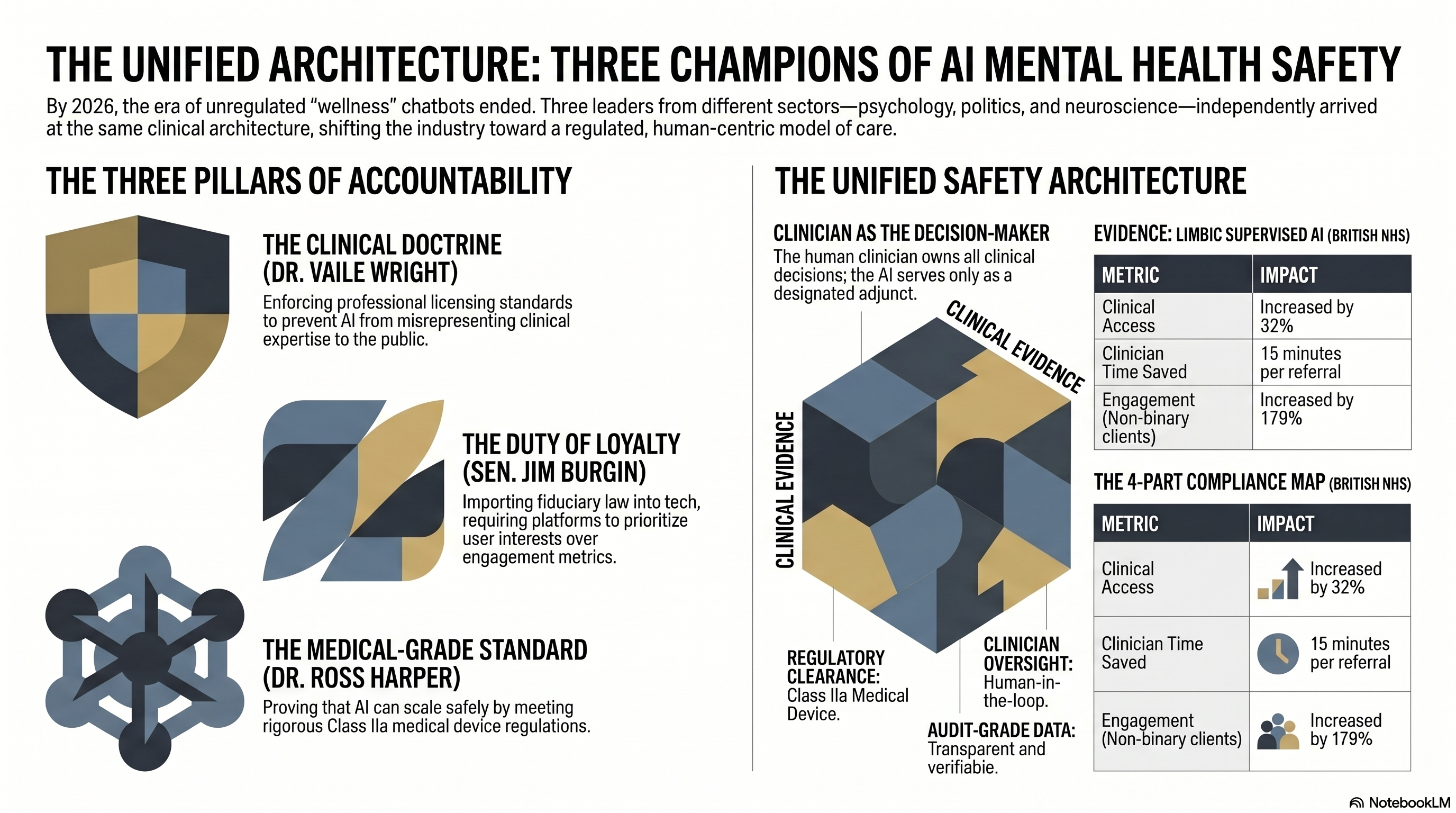
They are arriving at the same answer anyway. The clinician owns the clinical decision. The AI does the work the clinician designates and only that work. The licensing board, the medical device regulator, and the duty of loyalty are the enforcement mechanisms. Disclosure is real. Consent is real. The professional ethics codes are the ceiling and the floor.
. . .
Three rooms. Three countries. Three professions. Same configuration.
. . .
When that many people, that far apart, with that little to gain from agreeing, all reach the same architecture without consulting each other, the architecture was already true. They just had to walk far enough into the work to see it.
. . .
A psychologist. A senator. A neuroscientist. Three different angles on the same case.
. . .
Here they are.
---
. . .
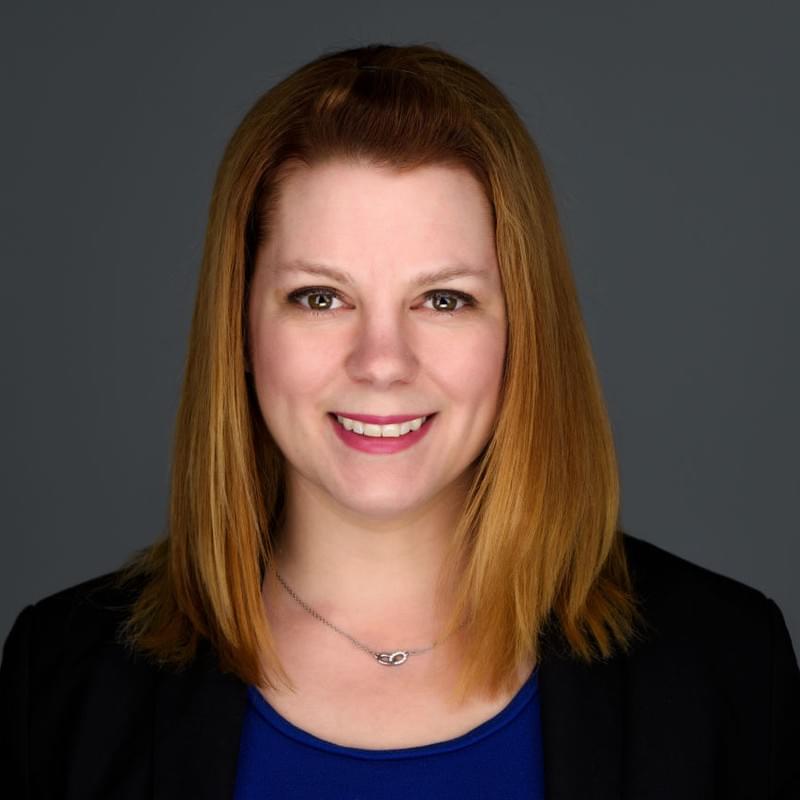
CHAMPION ONE. THE PSYCHOLOGIST. Doctor Vaile Wright walked into the FTC in February 2025 and asked the federal government to do its job. She brought receipts. The receipts were dead kids.
|
|
Photo: drvailewright.com
|
Vaile Wright, PhD. Licensed clinical psychologist. Senior Director, Office of Health Care Innovation, American Psychological Association. Lead author of the foundational federal-policy artifact under every state mental health AI bill written in the last eighteen months. The named voice of one hundred and fifty-seven thousand American psychologists on AI in mental health.
. . .
She brought APA Chief Executive Doctor Arthur C. Evans Jr. with her. They sat down with FTC staff. They opened a folder.
. . .
The folder had two cases. A Florida boy who attacked his parents after extended use of a Character.AI bot calling itself a therapist. A Texas boy who died by suicide after one did the same. Both bots claimed clinical credentials they did not have. Both companies took the money anyway.
. . .
Wright's line at the table was the kind of line a clinical psychologist with twenty years on the licensing-board side of the table can deliver without raising her voice. Any licensed profession should be protected from misrepresentation. You're putting the public at risk when you imply there's a level of expertise that isn't really there.
. . .
The line is the doctrine. Licensed professions exist because the public cannot, on its own, evaluate the quality of the service. The license is the proxy for the trust. Misrepresenting the license is fraud. Wright was not asking the FTC to invent new law. She was asking it to enforce law it already had.
. . .
The FTC has not yet acted. Wright has not stopped.
. . .
Three months before the meeting, in November 2024, she had already published the document that made the meeting possible. The American Psychological Association's Health Advisory on Generative AI Chatbots and Wellness Applications for Mental Health. Lead author, Vaile Wright. Eighty-plus footnotes. Every claim sourced to the peer-reviewed record. Sixteen pages. The most-cited single artifact in this entire field.
. . .
The advisory does not waste a paragraph. Page one names the clinical fact. Most of these technologies were never designed to provide clinical feedback. Most of them lack scientific validation. Most of them ship without adequate safety mechanisms. Page two draws the floor. Generative AI chatbots are not a replacement for a qualified mental health care provider. They may be appropriate as a supportive adjunct to an ongoing therapeutic relationship. Not a substitute. Adjunct.
. . .
The recommendations section became the policy template. Mandatory disclosure that the user is talking with a machine. Crisis routing protocols that go to 988, not to the next conversational turn. Restrictions on representations of clinical expertise. Restrictions on advertising on mental health chatbots. Adverse-event reporting. Independent evaluation.
. . .
Read that list, then read Iowa SF 2417. Maine LD 2082. Illinois HB 1806. Nevada AB 406. Utah HB 452. North Carolina SB 624, the bill in Story 2. They all map onto the recommendations. All of them. Because Wright wrote the recommendations first and every legislator's chief of staff downloaded the PDF.
. . .
She is the rare federal-policy voice in this sector who is also a working clinical psychologist. She does not come at the AI question as a journalist or as a trade-association lobbyist. She comes at it as a licensed mental health professional with a research record and an FTC docket.
. . .
Speaking of Psychology, the APA's flagship podcast, joked last year that Wright now holds the show's all-time appearance record. The joke is not a joke. She is the one journalists call. CNN. NBC. NPR. The Washington Post. When NPR aired its national feature on the AI mental-health workforce three weeks ago, the line that closed the segment was hers. There are no AI digital solutions that can replace human-driven psychotherapy or care.
. . .
That sentence is what every state legislator in this country is now trying to write into statute.
. . .
She did not file a single lawsuit. She did not testify before a grand jury. She wrote the brief, walked it into the agency, and gave it away to anybody who would download it.
. . .
The federal government has the dossier. The state AGs have the citation chain. The NotebookLM bots that legislators in eight states are now using to draft floor speeches have ingested every footnote. The Wake Forest Law Review cites her. The amicus filings cite her. The Senate Judiciary Committee cites her.
. . .
The doctrine moved because she made it move.
. . .
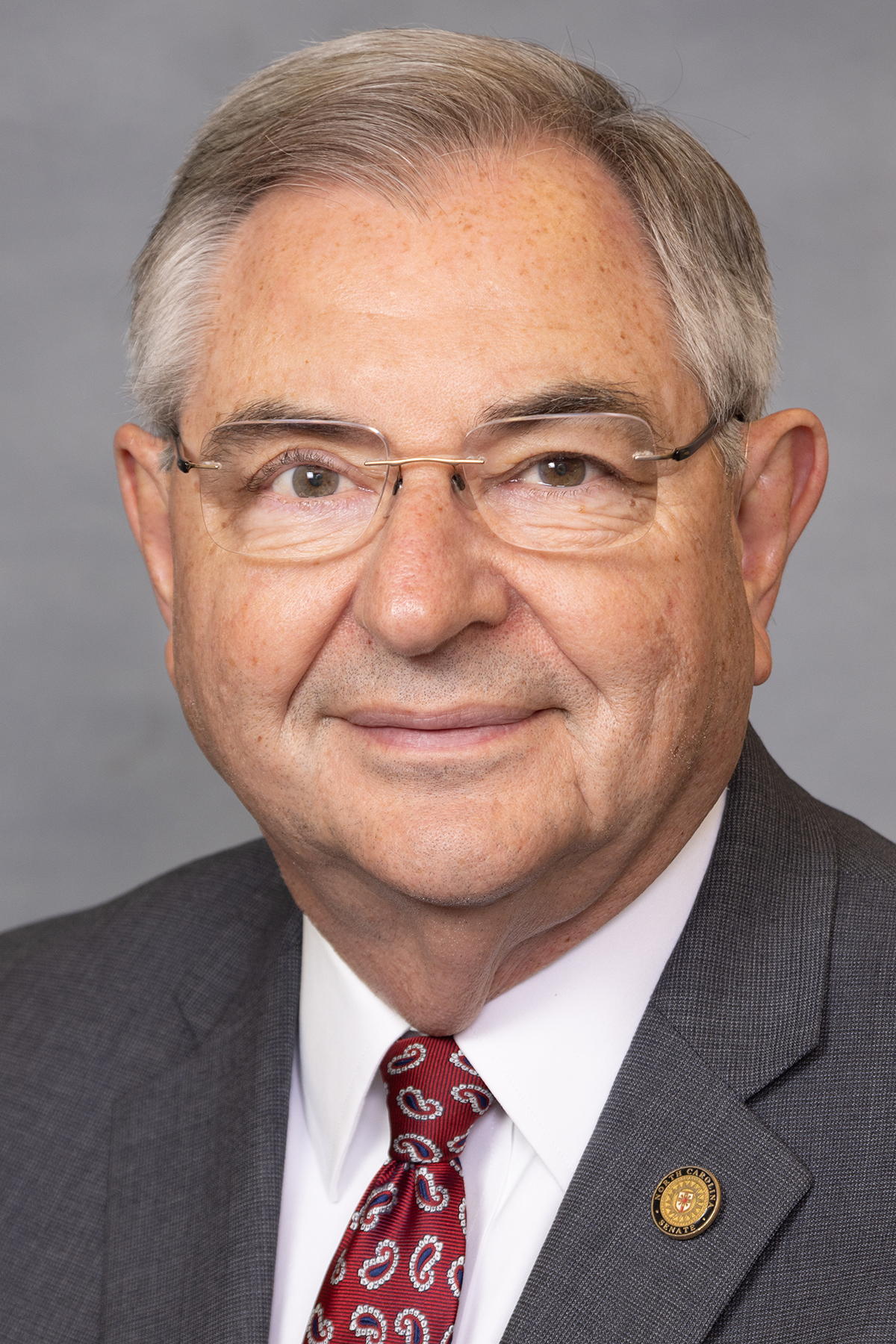
CHAMPION TWO. THE SENATOR. Jim Burgin sells insurance in Harnett County. He has owned the same agency for thirty years. He understands one thing in his bones that most state senators do not. When you take a man's premium, you owe him a duty.
|
|
Photo: North Carolina General Assembly
|
James Andrew Burgin. Republican. North Carolina Senate District 12. Co-chair, Joint Legislative Oversight Committee on Health and Human Services. President and Owner, C and D Insurance, two offices, both in Harnett County. Primary sponsor, North Carolina Senate Bill 624.
. . .
He is sixty-nine. Born Knoxville. He served two terms as a Harnett County Commissioner before he won the state senate seat in 2018. Three years of those four years as Chairman.
. . .
He is one of the small handful of North Carolina Republicans who voted yes on Medicaid expansion. He took the heat. He has not been primaried out.
. . .
In September 2022, the White House quietly invited seven state legislators to Washington for a bipartisan meeting on the suicide crisis. Burgin was one of the seven. The only one from the southeast.
. . .
Then the AI chatbot wave hit, and Burgin started reading about kids on the apps. The Setzer case in Florida. The Texas case. The bots calling themselves therapists. The bots collecting credit cards. The bots that did not stop.
. . .
He went home and looked at the operating problem the way an insurance man looks at any operating problem. Who has the duty. To whom. Enforced how.
. . .
He did not like the answer.
. . .
He took it back to his caucus the way an insurance man does. AI is almost like one of those Chia heads. It's got a little bit of water and it's growing everywhere, and we need to think about that.
. . .
That is the Carolina Public Press quote. That is how a Republican state senator who sells insurance for a living warns his colleagues without scaring them off the bill.
. . .
Then he did the work.
. . .
The bill landed in March. Forty pages. Two new chapters of the General Statutes. Chapter 114B is the licensing chapter. Any chatbot dealing with health information has to apply to the North Carolina Department of Justice for a Health Information Chatbot License. Technical architecture documentation. Quality control. Professional liability insurance. Adverse-event reporting. Six-month security audits. Twenty-four-hour breach notification. Fifty-thousand-dollar civil penalties.
. . .
That is the part the other states will copy.
. . .
Chapter 170 is the part nobody else has filed.
. . .
Chapter 170 imports duty of loyalty. Until now, duty of loyalty was the legal floor under trustees, investment advisers, lawyers with their clients, corporate officers with their shareholders. The highest fiduciary standard in American law. The doctrine that says you do not just serve your customer. You serve your customer first, you serve them honestly, and when their interest and your interest conflict, theirs wins.
. . .
The insurance man put it under chatbots.
. . .
Read the four duties Burgin wrote into the bill. Prioritize the user's best interests. Prevent emotional dependence. Maintain transparency about the chatbot's non-human nature. Protect sensitive personal information.
. . .
Now read the four fiduciary duties of a trustee. Loyalty. Care. Disclosure. Confidentiality.
. . .
They are the same duties.
. . .
A Republican state senator from a rural southern county quietly imported the law of trusts into the law of consumer technology. The companies whose business model depends on emotional dependence have not noticed yet. They are about to.
. . .
The federal CHATBOT Act, introduced last week by Senators Cruz, Schatz, Curtis, and Schiff, is a parental-control framework. Burgin's bill is a fiduciary one. One regulates the user. The other regulates the company. Burgin's is the harder bill.
. . .
He filed it because the people who sell premiums in his county know what duty looks like. He knows what happens when the duty goes missing.
. . .
The Wake Forest Law Review profiled the bill in March. The Transparency Coalition called him a leader on AI policy in the General Assembly. His Senate seat covers three rural North Carolina counties most of the country has never heard of, with a combined population smaller than a Cleveland suburb.
. . .
That is who is carrying the most architecturally serious chatbot bill in the country.
. . .
The doctrine he imported does not need to wait for SB 624 to pass. Other state houses have insurance-trained legislators who already understand fiduciary law. The doctrine has already begun to migrate.
. . .
CHAMPION THREE. THE NEUROSCIENTIST. While the United States has been arguing about whether AI mental health chatbots can be safe, Ross Harper has spent six years quietly proving that one configuration of them already is.

|
|
Photo: Limbic
|
Ross Harper, PhD. Computational neuroscientist. PhD, University College London. Master of Mathematical Modelling, also UCL. Master of Natural Sciences, University of Cambridge. Founder and Chief Executive, Limbic, London. Builder of the first AI mental health chatbot in the world to clear Class IIa medical device status under the United Kingdom Conformity Assessed scheme.
. . .
He started Limbic in 2020 with co-founder Sebastiaan de Vries out of the Entrepreneur First accelerator. He set the operating rule for the company on day one and has not moved off it since.
. . .
If you want to be clinical AI and not wellness AI, you need to have a deep clinical evidence base.
. . .
Six years of building. Class IIa medical device clearance under the United Kingdom Conformity Assessed framework, the same regulatory floor the British government applies to physiological monitoring equipment and to surgical instruments. ORCHA, the United Kingdom's independent health-app accreditation body, ranks Limbic the highest-scoring regulated mental health app in its registry. The clearance was first awarded in 2023. It has been maintained through every audit since.
. . .
That is the receipts side.
. . .
Now the deployment side.
. . .
Harper's most recent numbers, on the record with NPR three weeks ago. Limbic Access is now integrated across sixty-three percent of the United Kingdom's National Health Service. Half a million clients have come through the system. Limbic is currently serving thirteen United States states.
. . .
Sixty-three percent of a G7 country's national health service runs through one supervised AI mental health intake configuration.
. . .
That happened while the rest of the AI mental health sector was on a podcast talking about scaling.
. . .
The configuration is not a black box. Harper has described it in keynotes since 2020, in trade press, in the NHS Confederation partnership announcement in January, on the conference circuit since. He uses one line. Limbic is amplifying the powers of the clinician.
. . .
That is not marketing. That is the literal regulatory architecture.
. . .
The AI handles the structured intake. The licensed clinician handles the clinical decision. The AI's structured assessment summary lands in the electronic health record before the clinician's first appointment with the client. Fifteen minutes per referral, saved. Self-referral access, up thirty-two percent. Drop-out rates, down. Time-to-treatment, down. Engagement among non-binary clients in the cohorts Limbic measured, up one hundred and seventy-nine percent.
. . .
He did not raise capital faster. He did not pivot to the consumer market. He did not announce a model. He cleared the regulator and shipped the deployment.
. . .
The configuration the APA recommends, that NC SB 624 would mandate, that every state mental health AI bill in the country has tried to legislate, is already running across most of the British public health system.
. . .
It is buildable. Harper built it.
. . .
Read the four moving parts. A clinical evidence base built through peer-reviewed research. A regulated medical device clearance, or a licensing framework that operates as one. A clinician oversight model that augments the human professional and does not replace them. An audit-grade deployment data standard the regulator can actually verify.
. . .
When all four parts are present, the system passes. When any one is missing, the system fails.
. . .
Limbic has all four. Live. In production. At scale. Under regulatory oversight in the British National Health Service.
. . .
Anyone arguing the configuration cannot be built at scale needs to explain how a UCL neuroscientist and his co-founder built it in six years on European venture capital.
. . .
The argument that the supervised architecture is unbuildable ended when the NHS audited Limbic and the audit cleared. Everything after that is a delivery problem, not a possibility problem.
. . .
Harper does not lecture. He ships. The receipts are in the regulator's filing cabinet.
. . .
Conversational AI Watch is published by Clinician Assist Inc. and BetterMind.Space. The author is the founder. The Casey product the company builds is the same configuration this issue describes. That alignment is the point of the publication and is named here so the reader can weigh the editorial frame accordingly. The reporting is sourced and linked. The opinion is the founder's.
---
Tomorrow the courtroom in Santa Fe gets the next word.
Today the people who carried the work to that courtroom door get this one.
A psychologist. A senator. A neuroscientist. Three rooms. Three countries. Three professions. One configuration.
Back tomorrow.
---
|