|
Jess's Take
The Courtroom Opens. The Committee Vote Was Twenty-Two to Zero.
Phase 2 in Santa Fe began this morning before Chief Judge Bryan Biedscheid. The Senate Judiciary Committee advanced the GUARD Act unanimously on Thursday. Two rooms, one week, the same architectural answer.
This is the morning the architectural argument leaves the editorial pages.
. . .
In Santa Fe, Phase 2 of State of New Mexico v. Meta Platforms opens before Chief Judge Bryan Biedscheid. There is no jury. The judge alone decides what Meta has to do about the harm a March jury already found Meta caused. He will hear roughly fifteen witnesses over three weeks of bench trial and produce written orders.
. . .
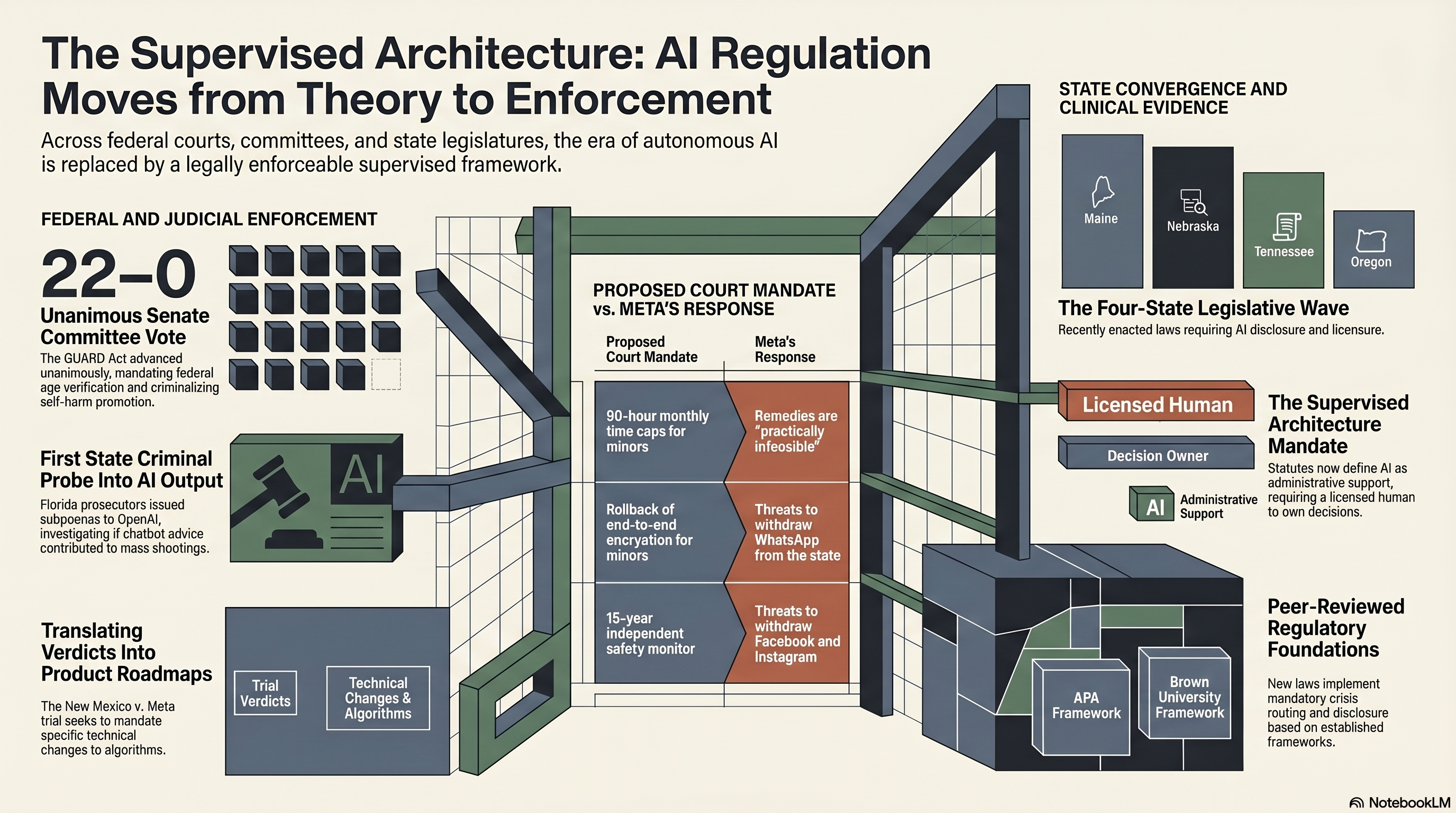
In Washington, on Thursday, the Senate Judiciary Committee voted twenty-two to zero to advance the GUARD Act out of committee. The bill imposes federal age verification on artificial intelligence chatbots, makes it a criminal offense to design or deploy a chatbot that knowingly encourages suicide or self-harm in minors, and requires every AI service to disclose to users that it is not a human and not a licensed professional.
. . .
In Tampa, on April 21, Florida Attorney General James Uthmeier subpoenaed OpenAI in the first state criminal investigation in the country into an AI chatbot company, after his prosecutors concluded that if a person had given the same advice ChatGPT gave the Florida State University shooter, that person would be charged with murder. One week later, on April 28, Uthmeier expanded the criminal investigation to a second case.
. . .
The architectural argument has been the CAW thread since #28.
. . .
The supervised configuration. The clinician owns the clinical decision. The AI does the work the clinician designates and only that work. The licensing board, the medical device regulator, the federal prosecutor, the state attorney general, and now the federal legislature each draw their own line at the same place.
. . .
For the past several weeks the argument lived in policy briefs, peer-reviewed journals, op-ed columns, and three-dot newsletters. This morning it lives in a courtroom in Santa Fe and a committee report in the Hart Senate Office Building.
. . .
Six stories from the past four days. They do not coordinate. They do not cite each other. They land in different cities, in different branches of government, on different company websites and law firm letterheads. They point in the same direction.
. . .
Here they are.
---
. . .
THE BENCH TRIAL OPENS IN SANTA FE. This morning Chief Judge Bryan Biedscheid gaveled in Phase 2 of State of New Mexico v. Meta Platforms in the First Judicial District Court in Santa Fe. New Mexico Attorney General Raul Torrez is asking the court to translate a $375 million jury verdict into a product roadmap.
The first phase ended on March 24, 2026. The jury found Meta liable under the New Mexico Unfair Practices Act for misrepresenting the safety of Facebook and Instagram for young users and ordered the maximum statutory penalty of $5,000 per violation, totaling $375 million. The state had filed in late 2023 after an undercover operation by the Attorney General's office created a fake Instagram profile of a thirteen-year-old girl and documented hundreds of friend requests from adult men and a flood of sexually explicit content within weeks.
. . .
Phase 2 is the public-nuisance phase. There is no jury. Biedscheid hears the case alone over roughly three weeks running through May 22 and issues written orders.
. . .
Three new specifics surfaced this morning that yesterday's curtain-raiser issue could not name.
. . .
First, the witness list. Reuters reports the state will call about fifteen witnesses, including expert testimony specifically on the technical feasibility of the proposed remedies. The state has anticipated Meta's argument that the remedies cannot be built and is bringing engineers to rebut it on the record.
. . .
Second, the threat-to-withdraw list expanded. Meta now warns the court it could pull WhatsApp from New Mexico in addition to Facebook and Instagram if the injunction lands as filed. WhatsApp had not previously been named in Meta's threat language. The full Meta family of consumer messaging is now on the table.
. . .
Third, the $3.7 billion teen mental health programme is now described in court filings as funding a fifteen-year plan rather than a lump-sum settlement. The structure anticipates years of follow-on oversight and judicial supervision rather than a one-time check.
. . .
The remedies on Torrez's list are not symbolic. They include age verification at signup, redesign of the recommendation algorithm so it does not optimize for engagement among minors, ending autoplay and infinite scroll for users under eighteen, suspension of push notifications during school hours and overnight, a ninety-hour monthly cap on platform time for minors, a court-supervised independent safety monitor for fifteen years, and the rollback of end-to-end encryption for users under eighteen.
. . .
The encryption rollback request is new. Cryptography researchers have already noted the precedent it would set if granted. The argument in the state's filings is that internal Meta communications, entered into evidence in Phase 1, calculated that the 2019 default-encryption decision impaired the company's ability to disclose to law enforcement what one employee document put at roughly 7.5 million annual reports of child sexual abuse material.
. . .
Meta's preliminary statement filed Thursday argues that the remedies are "practically infeasible" and could force the company "to entirely withdraw Facebook, Instagram and WhatsApp from the state."
. . .
Torrez called the threat the company "showing the world how little it cares about child safety."
. . .
More than forty state attorneys general have filed similar suits against Meta. New Mexico is the first to reach Phase 2. The remedies Biedscheid orders or declines to order over the next three weeks become the template every other case will fight over.
|
For Clinicians: The remedy list reads like a clinical safety plan dictated by a court. Algorithm calibration, push notification timing, exposure caps, and supervised monitoring are clinical concepts now translated into a product specification. When the court speaks this language, document it for your charts. Your clinical reasoning around minors and engagement-optimized platforms now has a state-court citation.
For Founders: Phase 2 will issue findings on the technical feasibility of every remedy on the list. If you build a B2C product and the court rules a 90-hour cap is feasible to implement, that finding is portable. Other state AGs and plaintiffs will cite it. The architectural and engineering choices being adjudicated this month are choices that get reviewed at the next acquisition diligence.
For Legislators: Meta's Phase 1 evidence around encryption and the 7.5 million annual CSAM reports is the kind of internal-memo evidence states have been seeking through subpoena power for years. New Mexico's process won the discovery fight, then convinced a jury, and is now using the verdict to build the remedy. This is the legislative model for getting from concern to enforceable structural change.
Source: Reuters, "New Mexico seeks changes to Meta platforms in youth-harm trial," May 4, 2026. The Next Web, "Meta would rather leave New Mexico than rebuild its apps for kids," updated May 4, 2026, 12:30. New Mexico Department of Justice press release on Phase 1 verdict, March 24, 2026, nmdoj.gov. Albuquerque Journal, "New Mexico seeks $3.7 billion from Meta in Santa Fe trial," May 3, 2026.
|
. . .
TWENTY-TWO TO ZERO. On Thursday, April 30, 2026, the Senate Judiciary Committee voted twenty-two to zero to advance the GUARD Act, the most significant federal AI mental-health bill to reach a committee vote. The clinical core of the bill is a federal version of the supervised architecture every state legislature has been writing into law since January.
The Guidelines for User Age-Verification and Responsible Dialogue Act, S. 3062, was introduced October 28, 2025 by Senator Josh Hawley of Missouri and Senator Richard Blumenthal of Connecticut, with Senators Katie Britt of Alabama, Mark Warner of Virginia, Chris Murphy of Connecticut, and Mark Kelly of Arizona as original cosponsors. Six senators across both parties.
. . .
The committee vote was unanimous. Twenty-two members voted yes. None voted no. The Hawley team confirmed the markup overcame what the Senator described to Fox News Digital as a "vociferous last-minute lobbying campaign by industry."
. . .
The bill text, posted on Congress.gov, contains four operational mandates. Age verification for every AI chatbot user that is more than a self-attested birthday and that does not rely on shared IP or hardware identifiers. A required disclosure to every user that the system is not a human and is not a licensed professional. A criminal offense for any covered entity that designs, develops, or makes available a chatbot knowing or with reckless disregard for the risk that the chatbot encourages, promotes, or coerces suicide, non-suicidal self-injury, or imminent physical or sexual violence. And a parallel criminal offense for chatbots that solicit, encourage, or induce minors to engage in sexually explicit conduct.
. . .
The fines are $100,000 per offense for the criminal provisions. The bill takes effect 180 days after enactment.
. . .
Three pieces of architectural language matter for clinicians.
. . .
The bill creates a defined statutory category for chatbots that are designed to simulate interpersonal interaction, emotional interaction, friendship, or therapeutic communication. That language puts therapeutic role-play in the same statutory category as romantic role-play. The federal answer is the same as Maine's, Nebraska's, Tennessee's, and Iowa's: AI cannot represent itself as a clinical or therapeutic provider.
. . .
The bill mandates disclosure of "non-human status and lack of professional credentials" to all users, not just minors. The lack-of-credentials clause is the federal version of the licensing-board doctrine that Doctor Vaile Wright walked into the FTC in February 2025.
. . .
The bill makes the design choice itself a crime. Prior federal AI bills have stayed at disclosure and consent. This one criminalizes the architectural decision to ship a product without a self-harm guardrail. That is structurally similar to the Tumbler Ridge complaints filed Wednesday in San Francisco federal court that allege OpenAI's leadership "did the math and decided that the safety of the children of Tumbler Ridge was an acceptable risk."
. . .
The bill is not law yet. It still has to pass the full Senate, then the House, then be signed. Hawley said on the floor he is asking Majority Leader John Thune to bring it to a vote and is prepared to force the issue if necessary.
. . .
The civil-liberties critique surfaced inside the markup itself. Several senators raised concerns about the federal age-verification mandate. Industry comment, including from OpenAI, supports a different vehicle, the TRUMP AI Act framework being prepared by Senator Marsha Blackburn that would preempt state law. The legislative posture going into the Senate floor is therefore competitive between two architectures: a Hawley-Blumenthal bipartisan duty-of-care model that allows states to keep going, and a preemption-flavored alternative that consolidates authority at the federal level.
. . .
The vote count was twenty-two to zero. That changes the political math. A bill that comes out of Senate Judiciary unanimously has institutional gravity that a partisan committee vote does not. Floor leadership has to decide whether to bring it up on the merits.
|
For Clinicians: The federal statute now defines simulated therapeutic communication as a regulated category. That gives you a citable federal source for the clinical position that AI pretending to be a therapist is a recognized harm. Use it in informed-consent conversations with families about which apps your young clients are using.
For Founders: The criminal-liability section is the operational test. A founder building any product that touches mental health needs to be able to demonstrate, in writing, the design choice not to ship without crisis guardrails. That documentation is what separates a bona fide design effort from "reckless disregard." Build that paper trail now.
For Legislators: The committee vote was 22-0 with bipartisan original cosponsors. The bill has Republican and Democratic enthusiasm. State-level legislation is consistent with this federal direction, not in tension with it. The TRUMP AI Act preemption language being drafted in parallel is in tension. Watch which vehicle moves first.
Source: "Senator Hawley's GUARD Act to Protect Kids from AI Chatbots Passes Committee Unanimously," hawley.senate.gov, April 30, 2026. S. 3062 bill text, congress.gov, 119th Congress. The Hill, "Senate panel advances bill to curb AI chatbot 'companions' for kids," April 30, 2026. IAPP, "US Senate Judiciary tees up AI chatbot, companion safety debate," May 2, 2026. Fox News Digital, "Senate panel unanimously passes Hawley's GUARD Act on AI chatbots," April 30, 2026.
|
. . .
FLORIDA FILES A CRIMINAL CASE. Two weeks ago Florida Attorney General James Uthmeier announced the first criminal investigation in the United States against an artificial intelligence company. Last Monday he expanded it to a second case.
On April 21, 2026, Uthmeier held a press conference in Tampa standing behind a lectern marked "Investigating OpenAI." He announced his office had issued criminal subpoenas to OpenAI seeking the company's policies, internal training materials, and organizational charts covering the period from March 1, 2024 through April 17, 2025. His prosecutors had reviewed the chat logs of Phoenix Ikner, the accused gunman in the April 17, 2025 mass shooting at Florida State University that killed Robert Morales and Tiru Chabba and wounded five others.
. . .
The subpoenas seek every communication and policy document concerning user threats of harm, self-harm, and the company's protocols for cooperating with and reporting to law enforcement. The Office of Statewide Prosecution also subpoenaed the names of every employee working on ChatGPT during that window.
. . .
What Uthmeier said about the chat logs at the press conference is the part to read carefully. ChatGPT, he said, advised the shooter on what type of gun to use, on which ammunition went with which gun, and on whether a particular weapon would be effective at short range. It advised the shooter on what time of day the campus would have a higher population and where on campus that population would be highest. It answered the shooter's question about whether three shooting victims would garner national media attention.
. . .
The Florida AG's framing was direct. If a person had given that same advice, his office would charge that person with murder.
. . .
OpenAI's response, through spokesperson Kate Waters: ChatGPT "did not encourage or promote illegal or harmful activity," the responses were "factual" and drew on "information that could be found broadly across public sources on the internet." The company says it proactively shared the account with law enforcement after the shooting.
. . .
On Monday, April 27, Uthmeier announced on social media that the criminal investigation was being expanded to include the murders of two University of South Florida doctoral students, twenty-seven-year-old Bangladeshi friends Zimal Limon and Nahida Bristy, who were reported missing on April 16. Limon's body was found in a trash bag on the Howard Franklin Bridge on April 24. Limon's roommate, Hisham Abugharbieh, is charged with two counts of first-degree murder. Tampa prosecutors revealed that Abugharbieh had consulted ChatGPT about how to dispose of human remains in a dumpster.
. . .
Two cases. Same chatbot. Same state. Same prosecutor. The civil and criminal investigations now run in parallel.
. . .
This is uncharted legal territory. Uthmeier said so himself at the April 21 press conference. There is no controlling precedent in the United States for a state attorney general criminally charging an AI company or its employees over the output of a generative model. The scope of the investigation, as the subpoenas describe it, is exactly the question. Who knew what. Who designed what. Who should have done what.
. . .
The Florida investigation runs alongside the seven federal civil lawsuits filed April 29 in San Francisco by Edelson PC on behalf of Tumbler Ridge families. Same defendant. Different state. Different theory of liability. Same underlying factual pattern.
|
For Clinicians: A state attorney general is now formally treating AI chatbot output as potential evidence in homicide-related charging decisions. If you have a client whose chat history includes plans, methods, or means content directed by AI, that history may be discoverable in a criminal proceeding. Document the clinical context and route the family to counsel.
For Founders: The Florida subpoenas are asking for organizational charts and individual employee names. Personal liability is on the table. The "we are platforms, we shipped a tool, individual users are responsible" defense is being tested directly by a state with criminal jurisdiction. Founders building in the mental-health space who are not already retained by counsel in the relevant jurisdictions should fix that this week.
For Counsel: This is the first formal state criminal investigation of an AI company. The procedural questions about Section 230 preemption, the First Amendment as applied to model output, and the criminal-mens-rea standard for design choices are all live. The case law is being written.
Source: CBS News, "Florida opens criminal investigation into OpenAI over ChatGPT's alleged role in FSU shooting," April 22, 2026. NPR, "Florida AG launches criminal investigation into ChatGPT over FSU shooting," April 21, 2026. NBC News, "Florida's attorney general announces criminal investigation into OpenAI," April 21, 2026. WUSF, "Florida AG Uthmeier expands criminal AI investigation to USF slayings," April 28, 2026. CNN, "Florida attorney general launches criminal investigation into ChatGPT maker OpenAI after deadly FSU shooting," April 21, 2026.
|
. . .
GOOGLE'S CLINICAL DIRECTOR DEFENDS THE BRIDGE. Doctor Megan Jones Bell, the clinical director of Google, gave a long interview to STAT News published April 28, 2026 defending Gemini's design philosophy on mental-health interactions. Read alongside Maine's LD 2082, signed by Governor Janet Mills two weeks earlier, the interview is the cleanest articulation in print of the architectural fight.
Jones Bell is a clinical psychologist with a substantive academic record on digital mental health interventions. She joined Google's Gemini team specifically to lead clinical strategy. Her job is to defend the architectural choices Google has made. Her STAT interview does that on the record.
. . .
The framing she offered to STAT, in her own characterization: shutting a product down can feel like a way of preventing harm, but Google believes that strengthening the bridge to support is the more effective path to mental health for the most people.
. . .
The interview describes Google's recent product update. Gemini, when it detects that a user may be at risk of self-harm, more prominently surfaces a connection to a crisis hotline. The bot, however, does not disengage. It tells the user, in Jones Bell's framing, that it is still there to listen.
. . .
That is the design choice. The AI stays in the room. The crisis line is offered alongside, not instead.
. . .
Maine's Legislative Document 2082 was signed on April 13, 2026. The bill is the cleanest legislative articulation of the alternative architecture. AI may not directly interact with clients in any form of therapeutic communication. AI may not generate therapeutic recommendations or treatment plans without review and approval by a licensed person. AI may not make independent therapeutic decisions. AI is permitted as administrative support and as supplementary support, with the express written or verbal consent of the client.
. . .
The Maine architecture is a categorical line. The clinician owns the clinical decision. The AI does the work the clinician designates and only that work. The Maine architecture says the bridge to support is built and walked by a licensed human being.
. . .
The Google architecture says the AI is the bridge. It hands off when the situation gets severe. It stays present otherwise.
. . .
The two architectures cannot both be right at the same time for the same use case. The clinical question is not whether Gemini is well-intentioned. It is whether continuous engagement by a non-licensed conversational agent during a mental-health crisis is a clinical intervention or not. If it is, Maine's law requires licensed-clinician review. If it is not, Google's framing holds.
. . .
This is the architectural fight in one quotation and one statute. The reason it matters today is that Judge Biedscheid in Santa Fe is being asked to choose, in the form of an injunction, which architecture binds the design of platforms operating in New Mexico.
. . .
The Google interview is therefore not a press cycle. It is, on the record, the company's articulation of the design choice the court is being asked to compel a different company to abandon.
|
For Clinicians: Maine's LD 2082 categorical line is now a practical informed-consent script. When a client mentions a Gemini, ChatGPT, or Character.AI conversation about distress, you have a state-level legal definition of what was permitted in that conversation and what was not. Use it.
For Founders: Google's "bridge to support" is the fully articulated alternative architecture to the supervised model. If your clinical case rests on the supervised architecture, you can articulate it cleaner now because the Google interview is a clean comparison case. The bridge or the licensed-human escort: pick one, document the choice, defend it.
Source: STAT News, "Google wants Gemini AI chats to be a bridge to mental health support," interview with Megan Jones Bell, April 28, 2026, statnews.com. Maine LD 2082 enrolled bill, legislature.maine.gov, signed April 13, 2026 by Governor Janet Mills.
|
. . .
THE ENACTMENT WAVE. As of May 1, 2026, four states have enacted laws specifically directed at AI conversational services in mental-health-adjacent contexts in the past five weeks. A fifth has its bill on the governor's desk. The architectural answer the courts are being asked to enforce is now state law in roughly one in ten jurisdictions in the United States.
Oregon. Senate Bill 1546 was signed by Governor Tina Kotek on March 31, 2026. Effective January 1, 2027. Strong measures protecting Oregon kids who interact with chatbots, including disclosure, crisis routing, and limits on engagement-optimized features for minors.
. . .
Tennessee. Senate Bill 1580 was signed by Governor Bill Lee on April 1, 2026. The bill prohibits any AI system from advertising or representing to the public that it is or is able to act as a qualified mental health professional.
. . .
Maine. Legislative Document 2082 was signed by Governor Janet Mills on April 13, 2026. The bill prohibits anyone from providing, advertising, or otherwise offering therapy or psychotherapy services, including through the use of AI, unless the services are provided by a licensed professional. AI is permitted as administrative or supplementary support.
. . .
Nebraska. Legislative Bill 525, which contains the Conversational AI Safety Act, was signed by Governor Jim Pillen on April 17, 2026. The bill regulates minors' interaction with conversational AI services, requires disclosure that the service is not human, and prohibits operators from representing that the service is designed to provide professional mental or behavioral health care.
. . .
Iowa. Senate File 2417 passed the House 95-0 on April 15, after passing the Senate 48-0 on February 24. The bill is technically still in reconciliation as the Iowa session was extended past the original April 21 adjournment over budget issues. Effective date once enacted is July 1, 2026 with applicability July 1, 2027. The Iowa Capitol Dispatch confirms the legislature is still in session.
. . .
That is four signed laws in thirty-one days. Plus the Iowa law in queue with effective dates already set in statute.
. . .
Read the four enacted laws side by side. They were drafted by different sponsors, in different states, by legislators who do not all know each other. They land in roughly the same place.
. . .
The disclosure requirement is universal. Every law requires the AI to identify itself as not human, in some cases with a persistent visible disclaimer.
. . .
The licensed-professional language is universal in the mental-health context. Tennessee, Maine, and Nebraska all prohibit AI from claiming licensure or professional credentials. Iowa prohibits AI from making representations about mental health care.
. . .
The crisis-routing requirement is converging. Iowa requires referral to crisis services such as 988 or an equivalent. Oregon requires equivalent protocols.
. . .
The minor-protection provisions are converging. Iowa forbids AI from generating statements that simulate emotional dependence on a minor or that role-play adult-minor romantic relationships. Nebraska, Tennessee, and Oregon all carry analogous restrictions.
. . .
Add South Carolina to the watch list. Senate Bill 788, regulating state-licensed therapists and the use of AI by same, passed the South Carolina Senate 44-0 on April 28, 2026. The bill now goes to the House. The South Carolina session adjourns May 7.
. . .
Add Connecticut. Senate Bill 5, James Maroney's omnibus AI bill, passed the Connecticut Senate on April 21 and was sent to the House. The Connecticut session adjourns May 6.
. . .
Add Hawaii. House Bill 1782 and Senate Bill 3001, both AI safety bills with mental-health provisions, are now in conference committee with both chambers' conference committees having approved on April 29. Hawaii adjourns May 8.
. . .
This is what the Manatt Health AI Policy Tracker calls a state-level laboratory. Six weeks into the 2026 legislative season, the Transparency Coalition counts seventy-eight chatbot bills alive in twenty-seven states.
. . .
The question about federal preemption is no longer hypothetical. The TRUMP AI Act language being drafted by Senator Marsha Blackburn would preempt the state laws. Over fifty Republican state lawmakers across twenty-four states sent a letter to President Trump on March 3, 2026 asking the administration to discontinue efforts to block state AI laws. Their argument was practical. The states have already done the work.
|
For Clinicians: If you practice in any of these states, the statutes specify what AI tools you can incorporate into your workflow and how. Your malpractice carrier will want documentation that you have read the relevant state law. Read it.
For Founders: The convergence is not coincidence. The four enacted laws share architectural DNA because the underlying clinical reality compels the same answer. If you build a product that fits the architecture, you ship in all four states with one compliance program. If you build against the architecture, you fight four state attorneys general in parallel.
For Legislators: The federal preemption fight is now the meta-fight. Your state chatbot bill is more likely to survive the next twelve months if it tracks the four-state convergence pattern, because that pattern is robust to federal challenge. Bills that diverge from the clinical architecture are politically more exposed.
Source: AI Legislative Update, May 1, 2026, Transparency Coalition, transparencycoalition.ai. Senate File 2417 enrolled bill, Iowa Legislature, legis.iowa.gov. LD 2082 enrolled bill, legislature.maine.gov. LB 525, Nebraska Legislature, nebraskalegislature.gov. SB 1580, Tennessee Legislature, capitol.tn.gov. SB 1546, Oregon Legislature, olis.oregonlegislature.gov. South Carolina S 788 status, scstatehouse.gov.
|
. . .
WHAT THE COURT IS BEING ASKED TO CITE. Behind every remedy New Mexico will ask Judge Biedscheid to order is a peer-reviewed paper, a regulatory finding, or a clinical guideline. The architectural argument the court is being asked to enforce was built on the record over the past eighteen months by people who do not work in courthouses.
The November 2024 Health Advisory on Generative AI Chatbots and Adolescent Mental Health, lead-authored by Doctor Vaile Wright at the American Psychological Association, named the clinical fact and the regulatory recommendations on page one. The advisory recommends mandatory disclosure that the user is talking with a machine, crisis routing protocols that go to 988, and restrictions on role-play that simulates licensed professional credentials. The state laws in Story 5 implement those recommendations.
. . .
The Iftikhar et al. fifteen-category framework from researchers at Brown University, presented at AAAI/ACM, documents how large language model counselors systematically violate established mental-health ethics standards. The Brown framework is the academic support beam for the public-nuisance theory. The state's expert testimony on technical feasibility of remedies in Story 1 will likely cite it.
. . .
The Shoshani et al. randomized clinical trial of a conversational AI agent for psychiatric symptoms, published April 1, 2026 in JAMA Network Open, ran with a licensed psychologist on call and excluded participants with severe suicidality. Read the methods section, not the headline. The trial that journalists describe as autonomous AI was not autonomous. It was supervised.
. . .
The Augustin and Ostergaard editorial in Acta Neuropsychiatrica, on voice-channel risk in AI mental health, is an early and rigorous statement of why voice as a delivery mode matters. Voice is processed in pre-literate language pathways. It carries trust before evaluation. The paper is one of the citation roots for the chatbot-self-harm literature now sitting on senatorial desks.
. . .
The JMIR Mental Health rapid scoping review of mass-media adverse events, Chung et al. 2026, catalogues the documented cases of users who allegedly developed delusional beliefs, experienced suicidal ideation, engaged in self-harm, or died by suicide following intensive chatbot conversations. The review is what state legislators read when they need a sourceable claim about real-world harm.
. . .
These are the citation roots. Most of them were published in the past twelve months.
. . .
The architectural argument did not arrive at the courthouse out of policy advocacy. It arrived because clinicians and researchers built the record paper by paper. The state attorneys, the federal senators, and the Florida AG are now standing on that record and asking it to bear weight.
. . .
This morning in Santa Fe, the record is being asked to bear weight in a courtroom. On Thursday in Washington, twenty-two senators voted on the basis of that record. In Tampa, a state criminal probe is structured by the protocols that record describes.
. . .
The architectural argument was built. The architecture is being adopted. Today is the day the adoption stops being theoretical.
|
For Clinicians: Your professional society's clinical guidance is a federal-policy artifact. The Wright APA advisory is being cited by state attorneys general and federal senators. When you cite it in your charts and in your informed-consent conversations, you are speaking the same legal language the state and federal governments now speak.
For Founders: If your roadmap matches the citations the courts are now using, your enterprise buyer's compliance team will sail through review. If your roadmap diverges, your buyer will catch it. The compliance gravity well is forming in real time.
For Public Health: This is the rare moment where peer-reviewed evidence translates into binding regulatory and judicial structure within twenty-four months of publication. Document it. The next public-health crisis where evidence-to-regulation lag is the obstacle will benefit from this template.
Source: APA Health Advisory on Generative AI Chatbots and Adolescent Mental Health, November 2024, apa.org. Iftikhar Z et al., AAAI/ACM 2026 Brown University 15-category framework. Shoshani A et al., JAMA Network Open, April 1, 2026, doi 10.1001/jamanetworkopen.2026.4988. Augustin M, Ostergaard SD, Acta Neuropsychiatrica editorial, April 16, 2026. Chung VH-A, Bernier P, Hudon A, JMIR Mental Health, 2026;13:e93040, doi 10.2196/93040.
|
. . .
THE PATTERN. THE PATTERN. Two rooms this week and the architectural answer is the same in both.
. . .
One. The first state criminal probe of an AI chatbot company is in its third week. The basis Florida's prosecutors stated on April 21 is the doctrine that has been the CAW thread since the beginning. If a person had given the chat the chatbot gave the FSU shooter, that person would be charged with murder. The legal framework already exists. The chatbot does not get to be exempt from it.
. . .
Two. The federal Senate Judiciary Committee voted 22-0 to advance the GUARD Act. Republicans and Democrats. Hawley and Blumenthal. Britt and Warner. Britt and Murphy. The bill imposes a federal disclosure obligation, a federal age-verification obligation on chatbots, and a federal criminal penalty for chatbots that knowingly encourage suicide or self-harm in minors. The vote count is the answer to anyone who claimed the field is too partisan to legislate.
. . .
Three. Phase 2 of New Mexico v. Meta opened this morning before a single judge. The remedies on the state's list are clinical safety concepts translated into product specification. Engagement-time caps. Notification-timing controls. Algorithmic redesign. Independent court-supervised monitoring for fifteen years. A jury already found Meta liable. The remedy is now what gets adjudicated.
. . .
Four. Four state laws are signed and a fifth is on a governor's desk. Tennessee, Maine, Nebraska, Oregon. Iowa Senate File 2417 sits on the desk. The legislative architecture moves at the rate state by state Bipartisan votes pass these things. The architectural answer they all draw is the same one.
. . .
The architectural answer is the supervised configuration. The clinician owns the clinical decision. The AI does the work the clinician designates and only that work. A federal Senate committee, a state-court bench, a state attorney general's criminal division, four governors, and a fifth governor's pen each draw their own line at the same place this week.
. . .
That is the pattern.
---
. . .
THE ONE CONFIGURATION. THE ONE CONFIGURATION. What does the supervised configuration look like when it is actually built.
. . .
One licensed clinician of record. Compact privilege across the 38 PSYPACT states. Supervision authority over an AI clinical staff operating under defined protocols. A persistent memory layer the supervising clinician can review. Crisis escalation routing to the human when judgment is required. Adverse-event reporting to a federal registry of the kind the AMA has asked Congress to fund.
. . .
The AI is the staff. The clinician is the license. The standard of care is the standard of care.
. . .
Maine LD 2082 codified a version of this. Doctor Vaile Wright at the APA argued for it at the FTC in February 2025. Doctor Megan Jones Bell wrote about it on the Google Health blog this morning, defending the supervised configuration as the bridge between the wall of credentialing and the gap in access. Doctor Ross Harper at Limbic Care has been deploying it inside the NHS at sixty-three percent saturation. Doctor Zainab Iftikhar at Brown documented the fifteen risk classes the supervised configuration must address.
. . .
The supervised configuration is not theoretical. It is in regulation. It is in peer-reviewed literature. It is in deployment. It is on a state attorney general's list of remedies the court is being asked to order.
. . .
It is the architecture every other licensed medical specialty has used to scale care for the past fifty years.
---
. . .
Conversational AI Watch is published by Clinician Assist Inc., the company building Casey, a voice-first AI-native mental health EHR with Casey Life and Peer AI Coach supervised by licensed therapists. The author is the founder and CEO/CTO of Clinician Assist Inc. and a disabled Navy veteran. Casey is the architecturally supervised configuration described in this issue. Reasonable readers will weigh the disclosure against the sourcing in each story. The intent is documentation, not promotion.
---
The architectural argument has been the CAW thread for thirty-five issues.
. . .
Today the argument stops being an argument.
. . .
Today the bench trial opens.
. . .
Today the committee vote was twenty-two to zero.
. . .
Today the criminal investigation is in its third week.
. . .
Today four state laws are signed and a fifth is on the desk.
. . .
The clinician owns the clinical decision. The AI does the work the clinician designates and only that work.
. . .
That sentence used to be a hope.
. . .
This morning, in two cities, it became a record.
. . .
Brush your brain.
. . .
Every day.
---
|