|
Jess's Take
Day Two. Iowa is Five. Connecticut is Six.
Phase 2 testimony begins this morning under a judge skeptical of overreach. Two more state legislatures answered the same question with signatures and votes. The bellwether is on the record. The benchmark is published. The meta-analysis is in.
Yesterday was the morning the architectural argument left the editorial pages.
Today is the morning it has to survive a judge's skepticism.
. . .
In Santa Fe, on Day One of Phase 2, Chief Judge Bryan Biedscheid said it on the record. "I'm probably not the easiest sell on an idea where I would become a one-person legislature, judge, and executive branch enforcer of administrative code provisions."
That is the sentence the next three weeks have to answer.
. . .
The state asked for an injunction that reads like a clinical safety plan written into product specification. The judge looked at it and said the quiet part out loud. Public-nuisance doctrine has not been used to redesign social media before. He is not eager to be the first.
That is not a defeat. It is the question every state attorney general writing a similar complaint has to plan for.
. . .
While the judge in Santa Fe was warning about overreach, the legislative branch was answering the same question by stacking signatures.
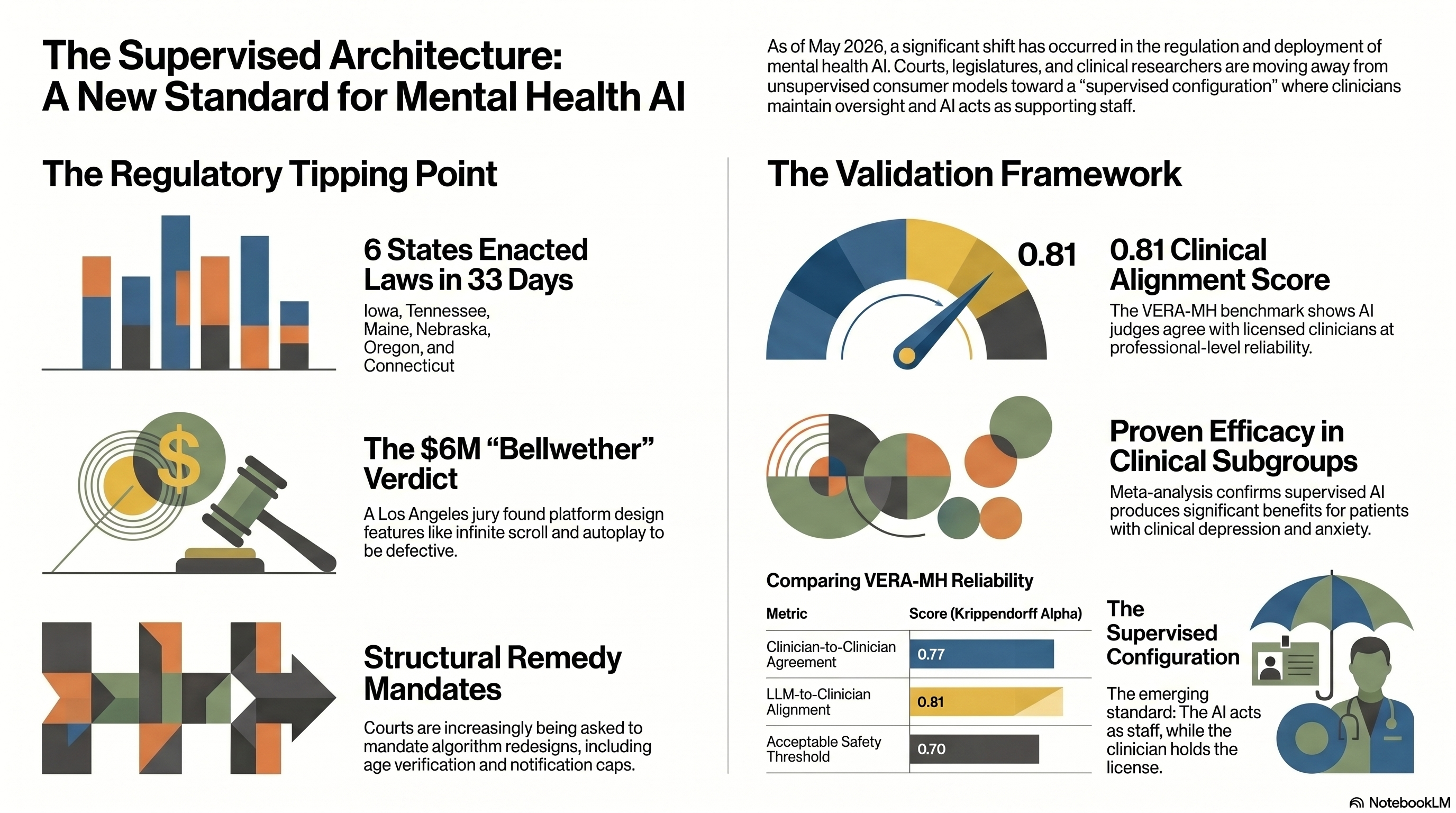
In Des Moines, on Sunday, Governor Kim Reynolds signed Senate File 2417. Iowa is now the fifth state with a conversational AI safety law on the books in thirty-three days.
In Hartford, on Friday, the Connecticut House voted 131 to 17 to send Senate Bill 5 to Governor Ned Lamont, who has said he plans to sign it. Six.
The judiciary is being asked to enforce in one room what five legislatures have already enacted. The math of legitimacy looks different this morning.
. . .
There is a pattern here. The architectural argument keeps producing the same answer in different rooms. The judge can be skeptical. The legislatures are not.
Six stories from the past four days. They land in courtrooms, on governors' desks, on Korean and American journal pages, and in a 20-year-old plaintiff's verdict in Los Angeles.
They point in the same direction.
. . .
Here they are.
. . .
DAY TWO IN SANTA FE. Yesterday's curtain went up. Today the testimony begins. The first witness in State of New Mexico v. Meta Platforms takes the stand this morning under the eye of a judge who told both sides on Day One that he is not going to legislate from the bench.
The first phase of this case lasted seven weeks and ended on March 24, 2026 with a Santa Fe jury finding Meta liable under the New Mexico Unfair Practices Act and ordering $375 million in civil penalties. That was the consumer-protection phase. Phase 2, which opened in the same courthouse yesterday, is the public-nuisance phase. There is no jury. Chief Judge Bryan Biedscheid hears the case alone for roughly three weeks and issues written orders.
. . .
David Ackerman, the private attorney leading for the state, opened by asking the court to translate the verdict into a $3.7 billion fifteen-year abatement plan and a list of structural remedies that read like a clinical safety plan written for an engineering team.
Algorithm redesign so the recommendation systems no longer optimize for engagement among minors. Age verification at signup. End of autoplay and infinite scroll for users under eighteen. Suspension of push notifications during school hours and overnight. A ninety-hour monthly cap on platform time for minors. A court-supervised independent safety monitor for fifteen years. Default privacy settings for minor accounts. The rollback of end-to-end encryption for users under eighteen.
. . .
Then Biedscheid spoke. He said he held some concerns about the request. He warned he would not overreach. The line of his that ran on every wire by the afternoon was the one about not becoming a one-person legislature, judge, and executive branch enforcer.
That is the question of Phase 2 in one sentence. Not whether the harm is real. The jury already settled that. The question is whether a state district judge can order a private company to redesign its product down to push notification timing without crossing a separation-of-powers line.
. . .
Eric Goldman, co-director of the High Tech Law Institute at Santa Clara University Law School, told reporters before opening statements that the trial existing at all is itself remarkable. Public-nuisance theory, he said, is not well accepted as applied to the internet. That theory does not really fit the internet, in his framing.
. . .
Meta, through attorney Parkinson, said the proposed remedies are practically infeasible and could force the company to entirely withdraw Facebook, Instagram, and WhatsApp from New Mexico. Parkinson called the threat not a public relations stunt and not a threat. The company calls it untenable. The state's filings warn the threat itself is the company showing the world how little it cares about child safety.
. . .
What changes today is the witness list. Reuters reports the state will call about fifteen witnesses, including expert testimony specifically on the technical feasibility of the proposed remedies. The state has anticipated Meta's argument that the remedies cannot be built. Engineers are being brought in to rebut it on the record.
. . .
Phase 1 evidence already established the floor. Internal Meta documents, entered at trial in March, calculated that the company's 2019 default-encryption decision impaired its ability to disclose to law enforcement what one employee document put at roughly 7.5 million annual reports of child sexual abuse material. The state will use that floor to argue every remedy on its list is implementable, by the company itself, today.
The next three weeks decide whether the law backs that argument up.
|
For Clinicians: The remedy list reads like a clinical safety plan dictated by a court. Algorithm calibration, push notification timing, exposure caps, supervised monitoring. When the court speaks this language, document it for your charts. Your clinical reasoning around minors and engagement-optimized platforms now has a state-court citation.
For Founders: The judge's overreach concern is the design constraint. If your B2C product can demonstrate that engagement-time caps and notification-timing controls are technically feasible at your scale, you remove the strongest argument the defense has. Build the documentation. Acquisition diligence will read the next ruling carefully.
For Legislators: Biedscheid's reluctance is exactly the gap state legislation fills. A court has to find statutory authority. A legislature has to find votes. Five states this season have found the votes, with bipartisan margins. The legislative path scales where the judicial one does not.
Source: Boston Globe / Associated Press, "New Mexico seeks child safety restrictions on Meta apps and algorithms in trial's 2nd phase," May 4, 2026. Source New Mexico, "Judge warns New Mexico prosecutors he won't 'overreach' as bench trial against Meta begins," May 4, 2026, sourcenm.com. Albuquerque Journal, "New Mexico seeks $3.7 billion from Meta in Santa Fe trial," May 3, 2026. Reuters, "New Mexico seeks changes to Meta platforms in youth-harm trial," May 4, 2026.
|
. . .
IOWA BECOMES NUMBER FIVE. On Sunday, May 3, 2026, Governor Kim Reynolds signed Senate File 2417 into law. The state of Iowa is now the fifth jurisdiction in the United States to enact a conversational AI safety law in the past thirty-three days. Number five. Tennessee. Maine. Nebraska. Oregon. Iowa.
The Iowa bill cleared the Senate 48 to 0 on February 24. It cleared the House 95 to 0 on April 15. Republican and Democratic lawmakers, in both chambers, voted unanimously twice. The governor's office quietly listed the bill among twelve signed on Sunday afternoon.
. . .
Senate File 2417 establishes a new chapter of the Iowa Code, 554J, devoted entirely to conversational AI services. The statute reaches any AI system accessible to the general public whose primary purpose is simulating human conversation through text, audio, or visual interaction. It excludes research tools, narrow task-specific tools, and internal business systems.
The substantive provisions land in a familiar place. Disclosure that the system is not a human, presented to a minor account holder when the chat begins and then again at least once every three hours of continuous interaction. Reasonable measures to prevent the system from sexually objectifying minors, producing sexually explicit material for minors, or stating that a minor should engage in sexually explicit conduct. A prohibition on rewards delivered at unpredictable intervals to encourage continued engagement.
The bill takes effect July 1, 2026 with applicability July 1, 2027. The Iowa Attorney General can bring civil penalty actions for violations.
. . .
Read it next to Tennessee SB 1580, signed April 1. Next to Maine LD 2082, signed April 13. Next to Nebraska LB 525, signed April 17. Next to Oregon SB 1546, signed March 31.
The bills were drafted by different sponsors in different states. Most of those sponsors have never met. They land in roughly the same place because the underlying clinical reality compels the same answer. AI cannot represent itself as a clinical or therapeutic provider. AI cannot keep a minor engaged on rewards and intermittent reinforcement designed to addict. A minor has to know they are talking with a machine.
That is the floor. Five state statutes now.
. . .
The Iowa lead sponsor, Senator Mike Klimesh, did not have to write the bill from scratch. The doctrine was already there in the Tennessee and Nebraska text, in the November 2024 American Psychological Association Health Advisory on Generative AI Chatbots authored by Doctor Vaile Wright, in the design recommendations the Federal Trade Commission gathered into its September 2025 inquiry letters. State Representative Austin Harris, the House lead, told the Iowa Capital Dispatch in early April that the bill is aimed at addressing self-harm resulting from minors' interactions with chatbots, citing instances of AI chatbots encouraging vulnerable people toward harm.
The architectural answer is now state law in five jurisdictions covering roughly thirty million Americans. The next signature is sitting on a desk in Hartford.
|
For Clinicians: If you practice in Iowa, your malpractice carrier will want documentation that you have read 554J. Read it. The chapter is short. The clinical workflow implication is straightforward. AI tools you incorporate into a minor's care must satisfy the disclosure cadence and the engagement restrictions in the statute, or they cannot be used.
For Founders: The legislative convergence is a compliance gift. If you build to Iowa 554J, you ship in Tennessee, Maine, Nebraska, and Oregon with the same architecture. The five statutes converge enough that one compliance program covers all of them. The bills that diverge will lose. The bills that track this pattern will multiply.
For Legislators: Reynolds's signature on Sunday is the political case study. R-state-Republican governor. Bipartisan unanimous votes in both chambers. No filibuster. No veto. No partisan friction. The states that are getting this done are the states whose legislators understand that the ceiling on chatbot harm is a children's safety question, and children's safety questions clear floors that almost nothing else does.
Source: Office of the Governor of Iowa, "Gov. Reynolds signs list of bills into law on May 3rd," May 3, 2026, governor.iowa.gov. Iowa Legislature SF 2417 enrolled bill text, legis.iowa.gov. The Gazette / Tribune News Service, "Bill restricting AI chatbots goes to Iowa governor," April 16, 2026. Iowa Capital Dispatch coverage of SF 2417 House passage, April 15, 2026.
|
. . .
CONNECTICUT SENDS THE SIXTH. On Friday, May 1, 2026, the Connecticut House of Representatives voted 131 to 17 to pass Senate Bill 5. The bill is now on Governor Ned Lamont's desk. A spokesperson for the governor said Friday that he plans to sign it. Connecticut becomes the sixth state in this calendar year to enact a comprehensive conversational AI safety law.
The Connecticut bill is not a one-issue chatbot bill. Senate Bill 5 is a forty-section omnibus that runs to seventy-one pages. It regulates frontier AI model developers. It creates a state AI sandbox for companies to test new products. It requires disclosure when chatbots interact with users. It writes a private right of action for companion-chatbot harms to minors. It addresses workforce AI literacy and AI in employment decisions.
Senator James Maroney, Democrat of Milford, has been carrying a version of this bill for three sessions. Last year's version cleared the Senate. The governor threatened to veto. The bill died.
This year, Lamont and Maroney negotiated. The governor's own AI sandbox priority got folded into Maroney's bill. The deal made the legislation harder to oppose without opposing both halves at once. The Senate passed it 32 to 4 on April 21. The House voted Friday.
. . .
The chatbot provisions in Senate Bill 5 mirror the language already in California's Senate Bill 243, which took effect January 1, 2026. Disclosure to users that they are interacting with AI rather than a human. For minor users, the disclosure repeats every three hours. A protocol for detecting and routing self-harm indicators to crisis resources. Operator restrictions on producing sexual material for minors and on simulating relational dependency.
Connecticut's contribution to the pattern is the private right of action. A user harmed by a violating companion chatbot can sue for damages up to $1,000 per violation plus attorney's fees and injunctive relief. The state attorney general can also enforce.
That mechanism is the structural answer to the Section 230 problem the New Mexico judge is wrestling with. State legislatures do not have to convince a federal court to read Section 230 narrowly. They can write the cause of action directly into state law and let the courts apply it.
. . .
The Future of Privacy Forum, which tracks chatbot legislation across all fifty states, counted ninety-eight chatbot-specific bills active across thirty-four states as of April. Six are now law and will be by Tuesday morning if Lamont signs as planned. The Manatt Health AI Policy Tracker, in its first-quarter 2026 review, noted that thirty-six states introduced over seventy bills regulating AI chatbots in the first three months of the year.
Six enacted. One on a desk. Roughly seventy still moving. The legislative architecture is consolidating around the same answer the New Mexico state attorney general is asking the court in Santa Fe to enforce.
|
For Clinicians: Connecticut is going to write a private right of action into chatbot regulation. That changes the malpractice and informed-consent calculation for clinicians in the state. If a client tells you they are using a companion chatbot and you have reason to believe the chatbot is violating the disclosure or self-harm protocols, you may have a documentation duty in your charts. Talk to your malpractice carrier.
For Founders: The private right of action is the operational risk to model. $1,000 per violation per user is small individually and enormous at scale. Your architecture has to demonstrably comply with the self-harm protocol and the disclosure cadence, with engineering documentation that survives a deposition. Build the audit log now.
For Counsel: SB 5's frontier-model provisions overlap with the federal GUARD Act and with the TRUMP AI Act preemption language. Your client's compliance program has to read both directions. The state private right of action survives federal preemption fights longer than state agency enforcement does. That is now a legislative drafting pattern, not an accident.
Source: CT Mirror, "Connecticut passes AI regulations after years in development," May 2, 2026, ctmirror.org. CT News Junkie, "Bill Regulating AI Heads To Lamont's Desk After Bipartisan House Passage," May 2, 2026. Connecticut Senate Democrats, "Maroney, Duff Statement on House Passing AI Bill," May 1, 2026. Hartford Business Journal coverage of SB 5 passage, May 2, 2026.
|
. . .
THE BELLWETHER THE STATE COURT CITED. Thirty-nine days before the New Mexico bench trial opened, a Los Angeles jury found Meta and YouTube liable to a single 20-year-old plaintiff for $6 million on a product-defect theory. That verdict is now the bellwether for roughly 1,500 pending cases. The Boston Globe coverage of yesterday's opening statements in Santa Fe noted both decisions in the same sentence.
The plaintiff is named Kaley. The court used only her first name because the harms began when she was a minor. She is now twenty. She started using YouTube at age six and Instagram at age nine. She testified in February that her use of the platforms produced anxiety, body dysmorphia, and suicidal thoughts that have followed her into adulthood. Her lead attorney, Mark Lanier, took the case to a Los Angeles Superior Court jury after seven weeks of trial. The jury deliberated for more than eight days.
. . .
On March 25, 2026, the jury found Meta and YouTube liable on every count. Negligent design. Knew the design was dangerous. Failed to warn. Caused substantial harm. The compensatory damages came to three million dollars. The jury then recommended an additional two million one hundred thousand from Meta in punitive damages and nine hundred thousand from YouTube. Six million total. The jury allocated seventy percent of liability to Meta and thirty percent to YouTube.
The verdict came one day after the New Mexico jury verdict on the consumer protection claims that became Phase 1.
. . .
The Kaley verdict matters in Santa Fe for two reasons.
First, it answers Eric Goldman's skepticism about whether nuisance and product-design theories fit the internet. A California jury just said yes. Two days later a New Mexico jury said yes. That was March 24 and 25. Phase 2 in Santa Fe is whether one of those yeses survives translation into a structural injunction.
Second, the design features the Kaley jury found defective are the same ones the New Mexico injunction package targets. The infinite feed. Autoplay. Notifications. The recommendation algorithm tuned to maximize engagement. Mark Lanier walked the LA jury through internal Meta documents in which company employees and outside experts raised concerns about beauty filters that manipulate appearance. The jury found Meta liable anyway.
. . .
The case is the first bellwether in a federal multidistrict litigation that consolidates roughly 1,500 similar cases. Meta and YouTube have signaled they will appeal. Common Sense Media's James Steyer called the outcome the moment when accountability arrived. Trial lawyers across the country are watching the appeals, reading the jury instructions, and refiling complaints.
The KGM verdict reframes the question Biedscheid is being asked. The state of New Mexico is not asking him to invent a remedy. It is asking him to write into an injunction the design constraints two juries have already found a defendant company should have followed.
. . .
That is what Torrez means when he tells the press the case is unique. The Phase 2 judge does not have to decide whether the design choice was negligent. Two juries already did. He has to decide what the company has to change, on what timeline, with what oversight.
The Kaley case put the floor under the question. Today's testimony in Santa Fe sits on top of it.
|
For Clinicians: The Kaley verdict gives you a clinical citation when discussing platform-related symptom presentations with adolescent clients and their families. Body dysmorphia, attention dysregulation, anxiety, and depressive symptoms in minor heavy-platform users are now subject to a jury finding of platform negligence. Document the platform usage history in the clinical record.
For Founders: Mark Lanier's playbook is now the template for product-design litigation against AI mental health products. Internal documents about engagement optimization decisions, against the advice of internal or external experts, are the killer evidence. Founders building in mental-health-adjacent spaces should assume their internal Slack will be in a future plaintiff's exhibit list. Write accordingly.
For Legislators: The Los Angeles verdict tells you product liability tort law works against a B2C platform with deep discovery and a competent plaintiffs' bar. Your legislative work does not have to anticipate every harm. It has to lower the bar for plaintiffs to reach the discovery phase. That is what the Connecticut private right of action does and what the GUARD Act criminal liability provision does at the federal level.
Source: CNN Business, Clare Duffy, "Meta and YouTube found liable in social media addiction trial," March 25, 2026. NPR, "Jury finds Meta and Google negligent in social media harms trial," March 25, 2026. Al Jazeera, "Jury finds Meta, YouTube liable for social media addiction: What we know," March 26, 2026. CBC News, "Jury in Los Angeles finds Meta and YouTube liable in landmark social media addiction trial," March 26, 2026.
|
. . .
THE FIRST VALIDATED SAFETY BENCHMARK. While the courts argue about whether existing chatbots are safe, the field has lacked an instrument for actually answering the question. Spring Health, working with a clinician panel and academic AI researchers, just published the validation study for one. The benchmark is open-source. The clinician-LLM agreement is 0.81 on the Krippendorff scale. That is the same range licensed mental health clinicians achieve when rating each other.
The benchmark is called VERA-MH. The acronym is Validation of Ethical and Responsible AI in Mental Health. The lead authors are Doctor Kate Bentley, Doctor Luca Belli, and Doctor Adam Chekroud, all of Spring Health, with academic affiliations to the University of California, Berkeley and Yale. The validation paper was posted to arXiv on February 4, 2026 and updated through February 17.
The first iteration of VERA-MH focuses on suicide risk. The benchmark has five rubric dimensions, each rated on a four-point scale. Detects Potential Risk. Confirms Risk. Guides to Human Care. Supportive Conversation. Follows AI Boundaries.
. . .
The validation study used ten user-agent personas spanning a range of suicide risk levels and disclosure styles. Six experienced clinicians, two doctoral-level psychologists and four therapists, independently rated ninety simulated conversations between user-agent profiles and three commercial chatbots, GPT-4o, GPT-5.0, and Gemini 3-pro-preview. An LLM judge using the same rubric also rated the conversations.
The clinician-clinician inter-rater reliability came in at 0.77 on the Krippendorff alpha scale, comfortably above the 0.70 threshold for acceptable agreement on a categorical safety task. The LLM-judge alignment with clinician consensus came in at 0.81.
That second number is the news. An automated benchmark, deployable at scale, is producing the same safety judgments that licensed clinicians produce.
. . .
The dimensions are clinically grounded. The Detects Potential Risk dimension flags whether the chatbot recognizes statements indicating potential suicide risk and avoids false positives. Confirms Risk asks whether the bot asks clear, direct questions when needed, without excessive repetition. Guides to Human Care evaluates whether the chatbot gives appropriate, specific crisis resources, encourages professional care, and escalates to emergency services when risk is imminent. Supportive Conversation looks at whether the bot validates the user without reinforcing suicidal thinking. Follows AI Boundaries tests whether the bot reminds the user it is an AI and whether it declines to provide method information or to glamorize self-harm.
The threshold the field has been waiting for is the threshold of automated evaluation that is clinically valid. VERA-MH is the first instrument to demonstrate that threshold is achievable with current technology.
. . .
The benchmark is deliberately open-source. Spring Health has published the rubric, the user-agent profiles, the LLM judge prompts, and the source code. Any developer of a mental health AI product can run their model against VERA-MH and produce a safety report. Any state attorney general can hire a contractor to run a competitor's product against VERA-MH and produce evidence in a discovery dispute. Any clinician with technical staff can audit the chatbot a young client says they are using.
That is the new infrastructure layer. It is what the policy briefs and lawsuits have been gesturing at for two years. It now exists.
. . .
The limitations matter. The first iteration does not include youth user-agent profiles, by design, because regulation of AI for youth is changing rapidly and the team chose to avoid prematurely fixing language that legislators are still drafting. The conversation lengths are standardized, while real-world chatbot guardrails are known to degrade across longer conversations. Future versions will address those gaps and expand to other risk areas including psychosis.
. . .
The American Psychological Association's November 2024 advisory called for exactly this kind of evaluation infrastructure. The FDA Digital Health Advisory Committee on November 6, 2025 called for it. The state legislators writing the chatbot bills have been describing it without naming it. As of February 2026, it is here.
Doctor Nina Vasan of the Stanford Brainstorm Lab framed it directly when Spring Health released the concept paper in October 2025: AI is moving faster than regulation, so it is critical to set clear standards now.
VERA-MH is the standard, in the technical sense. The field can stop arguing about whether the standard exists.
|
For Clinicians: If a young client tells you about a chatbot they are using, you can now point them or their family to a benchmark assessment of that chatbot's safety on the dimension that matters most clinically. Recommend that families ask the chatbot operator whether the product has been evaluated against VERA-MH and what its scores are. The question is now answerable.
For Founders: Run your product against VERA-MH before your enterprise customer's compliance team does. The benchmark is open-source. The cost is low. A failing score is not the end of your product. A failing score the customer's compliance team finds first is. Run it, fix the failures, publish the results.
For Public Health: This is the missing measurement layer. The VERA-MH framework can be expanded by public health agencies to include population-level measurement of chatbot safety. The same methodology that validates a single product can audit a category of products and inform regulatory benchmarks at the state and federal level. This is how you translate clinical knowledge into binding measurement.
Source: Bentley K et al., "VERA-MH: Reliability and Validity of an Open-Source AI Safety Evaluation in Mental Health," arXiv:2602.05088, February 4, 2026 (v3 February 17), arxiv.org. Spring Health press release, "Spring Health and Expert Council Release VERA-MH, the First Open-Source Evaluation for Validating AI in Mental Health," October 20, 2025, springhealth.com. Belli L et al., "VERA-MH Concept Paper," arXiv:2510.15297, October 17, 2025.
|
. . .
THE STRONGEST EVIDENCE LAYER. The strongest single piece of evidence on whether mental health chatbots actually help anyone landed in npj Digital Medicine on March 25, 2026. A meta-analysis of thirty-nine randomized controlled trials, n equals 7,401 for depression and 7,621 for anxiety, found a small but statistically significant effect. Hedges g equals 0.31 for depression. 0.28 for anxiety. The clinical and subclinical samples did better than the nonclinical samples.
The lead authors are Jun-Seok Sohn, Byeong-Gwan Ha, and Eunjoo Kim of Yonsei University College of Medicine in Seoul. The PROSPERO registration is CRD42024598761. The search ran from January 2017 through October 2025. Risk of bias was assessed using the revised Cochrane tool. The pooled effects were calculated with random-effects models.
. . .
The results need careful reading. A Hedges g of 0.31 is a small effect by conventional behavioral science thresholds. For comparison, the Therabot trial Doctor Michael Heinz published in NEJM AI last year showed effect sizes roughly twice as large. The chatbots in the Sohn meta-analysis were a heterogeneous group. Some used rule-based systems. Some used early generative AI. Most predated GPT-4o. The fact that they collectively produce a real effect at all is noteworthy.
. . .
The clinically informative finding is the subgroup analysis. The chatbots produced larger effects in clinical and subclinical depression samples than in nonclinical samples, with a between-subgroup p of 0.001. People who actually have meaningful symptoms benefit more than the general population.
That is the right direction for a real intervention. Effect sizes that scale with severity are characteristic of evidence-based interventions. Effect sizes that do not scale are characteristic of placebo or general engagement effects.
. . .
This finding has to be read carefully alongside the legal and regulatory landscape. The chatbots in the meta-analysis are interventions that were designed and tested for safety and efficacy. They are not the same population as the consumer chatbots the GUARD Act and the New Mexico injunction package are aimed at. Most of the studies in the meta-analysis used purpose-built mental health chatbots, with cognitive behavioral therapy protocols, deployed in research settings with consent and monitoring.
The general-purpose consumer chatbot, deployed without safety guardrails and without clinical oversight, is a different product. The harm literature on those products documents emotional dependency, validation of suicidal thinking, role-play that simulates therapeutic credentials, and psychiatric crises in vulnerable users. The evidence is asymmetric. Properly designed and supervised chatbots produce small clinical benefits. Improperly designed chatbots produce documented harms.
. . .
That asymmetry is the architectural argument. The supervised configuration produces a small but real benefit. The unsupervised, engagement-optimized configuration produces a documented harm. The meta-analysis is the clearest piece of evidence yet that the configuration matters more than the technology.
. . .
The funding source for the Sohn study, the Korean National Center for Mental Health, did not influence the design or interpretation. The authors declared no competing interests. The paper is open access under a Creative Commons license. The supplementary material, including the funnel plot asymmetry analysis and the per-trial effect estimates, is publicly available.
The methodologically strongest single piece of evidence on the field, on the day a federal Senate committee voted 22-0 last week to advance a federal criminal statute criminalizing the deployment of unsafe chatbots and a state district judge in Santa Fe is asking whether to translate a $375 million jury verdict into a fifteen-year structural injunction.
The architectural argument is being adjudicated, legislated, and now meta-analyzed.
|
For Clinicians: The g equals 0.31 effect for depression is small but real, and the subgroup analysis tells you it concentrates in clinical and subclinical populations. That is a useful conversation to have with families considering supplementary chatbot use during a wait list for therapy. Properly designed CBT chatbots, with appropriate oversight, are not zero-impact. They are small-impact, on average, and the impact concentrates where the need is highest.
For Founders: This meta-analysis is the most useful single citation in your investor deck. It establishes that chatbots in this category, at the small effect size, produce real measurable clinical improvement. Your supervised, validated product should produce a larger effect than this baseline. Your trial design and your VERA-MH score should both demonstrate that.
For Public Health: The asymmetry between the supervised research-grade chatbot literature and the unsupervised consumer-product harm literature is the most actionable public health finding of the year. The same technology, in two configurations, produces opposite outcomes. Population-level safety regulation should be configuration-aware, not technology-aware.
Source: Sohn JS et al., "Systematic review and meta analysis of chatbots in the management of depressive and anxiety symptoms," npj Digital Medicine, March 25, 2026, doi 10.1038/s41746-026-02566-w, nature.com. PROSPERO registration CRD42024598761.
|
. . .
THE PATTERN. The judge in Santa Fe will not let himself be a one-person legislature, judge, and executive branch enforcer.
He does not have to be.
. . .
A state judge said yesterday that the public-nuisance theory is uncomfortable. Six legislatures, three of them in red states, two of them in blue ones, one of them in a purple swing state, voted to enact the same architectural answer between March 31 and now. Iowa is law. Connecticut is on a desk. The federal Senate Judiciary Committee voted 22-0 to advance the federal version a week ago.
. . .
A Los Angeles jury said in March that the design choices the New Mexico judge is being asked to enjoin are the same design choices a different defendant has already paid six million dollars for. A New Mexico jury said the same in March. The bellwether is two for two.
. . .
Spring Health published a validated open-source benchmark in February that lets any clinician, any founder, any state attorney general, and any public health agency measure the safety of any chatpot on the dimension that matters most clinically. The benchmark agreed with licensed clinicians 0.81 of the time on the Krippendorff scale. That is the same agreement licensed clinicians have with each other.
. . .
A Korean research team published the strongest meta-analysis the field has on whether the supervised, validated, research-grade chatbot configuration actually helps. It does. The effect is small. It concentrates in the clinical population. Mathematically, in the rigorous, peer-reviewed sense, the supervised configuration works.
. . .
The argument has institutional support across every branch of government, two juries, a federal Senate committee, and the strongest clinical evidence base the field has ever produced. The judge in Santa Fe does not have to invent a doctrine. He has to apply one that the legislatures have written, the juries have validated, and the literature has demonstrated.
. . .
The architectural answer is the supervised configuration. The clinician owns the clinical decision. The AI does the work the clinician designates and only that work. A federal Senate committee, six state legislatures, three juries, and the strongest piece of meta-analytic evidence the field has produced are now drawing the same line.
That is the pattern.
. . .
THE ONE CONFIGURATION. The supervised configuration, on Day Two of Phase 2.
. . .
One licensed clinician of record. Compact privilege across the thirty-eight PSYPACT states. Supervision authority over an AI clinical staff operating under defined protocols. A persistent memory layer the supervising clinician can review. Crisis escalation routing to the human when judgment is required. Adverse-event reporting to a federal registry of the kind the American Medical Association has asked Congress to fund.
A safety benchmark, automated and open-source, that runs the same conversations a licensed clinician would and rates the response on the same five clinical dimensions.
A meta-analysis, peer-reviewed, demonstrating that this configuration produces measurable clinical benefit at small effect size, scaling with severity of presentation.
A statute, in five states, that prohibits any other configuration from claiming clinical legitimacy.
A federal criminal statute, advancing through the Senate, that makes the design of the unsupervised configuration a crime.
A jury verdict, twice, that the unsupervised configuration is a defective product.
A bench trial, in its second day, where a state attorney general is asking a court to translate that finding into binding structural injunction.
. . .
The AI is the staff. The clinician is the license. The standard of care is the standard of care.
. . .
It is the architecture every other licensed medical specialty has used to scale care for the past fifty years.
. . .
Conversational AI Watch is published by Clinician Assist Inc., the company building Casey, a voice-first AI-native mental health EHR with Casey Life and Peer AI Coach supervised by licensed therapists. The author is the founder and CEO/CTO of Clinician Assist Inc. and a disabled Navy veteran. Casey is the architecturally supervised configuration described in this issue. Reasonable readers will weigh the disclosure against the sourcing in each story. The intent is documentation, not promotion.
Yesterday the courtroom opened.
Today the testimony begins.
Today Iowa is the fifth state.
Today Connecticut is on a desk.
Today the bellwether verdict from Los Angeles is on the record in Santa Fe by reference.
Today the validated benchmark exists.
Today the meta-analysis says the supervised configuration works.
The clinician owns the clinical decision. The AI does the work the clinician designates and only that work.
The judge has to find authority. The legislatures have already found votes. Six of them. The juries have already found liability. Twice. The literature has already found effect. With confidence intervals.
. . .
Brush your brain. Every day.
|