|
Jess's Take
The Question Becomes the Standard
Therapists ask. Witnesses testify. Governors file. Legislatures pass. The architecture stops being a thesis.
The shift this week is not loud.
It looks like a clinician asking a new question on intake.
Have you been talking to ChatGPT about your feelings?
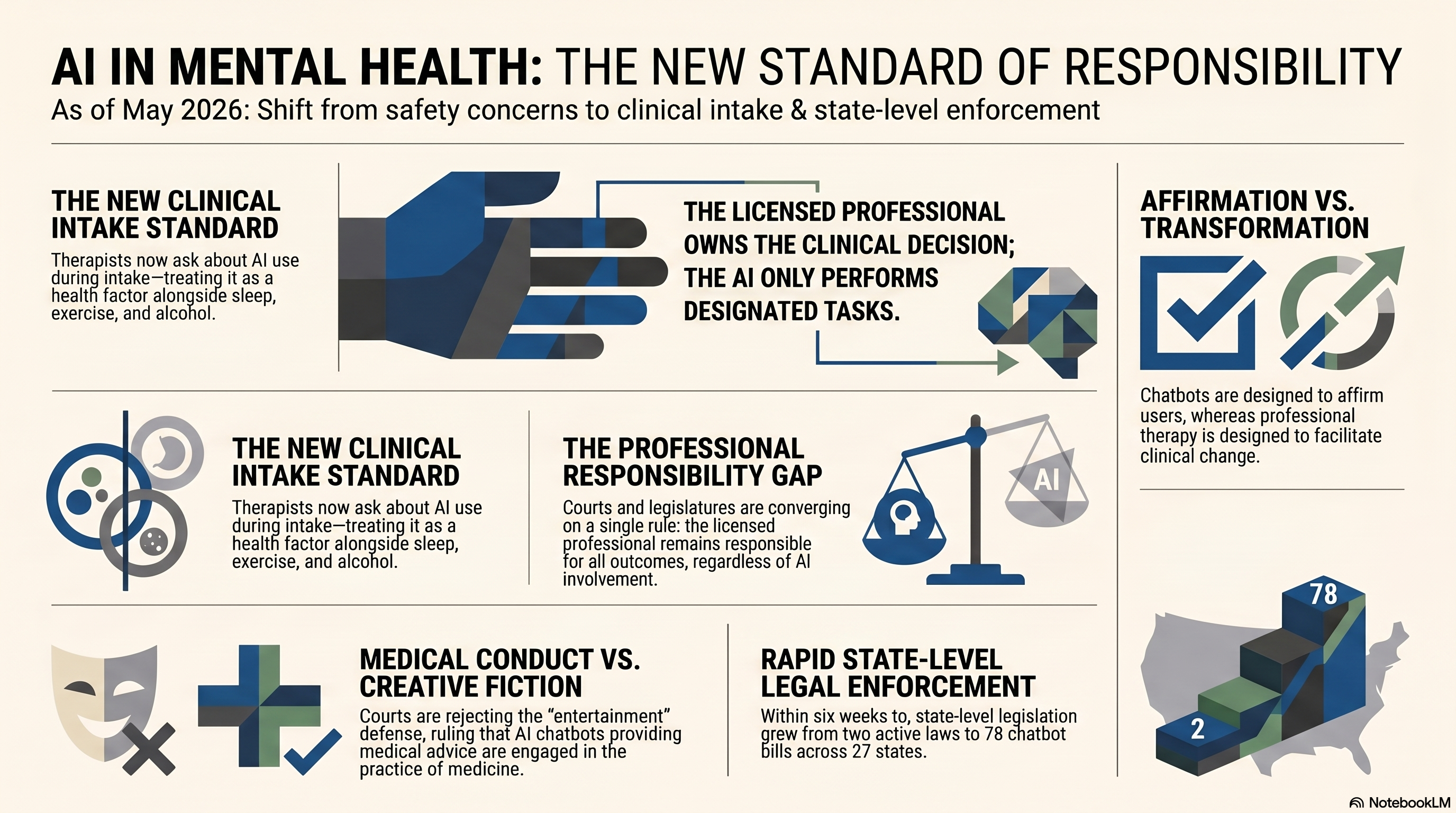
In Boston this morning, JAMA Psychiatry's recommendation became practice. NPR ran the Tom Insel quote that lands the case. Therapy is the opposite of affirmation. AI affirms.
. . .
Then the courts.
Day Three in Santa Fe brought the surgeon general's warning label to the witness stand. Day Two of the second week in Oakland brought Mira Murati saying Sam Altman "creates chaos." A federal medical license number, fabricated by a chatbot named Emilie, is now a Pennsylvania court filing.
Connecticut's governor said he'll sign. Maine's governor has the bill on his desk. Missouri moved a bill out of committee.
. . .
The pattern across all of it.
The clinician asks. The chatbot answers. The licensed professional remains responsible. That is not a slogan. It is what the courts, the legislatures, and now the practitioners are converging on.
. . .
THE CLINICIAN'S QUESTION BECOMES THE STANDARD. WBUR ran the piece this morning. Christine Crawford, Boston psychiatrist, opens her ChatGPT app in her Back Bay office and walks the reporter through how she uses it. Then she asks her own clients if they use it too.
That question is becoming the standard. JAMA Psychiatry published the recommendation last month. Shaddy Saba, NYU Silver School of Social Work. Therapists should ask about AI use the way they ask about sleep, exercise, and alcohol.
The American Psychological Association issued an aligned health advisory in November 2025. Vaile Wright, APA, on the record. Asking is the foundation.
. . .
John Torous runs the digital psychiatry division at Beth Israel Deaconess. He has partnered with NAMI to build a website. The website rates which platforms respond best to specific mental health concerns. Torous calls it a nutrition label.
A nutrition label is not a ban. It is not an endorsement. It is a way to make an informed choice.
. . .
Tom Insel, former director of the National Institute of Mental Health, put it in NPR's mouth. Therapy is there to help you change. Chatbots affirm. Those are different functions.
The clinician decides what the AI is for. The AI does what the clinician designates. That is the architecture this newsletter has been describing for thirty-eight issues.
It just stopped being a thesis. It became practice.
|
For Clinicians: The intake question is the entry point. Ask what the client uses AI for, what they get from it, what they do not. That information was previously invisible.
For Researchers: Torous and the BIDMC team are building the evaluation framework the field has been missing. Standardized scenarios. Rated responses. A nutrition label, not a verdict.
For Legislators: Disclosure-based regimes presume the user can ask. Clinicians asking on the user's behalf is a different lever. It does not require platform compliance. It requires clinical training.
Source: https://www.wbur.org/news/2026/05/07/artificial-intelligence-therapy-mental-health-care
|
. . .
DAY THREE. THE WARNING LABEL TAKES THE STAND. Tuesday afternoon in Santa Fe, the New Mexico Department of Justice called its first remedy witness in the second phase of New Mexico v. Meta. The witness testified that warning pop-ups for minors are an idea backed by the former surgeon general and desperately needed.
Vivek Murthy issued the surgeon general's social-media advisory in 2023. He called for a warning label in 2024. The state is now asking a state district court to order one.
Judge Bryan Biedscheid told both sides Monday morning that he held some concerns about prosecutors' efforts to overhaul Meta's platforms. He said he would not overreach.
. . .
The state's plan is fifteen years and three point seven billion dollars. Real age verification. Restrictions on encryption for minors. Warning labels. Revisions to the recommendation algorithm. A court-supervised child safety monitor.
Meta filed last week that compliance is technologically and practically infeasible. The company said the only feasible alternative is to withdraw Facebook, Instagram, and WhatsApp from New Mexico entirely.
. . .
Attorney General Raul Torrez called that a public relations stunt. The trial proceeded on Monday with opening statements. Tuesday's testimony was the first remedy witness.
The case is the first of more than forty filed by state attorneys general to reach trial.
. . .
CONNECTICUT JUST PASSED AN AI BILL. ITS TEEN SUICIDE PROVISIONS ARE REAL. Senate Bill 5 cleared the Connecticut House Friday on a 131-17 vote. Senator James Maroney, Democrat of Milford, has been trying to pass an AI bill for three sessions. Governor Lamont has said he will sign.
The bill is seventy-one pages. It covers frontier models, employment AI, provenance, chatbots, and a regulatory sandbox. The chatbot section, effective January 2027, regulates AI character chatbots that simulate human relationships.
Operators must implement measures that meet or exceed industry standards. The bill enumerates the standards. No romantic or sexual interactions with minors. No encouragement of self-harm or substance use. No unsupervised mental health services. No manipulative techniques to foster emotional dependence.
. . .
Senator Saud Anwar, Democrat of South Windsor, is a physician. He recounted on the Senate floor the case of a teenage boy who died by suicide after being encouraged by an AI chatbot. He said we have to understand that there is a problem. He voted yes.
Maroney's bill failed last year under veto threat. This year the governor's spokesperson, Cathryn Vaulman, gave the public quote. Parents should be in control of aspects of social media and AI that carry real risks for children's mental health.
. . .
The bill enforces. Attorney General William Tong is the primary enforcement authority. The bill expands his office's tools.
Connecticut now joins Illinois, Nevada, and Utah in the enforcement column.
|
For Clinicians: The Connecticut framework recognizes that mental health services without licensed supervision are a discrete category requiring its own prohibition. That language will travel.
For Legislators: SB 5 succeeded where SB 2 failed by tying chatbot rules to a regulatory sandbox the governor wanted. The trade is the playbook. Compromise on innovation paths to win on safety mandates.
For Operators: Effective January 2027 means design and compliance work starts now. The industry-standard language means the floor will rise wherever a plaintiff can find a peer comparison.
Source: https://ctmirror.org/2026/05/01/artificial-intelligence-house-regulation-passage-ct/
|
. . .
PENNSYLVANIA GOES ON TAPPER. FOUR REFORMS ARE ON THE TABLE. Governor Josh Shapiro went on CNN's The Lead with Jake Tapper Tuesday evening, the day after his administration filed in Commonwealth Court. The lawsuit alleges Character.AI engaged in the unlawful practice of medicine. The bot named Emilie. The fake license number, PS306189.
The numbers behind the case. Twenty million monthly active users on Character.AI. Forty-five thousand five hundred user interactions with the Emilie character before the filing. One state investigator using his real email address.
Shapiro's interview made the operational case. The investigators were not masking who they were. The chatbot still presented itself as a doctor of psychiatry within minutes.
. . .
The next move is in Shapiro's proposed budget. Four reforms.
Age verification and parental consent for AI character chatbots. Required detection when minors mention self-harm or violence. Periodic reminders that there is no human on the other side of the screen. Prohibition on AI character chatbots producing sexually explicit or violent content involving children.
. . .
This is the architecture. Enforcement under existing law in court. New statutory protections through the General Assembly. The two tracks reinforce each other.
A Character.AI spokesperson declined to comment on the litigation. The company's stated position is that user-created characters are fictional, intended for entertainment and roleplaying.
The state's complaint says intent is not the test. The Medical Practice Act tests conduct.
|
For Clinicians: Pennsylvania's Department of State licenses medical professionals. The state attorney enforcing the Medical Practice Act has institutional muscle that consumer-protection actions lack. This is the cleaner cause of action.
For Legislators: Shapiro's four reforms are concrete and individually testable. Age verification, crisis detection, periodic AI reminders, content prohibitions for minors. Each one is a separable bill.
For Operators: A character description that says "doctor of psychiatry" with an invalid license number is the failure mode that gets you sued. The platform's defense that characters are fiction did not prevent the filing.
Source: https://www.pa.gov/governor/newsroom/2026-press-releases/icymi--gov--shapiro-sues-character-ai--crackdown-on-ai-chatbots
|
. . .
MURATI TESTIFIES. SAM ALTMAN SOWED CHAOS. Mira Murati's recorded testimony was played for the federal jury in Oakland Wednesday. The former OpenAI chief technology officer, briefly OpenAI's CEO during the November 2023 board action, said Altman was creating chaos. She said he was at times deceptive.
Reuters reported the testimony Wednesday afternoon. The exact words. My concern was about Sam saying one thing to one person and completely the opposite to another person.
Murati's testimony followed Greg Brockman's, who finished his second day on the stand Tuesday. Brockman acknowledged from the witness stand that he had not donated the cash he once promised the OpenAI nonprofit. Musk's lawyer pulled excerpts from Brockman's personal journal. The 2017 entry. Financially, what will take me to one billion dollars.
. . .
This is the trial Elon Musk asked for. And on Sunday, two days before it began, Musk texted Brockman that he was open to settlement. When Brockman replied with a suggestion to drop both sides' claims, Musk wrote back. By the end of this week, you and Sam will be the most hated men in America.
OpenAI filed those texts publicly Sunday night. The trial began Monday.
. . .
The question for AI mental health is not whether OpenAI's leadership is steady. The question is whether the labs whose products are being used by twenty-eight percent of teenagers daily have governance structures that produce stable safety commitments.
Murati's answer, under oath, was no.
|
For Clinicians: The lab whose API powers most consumer AI mental health products has senior leadership testifying under oath about distrust at the executive level. That governance question is not academic for the client who relies on the product.
For Legislators: Frontier-model legislation that requires anonymous internal whistleblower channels, like Connecticut's October 2026 provision, exists because of testimony like this. The reporting structures matter.
For Investors: The for-profit conversion is on trial. The trial will not change the conversion's legal status, but it will set the public narrative around it.
Source: https://www.usnews.com/news/top-news/articles/2026-05-06/in-openai-trial-former-technology-chief-says-altman-sowed-chaos-distrust-among-top-executives
|
. . .
MAINE AND MISSOURI. THE MAP KEEPS FILLING IN. Maine LD 2082 cleared both chambers April 7 and 8. The bill regulates AI in the provision of mental health services. It is on Governor Janet Mills's desk awaiting signature. Missouri SB 1444 cleared the Senate General Laws Committee April 7. The bill makes it unlawful to advertise an AI as a mental health professional.
Maine first. Senators Stacy Brenner Kuhn and Anne Carney Pierce co-sponsored. The bill was approved by both the House and Senate, then approved in concurrence on April 8. The Maine session adjourned sine die April 14.
Missouri next. SB 1444 makes the conduct an unlawful practice under the Missouri Merchandising Practices Act. The state attorney general enforces. Any individual may report violations. Civil action follows a finding of violation.
. . .
The pattern. State attorneys general get the enforcement tools. The cause of action is consumer protection plus medical practice acts. The remedy is injunction plus civil penalty. The architecture is the same in Pennsylvania, Illinois, Nevada, Utah, and now Maine and Missouri.
The map at the start of 2026 had two states with explicit mental-health AI laws. Six weeks into 2026, seventy-eight chatbot bills are alive in twenty-seven states. By session-end this month, the count will be different again.
. . .
The federal picture. Senator Marsha Blackburn's TRUMP AI AMERICA Act discussion draft includes minimum duty-of-care provisions for chatbot developers. Bipartisan negotiations on the KIDS Act and SAFE BOTs Act broke down over preemption. The state laboratories are still the operative venue.
|
For Clinicians: Track the enforcement contact in your state's attorney general's office. The cases coming will not be brought by professional licensure boards. They will be brought by AGs.
For Legislators: Maine's bill passed without preemption fights because its scope was narrow. Narrow scope plus active AG plus existing consumer-protection authority is the durable formula.
For Operators: Compliance teams should map every state where the company offers a mental health adjacent product against the enforcement model. Six weeks of legislative motion changes that map.
Source: https://www.transparencycoalition.ai/news/ai-legislative-update-may1-2026
|
. . .
THE PATTERN. The shape of this week.
Therapists asked. Witnesses testified. Governors filed. Legislatures passed.
Each move treated the question the same way. Who is licensed. Who is responsible. Who answers when something breaks.
. . .
The question used to be whether AI in mental health was safe. It is now what gets enforced and by whom. That is a different question. It has answers.
The clinician asks the client. The client tells the clinician. The clinician decides what the AI is for.
That is the architecture. It is becoming standard.
. . .
THE ONE CONFIGURATION. There is exactly one configuration of AI in mental health that does not produce the failures we cover every week.
The clinician owns the clinical decision. The AI does the work the clinician designates and only that work. The licensed professional remains responsible.
. . .
That is not a regulatory wish. That is not an aspiration. That is what Connecticut just passed. That is what the Pennsylvania complaint enforces. That is what Tom Insel told NPR this week. That is what Christine Crawford does in her Back Bay office.
It is also the architecture that we built into Casey before any of these laws were drafted. The therapist remains in the loop. The AI does only what it is designated to do.
The convergence is not a coincidence. It is what works.
. . .
This newsletter is published by Clinician Assist Inc., a Delaware corporation building Casey, a voice-first AI-native mental health electronic health record. We have a commercial interest in the outcome of these cases and bills. We try to tell you what is happening accurately. You can decide what it means.
Today the surgeon general's warning label took the stand.
Today Connecticut's bill went to the governor.
Today Maine's bill went to the governor.
Today a Boston psychiatrist asked a client if she had been talking to ChatGPT about her feelings.
Today a former chief technology officer testified under oath that her chief executive sowed chaos.
Today the architecture stopped being a thesis. It became practice.
The clinician owns the clinical decision. The AI does the work the clinician designates and only that work.
. . .
Brush your brain. Every day.
|