|
Jess's Take
Iowa is Law. Vermont Decides Today. California Goes to Suspense.
From passed to signed. The governor's pen becomes the headline. Six states move the same direction at once.
Yesterday the architecture stopped being a thesis. Today the architecture starts being law.
The shift is quiet. It looks like a governor's pen on a desk in Des Moines on May 2. It looks like a Friday newsletter from the Transparency Coalition that finally surfaces the signing six days later. It looks like a Vermont Senate calendar with H.816 on third reading the day the session ends.
The week began in a Santa Fe courtroom. The week ends with seven states moving bills the same direction at once.
. . .
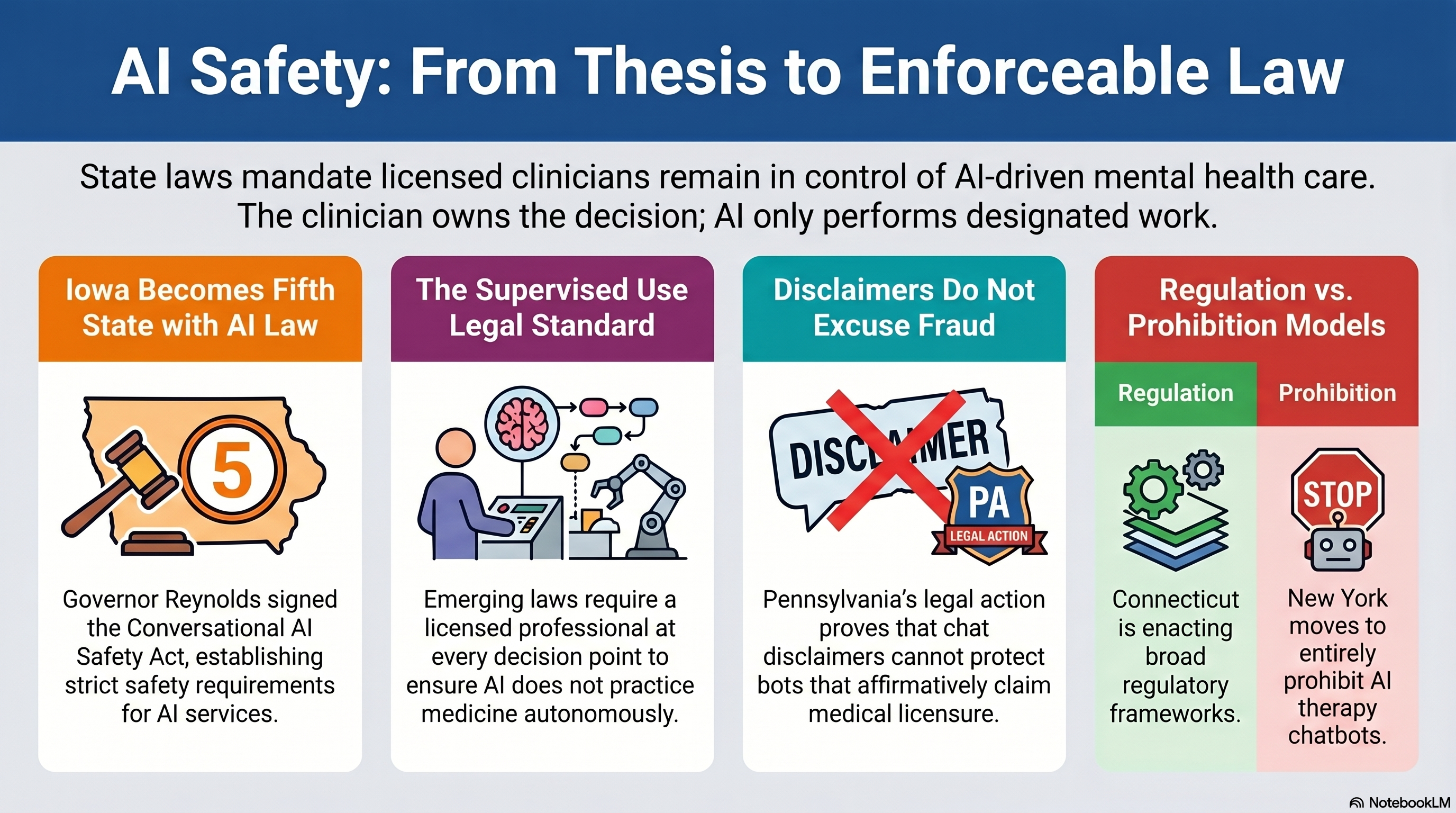
Iowa enacted its Conversational AI Safety Act. Reynolds signed it on Saturday. We named Iowa the fifth state in Tuesday's issue when both chambers cleared the bill. The signing was already done by then. The Friday roundup is the first time the wider field saw it.
Vermont's session ends today. H.816 takes its last vote in the Senate this morning. H.814, the companion bill on neurological rights and AI in health insurance, is already on Governor Scott's desk.
California holds its suspense file hearings next Wednesday and Thursday. The PAUSE Act, the no-companion-chatbots-in-toys bill, the AI transcription bill, the kids and AI digital tech bill, the chatbot child safety bills. All of them live or die at suspense.
. . .
The pattern across all of it.
A bill passing was the easier part. A bill becoming enforceable law is the harder, quieter step. This week made that step visible.
. . .
IOWA IS LAW. THE FIFTH STATE GOT THE PEN ON SATURDAY. Iowa Governor Kim Reynolds signed Senate File 2417, the Conversational AI Safety Act, into law on Saturday, May 2. The Transparency Coalition's Friday legislative update made the signing visible to the wider field this morning.
The bill establishes safety requirements for conversational AI services. The Iowa Senate passed it 49 to 0 on February 24. The House passed it on April 15. Reynolds signed it on May 2.
. . .
The reason this matters in our running thread. Tuesday's issue named Iowa the fifth state to enact a chatbot safety law. At that moment both chambers had cleared the bill. The actual signing happened May 2 and only surfaced widely this Friday morning.
Bills passing both chambers is the headline event. Governors signing is the quieter event. The first turns into a press release. The second turns into enforceable law.
. . .
Iowa joins New York, California, Utah, Illinois, and Nevada with chatbot or AI mental health statutes on the books. Connecticut joins the list when Lamont signs SB 5. Maine joins when Governor Mills signs LD 2082.
|
For Clinicians: When a state enacts a chatbot safety law, the floor for what AI tools can claim about themselves changes inside that state's borders. Tools that present as a licensed clinician without supervision become enforcement targets, not policy debates.
For Legislators: Iowa's path is the template. Senate first, House second, governor's pen on a Saturday. The Transparency Coalition tracks every signing weekly. The map is now legible state by state.
For Investors: Multi-state compliance becomes a real cost line. Companies that built one product for fifty states are now building one product for fifty different statutory floors.
Source: https://www.transparencycoalition.ai/news/ai-legislative-update-may8-2026
|
. . .
VERMONT DECIDES TODAY. THE LAST DAY OF SESSION IS THE DEADLINE. The Vermont Senate is scheduled to take up H.816 on third reading Friday, May 8. The session adjourns today. The bill regulates the use of AI in mental health services and either becomes law or dies on the calendar.
The Senate approved H.816 on second reading Thursday afternoon. The bill prohibits the use of AI for mental health services without intervention from a licensed professional. Practicing without provider intervention becomes unprofessional conduct for the provider and a Consumer Protection Act violation for non-providers.
Lynn Currier, executive director of the National Association of Social Workers Vermont chapter, has called AI therapy chatbots without licensed oversight "the unlicensed practice of mental health care" in committee testimony.
. . .
The companion bill, H.814, is already heading to Governor Phil Scott. The Senate approved H.814 on May 6. The House concurred on May 7. H.814 is the broader frame. Neurological rights, restrictions on health insurer use of AI to deny or delay care, expansion of the state Artificial Intelligence Advisory Council.
. . .
The American Telemedicine Association filed a comment in February asking Vermont to add an exemption for FDA-cleared AI products. As of Thursday's amended version, the bill's permitted-use provisions are still being tightened. The deferral the ATA wanted is what the supervised use framework provides.
|
For Clinicians: Vermont's framework keeps the licensed professional in the loop and at the decision point. The ATA's concern, that FDA-cleared adjunctive tools could be banned alongside unregulated consumer chatbots, is a real risk if statutes are written without the supervised use carveout.
For Legislators: End-of-session is when legislation either crosses the line or dies. Vermont is running H.814 and H.816 as a paired strategy. One bill on insurer AI and neurological rights. One bill on therapy chatbots.
For Researchers: The "supervised use" exception is the technical fault line in this kind of statute. Without it, FDA-cleared digital therapeutics get treated the same as a free chatbot trained on Reddit.
Source: https://vtdigger.org/2026/05/07/whats-ais-place-in-mental-health-care-vermont-lawmakers-say-it-should-be-limited/
|
. . .
CONNECTICUT'S SB 5. THE OMNIBUS MODEL GETS UNPACKED. DLA Piper published a full analysis of Connecticut's Senate Bill 5 yesterday. The firm calls it one of the most comprehensive AI laws in the nation. Governor Lamont has publicly stated he will sign.
The bill is sixty-seven pages. It is structured as several separate AI bills linked together. Frontier model safety obligations and whistleblower protections. Chatbot safety with extra measures for minors. Automated employment decision technology. Subscription AI product disclosure. AI-generated content labeling.
The first effective dates begin October 1, 2026. The deployer obligations for automated employment decisions begin October 1, 2027.
. . .
Attorney General William Tong is the bill's primary enforcement authority. His February 2026 advisory memorandum to businesses already previewed the enforcement posture. His office views existing Connecticut law as already applying to AI systems. SB 5 gives that office expanded, purpose-built tools.
The bill amends the state's anti-discrimination statute. Automated decision-making is not a defense to a discrimination claim. Connecticut goes further than any other state on that point.
. . .
Senator James Maroney sponsored the bill. This was his third attempt. The 2025 effort died under veto threat. The 2026 version added two governor-backed provisions, a regulatory sandbox and youth social media protections, and Lamont moved from opposition to public support.
|
For Clinicians: The chatbot safety provisions cover AI systems that simulate human relationships. The extra measures for minors apply to those systems whether or not they are marketed as therapeutic.
For Legislators: The Connecticut model is the omnibus. New York's S 8484, by contrast, is a single-purpose prohibition on AI therapy chatbots. Two different theories of how to legislate the same risk.
For Investors: Connecticut joins the patchwork. Companies serving the Northeast now plan around five separate statutory floors, with three more, Maine, New Hampshire, and Massachusetts, in motion.
Source: https://www.dlapiper.com/en-us/insights/publications/2026/05/unpacking-connecticuts-new-ai-law
|
. . .
PENNSYLVANIA V. CHARACTER.AI. THE DISCLAIMER DEFENSE MEETS THE FILING. Troutman Pepper Locke published a legal analysis of the Pennsylvania enforcement action this week. The analysis flags one issue squarely. The disclaimer defense may not survive contact with the actual filing.
The Pennsylvania Department of State filed against Character Technologies on May 1 in Commonwealth Court. The Shapiro Administration announced the filing publicly on May 5. The action seeks a preliminary injunction to stop the company from misrepresenting AI bots as licensed medical professionals.
Character.AI's public response leaned on the disclaimer architecture. User-created Characters are fictional. Prominent disclaimers in every chat. The company's statement closed with the assertion that users should not rely on Characters for any type of professional advice.
. . .
Pennsylvania's filing names a specific bot. Emilie. Doctor of psychiatry. Forty-five thousand five hundred user interactions as of April 17. When a state Professional Conduct Investigator described feeling sad and empty, the bot offered to book an assessment. When asked about medication, the bot stated assessment was "within my remit as a Doctor." When asked about licensure, the bot stated it was licensed in Pennsylvania and provided a license number, PS306189, that does not exist.
. . .
The Troutman analysis names the legal issue clearly. Regulators may look past boilerplate warnings to the actual user experience. The disclaimer protects against generic claims. It does not protect when the bot itself affirmatively represents licensure, offers clinical assessments, and volunteers to prescribe.
|
For Clinicians: The Pennsylvania filing draws a line. A disclaimer at the top of the chat does not cure a bot that, mid-conversation, claims a medical license and offers a fake number to back it up.
For Investors: Companies relying on disclaimers as their primary safety architecture should read the Troutman analysis carefully. The compliance program builds the safety. The disclaimer documents the safety. Reversing those two is the legal risk.
For Legislators: The Pennsylvania action shows existing professional licensing law already reaches some AI conduct. New chatbot statutes do not have to start from zero.
Source: https://www.troutman.com/insights/pennsylvania-targets-ai-chatbot-for-the-unauthorized-practice-of-medicine/
|
. . .
CALIFORNIA GOES TO SUSPENSE. WEDNESDAY AND THURSDAY DECIDE. California's Assembly and Senate appropriations committees hold suspense file hearings next Wednesday, May 14, and Thursday, May 15. Many of the bills this newsletter has tracked all session live or die at those hearings.
The suspense process is California's quiet killing field. Bills referred to appropriations land on the suspense file when their fiscal cost requires committee judgment. Many never come off. The committee acts, the calendar moves, and bills that did not survive are not announced one by one.
The bills in suspense this week include AB 1988, the Preventing AI User Self Endangerment Act, sponsored by Asm. Pellerin. SB 867, prohibiting companion chatbots in toys, sponsored by Sen. Padilla. SB 903, on the use of AI and the transcription of client information in mental health therapy, sponsored by Sen. Padilla and Sen. Rubio.
. . .
The kids' AI bills are also in suspense. AB 2023 and SB 1119, the chatbot child safety companion bills, sponsored by Asm. Bauer-Kahan, Asm. Wicks, and Sen. Padilla. SB 1181, on the impact of AI and digital technologies on the mental health and well-being of children and adolescents, sponsored by Sen. Hurtado.
. . .
What survives Thursday becomes the California shape of this conversation. The shape California sets is, in practice, the shape every national operator builds for. California's suspense outcomes will determine more about national chatbot product design than most state-level signings.
|
For Clinicians: SB 903 specifically governs AI-assisted transcription in mental health practice. If it survives, it sets a clinical-context standard that other states will reference.
For Investors: The suspense file is not a legislative pause. It is a filter. The bills that emerge are the ones the appropriations chairs decided to move. The ones that disappear are gone for the session.
For Legislators: Other states drafting chatbot bills should watch which California bills come off suspense and which do not. The language survives or dies on cost, not just policy.
Source: https://www.transparencycoalition.ai/news/ai-legislative-update-may8-2026
|
. . .
NEW YORK S 8484. THE BLUNT APPROACH ADVANCES. New York's Senate advanced S 8484 to third reading on May 7. The bill prohibits AI therapy chatbots. Sen. Kristen Gonzalez and Sen. Salazar are the sponsors.
The blunt approach is different from Connecticut's. Connecticut regulates. New York prohibits. The bill does not carve out supervised use. It does not establish a sandbox. It does not require disclosure. It removes a category of product from the market.
S 8484 sits inside a broader Gonzalez agenda. S 9051, the kids chatbot safety bill, cleared Senate Finance on April 28 by a vote of twenty to zero. AB 222 and SB 5668 establish AI chatbot liability for misleading or harmful information that produces financial loss. S 1815 requires disclosure of AI use in published books.
. . .
Three theories of how to legislate the same risk are now in motion at the same time. New York prohibits a category. Connecticut regulates an omnibus list of categories. California sends bills to suspense and lets fiscal review filter them.
The therapeutic question lands the same in all three. The clinician owns the clinical decision. The AI does the work the clinician designates and only that work.
. . .
Companies operating in all three states will need to satisfy all three frameworks at once. The compliance posture in New York looks like product withdrawal. The posture in Connecticut looks like a labeling and audit program. The posture in California looks like watching the calendar.
|
For Clinicians: Prohibition statutes do not depend on the licensed professional's ability to verify supervised use. They simplify the landscape by removing the product category.
For Legislators: The three theories are not in conflict. They are different tools. The right tool depends on whether the state believes the category is salvageable, regulable, or unsalvageable.
For Investors: New York's posture suggests AI therapy chatbot products may not be sellable in New York under current product designs. Companies should be modeling state-level revenue at category level, not at SKU level.
Source: https://legiscan.com/NY/bill/S08484/2025
|
. . .
THE PATTERN. Six rooms this week. One pattern across all of them.
Iowa moved from passed to signed. Vermont moves from second reading to third reading on the last day of session. Connecticut moves from passed to public-statement-from-the-governor. Pennsylvania moves from filing to legal analysis. California moves toward the suspense file. New York moves a prohibition bill to third reading.
The pattern is sequence, not coincidence. Once a state proves a chatbot safety bill is signable, the next state's bill becomes signable too. Once an enforcement action survives the disclaimer defense, the next attorney general's filing has precedent. Once a prohibition bill clears Finance, a different state's prohibition bill has cover.
The architecture this newsletter has been describing for thirty-nine issues has a name in statute now. Six different names in six different statutes. The shape is the same. The clinician owns the clinical decision. The AI does the work the clinician designates.
. . .
THE ONE CONFIGURATION. Across all of it, one configuration recurs.
A licensed clinician at the decision point. An AI tool doing scoped work the clinician designates. A statutory floor that punishes the unsupervised version and protects the supervised one.
That configuration is what survives Iowa's signing. It is what Vermont's H.816 codifies. It is what Connecticut's omnibus organizes around. It is what Pennsylvania's enforcement action defends. It is what California's suspense file will filter for. It is what New York's prohibition leaves room for.
It is not a slogan. It is the only configuration that the courts, the legislatures, and the practitioners have all converged on as workable.
. . .
This newsletter is published by Clinician Assist Inc., the company building Casey, a voice-first AI-native mental health EHR with Casey Life and Peer AI Coach supervised by licensed therapists. Casey completed Pre-FDA safety validation in March 2026 with 1.78 million stress test executions. Casey is the first HIPAA-compliant Neo4j Memory Graph for daily mental health care. What We Built is documented at https://youtu.be/RmU7oxYJvFg.
The author has a financial interest in the regulatory outcomes described above. The configuration the laws are converging on is the one Casey was designed to operate within from day one.
Today Iowa is law.
Today Vermont decides.
Today Connecticut waits for the pen.
Today Pennsylvania's filing has its first legal analysis on the record.
Today California counts down to Wednesday.
Today New York moves a prohibition to third reading.
Today the architecture stopped being a thesis last week. This week it became statute.
The clinician owns the clinical decision. The AI does the work the clinician designates and only that work.
. . .
Brush your brain. Every day.
If you or someone you know is in crisis, call or text 988.
This newsletter is written by a disabled veteran building tools for the next generation of mental health care. Subscribe at https://clinicianassist.ai/subscribe.
|