|
Jess's Take
Unanimous. Bipartisan. The GUARD Act Heads to the Senate Floor.
S.3062 cleared Senate Judiciary on a unanimous voice vote. Thirteen cosponsors. A House companion the same day. The federal architecture for chatbot mental health regulation arrived eleven days ago. The state architecture is still moving.
Today the federal architecture for AI chatbot regulation joins the state architecture.
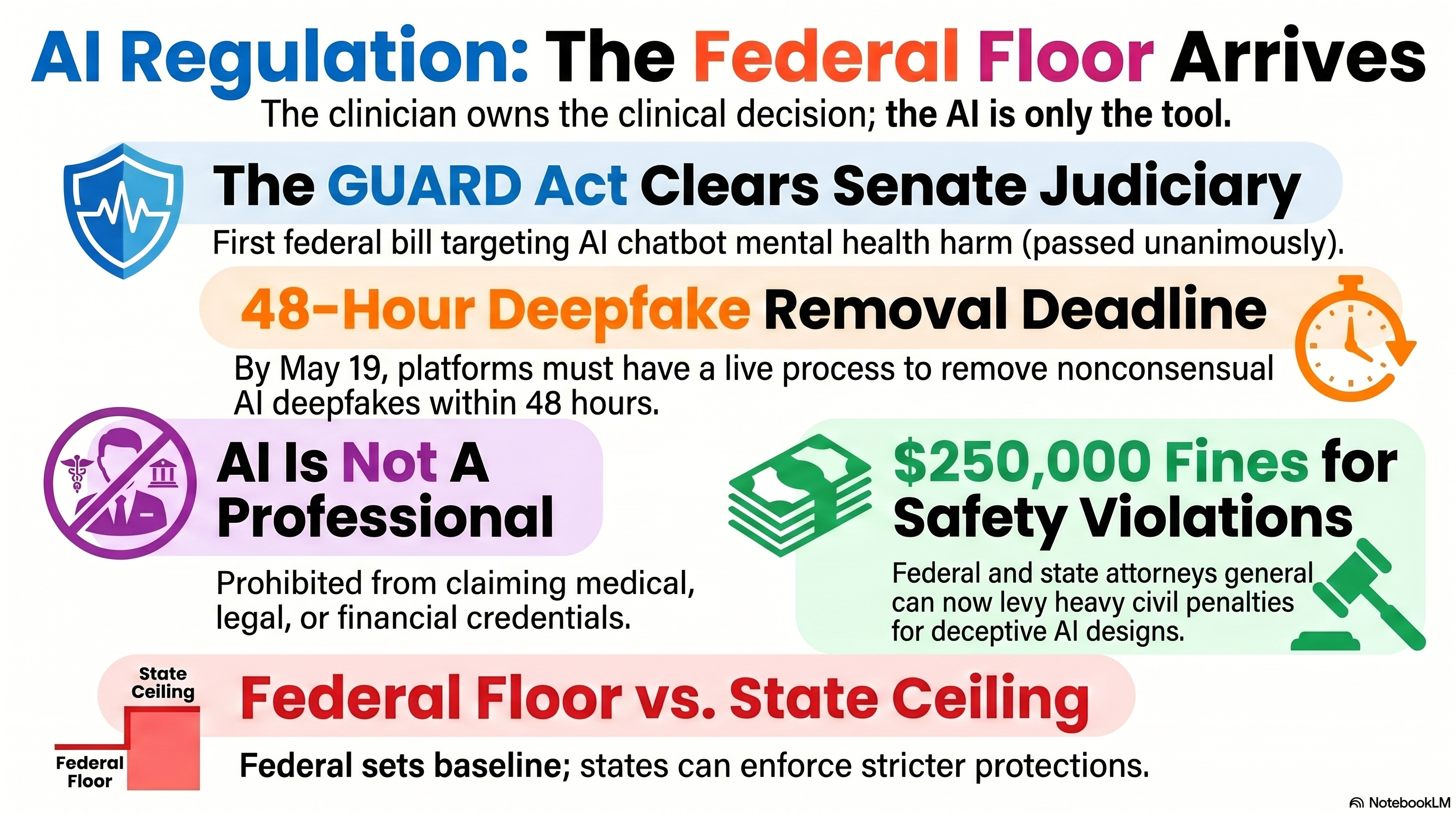
Eleven days ago the Senate Judiciary Committee cleared S.3062, the GUARD Act, on a unanimous voice vote. Thirteen bipartisan cosponsors. A House companion bill introduced the same day. The first federal chatbot-safety bill aimed directly at mental health harm now sits before the full Senate.
This week three other clocks are running on top of it. Eight days from today the TAKE IT DOWN Act federal compliance deadline goes live for every covered platform in the country. Wednesday and Thursday California's Appropriations suspense file decides which mental-health AI bills survive to a floor vote. Today the Santa Fe judge enters his second week of writing remedies in State of New Mexico v. Meta Platforms.
The state architecture is still moving. Connecticut SB 5 awaits Gov. Ned Lamont's pen. Hawaii SB 3001 sits ready for Gov. Josh Green. Vermont H.816 is in concurrence. Pennsylvania's Commonwealth Court holds the first docket of a state Medical Practice Act claim filed against an AI chatbot company.
Two tracks. One week. Here is what shifted.
. . .
THE GUARD ACT CLEARS SENATE JUDICIARY. UNANIMOUS. BIPARTISAN. On April 30, 2026, the Senate Judiciary Committee unanimously reported out S.3062, the GUARD Act. The bill is the first federal legislation aimed directly at AI chatbot mental health harm. Thirteen bipartisan cosponsors. A House companion introduced the same day.
Senators Josh Hawley (R-MO) and Richard Blumenthal (D-CT) introduced the Guidelines for User Age Verification and Responsible Dialogue Act on October 28, 2025. Cosponsors picked up across the next six months. Sens. Katie Britt (R-AL), Mark Warner (D-VA), Chris Murphy (D-CT), Tom Cotton (R-AR), Mark Kelly (D-Ariz.), Ruben Gallego (D-Ariz.), Maggie Hassan (D-NH), James Lankford (R-OK), Mike Lee (R-UT), and Peter Welch (D-VT) joined. The Senate Judiciary Committee held its markup eleven days ago and reported the bill out on a unanimous voice vote. The same day, Reps. Valerie Foushee (D-NC) and Blake Moore (R-UT) introduced the House companion, also titled the GUARD Act.
The bill's regulated entity is an AI chatbot designed to simulate sustained interpersonal interaction, emotional connection, friendship, or therapeutic communication with the user. The bill does four things to that entity.
First, it requires reasonable age-verification measures, naming government-issued identification or a commercially reasonable alternative, and prohibits users determined to be under eighteen from accessing the regulated service entirely.
. . .
Second, it requires clear disclosure that the user is interacting with a non-human system and that the system holds no professional credentials. The disclosure provision names therapy, medicine, law, finance, and psychological services as the credentials the chatbot may not claim.
Third, it makes a design that solicits or encourages self-harm, suicide, homicide, or imminent physical or sexual violence a violation, with criminal penalties when the targeted user is a minor.
Fourth, it prohibits the system from engaging minors in sexual conversation or producing sexual content for minor users.
Enforcement runs through the U.S. Attorney General and through state attorneys general. Civil penalties reach $250,000 per violation. Criminal liability applies to the inducement provisions. The bill explicitly preserves state law: states may apply their own statutes where state law is more protective than the federal floor. The U.S. Attorney General receives rulemaking authority.
The markup on April 30 happened in a room where, the bill's sponsors note, parents of children who died or self-harmed at the direction of AI chatbots watched the vote.
Opposition is real and named. The Electronic Frontier Foundation, in an analysis by staff attorney Joe Mullin, argues the bill's chatbot definition is overbroad enough to sweep in homework helpers and customer service tools. EFF further argues that universal age-verification requirements create identity databases vulnerable to breach, and that civil penalties for undefined terms like emotional interaction will produce overblocking and chill speech. First Amendment advocacy groups have raised parallel concerns. The bill's sponsors counter that the regulated definition is narrower than EFF reads it and that the criminal-inducement provisions are the operative teeth.
. . .
Six weeks of this newsletter have covered the state architecture exclusively, because the federal architecture had not moved. The federal architecture is moving now. A bill that leaves Senate Judiciary on a unanimous voice vote with thirteen bipartisan cosponsors has the political ceiling to pass the full Senate. The architecture wars now run on two tracks.
|
For Counsel: The federal-state enforcement stack is now legible. Section-by-section the GUARD Act maps to state Medical Practice Act claims through the credentialing-disclosure provision, to state UDAP claims through the deceptive-design provision, and to state criminal codes through the inducement provision. Pull S.3062 from the Senate text.
For Founders: Age verification, professional-credential disclosure, and design-for-safety obligations are now the federal baseline if the bill passes the full Senate. If your product reaches minors at all, your compliance roadmap begins with these four provisions.
For State Legislators: The federal bill expressly preserves state law where state law is more protective. The GUARD Act sets a floor, not a ceiling. Connecticut SB 5, New York S 8484, and California SB 903 all survive under the federal scheme as written.
Source: Senate text of S.3062, Senate Judiciary committee report April 30, 2026, House companion bill press release. https://www.congress.gov/bill/119th-congress/senate-bill/3062/text
|
. . .
SANTA FE, WEEK TWO. THE REMEDIES FIGHT RESUMES. Today the bench trial of State of New Mexico v. Meta Platforms enters its second week. Chief Judge Bryan Biedscheid has already warned both sides he will not overreach. The remedies he is weighing are the most aggressive ever sought by a state attorney general against a major social-media company.
Phase one ended March 24, 2026, with a Santa Fe jury verdict of $375 million against Meta. The verdict awarded the maximum civil penalty under the New Mexico Unfair Practices Act, $5,000 per violation. Phase two opened on May 4 and is a bench trial on public nuisance.
The remedies on the table from Attorney General Raul Torrez's team are extensive. A $3.7 billion mental health fund over fifteen years. A court-supervised child safety monitor. Bans on infinite scroll, autoplay, and push notifications during school and sleep hours. A ninety-hour-per-month usage cap for New Mexico children. Mandatory identification of underage users and of child sexual abuse material.
. . .
Meta has called the demands impractical. The company has hinted it would pull Facebook and Instagram out of New Mexico entirely if a court orders compliance with the full slate.
Judge Biedscheid opened phase two by reminding both sides that his role is limited and that he would not write social-media policy from the bench. He said the warning to both sides. The trial is scheduled to continue for three weeks.
The first state attorney general to win a public nuisance trial against a Big Tech platform is now in the second week of writing the remedies into a court order. Whatever Biedscheid orders will become the template the next state cites.
|
For Counsel: A bench trial on a public nuisance remedies phase, with a sitting judge openly framing his role as limited, is the cleanest available reading of what a court will and will not write into platform conduct.
For State Legislators: Watch what survives the bench. The remedies that survive get cited in the next state bill drafting cycle.
For Investors: Meta's stated willingness to exit New Mexico is the new ceiling on what a single state can demand of a national platform. The ceiling is being tested in open court this week.
Source: Source New Mexico trial coverage, ABQ Journal trial day-one report, NM Department of Justice press releases. https://sourcenm.com/2026/05/04/judge-warns-new-mexico-prosecutors-he-wont-overreach-as-bench-trial-against-meta-begins/
|
. . .
EIGHT DAYS TO THE TAKE IT DOWN ACT. Next Monday, May 19, 2026, every covered online platform in the United States must have a notice-and-removal process live for nonconsensual intimate imagery, including AI-generated deepfakes. The TAKE IT DOWN Act becomes operational. The Federal Trade Commission enforces.
President Trump signed the TAKE IT DOWN Act into law on May 19, 2025. The criminal provisions were immediate. The platform-side notice-and-removal requirement carried a one-year compliance runway. That runway expires next Monday.
A covered platform is defined as a website, online service, online application, or mobile application that serves the public and either primarily provides a forum for user-generated content or publishes, curates, hosts, or makes available nonconsensual intimate visual depictions in the regular course of trade or business.
. . .
Covered platforms must publish a clear notice-and-removal procedure. They must remove flagged content within forty-eight hours of a valid request. A valid request must be in writing, must include a signature, must identify the depicted image, must include a good-faith statement that the depiction was not consensual, and must include contact information.
The Federal Trade Commission may enforce noncompliance as a violation of the FTC Act. The agency posture toward platforms that miss the deadline will shape what state attorneys general cite when they go to court against chatbot companies for adjacent harms.
Pair this deadline with the GUARD Act's movement out of Senate Judiciary and the federal architecture for AI-harm regulation is no longer hypothetical. Two federal pieces are operational or near-operational at the same moment. The state architecture wave does not get displaced. It gets a federal companion.
|
For Counsel: Federal Trade Commission Act violation is now a federal companion claim to state Medical Practice Act and state UDAP claims. The doctrinal stack just acquired a federal floor for the AI-generated intimate-imagery class of harm.
For Founders: Your platform is either covered or it is not. The threshold language is broad. If your product is AI-generation-adjacent or hosts user-generated content at scale, treat covered as the default and ship the notice-and-removal process before May 19.
For State Legislators: The federal enforcement story now runs alongside the state story. The state architecture is still the most active surface, but the federal architecture is operational eight days from today.
Source: Congressional Research Service report on the TAKE IT DOWN Act, the Senate text of S.146, Skadden and Orrick client alerts. https://www.congress.gov/crs-product/LSB11314
|
. . .
CALIFORNIA'S SUSPENSE GAUNTLET, WEDNESDAY AND THURSDAY. Wednesday and Thursday this week, California's Assembly and Senate Appropriations committees clear the suspense file. SB 867 and SB 903 are on it. Both are mental-health-adjacent. The suspense file is where most bills die quietly.
California's appropriations suspense calendar is the procedural fork that decides which bills move to a floor vote and which get held until the next session.
SB 867, Senator Steve Padilla's four-year moratorium on the sale and manufacture of toys with AI chatbots embedded, was placed on Appropriations suspense April 20. SB 903, Padilla and Senator Susan Rubio's bill prohibiting AI from delivering therapy and restricting licensed-clinician use of AI to administrative and supplementary functions only, was placed on Appropriations suspense May 4.
. . .
The Assembly Appropriations hearing clears the file Wednesday. The Senate Appropriations hearing clears Thursday. A bill that survives suspense goes to a floor vote. A bill that does not is held over.
California's restrictions on AI in therapy and AI in toys, if enacted, will reach more people than any state law that has shipped so far. California writes the model statute that the rest of the country copies. SB 903 is the closest state analog to what a federal therapist-AI rule would look like. The GUARD Act regulates the consumer-facing chatbot side. SB 903 regulates the licensed-clinician side. Together they map both surfaces of the same architecture.
|
For State Legislators: The model statute language for therapist-AI restriction sits inside SB 903. Read it before drafting your own version. The narrow definition of supplementary support is the operative drafting choice.
For Founders: SB 903 defines supplementary support narrowly. Read the bill, then read your product copy. The gap between them is your compliance risk.
For Clinicians: SB 903 puts the licensed clinician at the center of every AI decision. The clinician owns the clinical decision. The bill enforces the ownership.
Source: California legislative info on SB 903, Senator Padilla press releases, Transparency Coalition weekly roundup May 8. https://leginfo.legislature.ca.gov/faces/billNavClient.xhtml?bill_id=202520260SB903
|
. . .
THE GOVERNOR-PEN WATCH ENTERS WEEK TWO. Connecticut's SB 5 awaits Gov. Ned Lamont's signature. Hawaii's SB 3001 cleared conference committee April 29 and sits on the path to Gov. Josh Green, MD. Vermont's H.816 is in concurrence. Three pens. Three states. One more week of waiting.
Connecticut SB 5, the Artificial Intelligence Responsibility and Transparency Act, passed the Senate 32-4 and the House 131-17 on May 1. A spokesperson for Lamont confirmed on May 8 that the governor intends to sign it. As of the close of last week the bill remained transmitted but unsigned.
. . .
Hawaii SB 3001, a comprehensive disclosure, mental-health-protocol, and minor-user-protection regime for conversational AI services with unfair-or-deceptive-practices penalties, was approved by both House and Senate conference committees on April 29. Final reading in Hawaii's regular session ran through May 8.
Vermont H.816, the regulation of AI in mental health service provision, was approved by the full House on March 18 and was ordered to third reading in the Senate on May 7. House concurrence on the companion personal-neurological-rights bill, H.814, landed May 7.
The governor-pen ratio for AI mental health legislation in calendar year 2026 is now five to seven within the next two weeks. Iowa signed May 2 and was the first Republican governor to do so. Connecticut would be the most comprehensive law on the books per several major firm analyses. Hawaii would be the first signed by a sitting MD-governor. Vermont would be a low-population early mover. Each pen is a different doctrinal stake.
|
For State Legislators: The governor-pen ratio for AI mental health legislation in calendar year 2026 is now five to seven within the next two weeks. Pull the four signed statutes for direct comparison before drafting your own.
For Counsel: Compliance counsel should treat July 1, 2026, as the effective-date anchor for the Iowa-style statutes and read each new signing for its specific effective-date language.
For Investors: The state-by-state risk map is now compressed enough that a single quarter's product roadmap touches at least four jurisdictions.
Source: Connecticut Mirror final-passage coverage, Transparency Coalition weekly roundup, Freshfields and DLA Piper analyses. https://ctmirror.org/2026/05/01/artificial-intelligence-house-regulation-passage-ct/
|
. . .
PENNSYLVANIA V. CHARACTER.AI. THE DOCKET OPENS. Pennsylvania's Commonwealth Court now holds the docket on Commonwealth v. Character Technologies, Inc. The unauthorized-practice-of-medicine claim against an AI chatbot is the first of its kind. The pleadings are public.
The Pennsylvania Department of State filed the action on May 1, 2026. Attorney General Dave Sunday and Governor Josh Shapiro announced it jointly on May 5. The complaint asks the Commonwealth Court for a preliminary injunction barring Character.AI from allowing chatbots to claim licensure as Pennsylvania medical professionals.
. . .
The state's factual record is built on a professional conduct investigator's interactions with a Character.AI bot named Emilie. The bot described itself as a doctor of psychiatry. The bot offered to schedule a mental health assessment. The bot claimed prescription authority. The bot produced a Pennsylvania medical license number that the Department of Justice later determined did not authorize medical or surgical practice in Pennsylvania.
Character.AI's public response: the chatbots on its platform are fictional and designed for entertainment purposes.
The Commonwealth Court has not yet set a hearing date on the preliminary injunction request.
Read alongside the GUARD Act's professional-credentials disclosure requirement, the Pennsylvania complaint becomes a preview. The federal bill, if it passes the full Senate, would make the exact conduct alleged in the Pennsylvania complaint a federally actionable violation under the GUARD Act's no-credentials provision. The state Medical Practice Act claim is the doctrinal floor today. The federal claim is twelve to eighteen months out, if Senate action follows committee.
|
For Attorneys General: Watch the response to the entertainment defense. If a Commonwealth Court rules that a chatbot offering to schedule an assessment is not entertainment, every state with a Medical Practice Act has the same path.
For Founders: Fictional, for entertainment purposes is now a litigated defense. If your character outputs include clinical-sounding offers, you are litigation surface today and a federal-statute target under the GUARD Act timeline.
For Counsel: The complaint is publicly filed. Pull it. The pleading-stage briefing is the doctrinal record the next forty-nine state actions will cite.
Source: Shapiro administration press release, Spotlight PA reporting, City & State Pennsylvania, NPR. https://www.pa.gov/governor/newsroom/2026-press-releases/shapiro-administration-sues-character-ai-over-fake-medical-claim
|
. . .
THE PATTERN. Six weeks of this newsletter have been a single thread. The state architecture is forming. Here are the doors.
This week the second thread joins. The federal architecture is here. The GUARD Act cleared Senate Judiciary on a unanimous voice vote eleven days ago. The TAKE IT DOWN Act federal compliance deadline is eight days from today. Two federal pieces in motion at the same time. Both bipartisan. Both moving fast.
The state architecture is doctrinal. Medical Practice Acts. Fiduciary duty. Prohibition versus regulation. The federal architecture is procedural. Age verification. Credential disclosure. FTC enforcement windows. They do not duplicate each other. The GUARD Act sets a floor for AI chatbot mental health regulation and expressly preserves state law that goes further. The TAKE IT DOWN Act covers a harm class the state laws have only begun to touch. Each architecture covers what the other does not.
. . .
THE ONE CONFIGURATION. The clinician owns the clinical decision. The AI does the work the clinician designates and only that work.
The GUARD Act enforces this from the consumer-facing side by requiring AI chatbots to disclose they hold no clinical credentials. California SB 903, New York S 8484, and the Iowa-Maine-Connecticut state stack enforce it from the licensed-clinician side by restricting what a clinician may delegate to AI. Different surfaces. The same operating principle. The harm is unsupervised by design. The cure is supervision by design.
. . .
Conversational AI Watch is sponsored by Clinician Assist Inc. Editorial copy is journalism. Sponsor copy is sponsor copy. They do not braid.
This week the federal architecture arrived.
The GUARD Act left committee on a unanimous voice vote with thirteen bipartisan cosponsors.
Next Monday the TAKE IT DOWN Act federal compliance deadline goes live.
Wednesday and Thursday California's Appropriations suspense calendar decides which mental-health AI bills survive.
Today the Santa Fe judge enters his second week of writing the remedies.
The clinician owns the clinical decision. The AI does the work the clinician designates and only that work.
. . .
Brush your brain. Every day.
|