|
Jess's Take
OpenAI Ships the Architecture the GUARD Act Requires.
Day two of the federal architecture. Trusted Contact ships globally. The floor opposition begins. Santa Fe hears its first expert witness.
Yesterday this newsletter led with the GUARD Act. Unanimous voice vote. Senate Judiciary. The federal architecture, finally arriving.
. . .
Today the platform got there first.
. . .
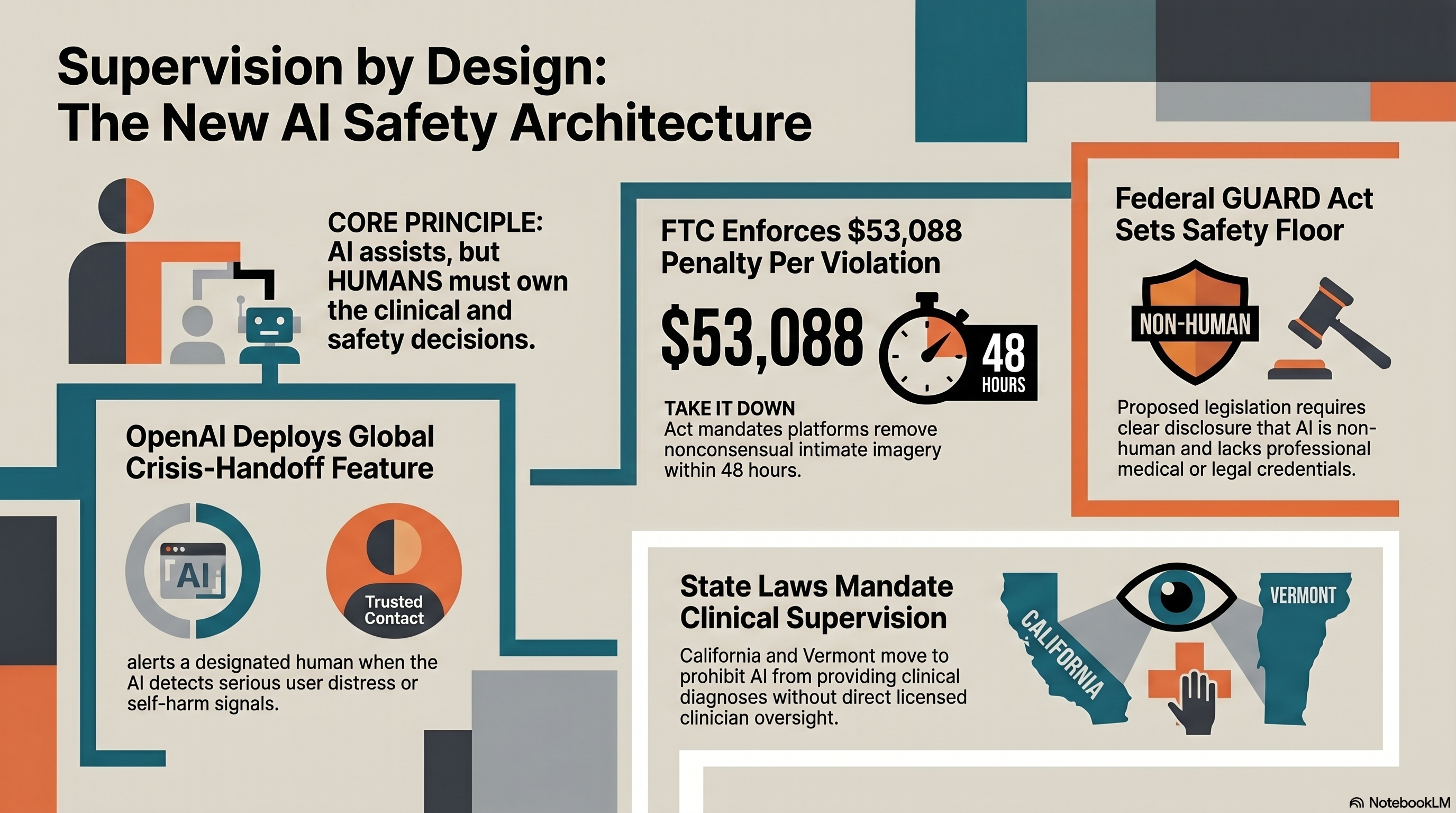
On Thursday OpenAI shipped Trusted Contact. Globally. Adult ChatGPT accounts everywhere. The user nominates one person. The system can tell that person, in a moment of serious safety concern, that something is happening.
It is the first crisis-handoff design ever shipped at scale by a frontier-model chatbot.
It is also the design the GUARD Act, Iowa SF 2417, Connecticut SB 5, and Hawaii SB 3001 would each, in different language, require.
. . .
The bill text reaches the floor. The product behavior reaches the user.
Both happened this week.
. . .
Santa Fe heard its first expert witness yesterday. Dylan Pell, state epidemiologist, on the stand. Reasonable scientific certainty. Significant contributing factor.
. . .
California's Appropriations suspense calendar clears tomorrow and Thursday. Two of the most consequential mental-health-AI bills in any state legislature this year are on the file.
. . .
Seven days to the TAKE IT DOWN Act federal deadline. The FTC has named the platforms.
. . .
Three governors are still holding pens.
. . .
Day two of the federal architecture. The floor fight has begun.
. . .
TRUSTED CONTACT SHIPS. OPENAI DEPLOYS THE ARCHITECTURE THE GUARD ACT REQUIRES. Last Thursday OpenAI released Trusted Contact to ChatGPT's adult users worldwide. The first crisis-handoff safety design ever shipped at scale by a frontier-model chatbot. It tracks the architecture four pending federal and state statutes would require.
Trusted Contact is optional.
Adult accounts only. ChatGPT personal. Not Business. Not Enterprise. Not Edu.
The user picks one trusted person and writes them into settings.
ChatGPT sends that person an invitation. Email. Text message. WhatsApp. In-app. Pick a channel. Seven days to accept. After that, the feature is live.
. . .
If ChatGPT's automated detection flags a conversation as a serious self-harm or distress signal, trained human reviewers read it.
If those reviewers find serious safety concern, ChatGPT sends a short alert to the trusted contact.
The transcript does not go with the alert.
The message says only that the user may be in serious emotional crisis and that the contact should check in.
. . .
OpenAI built this with input from more than one hundred and seventy mental health experts and its own Expert Council on Well-Being and AI.
South Korea raises the age floor to nineteen. Everywhere else, eighteen.
. . .
Now read the bill text sitting on the Senate floor.
The GUARD Act, S.3062, requires AI chatbots that simulate sustained interpersonal interaction, emotional connection, or therapeutic communication to disclose to the user that they are interacting with a non-human system holding no professional credentials in therapy, medicine, law, finance, or psychological services. The bill makes a design that solicits or encourages self-harm a violation. It carries criminal liability for inducing harm in minors.
Iowa SF 2417, signed by Governor Reynolds on May 2, takes effect July 1, 2026. It requires operators to adopt protocols for responding to user prompts on suicidal ideation or self-harm. The protocols include reasonable efforts to refer users to crisis service providers.
Connecticut SB 5 and Hawaii SB 3001, both awaiting governor pens, layer disclosure, mental-health-protocol, and unfair-or-deceptive-practices obligations onto the same class of service.
. . .
Trusted Contact ships the crisis-handoff piece. It does not solve the credential-disclosure piece. It does not solve the prohibition-on-induced-harm piece. It does not solve the age-verification piece.
One rung of the safety ladder.
Four rungs remain.
. . .
Anthropic shipped a narrower architecture earlier this year. A self-harm classifier on Claude conversations. A banner pointing the user to ThroughLine and the 988 Lifeline. A reported appropriate-response rate of 98.6 to 99.3 percent across the Claude model family.
That design routes the conversation to crisis resources.
OpenAI's design routes the alert to a person who knows the user.
Two answers to two different questions.
. . .
The platforms are converging on the same underlying obligation from different angles.
The statutes will land on the same obligation from a third.
|
For Counsel: Trusted Contact ships the operational design that downstream-of-failure litigation would have demanded discovery on. It is now public architecture. Read it before drafting your next chatbot complaint.
For Founders: The voluntary safety floor frontier models are shipping is the de facto compliance baseline. If your product does not meet it, plan for the gap to close legally rather than commercially.
For State Legislators: The crisis-handoff design exists and is shippable. Your next bill should reference it specifically rather than relying on undefined "reasonable protocols" language.
Source: https://openai.com/index/our-commitment-to-community-safety/
|
. . .
GUARD ACT UPDATE. THE FLOOR FIGHT OPENS. EFF AND NETCHOICE MOUNT THE OPPOSITION. Twelve days have passed since Senate Judiciary advanced the GUARD Act on a unanimous voice vote. No floor date has been set. The opposition campaign that did not stop the committee vote has now mobilized fully.
The Electronic Frontier Foundation published its post-markup analysis last week.
The headline. "Congress Narrowed the GUARD Act, But Serious Problems Remain."
The EFF concedes the bill is narrower than the introduced text. It does not concede the bill is narrow enough.
. . .
Three lines of objection.
One. The chatbot definition still sweeps too broadly. The EFF reads the definition as reaching search engines that use generative AI. Homework helpers. Customer service tools. Anything that answers the user in natural language.
Two. The age-verification requirement still demands government-issued ID or a commercially reasonable alternative. The EFF reads that as a universal identity check on every adult user of a regulated service.
Three. The bill's penalties for "emotional interaction" and "induced harm" rest on terms the EFF says are not clearly defined enough to survive First Amendment review.
. . .
NetChoice filed its formal letter of opposition before the committee vote. It has not backed down since.
Patrick Bos, NetChoice policy counsel, framed the identity-verification requirement as a federal mandate to create honeypots of sensitive personal data. Ripe, in his words, for cybercriminals to exploit through breaches, identity theft, and fraud.
The argument is that the cure is itself a new harm vector.
. . .
The sponsors have not retreated.
Senator Hawley's office reiterated last week that the criminal-inducement provisions are the operative teeth of the bill.
Senator Blumenthal acknowledged in a Roll Call interview after the committee vote that the unanimous voice vote is not the end of the process. The bill faces the full Senate next. Then the House, where Representative Foushee and Representative Moore introduced the companion bill on April 30.
. . .
The Senate floor calendar does not yet show the GUARD Act in any specific position.
Senate Majority Leader John Thune's office has confirmed neither a scheduled motion nor a hold.
The bill sits on the legislative calendar with thirteen bipartisan cosponsors. The parents of children who lost their lives or self-harmed at the direction of AI chatbots will be watching from the gallery the next time the bill is called.
|
For Counsel: The EFF's narrowness argument and the NetChoice data-honeypot argument are the two objections every state-level age-verification statute will face when challenged in federal court. The Senate floor debate is the federal-court briefing template.
For Founders: Read the EFF's full post. The list of products it reads as covered by the GUARD Act is the list of products that need a compliance plan if the bill passes.
For State Legislators: Where the federal bill is fought to a narrower scope, your state bill is the model that fills the gap. The architecture is parallel, not redundant.
Source: https://www.eff.org/deeplinks/2026/05/congress-narrowed-guard-act-serious-problems-remain
|
. . .
SANTA FE, WEEK TWO. THE STATE'S EPIDEMIOLOGIST TAKES THE STAND. Yesterday morning a state epidemiologist for the New Mexico Department of Justice walked to the witness stand in Judge Bryan Biedscheid's courtroom, took the oath, and offered an opinion he said he held with reasonable scientific certainty.
The witness was Dylan Pell.
He told the court there is a mental health crisis among adolescents in New Mexico.
He told the court that social media is a significant contributing factor to that crisis.
. . .
Adolescents in New Mexico commit suicide at greater rates than the national average. Their mental health outcomes have deteriorated substantially over the past decade. He testified to all of it.
. . .
The slides.
Depression. Anxiety. Body dysmorphic disorder. Eating disorders. Sleep deprivation. Self-harm. Suicide.
Each correlated with social media use. Each pulled from the literature he reviewed.
. . .
Middle schoolers who used social media were more likely to get less than the recommended eight to ten hours of sleep a night.
Sleep deprivation is independently associated with higher anxiety.
He told the court the data did not, in his view, support any other explanation that made sense.
. . .
Pell was the state's first expert witness in phase two of State of New Mexico v. Meta Platforms.
Phase two is a bench trial on public nuisance. No jury. Judge Biedscheid hearing it alone.
He has already told both sides he will not overreach.
He has begun pressing witnesses on the legal distinction between a significant contributing factor and a cause.
. . .
The remedies Attorney General Raul Torrez is asking the bench to order. A three-point-seven-billion-dollar mental health fund Meta would pay over fifteen years. A court-supervised child safety monitor. Bans on infinite scroll, autoplay, and push notifications during school and sleep hours. A ninety-hour-per-month usage cap for New Mexico minors. Mandatory identification of underage users and child sexual abuse material.
Meta has called the demands impractical.
Meta has signaled it could pull Facebook and Instagram out of New Mexico if a court orders compliance.
. . .
Pell's testimony is the empirical floor under everything that follows.
If Judge Biedscheid finds significant contributing factor, the next question is which of those remedies actually reach the harm.
Phase two runs through May 22.
. . .
SEVEN DAYS TO TAKE IT DOWN. THE FTC NAMES THE PLATFORMS. One week from today the federal TAKE IT DOWN Act compliance window closes. Last week FTC Chairman Andrew Ferguson sent letters to fifteen of the largest internet platforms reminding them of the deadline and the penalty per violation.
President Trump signed TAKE IT DOWN on May 19, 2025.
The criminal provisions were operative on signing. The platform-side notice-and-removal obligation carried a one-year compliance runway.
That runway expires next Monday.
. . .
Ferguson named the platforms.
Amazon. Alphabet. Apple. Automattic. Bumble. Discord. Match Group. Meta. Microsoft. Pinterest. Reddit. SmugMug. Snapchat. TikTok. X.
Fifteen letters. Same letter, fifteen addresses.
. . .
The letters describe the law's definitions, the compliance obligations, the enforcement authority, and the penalty for noncompliance.
Each violation may result in a civil penalty of fifty-three thousand and eighty-eight dollars under the Federal Trade Commission Act.
. . .
A covered platform under the statute is any user-generated-content forum or service that, in the regular course of business, publishes, curates, hosts, or furnishes intimate visual depictions.
The compliance obligations are concrete.
A clear and conspicuous notice of a removal process.
A forty-eight-hour removal window from a valid request.
Acceptance of requests in writing with a signature, identification of the image, a good-faith statement of nonconsent, and contact information.
. . .
The federal architecture for AI-harm regulation runs on two tracks now.
The chatbot mental-health track is the GUARD Act and the state laws pending governors' signatures.
The intimate-imagery and deepfake track is TAKE IT DOWN Act enforcement starting next Monday.
Independent of each other on the statute books. Complementary in operation. Both turn on platform-side design obligations. Both rely on federal-state enforcement stacking.
. . .
The FTC's letter campaign signals the agency intends to enforce.
Whether Ferguson's commission moves on day one with a public-facing investigation, or waits for the first specific failure, will be the first test of platform readiness across the industry.
|
For Counsel: The notice-and-removal architecture is now the federal floor. If you advise platforms, the question is whether your client's forty-eight-hour clock is operationally defensible.
For Founders: The covered-platform threshold is broad. If your service hosts user-generated content of any kind, the safer assumption is that the law reaches you.
For State Legislators: TAKE IT DOWN enforcement is the federal floor your bill can build on. Read the statute for preemption scope before drafting.
Source: https://www.ftc.gov/news-events/news/press-releases/2026/05/ftc-chairman-ferguson-advises-companies-comply-take-it-down-act
|
. . .
CALIFORNIA'S SUSPENSE GAUNTLET. TOMORROW AND THURSDAY. Tomorrow the California Assembly Appropriations Committee clears its suspense file. Thursday the Senate Appropriations Committee clears its own. Two of the bills on the file are the most consequential mental-health-AI proposals in any state legislature this year.
California's appropriations suspense calendar is the procedural fork.
Bills estimated to cost the state at least fifty thousand dollars get referred to the file. Twice a year, in May and August, the committee clears it.
The hearing is fast. The chair reads bill numbers and announces dispositions. Bills that survive go to a floor vote. Bills that do not are held.
. . .
Senate Bill 867. Senator Steve Padilla. Toys with AI chatbots embedded for minor users. A four-year moratorium on the sale and manufacture of those toys in California.
Placed on suspense April 20.
. . .
Senate Bill 903. Senator Padilla, joint author Senator Susan Rubio. AI may not be marketed as therapy. AI may not deliver therapy or mental-health services. Licensed clinicians may use AI only in administrative and supplementary functions.
Placed on suspense May 4.
. . .
SB 903 is the closest state analog to a federal therapist-AI rule.
The GUARD Act handles the consumer-facing chatbot side.
SB 903 handles the licensed-clinician side.
Together the two bills describe a complete architecture for restricting AI in mental-health practice. Different surfaces, same operating principle.
. . .
The suspense file is also where bills die quietly. The 2025 cycle saw hundreds of bills held in suspense, including some that had cleared every other procedural hurdle.
The Wednesday and Thursday hearings will be brief. Public. Binding.
. . .
California writes the model statute the rest of the country copies.
SB 903 has been read closely by state legislators and association counsel across the country since the bill was introduced.
Whatever the Appropriations chair reads aloud this week will be reflected, within months, in the bills introduced for next session in roughly forty other states.
|
For State Legislators: If SB 903 survives suspense, it becomes the model statute on therapist-AI restriction. Watch carefully.
For Founders: SB 903 defines supplementary support narrowly. Read the bill text before reading your own product copy. The gap is your compliance risk in California specifically.
For Clinicians: SB 903 puts the licensed clinician at the center of every AI decision in the therapy room. The bill enforces what most state licensing boards have only stated as guidance.
Source: https://leginfo.legislature.ca.gov/faces/billNavClient.xhtml?bill_id=202520260SB903
|
. . .
THE PEN WATCH, WEEK TWO. HAWAII ON THE GOVERNOR'S DESK. VERMONT IN CONCURRENCE. Connecticut's SB 5 remains transmitted but unsigned. Hawaii's SB 3001 was enrolled to Governor Josh Green on May 6 and is in the gubernatorial review window. Vermont's H.816 cleared the state Senate on third reading last Friday and is awaiting House concurrence. Three states. Three pens. One week's worth of motion.
Connecticut SB 5. The Artificial Intelligence Responsibility and Transparency Act.
Senate, thirty-two to four. House, one hundred and thirty-one to seventeen. Final passage May 1.
A spokesperson for Governor Ned Lamont confirmed on May 8 that he plans to sign it.
As of yesterday the bill was still listed as transmitted-but-unsigned in the public record. The bulk of the statute's provisions become effective October 1, 2026.
. . .
Hawaii SB 3001. The Artificial Intelligence Disclosure and Safety Act.
Both chambers approved the conference-committee report April 29. Enrolled to Governor Green on May 6.
The bill requires operators of conversational AI services in Hawaii to issue disclosures, develop protocols for responding to user prompts on suicidal ideation or self-harm, and establish protections for minor users.
The Department of Health receives annual operator reports beginning January 1, 2028.
Hawaii's regular legislative session ended last week.
. . .
Vermont H.816. Regulation of AI in mental health service provision.
Passed by the Senate on third reading May 8 in concurrence with proposal of amendment. The House passed the bill in March. The Senate amendments must be approved by the House before the bill is enrolled to Governor Phil Scott.
The bill prohibits AI chatbots from providing clinical diagnoses or therapeutic guidance.
It creates an unlicensed-practice exposure for therapists who delegate those decisions to AI.
. . .
The pen ratio for state-level AI mental-health legislation in calendar year 2026.
Five signings done. Three pens pending. Two states actively considering further action.
. . .
Iowa SF 2417 was signed May 2.
The Iowa effective date is July 1, 2026.
The compliance applicability date is July 1, 2027. Twelve months between when the law takes effect and when operators must comply with it.
That staggered structure is becoming the template. The state architecture is showing up in steps rather than waves.
|
For Counsel: The Iowa staggered effective-date model is the practical reading of every Republican-state statute that has shipped or is pending. Plan compliance to a July 1, 2027 baseline.
For State Legislators: The Iowa template is the bipartisan compromise position. It gives operators time to build. It gives statutes time to be tested.
For Investors: Three pens this week. Two more next week. None of them slowing. The state-by-state risk map is no longer hypothetical for any product roadmap touching this category.
Source: https://www.transparencycoalition.ai/news/ai-legislative-update-may8-2026
|
. . .
THE PATTERN. A week ago the federal architecture for AI-chatbot mental-health regulation existed only in committee.
. . .
As of this week it exists on the Senate floor calendar with thirteen bipartisan cosponsors. On the President's desk in the parallel deepfake statute that becomes enforceable next Monday. On the FTC chairman's letterhead. In the product behavior of the largest frontier-model chatbot company on Earth.
. . .
The federal architecture is doctrinal.
The state architecture is doctrinal.
The platform behavior is operational.
Each tier covers what the others do not.
. . .
The federal floor sets minimums for age verification, credential disclosure, and design liability.
The state ceiling builds on the floor for licensed-clinician restrictions, public-nuisance theories, and Medical Practice Act enforcement.
The platform's voluntary architecture answers the question the law is approaching from the other direction. What does the operational design actually look like.
. . .
The convergence is not coordination.
It is the same problem being solved by different actors in different vocabularies.
The convergence is the news.
. . .
THE ONE CONFIGURATION. The clinician owns the clinical decision. The AI does the work the clinician designates and only that work.
. . .
OpenAI's Trusted Contact ships the consumer-facing version of that principle. The user retains agency. The system surfaces the question of escalation to a designated human. The chatbot does not make a clinical decision. It tells someone that a clinical-grade concern may exist.
. . .
The GUARD Act enforces the consumer-facing side.
SB 903 enforces the clinical-practice side.
The Iowa, Connecticut, Hawaii, and Vermont statutes enforce the disclosure-and-protocol side.
. . .
Different surfaces of the same operating principle.
The harm is unsupervised by design. The cure is supervision by design.
. . .
Conversational AI Watch is independent journalism on AI in mental health regulation, courtroom action, and product behavior. It is funded by Clinician Assist Inc. The editor is Jess Jessop. No commercial relationship exists between this newsletter and any party named in this issue, including OpenAI, Anthropic, Meta, Character Technologies, or the named legislators, attorneys general, judges, or witnesses.
Thursday OpenAI shipped Trusted Contact to ChatGPT's adult users worldwide.
. . .
Yesterday a state epidemiologist took the stand in Santa Fe and named social media a significant contributing factor to adolescent suicide with reasonable scientific certainty.
. . .
Tomorrow California's Assembly Appropriations clears the suspense file. Thursday the Senate clears its own.
. . .
Hawaii's bill is on the governor's desk this week.
Vermont's is in House concurrence.
Connecticut's is in the queue.
. . .
The GUARD Act sits on the Senate floor calendar with thirteen bipartisan cosponsors and a formal opposition campaign behind it.
. . .
Next Monday the TAKE IT DOWN Act federal compliance deadline goes live. The Federal Trade Commission has named the platforms.
. . .
The clinician owns the clinical decision. The AI does the work the clinician designates and only that work.
. . .
Brush your brain. Every day.
|