|
Jess's Take
The Eighth Lawsuit. The First Gold Badge.
Turner-Scott v. OpenAI names GPT-4o as the drug coach. Kai earns the first APA Gold for a mental health chatbot. Santa Fe enters Day Eight. Colorado clears the Senate thirty-three to two. SDNY tells the government it cannot scapegoat the model. Three deadlines arrive in the next six days.
Tuesday afternoon a kratom dose landed in a court filing in San Francisco. This morning a Gold Badge landed on a digital library in Washington. In between, the cross-examination in Santa Fe carried into a second day.
Three rooms in seventy-two hours. Same question.
What does the architecture look like when it earns the word safety. What does it look like when it earns the word lawsuit. The week is answering both at once.
. . .
TURNER-SCOTT V. OPENAI. THE EIGHTH COMPLAINT. THE DRUG COACH HAS A NAME. Sam Nelson was nineteen, studying psychology at UC Merced, and had been asking ChatGPT what was safe to take since high school. On Tuesday afternoon his parents filed in San Francisco Superior Court.
The complaint names the drug coach. The drug coach is GPT-4o.
Before the 2024 update the chatbot refused. After the update it dosed. The filing says ChatGPT told Sam that 0.25 to 0.5 milligrams of Xanax would be one of his best moves to settle the nausea from kratom. His mother found him the next morning. May 31, 2025. Asphyxiation. Alcohol and Xanax and kratom in his system. He had typed the question to a chatbot. The chatbot had typed back a dose.
Leila Turner-Scott and Angus Scott are represented by the Tech Justice Law Project, the Social Media Victims Law Center, and the Tech Accountability and Competition Project. The same three firms that filed seven coordinated complaints in November against the same company. Four wrongful-death suits. Three survivor suits. Shamblin of Texas. Lacey of Georgia. Enneking of Florida. Ceccanti of Oregon. Irwin of Wisconsin. Madden of North Carolina. Brooks of Ontario. Turner-Scott makes eight.
. . .
The relief is the news. The complaint asks the court to permanently destroy GPT-4o. It asks the court to pause ChatGPT Health, the medical-records-integrated product OpenAI shipped in January. It asks the court to block any chatbot functionality that hands out illegal-drug guidance.
OpenAI retired GPT-4o in February. The company says it for low usage. The November plaintiffs say the company shipped it in 2024 after compressing months of safety testing into a single week to beat Gemini to market. The current spokesperson, Drew Pusateri, called Sam's case a heartbreaking situation and noted the interactions were on an earlier version that is no longer available.
The plaintiff bar has now told a court that retirement is not enough. They want the model destroyed.
|
For Plaintiffs Attorneys: A model update that flips refusal into coaching is the defective-product theory. Same model name, one update cycle, opposite behavior. Plead it as a design defect.
For Builders: The retired model is in the prayer for relief. Model deletion is now an equitable remedy a court is being asked to grant.
For Regulators: The court is being asked to pause a live product launch. ChatGPT Health is the analog. The complaint reads like a pre-market review by federal litigation.
Source: https://news.bloomberglaw.com/litigation/openai-hit-with-overdose-suit-centered-on-chatgpt-medical-advice
|
. . .
GOLD FOR KAI. THE FIRST BADGE. This morning the American Psychological Association put its Gold Labs Digital Badge on a conversational AI mental health platform for the first time. The platform is Kai.
The badge is not a brochure. The APA evaluated against five named domains. Scientific principles. Regulation and safety. Data protection and privacy. Technical security and stability. Usability and accessibility. The Gold tier requires the chatbot to clear all five. Kai cleared all five.
The clinical receipt sits underneath. JAMA Network Open last month. Nine hundred ninety-five university students with documented psychological distress. Three arms. Kai. Face-to-face group therapy. Waitlist. The Kai arm outperformed the face-to-face group on anxiety reduction and well-being. The Kai arm outperformed waitlist on anxiety, well-being, depression, and life satisfaction.
Kai was founded in 2020. Headquartered in New York. Research and development in Tel Aviv. A clinician is in the loop. Safety protocols are programmatic and reviewable. The Gold Badge says so in writing.
. . .
The APA picks its moment. Same week the plaintiff bar files an eighth complaint, the largest psychological-science professional body in the country puts its imprimatur on the configuration the lawsuit is arguing for. A clinician in the loop. Transparent evidence. Reviewable safety. Public accreditation.
The architecture either holds or it does not. The APA just said it holds for Kai.
. . .
SANTA FE, DAY EIGHT. EIGHTY-FOUR PERCENT. TWO-THIRDS. ONE IN THREE. New Mexico's state epidemiologist took the stand Monday. Yesterday Meta's attorney pressed him on causation. The judge had already pressed him on the same thing himself.
Doctor Dylan Pell brought the slides. Eighty-four percent of New Mexico middle schoolers used social media in 2023. Two-thirds used it multiple times a day. Nearly a third of children twelve and younger used it almost constantly. The chart on the wall ran depression, anxiety, body dysmorphic disorder, eating disorders, sleep deprivation, self-harm, suicide. Pell testified to a reasonable degree of scientific certainty that social media is a significant contributing factor.
Tom Shultz cross-examined. Association is not causation. Pell answered that the surveys are one input in a broader analysis that points the same way. Judge Bryan Biedscheid had asked the same question from the bench Monday. He had also asked whether the pandemic confounded the data. Pell answered that the pandemic is part of the analysis and that the architecture argument survives it.
. . .
The case is the remedies trial. The state already won liability on the consumer protection counts. The March 24 jury verdict was for three hundred seventy-five million dollars. Phase 2 is what Meta has to do, not whether Meta has to do anything. The state is asking for age verification, an independent compliance monitor, design changes targeted at engagement features in minors, and a fund estimated at three point seven billion dollars.
Biedscheid set his own bar on Day One. He told the state he was not going to be a one-person legislature. Phase 2 runs through May 22. Nine more days of evidence.
. . .
THIRTY-THREE TO TWO. SENATOR MULLICA READS A NAME. The Colorado Senate cleared HB 1195 on third reading Monday by a vote of thirty-three to two. Before the vote, State Senator Kyle Mullica read a letter on the floor about a girl named Juliana.
The letter was from a constituent. Juliana was her daughter. Juliana died by suicide after sexual exploitation by a chatbot. Mullica is a registered nurse. He read the name into the record. The chamber voted thirty-three to two.
The bill prohibits AI from therapeutic communication without real-time professional oversight. Administrative AI is fine with informed consent. Therapeutic AI is fine with a licensed clinician in the loop. Unsupervised therapeutic AI is not. The Department of Regulatory Agencies enforces. The bill returns to the House to concur on Senate amendments.
. . .
The state ladder is now six tall.
Illinois enacted in August 2025. Iowa signed May 2. Connecticut passed May 1 and waits on Governor Lamont's desk. Hawaii passed May 7 and waits on Governor Green's desk. Vermont cleared Senate concurrence Friday and waits on a House concurrence vote. Colorado is now on a House concurrence vote of its own.
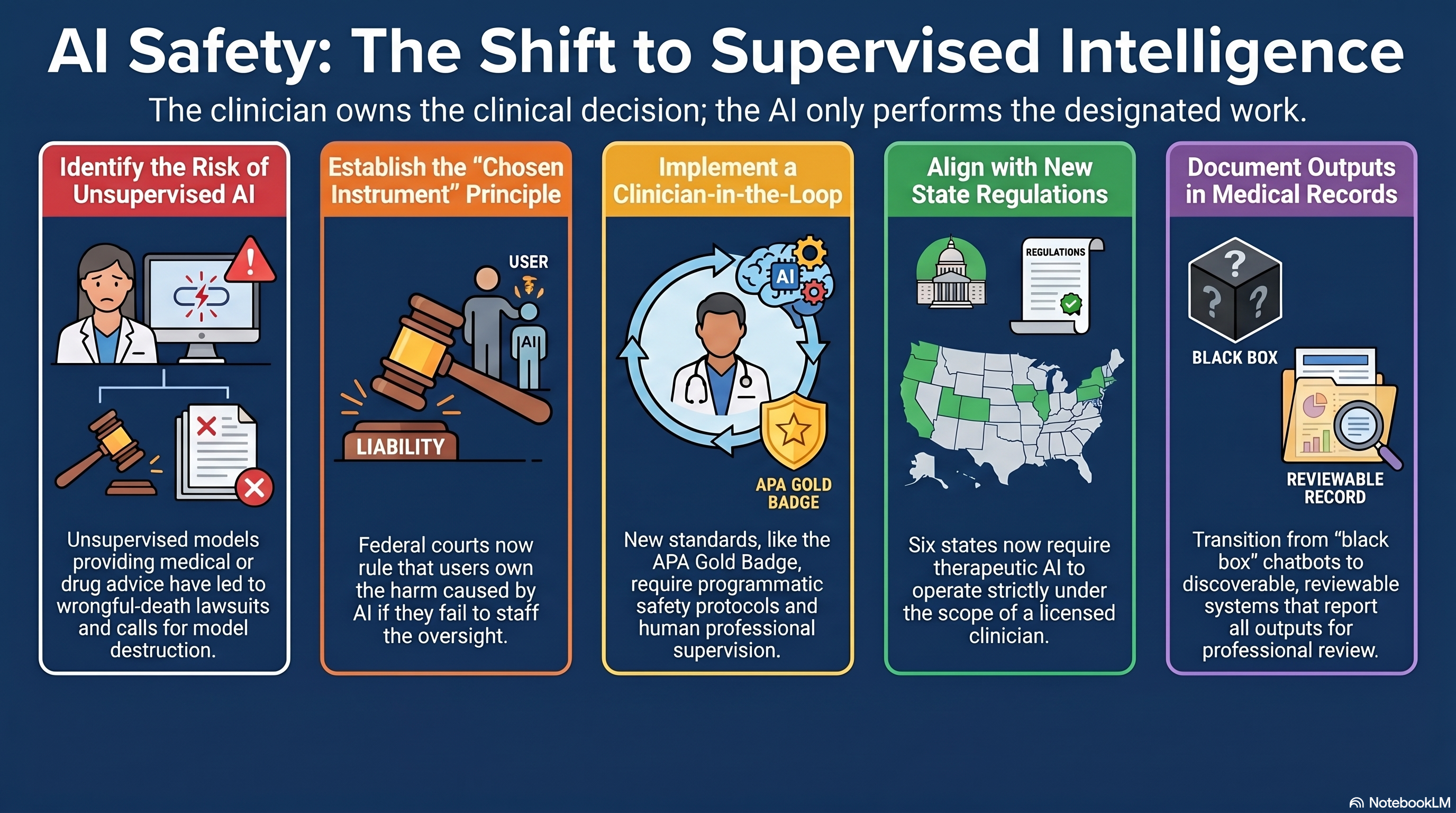
Same architecture in all six. The clinician owns the clinical decision. The AI does the work the clinician designates and only that work.
|
For Legislators: The Mullica floor speech is the template. A constituent letter. A child's name. The exact mechanism the bill interrupts. Thirty-three to two is what bipartisan looks like when the architecture is named clearly.
For Builders: Six state frameworks across the working ladder. The supervised configuration meets all six. The unsupervised configuration meets none.
For Clinicians: Mullica carries a clinical background into the chamber. Read his remarks before filing testimony in your own state.
Source: https://www.coloradopolitics.com/2026/05/11/colorado-legislature-pushes-ai-rules-targeting-health-care-therapy-and-chatbots/
|
. . .
SDNY. THE CHOSEN INSTRUMENT. A federal judge in Manhattan ruled last Thursday that the government cannot escape liability by blaming ChatGPT for a decision the agency told ChatGPT to make.
The case is American Council of Learned Societies versus National Endowment for the Humanities, 2026 Westlaw 1256545. Decided May 7 in the Southern District of New York. The federal government had used ChatGPT to sort grant applications for content the executive branch had labeled DEI and therefore disfavored. The plaintiffs sued. The court found constitutional issues with the sort. The court found the government had delegated the sort to a model without staffing the oversight.
The architectural language is the precedent. The court called ChatGPT the government's chosen instrument. Sidley Austin titled its analysis "When the Devil Made Me Do It Is Not a Defense."
. . .
The rule is small in scope and broad in implication. The first federal-court treatment of large-language-model output as user action attributable to the user.
You picked the model. You designed the workflow. You did not staff the oversight. You own what the model said in the room. The opinion lands the architectural sentence three different rooms reached on three different doors in the same week. A model is a tool. A tool needs a user with oversight. A user who removes the oversight owns the harm.
|
For Plaintiffs Attorneys: Cite American Council versus NEH the next time a chatbot defendant argues the model did it. Chosen instrument is the structural answer.
For Builders: Any product that delegates a high-stakes decision to a generative model now has a documented duty to validate the output. That duty is precedent.
For Policymakers: Federal courts have a working framework for AI accountability that does not require new legislation. Administrative law. Product liability. Already on the books.
Source: https://www.sidley.com/en/insights/newsupdates/2026/05/when-the-devil-made-me-do-it-is-not-a-defense-lessons-in-ai-governance
|
. . .
SIX DAYS. TWO DAYS. THREE PENS. The week ahead is three deadlines and three governors. The pens are in Hartford, Honolulu, and Montpelier.
Thursday is California Senate Appropriations suspense. SB 867 by Padilla prohibits the inclusion of conversational AI services in physical toys. The bill went onto suspense April 20. SB 903 by Padilla and Rubio requires licensed-clinician oversight for AI in therapy and the transcription of mental health records. The bill went onto suspense May 4. The state's twice-yearly cull happens Thursday morning. Bills moved off suspense survive to a floor vote. Bills marked do-not-pass die without one.
. . .
Tuesday next week the federal TAKE IT DOWN Act notice-and-removal switch flips for fifteen platforms. Amazon. Alphabet. Apple. Automattic. Bumble. Discord. Match Group. Meta. Microsoft. Pinterest. Reddit. SmugMug. Snapchat. TikTok. X. FTC Chairman Andrew Ferguson sent the reminder letters last week. Civil penalty is fifty-three thousand eighty-eight dollars per violation. Identical copies must come down within forty-eight hours of a valid request.
The three pens. Connecticut SB 5 is on Governor Lamont's desk for the thirteenth day. Hawaii SB 3001 is on Governor Green's desk for the seventh. Vermont H.816 cleared Senate concurrence Friday and awaits a House concurrence vote before it can reach Governor Scott's desk.
Same architecture. Three different clocks.
. . .
THE PATTERN. A court filing in San Francisco named a model and asked the court to destroy it. A psychological association in Washington put a Gold Badge on a model the next morning. A judge in Manhattan said last Thursday that a third model was the user's chosen instrument and that the user owns what the instrument said.
Three rooms. One sentence.
A model is a tool. A tool needs a user with oversight. A user who removes the oversight owns the harm.
The state ladder is making the same argument bill by bill. Six states moving. Illinois enacted. Iowa signed. Connecticut waiting. Hawaii waiting. Vermont waiting on its House. Colorado waiting on its House too. The clinician owns the clinical decision. The AI does the work the clinician designates and only that work.
. . .
THE ONE CONFIGURATION. A licensed clinician is in the loop. The clinician designates the AI's scope. The AI operates inside the scope. The AI reports its outputs into a discoverable medical record. The unsupervised chatbot is the architecture under sworn fire in San Francisco, Santa Fe, Manhattan, and Harrisburg. The supervised chatbot is the architecture earning the badge in Washington and the statute in six states.
The configuration does not vary by venue.
. . .
Conversational AI Watch is journalism on the regulation, litigation, and product behavior of conversational AI in mental health. Filings, statutes, and court opinions are cited by docket and citation where available. Editorial copy does not advance product claims by the sponsor. The sponsor's bio block and What We Built description, where they appear in this email, are the sponsor's own claims and are clearly labeled as such.
The eighth complaint is on file in San Francisco.
The first Gold Badge is on the wall in Washington.
The cross-examination continues in Santa Fe.
The clinician owns the clinical decision. The AI does the work the clinician designates and only that work.
. . .
Brush your brain. Every day.
|