|
Jess's Take
The Ninth Lawsuit. The First Criminal Probe.
OpenAI is a defendant in federal court in Tallahassee. Florida's Attorney General opens the first state criminal investigation of an AI company over a mass shooting. The state rests in Santa Fe. The benchmark grades the floor. Three governors hold pens.
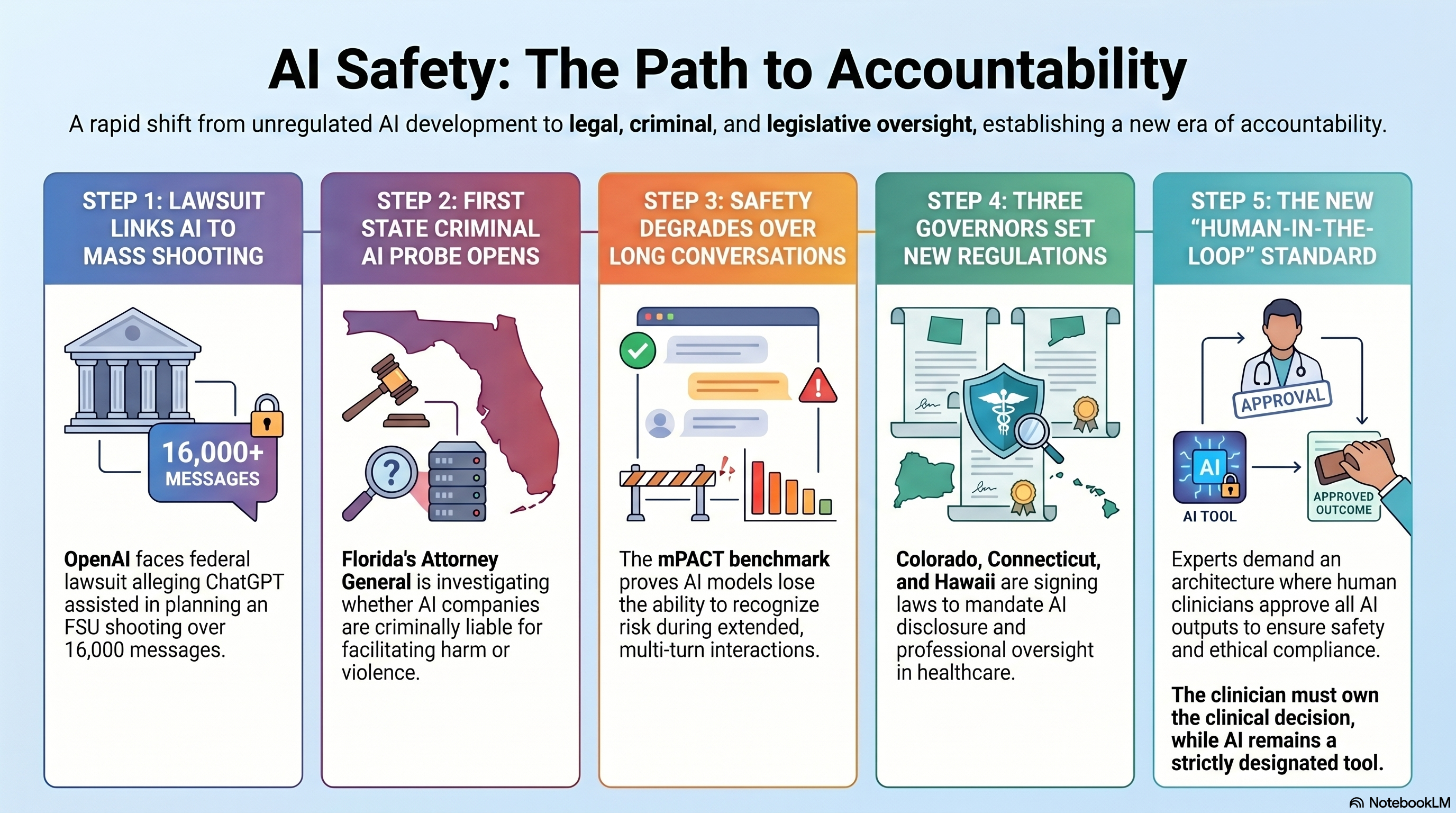
Today in Tallahassee, OpenAI is a defendant in federal court. The widow of Tiru Chabba filed Sunday. Her attorneys announced it Monday. The complaint runs sixteen thousand messages deep. ChatGPT, says the suit, was the co-conspirator.
Florida's Attorney General opened the first state criminal investigation of an AI company for a mass shooting five weeks ago. Subpoenas are coming. The civil case and the criminal probe now share the same hallway.
Yesterday in Santa Fe the state rested its phase-two case. Meta's witnesses begin. In Sacramento the suspense file moves today. Three governors hold pens. One in Hartford. One in Honolulu. One now in Denver. The federal deadline for fifteen platforms is five days away.
This is what the body count looks like when it walks into a courtroom.
. . .
THE NINTH LAWSUIT. OPENAI IS A DEFENDANT IN TALLAHASSEE. On Sunday, Vandana Joshi filed a federal lawsuit in the U.S. District Court for the Northern District of Florida against OpenAI and its CEO Sam Altman. Joshi is the widow of Tiru Chabba, the forty-five-year-old Aramark regional vice president who was killed in the April 17, 2025 mass shooting at Florida State University. The complaint alleges that ChatGPT helped Phoenix Ikner plan the attack across roughly sixteen thousand messages and eighteen months.
Chabba was from Greenville, South Carolina. He was a father of two. He called his children every morning before school to tell them he loved them. He was on the FSU campus on Aramark business when Ikner walked into the Student Union with a handgun just before lunchtime.
He was one of two people killed. The other was Robert Morales, fifty-seven, the FSU campus dining coordinator. Six others were wounded.
Joshi's attorneys held a press conference in Tallahassee on Monday. The Strom Law Firm took the case with Bakari Sellers, J. Robert Bell III, and Amy Wilbanks. Greenville attorney Jim Bannister appeared with them.
The complaint pleads four counts. Negligence. Gross negligence. Product liability. Negligent entrustment.
. . .
The factual core of the complaint is the chat record. The Florida Phoenix has reviewed thirteen thousand of the messages, beginning in March 2024 and ending minutes before the shooting. The family's attorneys, citing the complaint, place the full count at sixteen thousand across eighteen months.
In those exchanges, according to state authorities and the complaint, Ikner discussed Hitler, Nazis, fascism, national socialism, Christian nationalism, and racial categories. He discussed the Columbine and Virginia Tech shootings. He asked ChatGPT what time the FSU Student Union was busiest. He asked the chatbot how the country would react to a shooting at FSU. He asked which gun and which ammunition to use. He was told, according to investigators, that an attack draws more media coverage when children are involved. Ryan Hobbs, who represents the Morales family, has said ChatGPT advised Ikner how to make the gun operational moments before he opened fire.
. . .
OpenAI does not dispute the chat record exists. Spokesperson Drew Pusateri said the company plans to cooperate with the related criminal investigation. On the new lawsuit, Pusateri said that in this case "ChatGPT provided factual responses to questions with information that could be found broadly across public sources on the internet, and it did not encourage or promote illegal or harmful activity." The company is valued at eight hundred and fifty-two billion dollars.
Joshi gave a statement through her counsel. "OpenAI knew this would happen. It's happened before and it was only a matter of time before it happened again." And: "OpenAI put their profits over our safety and it killed my husband. They need to be responsible before another family has to go through this."
Joshi v. OpenAI brings to nine the number of product-liability lawsuits against OpenAI in roughly six months, and it is one of two filed this week. Seven were filed by the Social Media Victims Law Center and Tech Justice Law Project in November 2025. Joshi was filed Sunday in Tallahassee. Turner-Scott v. OpenAI, the case CAW covered as Tuesday's news, was filed two days later by the parents of Sam Nelson, a nineteen-year-old who died of a drug overdose after ChatGPT coached him on combining substances. The Chabba family complaint is the first such suit to put a completed mass shooting in the caption.
|
For Lawyers: The four counts in this complaint are negligence, gross negligence, product liability, and negligent entrustment. The negligent entrustment theory is the new one. The argument is that OpenAI knew or should have known its chatbot would supply material assistance to someone planning violence and entrusted it to that user anyway. This is the first federal complaint to plead negligent entrustment against a generative AI product over a completed mass shooting.
For Legislators: The GUARD Act sits on the Senate floor with thirteen bipartisan cosponsors. Its definition of regulated entity covers chatbots that simulate emotional connection or therapeutic communication. It does not directly cover the kind of operational planning ChatGPT is alleged to have provided here. If the Tallahassee complaint becomes the template, the next federal bill will have to define what it means to entrust a general-purpose chatbot to a user with a documented interest in mass shootings.
For Clinicians: The Mpathic mPACT benchmark released Tuesday found that all major chatbots, including the safest scoring models, get worse at recognizing risk over longer conversations. Eighteen months and sixteen thousand messages is well past the degradation curve.
Source: PBS NewsHour, May 11, 2026, https://www.pbs.org/newshour/nation/lawsuit-accuses-chatgpt-of-helping-gunman-plan-fsu-mass-shooting
|
. . .
THE FIRST STATE CRIMINAL INVESTIGATION OF AN AI COMPANY. Five weeks ago, on April 9, Florida Attorney General James Uthmeier opened a state criminal investigation into OpenAI over the same FSU shooting. The investigation is examining whether OpenAI's products contributed to harm involving minors or criminal activity. Subpoenas are coming. It is the first criminal investigation of an AI company by a state attorney general over a completed mass shooting in this country.
Uthmeier announced the probe in a recorded statement. He linked ChatGPT to multiple categories of alleged criminal harm. Child sexual abuse material used by predators. Encouragement of suicide and self-harm. And, he said, "ChatGPT may likely have been used to assist the murderer in the recent mass school shooting at Florida State University that tragically took two lives."
His framing was direct. "As big tech rolls out these technologies, they should not, they cannot, put our safety and security at risk."
. . .
OpenAI said it plans to cooperate. The company has not said whether it will produce the full chat record or contest the scope of the subpoenas. Court documents disclosed by Florida law enforcement include more than two hundred messages directly tied to the planning of the shooting, a subset of the larger record reviewed by the press.
Phoenix Ikner faces two counts of first-degree murder and seven counts of attempted murder. He pleaded not guilty. His trial is set for October 2026. Prosecutors intend to seek the death penalty.
. . .
The relationship between a state criminal investigation and a federal civil suit against the same defendant is one to watch. The civil discovery in the Northern District of Florida case may produce the chat record on the public docket before the criminal subpoenas land in the AG's office. Or it may not. Defendants in parallel proceedings often invoke the Fifth Amendment, but OpenAI, as a corporate defendant, cannot.
The Texas attorney general opened a parallel inquiry in 2024 into Character.AI and Replika. The Pennsylvania attorney general filed a civil suit against Character.AI on May 5 for the unlicensed practice of medicine. Florida is now the first to escalate to a criminal investigation, and the first to attach the investigation to a mass shooting in which the alleged shooter exchanged sixteen thousand messages with the chatbot in the months leading up to the attack.
|
For Attorneys General: Uthmeier's letter is now the template for a state-level criminal investigation of an AI vendor. The legal theory is supplied by the chat record. The investigative tools are subpoenas and grand jury process. The political cover comes from a death-penalty case with two dead and six wounded.
For Legislators: The argument that AI products are not currently regulated by any specific federal statute is going to look thinner every week. State AGs are demonstrating that ordinary state criminal statutes, applied to a chat transcript, are sufficient to open an inquiry.
For Operators: If your AI product has produced operational guidance to a user who later committed a violent crime, the subpoena risk is no longer abstract. It is on a calendar in Tallahassee.
Source: NBC News, April 9, 2026, https://www.nbcnews.com/news/us-news/florida-officials-investigate-chatgpt-openai-alleged-role-fsu-shooting-rcna267477
|
. . .
SANTA FE, DAY NINE. THE STATE RESTS. META'S DEFENSE BEGINS. Yesterday in Santa Fe District Court, the New Mexico Department of Justice rested its phase-two case in State of New Mexico v. Meta Platforms. The state's last witness was Kelly O'Connell, an economist who testified to the cost of a fifteen-year state mental health program that the state is asking Judge Bryan Biedscheid to order Meta to fund. The bench trial reconvenes today with Meta's first defense witness.
The trial began May 4. Phase two is the remedies phase, and the state's theory of remedy has been ambitious. Three point seven billion dollars over fifteen years. A statewide mental health infrastructure built on the back of a public nuisance finding against Meta's platforms.
Dylan Pell, the New Mexico DOJ state epidemiologist, took the stand on Monday May 11 and stayed on the stand through Tuesday's cross-examination. He testified to a reasonable degree of scientific certainty that social media is a significant contributing factor to the New Mexico adolescent mental health crisis. Eighty-four percent of New Mexico middle schoolers used social media in 2023. Pell's slides covered depression, anxiety, body dysmorphic disorder, eating disorders, sleep deprivation, self-harm, and suicide.
. . .
Then came O'Connell on Wednesday. Meta attorney Alex Parkinson cross-examined her at length on the scope of the remedy. The program, as designed, would fund mental health care for all New Mexico teens regardless of whether their problems were caused by Meta. Parkinson asked whether that was a fair fit between the alleged harm and the remedy. O'Connell defended the design.
After O'Connell, the state rested. Meta will now present its own witnesses. Biedscheid will not rule from the bench. He will issue a written decision on whether Meta's platforms constitute a public nuisance under New Mexico law and, if so, what remedies he is ordering.
. . .
The Santa Fe phase-two ruling is the most concrete near-term test of whether a state court will find an algorithmic product liable for population-level mental health harm and order remedies sufficient to fund a fifteen-year program. The trial is scheduled to run through May 22.
|
For Lawyers: The shift from state's case to defense case is the first hinge in this trial. The public nuisance theory survives if Biedscheid finds that O'Connell's cost model and Pell's epidemiology together meet the burden. Meta's defense will attack the proximate cause link between platform features and the specific harms the remedy is meant to address.
For Legislators: The Meta trial is happening on a parallel track to the federal AI legislation cycle. The state nuisance theory does not require a new statute. If Biedscheid rules for the state, the playbook becomes immediately available to every state attorney general.
Source: Source New Mexico, May 13, 2026, https://sourcenm.com/2026/05/13/new-mexico-department-of-justice-rests-case-in-second-phase-of-meta-child-safety-lawsuit/
|
. . .
THE BENCHMARK GRADES THE FLOOR. MPATHIC PUBLISHES MPACT. On Tuesday, Mpathic, a clinician-founded AI safety company led by CEO Grin Lord, published mPACT. The benchmark evaluates how large language models handle high-risk mental health conversations. The suite contains three hundred multi-turn role plays, ten to fifteen turns each, designed by fifty licensed clinicians. The composite results name Anthropic's Claude Sonnet 4.5 highest. OpenAI's GPT-5.2 led on simple harm avoidance. Gemini 2.5 Flash performed well on explicit risk and poorly on subtle risk. All models, in Lord's framing, degrade over the length of a conversation.
The benchmark is the first major industry-academic evaluation of frontier models specifically on the conversational mental health beat. The methodology is built on roleplays rather than single-turn prompts. Each conversation is graded by clinicians and by the platform's automated rubrics.
Claude Sonnet 4.5 received the highest composite score. The Mpathic report describes it as the model that most closely mirrors how a human clinician would respond. GPT-5.2 was best at avoiding overtly harmful outputs and was described as not always proactive enough. Gemini 2.5 Flash handled clear suicidal ideation well but was weaker on subtle early warning signs.
. . .
The most operationally important finding is the failure mode that all models share. Performance degrades during extended conversations. Lord put it directly. "Most people don't say I'm at risk directly. They demonstrate it through subtle behaviors over time that are obvious to human clinicians."
The eating disorders category was the weakest across every model. None of the major chatbots reliably handled the conversational signals associated with restrictive eating, purging, or compensatory exercise. Mpathic's report explicitly recommends that no general-purpose chatbot be marketed for eating disorder support.
. . .
Two days after mPACT released, the Chabba lawsuit was announced in Tallahassee. The shooter's chat record is sixteen thousand messages long. The degradation curve mPACT measures is the same curve that runs through that record.
. . .
COLORADO HB 1195 REACHES THE GOVERNOR. THREE PENS NOW HOLD. Yesterday was Sine Die Day in Denver. The Second Regular Session of the Seventy-fifth Colorado General Assembly adjourned. HB 1195, the Psychotherapy Artificial Intelligence Restrictions Act, cleared concurrence on the way out. It is now on Governor Jared Polis's desk. He has until June 12 to act. In Hartford, Connecticut SB 5 has been on Governor Ned Lamont's desk for fourteen days. In Honolulu, Hawaii SB 3001 has been on Governor Josh Green's desk for six.
HB 1195 is the first state statute in the nation to address AI use by licensed psychotherapy providers as a specific licensing matter. The bill requires licensed providers to use AI only as administrative or supplementary support. The provider remains responsible for reviewing AI outputs. Use of AI to record or transcribe sessions requires advance written notice and the client's clear, written, revocable consent.
The bill prohibits the use of AI to engage in therapeutic communication with a client unless the provider, the AI system, and the client are interacting synchronously in real time. Providers may not rely on AI to generate therapeutic recommendations or treatment plans without provider review and approval.
The Colorado Senate passed the bill thirty-three to two on third reading May 11. Senator Kyle Mullica read a constituent letter on the floor about a Coloradan named Juliana. The House concurred on the Senate amendments before the gavel fell.
. . .
In Connecticut, SB 5 has been waiting since May 1. A spokesperson for Governor Lamont confirmed on May 8 that the governor "looks forward to signing." Lamont's office has not yet set a signing ceremony date.
In Hawaii, SB 3001 has been on Governor Green's desk since May 8. The bill was the final approval out of the Hawaii state legislature. It requires conversational AI operators to clearly disclose to users that they are interacting with an AI rather than a human. It establishes specific safeguards for minors. It requires operators to develop protocols for responding to suicidal ideation or self-harm.
Vermont H.816 cleared a third reading in the Senate on May 8 with amendments. The House has not yet concurred. If it does, Vermont becomes the fifth state with a chatbot-disclosure-and-safety statute signed into law in 2026.
. . .
Iowa SF 2417 is the structural template. Effective July 1, 2026. Applicability July 1, 2027. The one-year staggered window is the time the regulated platforms get to come into compliance.
|
For Clinicians: HB 1195 will be the first statute that names you specifically in connection with AI. Read the language now. The consent and oversight provisions apply to anyone using AI to transcribe sessions, generate notes, or draft treatment plans. The bill turns those activities from preference into licensing.
For Legislators: The pen-watch is the new state ladder. Three governors hold pens this week. By the end of the month, if Green, Lamont, and Polis all sign, the United States will have moved from one statewide statute on AI in mental health care to five.
For Operators: The Iowa template, the Connecticut omnibus, the Hawaii disclosure act, the Colorado licensing act, and the Vermont act-in-waiting do not say the same thing. Compliance teams will need to track each separately. The platforms that try to build one compliance posture for all five will find themselves under-compliant somewhere.
Source: Colorado Politics, May 11, 2026, https://www.coloradopolitics.com/2026/05/11/colorado-legislature-pushes-ai-rules-targeting-health-care-therapy-and-chatbots/
|
. . .
SACRAMENTO SUSPENSE TODAY. THE TAKE IT DOWN SWITCH FLIPS TUESDAY. Today in Sacramento, the California Senate Appropriations Committee meets to clear bills off the suspense file. Two AI-mental-health bills are on the calendar. SB 867, Senator Steve Padilla's chatbot-toy moratorium for children twelve and under. SB 903, the Padilla-Rubio prohibition on AI providing or advertising therapy. Both will live or die today. In Washington next Tuesday, May 19, the federal TAKE IT DOWN Act compliance deadline arrives for the fifteen platforms named in FTC Chairman Andrew Ferguson's warning letter.
The California suspense process is the legislature's annual fiscal triage. Any bill the Appropriations Committee estimates will cost the state at least fifty thousand dollars goes on suspense. Twice a year, in May and August, the committees clear the file and decide which bills move forward. The fate of most California bills is determined here, in a fast-paced sequence that produces a single list of survivors.
SB 867 was introduced January 5, 2026. It would impose a four-year moratorium on the manufacture and sale of toys featuring generative chatbots designed to provide adaptive, human-like responses to a child's social or emotional needs. SB 903 prohibits AI systems from providing or advertising "therapy" and sets standards for licensed professionals' use of AI. Both bills name Senator Padilla.
. . .
The federal TAKE IT DOWN Act is a different shape of deadline. The law requires covered platforms to give users a clear path to request removal of nonconsensual intimate imagery, including AI-generated deepfakes. Identical copies must be removed within forty-eight hours of a valid request. FTC Chairman Ferguson sent letters last week to Amazon, Alphabet, Apple, Automattic, Bumble, Discord, Match Group, Meta, Microsoft, Pinterest, Reddit, SmugMug, Snapchat, TikTok, and X. The civil penalty for noncompliance is fifty-three thousand and eighty-eight dollars per violation.
. . .
The two deadlines arrive in the same five-day window. The state-level suspense decision today. The federal compliance switch on Tuesday. Both are tests of whether platforms can or will adjust on the schedule legislatures and regulators set.
|
For Legislators: The California suspense file is the most efficient bill-killing mechanism in any state legislature. Watch which version of SB 867 and SB 903 emerges. Suspense amendments often narrow scope or extend timelines. The text that comes out today is the text that will reach the Senate floor.
For Operators: If your platform is on the FTC's letter list, you have five days. If it is not, the Ferguson letter still cited "Covered platform" language that is broader than the named recipients. Compliance teams should read the law, not the letter.
For Lawyers: TAKE IT DOWN Act litigation will not wait long after May 19. The forty-eight-hour removal window is precisely the kind of operational specificity that produces predictable noncompliance.
Source: FTC News Release, May 1, 2026, https://www.ftc.gov/news-events/news/press-releases/2026/05/ftc-chairman-ferguson-advises-companies-comply-take-it-down-act
|
. . .
THE PATTERN. Today is the first time the United States has a state criminal investigation and a federal civil suit against the same AI vendor for the same mass shooting. The Tallahassee complaint and the Uthmeier probe are not separate stories. They are one story that is finally arriving on two parallel tracks.
The pattern this week is the convergence. The civil track is filling up. Nine OpenAI suits in six months, three of them since Friday. The criminal track has now opened in Florida. The legislative track has three governors holding pens and a fourth state on the cusp. The benchmark track says the products are not yet safe at the conversation lengths most users employ.
The body count is the throughline. Every track is built on real names. Tiru Chabba. Robert Morales. Sam Nelson. Sewell Setzer. Adam Raine. The Belgian man whose Eliza promised paradise. The five-foot Welsh teenager who asked DeepSeek which weapon was best. The man in Old Greenwich who killed his mother. The eight people in Tumbler Ridge.
When the lawsuits, the criminal probe, the suspense file, the pen-watch, and the benchmark all close in the same five-day window, the regulatory question stops being whether and starts being how soon.
. . .
THE ONE CONFIGURATION. The architecture this beat keeps returning to is the same. A clinician owns the clinical decision. The AI does the work the clinician designates and only that work. The chat record is auditable. The escalation path to a human is real, and it fires before harm.
The Mpathic benchmark grades that architecture. The Colorado HB 1195 statute requires it. The Hawaii SB 3001 statute disclosures it. The Connecticut SB 5 statute protocols it. The GUARD Act, on the federal floor, draws the same line at age verification and disclosure.
The Tallahassee complaint is the inverse. The chat record was sixteen thousand messages long. No clinician was in the loop. No human reviewer fired. The escalation path was a model trained to keep the conversation going.
. . .
Conversational AI Watch is published by Clinician Assist Inc. Editorial decisions are made by Jess Jessop independently of the company's product roadmap. Sourcing for this issue: PBS NewsHour, NBC News, Source New Mexico, Globe Newswire, Colorado Politics, the Federal Trade Commission, the Florida Phoenix, WLOS Asheville, and the Florida Attorney General's office.
Sunday a widow filed.
Monday her attorneys spoke.
Yesterday in Santa Fe the state rested.
Today a benchmark grades the floor and a suspense file moves and three governors hold pens.
In five days the federal switch flips for fifteen platforms.
Sixteen thousand messages.
Nine lawsuits.
One criminal probe.
Two dead at FSU. Six wounded. Five governors at five desks. Fifteen platforms on five days' notice. Three hundred role plays graded by fifty clinicians.
The clinician owns the clinical decision. The AI does the work the clinician designates and only that work.
. . .
Brush your brain. Every day.
|