|
Today CAW ships with reader feedback! This is huge for us and it took a lot of thought and code to make this a conversation rather than just a report. I hope you will like and use the comment sections and PLEASE rate us! Not an app store star thing, just a genuine feedback push of one button.
I do this work early every morning, it's today's news, and it's a labor of love. I don't get paid for this. I'm essentially sharing my work, as a CEO of Clinician Assist it's my daily industry brief, I polish and share it for free. I hope it is useful and enjoyable.
Now you get to tell me if this is important to you or I should sleep in. ;)
Tap a reaction below. Comment under any story. Forward to a colleague. Reach out privately if it should not be public.
Forty-six issues in. The conversation is two-way now. Tell us what landed and what did not.
. . .
Five state capitols moved on AI chatbot safety this week. One federal deadline lands Tuesday.
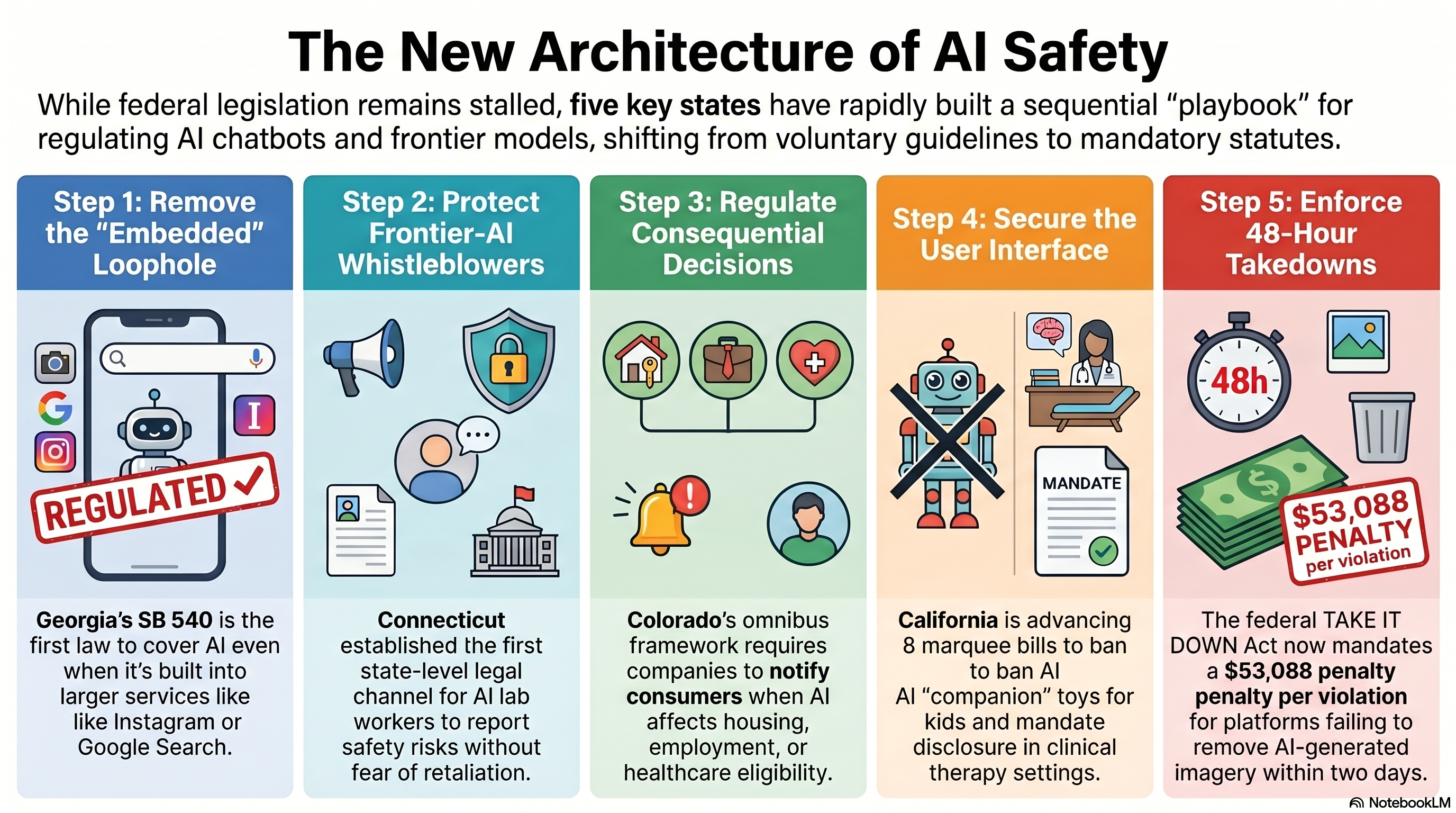
Monday, Gov. Brian Kemp signed Georgia SB 540. First state chatbot statute in the country with no carve-out for chatbots embedded inside larger services. Meta AI and Google Gemini are in scope.
Wednesday, Colorado adjourned Sine Die. Four AI bills on Gov. Jared Polis's desk. SB 189, the consequential-decisions omnibus, sits alongside them.
Wednesday at midnight, Connecticut adjourned Sine Die. SB 5 on Gov. Ned Lamont's desk. First state-level whistleblower protection for frontier-AI workers.
Thursday, the California Senate Appropriations Committee ran the annual suspense file. The marquee chatbot safety bills survived. Four bills did not.
Yesterday in Santa Fe, Judge Bryan Biedscheid denied Meta's directed verdict motion. Meta's defense begins today.
Tuesday, the federal TAKE IT DOWN Act compliance switch flips for fifteen covered platforms. FTC Chair Andrew Ferguson holds the enforcement pen.
The state architecture is more legible this morning than it was Monday.
. . .
GEORGIA SIGNS THE FIRST CHATBOT STATUTE WITHOUT A CARVE-OUT. Monday in Atlanta, Gov. Brian Kemp signed SB 540 into law. Georgia became the eighth state to enact an AI chatbot safety statute. It is the first to enact one without a carve-out for chatbots embedded inside larger services.
The mechanics are now standard.
Disclose that the user is interacting with AI, not a human. Respond under protocol when the user expresses suicidal ideation or self-harm. Limit certain interactions with minors. Provide privacy tools that let users control their data and conversations.
. . .
Iowa enacted the mechanics in SF 2417 on May 2. Idaho enacted them in SB 1297, effective July 1. Illinois enacted them last August. Nebraska enacted them April 17. The template is familiar.
. . .
Georgia changed one variable.
Most state chatbot statutes exempt chatbots that are embedded inside a broader service. The exemption shields Meta AI from California SB 243. It shields Google Gemini from Connecticut SB 5. It has kept the largest platforms out of scope of every state chatbot law passed this year.
. . .
Georgia removed the exemption. SB 540 applies to any chatbot operator offering chatbot services in Georgia. Embedded or standalone. Meta AI inside Instagram. Google Gemini inside Search. ChatGPT inside Apple Intelligence. All covered.
. . .
Sen. Anavitarte was the lead author. The Senate passed on March 6. The House cleared on March 25. The Senate agreed to the reconciliation version on March 27. Kemp signed Monday in his Capitol office. The Eversheds Sutherland analysis published this week called the no-embedded-carve-out the structural innovation of the 2026 state legislative cycle.
. . .
Kemp also signed SB 444 on May 5. That bill bars insurance carriers from making health care coverage decisions based solely on AI systems or software tools. Two AI laws in seven days from the same desk. Georgia adjourned April 6. The pens were waiting.
|
For Legislators: The embedded-services exemption is the line where lobbying lands when you mark up your state's chatbot bill. Georgia held the line. The bill text is the receipt. Read it before you mark yours up.
For Operators: Disclosure. Suicidal-ideation protocols. Minor protections. Privacy tools. Familiar from Iowa, Idaho, Illinois, Nebraska. The scope is the new variable. If your chatbot ships inside another service, Georgia now treats it the same as a standalone bot.
Source: Eversheds Sutherland analysis on Georgia SB 540, May 13, 2026, https://www.eversheds-sutherland.com/en/united-states/insights. Georgia General Assembly SB 540 text and history. WMGT-41 NBC coverage of the signing, https://www.41nbc.com/georgia-lawmakers-push-ai-safety-bill-focused-on-children-and-mental-health/.
|
. . .
COLORADO SINE DIE. FOUR AI BILLS ON POLIS'S DESK, PLUS THE OMNIBUS. Wednesday, Colorado lawmakers adjourned Sine Die after a 120-day session. Four AI-related bills are on Gov. Jared Polis's desk. SB 189, the omnibus framework, sits alongside them. Polis has said publicly he will sign the omnibus.
HB 1263 is the chatbot safety bill.
It covers minors under eighteen. Standard chatbot notification. Parental access tools. A ban on sexually explicit content and emotional-dependence content in chatbot output. A prohibition on gamifying user engagement. Sen. Camacho led. Senate final passage Monday. House final passage Tuesday.
. . .
HB 1195 is the AI psychotherapy bill. It bars AI from delivering therapeutic communications without real-time professional oversight. The Senate passed it 33 to two Monday with Sen. Mullica reading a constituent letter on the floor. The House concurred Tuesday. Polis has a June 12 deadline to sign or veto.
. . .
HB 1210 is the dynamic pricing bill. It limits the use of intimate personal data to make inferences that affect a person's financial position. Senate final passage May 6. House final passage May 7.
. . .
HB 1139 is the AI in health care bill. It restricts the use of AI in clinical decisions without human oversight. House approved March 16. Senate approved May 11.
. . .
SB 189 is the omnibus.
It requires companies that use AI to provide notice to consumers when making consequential decisions that could lead to discrimination. Covered decisions include eligibility for education, employment, housing, financial services, and health care. Consumers get the right to review and correct inaccurate information. Sponsored by Senate President Coleman, Senate Majority Leader Rodriguez, House Majority Leader Duran, and Assistant Majority Leader Bacon. It cleared both chambers within a week of introduction.
. . .
Colorado is the broadest single-week state AI output of 2026.
Five bills. Four lanes. Chatbots. Therapy. Pricing. Health care. The consequential-decisions omnibus on top. One desk.
|
For Legislators: Polis is the second governor this month to hold five AI bills at once. Iowa Gov. Reynolds held the same configuration twelve days ago. Reynolds signed two of them. The desk is the bottleneck the legislatures have shifted the work to.
For Counsel: SB 189 is the broadest consequential-decisions framework any state has put on a governor's desk in 2026. If your client makes consequential decisions about education, employment, housing, financial services, or health care, the Colorado consumer-notice and right-to-correct mechanisms are the operating environment your model deployment plan needs to assume.
Source: Colorado Politics coverage of the omnibus floor passage, May 11, 2026, https://www.coloradopolitics.com/2026/05/11/updated-ai-regulation-bill-clears-colorado-house-and-senate-heads-to-governors-desk/. Colorado General Assembly bill records for HB 1263, HB 1195, HB 1210, HB 1139, SB 189.
|
. . .
CONNECTICUT SINE DIE. SB 5 DAY FIFTEEN ON LAMONT'S DESK. Wednesday at midnight, Connecticut lawmakers adjourned Sine Die. SB 5 is on Gov. Ned Lamont's desk. Day fifteen.
SB 5 is the omnibus.
Consumer disclosures for subscription-based AI products and services. Safety obligations and whistleblower protections for employees of frontier AI developers. Safety protocols for AI chatbots, with additional measures for users under eighteen. Labeling and disclosure requirements for AI-generated material.
. . .
The frontier-AI whistleblower section is the structural innovation.
No other state has it. The premise is that the workers building frontier models are the only people positioned to see safety problems before the problems leave the lab. The protections are modeled on the federal whistleblower statutes for nuclear and chemical workers. Reporting channels run to the Connecticut Attorney General. Retaliation triggers a private right of action.
. . .
The chatbot safety section follows the embedded-chatbot carve-out template. Meta AI and Google Gemini are not covered. Standalone chatbots are.
. . .
The Senate approved SB 5 on April 21. The House approved May 1. It was sent to Lamont the same day. Lamont has indicated publicly he will sign. The Connecticut Mirror reported Tuesday that the governor's office is finalizing implementation guidance ahead of a signing ceremony.
. . .
The Transparency Coalition called SB 5 one of the most comprehensive AI measures in the country. The whistleblower section is the part lobbyists in Sacramento, Albany, and Lansing are reading on the train home.
|
For Workers: Connecticut's frontier-AI whistleblower protection is the first state-level mechanism that takes seriously the position OpenAI employees have asked for since the 2024 open letter. The state did the work the federal government has not done. If you work on a frontier model team, the Connecticut reporting channel is an option that did not exist on Tuesday.
For Legislators: If your state's AI bill is approaching final passage, the Connecticut whistleblower section is worth a floor amendment. It costs the state nothing. It gives frontier-AI workers a reporting channel that does not run through their employer's HR department.
Source: Transparency Coalition weekly state AI legislative update, May 15, 2026, https://www.transparencycoalition.ai/news/ai-legislative-update-may15-2026. Connecticut General Assembly SB 5 text and roll calls. Connecticut Mirror coverage of the governor's signing posture, May 13, 2026.
|
. . .
CALIFORNIA SUSPENSE DAY. THE MARQUEE CHATBOT BILLS SURVIVE. Thursday, the California Senate Appropriations Committee ran the annual suspense file. The marquee chatbot safety bills survived. Eight AI-related bills head to a floor vote. Four were held in committee.
SB 867 is Sen. Padilla's bill to ban companion chatbots inside toys.
It passed seven to nothing with amendments. The amended version narrows the definition of chatbot-toy to products marketed for users under sixteen. The original draft was broader.
. . .
SB 903 is Padilla and Sen. Rubio's bill on AI transcription of clinical session notes in mental health therapy. It passed. AB 1988, the Preventing AI User Self Endangerment Act sponsored by Asm. Pellerin, passed.
. . .
AB 2023 and SB 1119, the chatbot child-safety bills sponsored by Asm. Bauer-Kahan, Asm. Wicks, and Padilla, both passed. SB 1181, Sen. Hurtado's bill on AI impact on children's mental health, passed. SB 1050, Sen. Ashby's bill on AI disclosure in advertising, passed. SB 1146, Sen. Gonzalez's bill on AI provisions in false advertising for health products, passed. AB 1979, Asm. Bonta's bill on AI in health care, passed.
. . .
Held in committee.
AB 1898 on employer AI notice. AB 2027 on worker information protection. AB 2169 on CCPA AI deployer access. AB 2653 on sweat-free AI code. SB 1104 on data broker registration. SB 1142, the Digital Dignity Act. SB 1217 on the nonconsensual intimate image clearinghouse.
. . .
The pattern from the held bills.
Any bill that imposed direct compliance burdens on California employers cleared committee resistance. Any bill that created new state administrative infrastructure did not. The chatbot safety bills moved because they regulate chatbots, not employers. The bills that survived suspense now move to the floor. Floor votes are expected within ten legislative days.
|
For Industry: The eight bills that survived are the operating environment your California compliance plan needs to assume by July. The four bills that died can be reintroduced in 2027. The Padilla suite is the closest thing California has to an omnibus chatbot framework. It cleared the gate.
For Legislators: The California Suspense File is where bills die quietly without a public roll call. The eight that survived face the loudest part of the process now. Watch SB 867 and SB 903 for the floor amendments tech lobbyists are preparing this week.
Source: California Senate Appropriations Committee suspense hearing results, May 14, 2026, https://sapro.senate.ca.gov/system/files/2026-05/hearing_results-5-14-26-suspense.pdf. California Legislative Information bill records.
|
. . .
SANTA FE, DAY ELEVEN. THE DIRECTED VERDICT STAYS DENIED. META'S DEFENSE BEGINS. Wednesday, the New Mexico Department of Justice rested its phase-two case against Meta. Yesterday, First Judicial District Judge Bryan Biedscheid denied Meta's motion for a directed verdict. Meta's defense witnesses begin today.
Kelly O'Donnell was the state's final witness.
A University of New Mexico economist and public finance specialist. She testified Wednesday morning to the cost of the fifteen-year, three-point-seven billion dollar abatement plan designed by social-work researcher Dana Weiner. The plan includes mental health treatment services for youth in New Mexico, school-based digital literacy programming, parental controls audits, and platform-specific safety-by-design requirements.
. . .
Wendy Gross testified by deposition Wednesday afternoon. Meta's head of marketing insights for Creators and Threads. Stanford graduate. At Meta since 2019. The deposition was taken in October. The state played the recording. The testimony covered Meta's internal research describing harm to teen users.
. . .
After Gross, the state rested.
. . .
Meta moved for a directed verdict at the end of Wednesday's session. The motion argued that even taking the state's evidence in the light most favorable to New Mexico, the abatement plan was facially overbroad and the public-nuisance theory failed as a matter of law. Judge Biedscheid took the motion under advisement overnight.
. . .
Yesterday, the judge denied the motion from the bench.
The court found that New Mexico had presented sufficient evidence to require Meta to mount a defense. The denial is not a finding for the state. It is a finding that the state's case is non-trivial.
. . .
Meta's defense witnesses begin today and run through May 22. Parties present further argument after that. Judge Biedscheid will issue a written ruling at a later date. The first phase ended March 24, 2026 with a Santa Fe jury awarding 375 million dollars in compensatory damages. The phase-two outcome will determine whether the remedial structure of platform-liability law has a new floor.
|
For Counsel: A directed-verdict denial in a public-nuisance case against Meta is the first time a court has held that a state's evidence of platform-caused harm to teens crosses the threshold for trial. The threshold is not high. The path through it is. The state crossed it.
For Legislators: The Santa Fe record is the closest thing to a public archive of internal Meta safety documents that any state legislature has access to. Parts of the transcript will be sealed. The unsealed parts are already cited in five state bills introduced in 2026.
Source: KVIA coverage of the directed-verdict ruling, May 14, 2026, https://kvia.com/news/2026/05/14/new-mexico-judge-denies-metas-request-for-direct-verdict-in-public-nuisance-case/. New Mexico v. Meta phase-two trial transcripts, First Judicial District Court, Santa Fe.
|
. . .
TAKE IT DOWN SWITCH FLIPS TUESDAY. FOUR DAYS. Tuesday, May 19, is the federal compliance deadline for the TAKE IT DOWN Act. Fifteen covered platforms are subject. Statutory civil penalty is fifty-three thousand eighty-eight dollars per violation. FTC Chair Andrew Ferguson holds the enforcement pen.
TAKE IT DOWN became law January 14, 2025.
The compliance window has been one year and four months. Tuesday is the day platforms must have a working notice-and-takedown mechanism for nonconsensual intimate imagery, including imagery generated by AI. The mechanism must process takedown requests within forty-eight hours.
. . .
The covered platforms are the largest social media services and search engines. The statute requires the FTC to publish a list of compliant and non-compliant platforms within thirty days of the deadline. The Ferguson letters issued in April put more than a dozen large technology companies on notice that the FTC was prepared to enforce on Day One.
. . .
The Ferguson guidance was specific.
Platforms must make it easy to submit a removal request. Platforms should issue an identifying number for each takedown request so the requester, the platform, and the FTC can track it. Platforms should report back to the user on whether the content came down, with an explanation if it did not.
. . .
Internal communications from one covered platform, reported by industry trade press last week, showed implementation teams scrambling to release a usable form by Sunday. Two platforms have publicly stated their mechanism will be live before midnight Monday. Two more have not made public statements.
. . .
The first federal AI-generated content statute with teeth meets its first deadline Tuesday at one minute past midnight Eastern.
|
For Operators: Tuesday's compliance posture is the data point your legal team's report to the board needs to lead with. Which platforms shipped a working form by 12:01 a.m. Eastern, and which did not, is the FTC's enforcement docket for the next thirty days.
For Legislators: TAKE IT DOWN is the only federal AI-content statute with a hard deadline and a working enforcement mechanism. The GUARD Act is still on the Senate floor. The Kids Online Safety Act died in conference for the third time in December. TAKE IT DOWN is what federal enforcement of AI-generated content harms looks like in May 2026.
Source: National Law Review analysis of the FTC TAKE IT DOWN stakeholder letter, May 2026, https://natlawreview.com/article/ftcs-take-it-down-act-stakeholder-letter-signals-heightened-compliance-priority. TAKE IT DOWN Act, Public Law 119-1, January 14, 2025.
|
. . .
THE PATTERN. The state capitols this week did not move in coordination. They moved in parallel.
Georgia's no-embedded-carve-out is the most aggressive single drafting choice.
. . .
Colorado's omnibus is the most comprehensive single-state output of the year.
. . .
Connecticut's whistleblower section is the most novel mechanism.
. . .
California's Suspense outcome is the largest single-day count of marquee chatbot bills surviving in any state.
. . .
Santa Fe's directed-verdict denial is the courtroom counterpart.
. . .
Five capitols. Five different architectures.
The states are not running the same play. They are running adjacent plays from the same playbook. The playbook has converged faster than the federal government can write a counter-playbook. The GUARD Act has been pending Senate floor action since Senate Judiciary cleared it unanimously on April 30. There is still no scheduled vote.
. . .
The federal pen is on hold. The state pens are not.
. . .
THE ONE CONFIGURATION. The configuration that worked, in five capitols, in seven days, has the same shape.
A bill names the chatbot. A bill requires disclosure that the chatbot is not human. A bill requires a protocol for what the chatbot does when the user expresses suicidal ideation or self-harm. A bill protects minors from interactions the law judges harmful. A bill closes the embedded-services carve-out, or it does not.
. . .
The states that closed the carve-out captured Meta AI and Google Gemini. The states that did not closed the marketplace to standalone chatbots and left the embedded ones alone.
. . .
Either way, the chatbot has to disclose. The chatbot has to escalate. The chatbot has to keep certain content away from certain users.
That is the configuration. It is not the only configuration. It is the one that, this week, became the architecture state legislatures use.
|