|
. . .
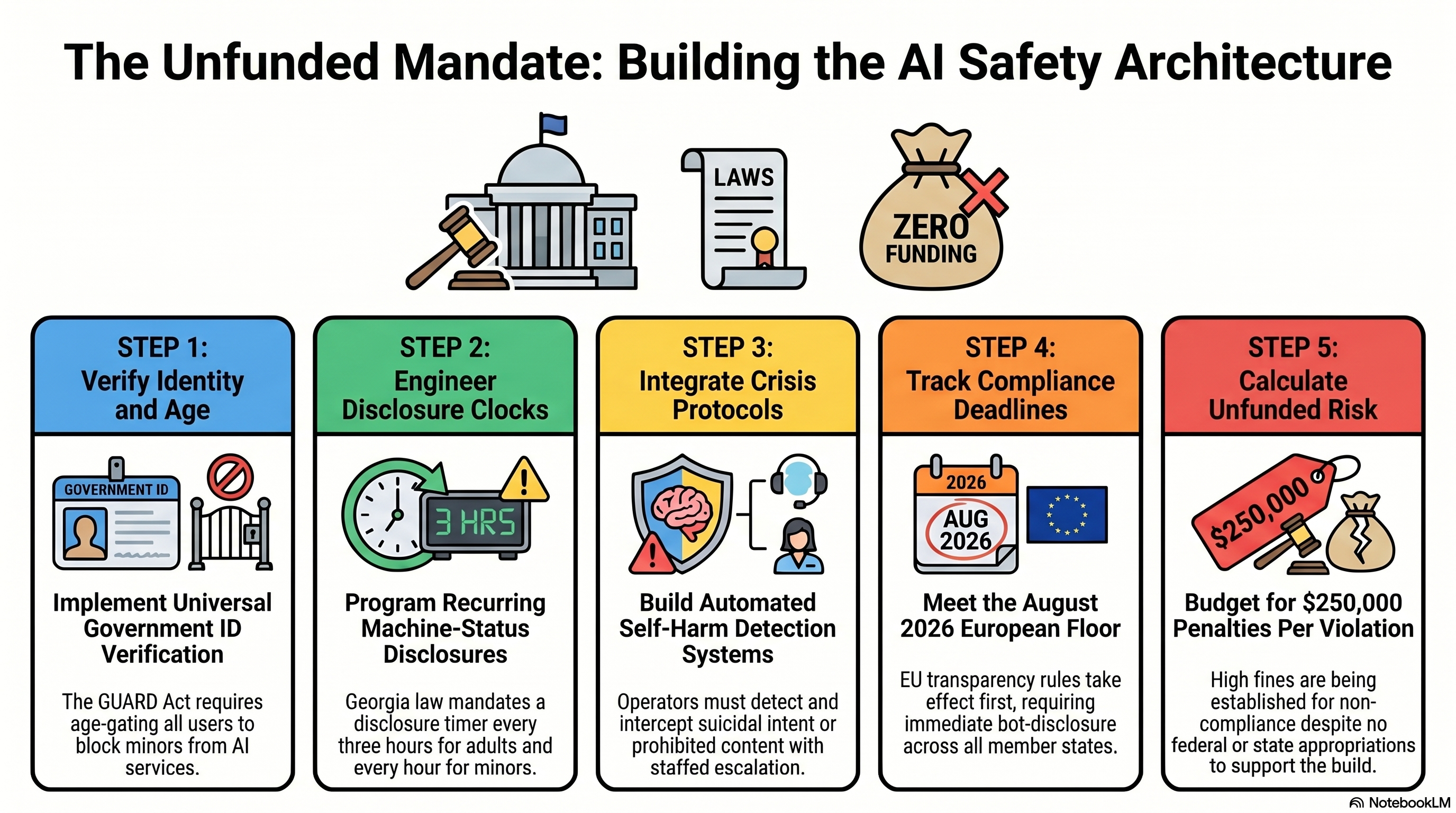
WASHINGTON MANDATES THE BUILD. IT PAYS FOR NONE OF IT. The GUARD Act cleared the Senate Judiciary Committee on April 30 on a unanimous vote, and it now waits for the Senate floor. It orders every chatbot company in the country to build a long list of new safety systems. It attaches zero dollars to any of them.
Senators Josh Hawley and Richard Blumenthal wrote the bill, with thirteen cosponsors from both parties. What it requires of operators is concrete and expensive: age verification for every user through a government ID or a commercially reasonable equivalent, a hard block on anyone under eighteen, recurring disclosure that the bot is neither human nor licensed, and working crisis protocols for self-harm. Every one of those is a line item. None of them comes with funding.
. . .
The enforcement side is heavier still. Break the age or disclosure rules and the penalty runs up to one hundred thousand dollars per violation, with a higher tier reaching two hundred and fifty thousand, and each violation counted separately. Design a bot that solicits sexual or self-harm content from a minor and it becomes a federal crime. Enforcement falls to the U.S. Attorney General and all fifty state attorneys general. Their budget for it, written into the bill, is nothing.
Then there is the part nobody is talking about. Under the Unfunded Mandates Reform Act, once a committee reports a bill, the Congressional Budget Office is supposed to score what it costs, with the trigger sitting around two hundred and six million dollars a year for the private sector. The committee reported the GUARD Act on April 30. As of today, no CBO score has been published.
So technically the bill is not yet labeled an unfunded mandate, because the score that would label it does not exist. But the absence of a number does not make the cost disappear. It only hides it. The cost is real and already assigned: to the companies that build the systems, to the Attorney General and fifty state AGs who enforce them, to the ID-check vendors, and to every user who now hands over a government ID just to keep talking.
The funding line is blank.
Why it matters: The federal floor for chatbot safety is one Senate vote away, and it tells everyone to build while paying for none of it. Read the bill, then look for the appropriation. It is not there.
|
For Counsel: Penalties run to two hundred and fifty thousand dollars per violation, counted separately, and state AGs get their own federal cause of action. Price the compliance build now, not after the floor vote.
For Founders: Age checks, recurring disclosure, and self-harm detection are now the federal cost of serving anyone who might be a minor. Put a real number on it before this passes.
For Legislators: The bill sets a floor and lets states go further. It also sets the funding precedent, which is none. If you draft the state version, the money question lands on you.
Source: S.3062 bill text and Senate Judiciary action, https://www.congress.gov/bill/119th-congress/senate-bill/3062/text
|
. . .
CHICAGO. OPENAI TELLS A COURT CHATGPT IS NOT A PERSON. OpenAI asked a federal judge in Chicago on May 15 to throw out a lawsuit accusing ChatGPT of practicing law without a license. Its defense came down to one line: the product is not a person and uses no legal skill.
Nippon Life Insurance sued OpenAI in the Northern District of Illinois, before Judge John Kness. The company says a former claimant, after settling a case, used ChatGPT to draft and file dozens of motions, one of which cited a case that does not exist. Defending against that flood, Nippon says, cost it roughly three hundred thousand dollars.
. . .
OpenAI's answer is that a tool is not a lawyer. The user was free to represent herself and free to use software to do it; the bot has no intent and no judgment; the blame belongs to the person who hit file. It is a clean argument, and it runs in the opposite direction from every other case on this beat. In Pennsylvania, the state says a bot practiced medicine by claiming a license. The GUARD Act wants bots forced to disclose they hold no license. Here, OpenAI argues that the missing license is the entire defense.
Why it matters: Whether a chatbot is a product, a service, or a speaker is the question sitting under every chatbot case in the country, and a federal ruling here would put down an early marker.
|
For Counsel: This motion is the cleanest statement yet of the tool defense. Read it against the product theory in the wrongful-death docket, where the same facts get framed the opposite way.
For Founders: The terms-of-service ban on legal advice is doing the heavy lifting in this motion. Your disclaimers are evidence now, working both for you and against you.
Source: OpenAI motion to dismiss, Nippon Life v. OpenAI, via Bloomberg Law, https://news.bloomberglaw.com/litigation/open-ai-dismissal-motion-says-chatgpt-is-mere-tool-not-attorney
|
. . .
DENVER. THREE AI BILLS WAIT ON THE GOVERNOR'S DESK. Three AI bills passed the Colorado legislature and now sit with Governor Jared Polis. One covers consumer chatbots, one restricts AI in therapy, and one governs AI in insurance denials. He has signed none of them, and bereaved parents are already telling lawmakers the chatbot bill is too weak.
House Bill 1263 is the consumer-chatbot bill. It requires operators to estimate a user's age, to tell minors on a recurring schedule that they are talking to a bot, to bar sexual content with children, and to run a protocol when a user signals suicide. Parents of children who died after heavy chatbot use testified that it does not go far enough.
. . .
The other two draw the harder line between AI and licensed care. House Bill 1195, carried by Representatives Gretchen Rydin and Javier Mabrey, bars AI treatment recommendations without a clinician review, requires client consent before any AI records a session, and bars psychotherapy from anyone who is not a licensed professional. House Bill 1139 bars insurers from denying coverage on group data alone, requires a human to review any AI-recommended denial, and blocks insurance payment for therapy delivered by AI.
Why it matters: Colorado wrote the country's first algorithmic-discrimination law, so what Polis signs and what he vetoes tells every other state where a national AI-policy leader draws the line between a chatbot and a clinician.
|
For Clinicians: House Bill 1195 puts a licensed human at the center of every AI-assisted clinical decision. If it signs, that review requirement becomes the compliance anchor.
For Legislators: Three bills, three angles on the same problem, one desk. Watch which get the pen and which get the veto, because the veto messages are where the real line gets drawn.
Source: Colorado Newsline on the 2026 tech bills awaiting the Governor, https://coloradonewsline.com/2026/05/18/tech-regulation-laws-colorado/
|
. . .
ATLANTA. A REPUBLICAN GOVERNOR SIGNS. NO CARVE-OUT FOR BIG TECH. Georgia Governor Brian Kemp signed Senate Bill 540, which makes chatbots disclose they are AI, limits how they treat minors, and requires self-harm protocols. There is no exemption for the big platforms, which means Meta and Google comply alongside everyone else.
State Senator Jason Anavitarte, the Senate Majority Leader, carried the bill. Its sharpest provision is a clock: disclose at the start of a conversation, then again every three hours, that the user is talking to a machine, and for known minors, every hour. The law also bars sexual content with children and any simulated romance with them. It takes effect July 1, 2027.
. . .
That three-hour interval is the most specific timing rule in any state chatbot law so far. Most laws ask for one disclosure at the start and leave it there; Georgia puts it on a timer, on the theory that a user deep in a long conversation forgets what they are talking to. The politics are as notable as the text. A red state, a Republican governor, and a broad bipartisan vote produced this while the White House was pressing states to leave AI alone. The line held anyway.
Why it matters: Chatbot safety is not breaking along party lines, and a red-state law with no big-platform carve-out, signed against federal pressure, tells every other statehouse the political cover is there.
. . .
SANTA FE. THE META TRIAL REACHES THE MONEY PHASE. New Mexico's case against Meta reaches its remedies phase this week before Chief Judge Bryan Biedscheid, with the state asking for a mental-health fund of three point seven billion dollars. The judge has already warned both sides he will not overreach.
A Santa Fe jury found Meta liable in March under the state's Unfair Practices Act and set the penalty at three hundred and seventy-five million dollars. The bench trial now underway decides whether Meta's platforms are a public nuisance and what the company must do about it. The state is asking for a multi-year mental-health fund, age verification, and limits on the engagement features aimed at minors.
. . .
Meta calls the demands impractical and has hinted it could pull Facebook and Instagram out of New Mexico rather than comply with the broadest of them. Biedscheid opened the phase by telling both sides he would not write platform policy from the bench, and the trial is set to close by May 22. This is a social-media case, not a chatbot case, but it earns the slot for one reason: a court-ordered mental-health fund in the billions becomes the template the next attorney general cites against the next platform, conversational or not.
Why it matters: The first state to win a public-nuisance trial against a major platform is days from a remedies order, and the number it lands on sets the ceiling for every AI-harm remedy that follows.
|
For Counsel: Watch what survives the judge's red pen. A judge openly limiting his own remedial reach is the clearest read available on what courts will actually order against platform conduct.
For Investors: Meta's threat to exit the state is a live test of how far one state can push a national platform, and it is playing out in open court this week.
Source: Albuquerque Journal on the New Mexico v. Meta remedies phase, https://www.abqjournal.com/news/meta-new-mexico-will-seek-37-billion-at-trial/3034124
|
. . .
BRUSSELS. EUROPE'S DISCLOSURE RULE BEATS WASHINGTON TO THE DEADLINE. The European Commission opened a feedback period on May 19 on which AI systems count as high-risk. It lands next to the AI Act's transparency rule, which takes effect in August and requires that anyone talking to a chatbot be told it is a machine.
The high-risk feedback is the next step in rolling out the AI Act, Europe's comprehensive AI law, but the provision that bites first is Article 50. It requires providers to tell users they are talking to a machine and to make AI-generated content identifiable, and it takes effect in August 2026. Alongside it, the Commission moved this month to ban nudification apps and opened a consultation on the transparency rules themselves.
. . .
Europe is arriving at the same destination as the United States by a different road. America is assembling a patchwork of state laws on top of a single federal bill; Europe runs one law across the whole bloc. Both now demand the same floor, that a chatbot must tell you it is not human, and Europe gets there first.
Why it matters: The disclosure rule the GUARD Act only proposes for the US is already law in Europe and goes live in August, so any company operating on both sides of the Atlantic hits the European deadline first.
|
For Founders: The August transparency deadline is firm and sooner than anything pending in Washington. Build to it now.
For Counsel: Article 50 plus the high-risk classification guidance is the pair to track, and the classification draft is open for comment today.
Source: European Commission AI Act framework and May 19 high-risk feedback notice, https://digital-strategy.ec.europa.eu/en/policies/regulatory-framework-ai
|
. . .
THE PATTERN. Four governments, one week, the same playbook. Each one tells operators to disclose the machine, verify the child, and build the protocol for the moment someone wants to hurt themselves. The mandates are nearly identical, and they are nearly all reasonable.
Then you reach the funding line, and it is the same in every one. The GUARD Act: zero. The Colorado bills: zero. Georgia: zero. Brussels: zero.
The mandate is the easy half of the sentence. The cost is the half they leave off.
. . .
THE ONE CONFIGURATION. The rules everyone is writing share a single shape. A human stays in the loop, the machine says what it is, and someone answers when it fails. That part is no longer controversial; four governments wrote it into law or near-law in the span of one week.
The unsettled question is the money. Who carries the cost of building all of it, and so far the answer written into the statutes is everyone except the government that wrote them.
|