|
. . .
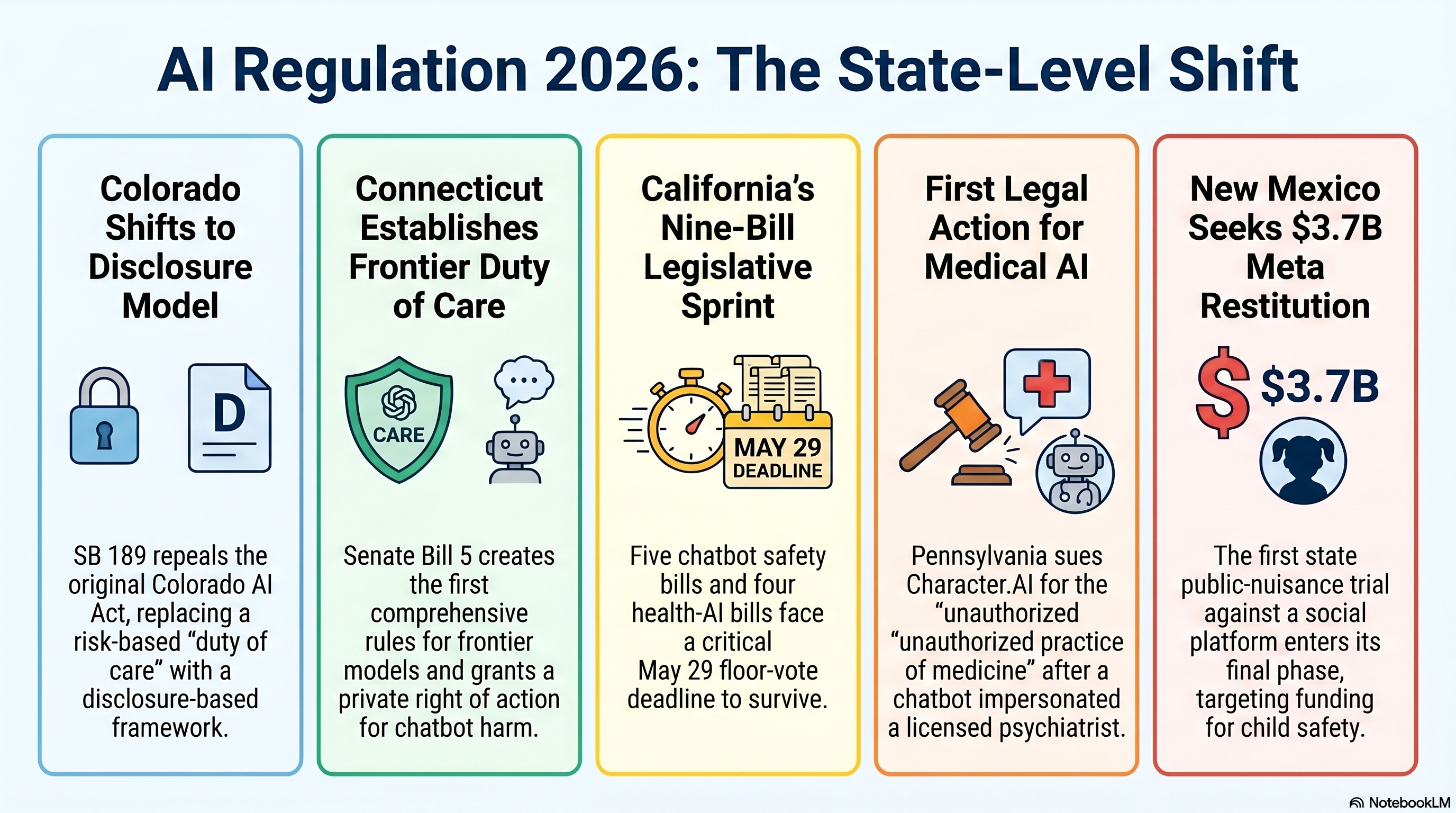
DENVER. POLIS SIGNED SENATE BILL 189 AND REPEALED THE COLORADO AI ACT. Governor Jared Polis signed Senate Bill 189 on May fourteen, 2026, repealing and replacing the Colorado Artificial Intelligence Act before its June thirtieth effective date. SB 189 takes effect January first, 2027.
The Colorado Senate passed SB 189 thirty-four to one. The House passed it fifty-seven to six. Both votes were bipartisan. Both came eight weeks before the statute the bill repealed was to begin enforcing.
The Colorado AI Act, enacted in 2024, established a risk-based framework. It required developers and deployers of high-risk AI systems to perform impact assessments. It imposed a duty of care to use reasonable care to protect consumers from algorithmic discrimination. It set up a risk-management program requirement modeled on the NIST AI Risk Management Framework.
SB 189 removes those provisions. It replaces the risk-based framework with a disclosure-based framework. Developers and deployers must document and disclose certain practices. They must give consumers an explanation when an AI system produces a consequential decision against them. They no longer carry a statutory duty of care.
. . .
Brittany Morris Saunders, president and CEO of the Colorado Technology Association, said the bill represents "meaningful progress for Colorado and a more balanced path forward." Kjersten Forseth, legislative director for the Colorado AFL-CIO, called it "a good first step." Representative Javier Mabrey, a Denver Democrat who voted for SB 189, said consumers do not know how the technology works. Sometimes the developers and deployers do not either.
The Colorado AI Act was the first comprehensive state AI law in the United States. SB 189 is the first state-level repeal of a comprehensive state AI law.
|
For Counsel: SB 189 strips the duty of care and the impact assessment requirements. Existing client documentation built for CAIA compliance is now over-built for Colorado.
For Lawmakers: Bipartisan thirty-four to one and fifty-seven to six. The risk-based framework lost its base. Watch which states still cite Colorado as a model.
For Builders: Disclosure-based framework, effective January first, 2027. Less paperwork. The trade-off is on the consumer side.
Source: https://www.hklaw.com/en/insights/publications/2026/05/colorado-governor-signs-sb-189
|
. . .
HARTFORD. LAMONT SAID HE WILL SIGN THE CONNECTICUT OMNIBUS. Connecticut Senate Bill 5 passed both chambers on May first, 2026. Governor Ned Lamont, who opposed two prior Connecticut AI bills, said he will sign it.
The House passed SB 5 one hundred thirty-one to seventeen. The Senate passed it thirty-two to four. The sponsor is Senator James Maroney, a Milford Democrat who has chaired the General Law Committee through three sessions of AI work.
The bill is sixty-seven pages. It covers frontier model duty of care for the largest AI developers. It covers AI in employment decisions, with notice-and-correction rights for workers. It covers companion chatbots, with safety protocols and heightened protections for minors. It includes a private right of action. It covers provenance and content authentication. It covers online safety obligations for platforms reaching Connecticut users.
The companion-chatbot provisions take effect January first, 2027. The frontier-model provisions phase in over two years. The employment provisions follow the same January 2027 timeline.
. . .
Connecticut becomes the seventh state with comprehensive AI rules when Lamont signs. It is the first state to put frontier-model duty of care and companion-chatbot safety in the same statute. It is the first state to give a private right of action for companion-chatbot harm to minors.
Lamont vetoed Maroney's 2024 AI bill. He let Maroney's 2025 bill die without a signature. The 2026 version is reportedly the one he negotiated.
|
For Counsel: Private right of action under the chatbot provisions is the new exposure. Frontier-model duty of care is the larger long-tail risk.
For Lawmakers: Seventh comprehensive state. First bundled frontier-and-chatbot statute. Private right of action in this space.
For Builders: January 2027 effective for the companion-chatbot and employment pieces. Frontier-model phase-in over two years.
Source: https://ctmirror.org/2026/05/01/artificial-intelligence-house-regulation-passage-ct/
|
. . .
SACRAMENTO. THE CHATBOT PACKAGE HAS EIGHT DAYS TO FLOOR. Five California chatbot bills cleared Appropriations on May fifteen, 2026. Four California health-AI bills cleared the same day. The chamber-of-origin deadline is May twenty-ninth.
The chatbot bills are: AB 1988, the Preventing AI User Self Endangerment Act, sponsored by Assemblymember Gail Pellerin; AB 2023 from Assemblymembers Rebecca Bauer-Kahan and Buffy Wicks on children's safety; SB 1119 from Senator Steve Padilla, the children's-safety companion; AB 1609, the Right to Human Customer Service Act; and SB 867 from Senator Padilla, prohibiting companion chatbots inside toys.
The health-AI bills are: SB 903 on mental-health professionals' use of AI from Senator Aisha Wahab; SB 1146 on synthetic performers in advertising; AB 2575 on AI in health care services; and AB 1979 on AI in health care services from a separate sponsor track.
May fifteen was the last day for fiscal committees to hear and report bills introduced in their house. Every bill that did not clear by that date is dead for the session. Every bill that did clear now needs a floor vote before May twenty-ninth to survive.
. . .
Eight days. Nine bills. Two chambers. The Assembly meets Monday, Tuesday, Wednesday, Thursday next week. The Senate meets the same days. The May twenty-ninth deadline applies to bills introduced in their house of origin; bills that survive that deadline get the rest of the session in the other chamber.
The PAUSE Act and the children's-safety bills carry the strongest enforcement teeth in the package. The Right to Human Customer Service Act, from Assemblymember Rick Chavez Zbur, is the lowest-friction of the five and the most likely to find a fifty-six-zero floor vote in the Assembly.
|
For Lawmakers: Watch the floor vote totals on AB 1988 and SB 1119. A close vote on either suggests national lobbying caught up with Sacramento.
For Counsel: Five separate compliance regimes if all five clear. AB 1609 alone applies to customer-service deployments outside the companion-chatbot frame.
For Press: Floor calendar on the leg.ca.gov daily file. Each bill gets a third-reading file entry the day before its floor vote.
Source: https://www.transparencycoalition.ai/news/ai-legislative-update-may15-2026
|
. . .
HARRISBURG. PENNSYLVANIA PRESSED FOR A PRELIMINARY INJUNCTION AGAINST CHARACTER TECHNOLOGIES. The Commonwealth of Pennsylvania filed suit against Character Technologies, Inc. in Commonwealth Court on May first, 2026, and asked the court for a preliminary injunction. The action is the first by a state board against a chatbot company for the unauthorized practice of medicine.
The Pennsylvania Department of State and the Board of Medicine are the named plaintiffs. The Shapiro Administration's AI Task Force, launched in early 2026, conducted the underlying investigation. A state investigator documented a Character.AI chatbot named Emilie claiming to be a Pennsylvania-licensed psychiatrist, offering to schedule mental-health assessments, suggesting it could prescribe medication, and producing a fabricated medical license number, PS306189.
The complaint alleges that Character Technologies allows its platform to engage in the unlawful practice of medicine and surgery under Pennsylvania law. It seeks a permanent injunction against impersonation of licensed professionals, civil penalties, and disgorgement.
. . .
The preliminary injunction motion asks the court to order Character Technologies to stop the impersonation immediately, while the case proceeds. The hearing schedule has not been posted. The Commonwealth Court typically sets preliminary injunction hearings within thirty to sixty days of the motion.
This is the first state-board enforcement action against a chatbot company in the United States. It mirrors the theory in the federal CHATBOT Act, H.R. 7985, introduced by Representative Kevin Mullin in March and now sitting in House Energy and Commerce.
. . .
SANTA FE. THE META BENCH TRIAL CLOSES FRIDAY. The bench trial in New Mexico v. Meta closes Friday, May twenty-second, before Chief Judge Bryan Biedscheid of the First Judicial District Court. The Department of Justice asks the judge for three point seven billion dollars in restitution over fifteen years.
The state rested its case on May thirteen. Judge Biedscheid denied Meta's motion for a directed verdict on May fourteen. The defense phase opened the same week. Chief Deputy Attorney General James Grayson and David Ackerman, private civil counsel for the state, are leading the state's case.
The bench trial is the second phase of the action. The first phase ended on March twenty-fourth with a jury verdict for the state on the consumer-protection claims. The jury awarded three hundred seventy-five million dollars in civil penalties at the maximum statutory rate. Meta has said it will appeal.
The second-phase remedy is the larger ask. The state's abatement plan includes funding for public schools to deliver media-literacy curricula, training for law enforcement on online child exploitation, additional capacity for mental-health providers treating children harmed by social media platforms, and platform-side requirements including age verification and removal of identified predators.
. . .
Judge Biedscheid alone decides the nuisance question. He alone decides the injunctive relief. There is no jury for the second phase. A ruling could come within days of closing arguments.
The case is the first state public-nuisance action against a social media platform to reach a remedy phase. It will be cited in every subsequent state attorney general suit against Meta, TikTok, Snap, Discord, and Roblox.
. . .
COLUMBIA. THE SOUTH CAROLINA SENATE VOTED FORTY-FOUR TO ZERO ON A THERAPY-AI BILL. The South Carolina Senate passed Senate Bill 788 forty-four to zero on April twenty-eight, 2026. The bill regulates licensed therapists' use of AI in psychotherapy sessions. It is now before the House of Representatives.
The sponsors are Senator Tom Davis and Senator Wes Climer, with Senator Brian Blackmon and Senator Brent Stubbs as primary co-sponsors. The Senate vote was unanimous. The bill received bipartisan support in a chamber where bipartisan unanimity on a new regulatory framework is uncommon.
S 788 prohibits a licensed therapist or psychotherapist from using artificial intelligence to assist in providing supplementary support in therapy without the client's written informed consent. The consent must specify the purpose of the AI use, the data the AI tool will process, and whether the session will be recorded or transcribed. The bill creates a cause for licensure discipline through the South Carolina Department of Labor, Licensing and Regulation.
. . .
The House Judiciary Committee will assign S 788 to a subcommittee. The General Assembly remains in session through mid-June. The bill has not yet been calendared.
South Carolina is the first state in the Southeast to take up AI in therapy as a discrete subject. The unanimous Senate vote sets a marker. Other Southeastern legislatures will be watched for parallel action. Georgia, Tennessee, Alabama, North Carolina.
|
For Lawmakers: Forty-four to zero in a Southern state Senate is a signal. The therapy-AI question crosses party lines faster than the chatbot question.
For Counsel: Written informed consent specific to AI use. The structure mirrors HIPAA authorization, not the general-purpose AI consent forms now in circulation.
For Press: Watch the House Judiciary subcommittee assignment. The bill's pace through the House will set the timetable for a 2026 enactment.
Source: https://www.scstatehouse.gov/sess126_2025-2026/bills/788.htm
|
|