|
. . .
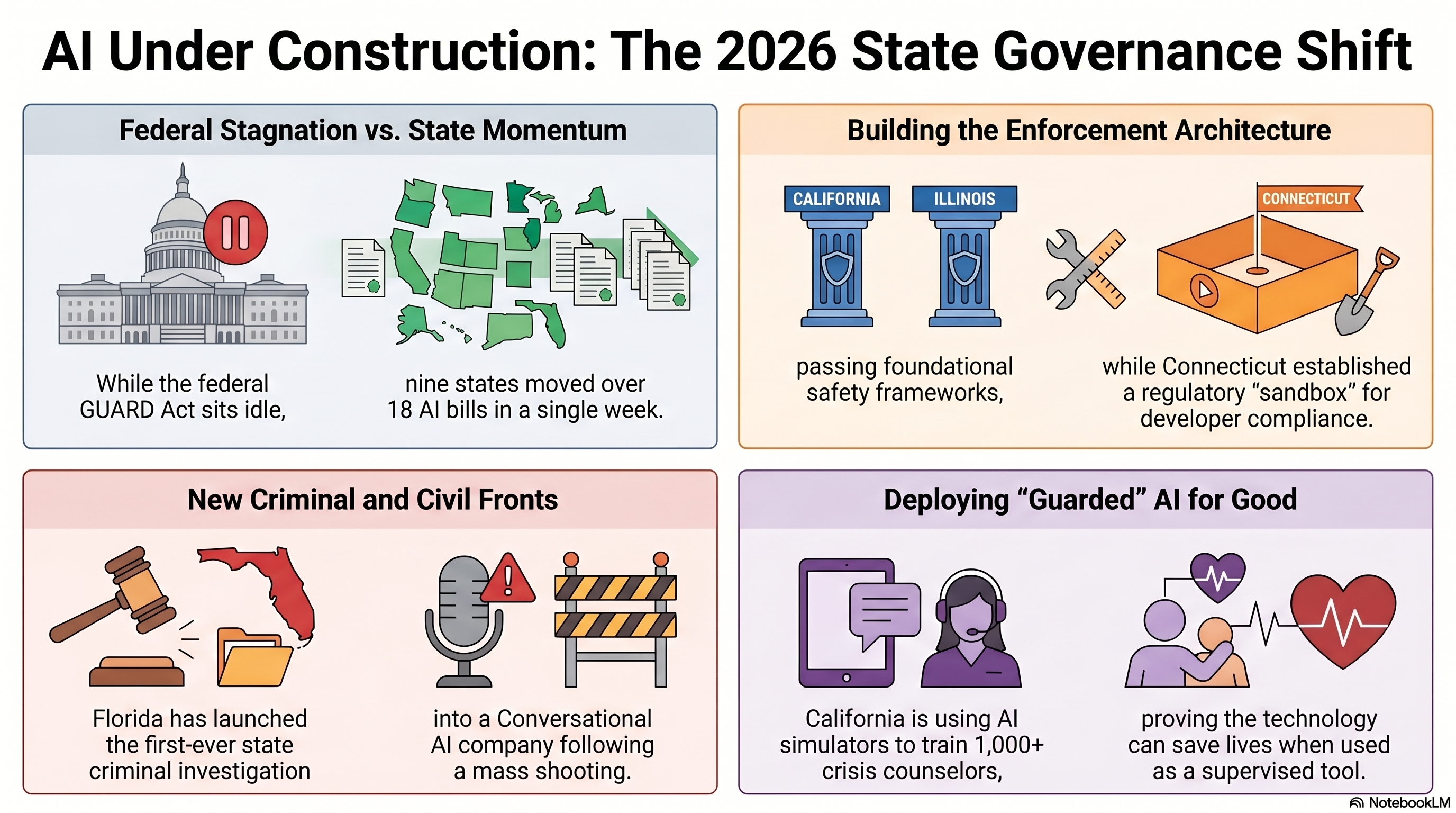
THE STATEHOUSES BUILT. THE SENATE DID NOT. State legislatures in California, Connecticut, Illinois, Missouri, New York, Rhode Island, South Carolina, Vermont, and Hawaii moved more than eighteen AI and chatbot bills the week of May eighteenth through May twenty-second. The federal Senate's GUARD Act sat where it has sat since May eleventh, on Calendar No. 406, with no floor schedule announced.
The state-level pace last week was the loudest of the twenty twenty-six AI session. Connecticut's omnibus Senate Bill 5 cleared both chambers and went to Governor Ned Lamont's desk, where his spokesperson confirmed he will sign. California passed nine AI and chatbot bills out of their original chambers. Illinois moved three foundational AI bills through the Senate.
. . .
Vermont enacted neurological rights. South Carolina enacted addictive-social-media age verification. Hawaii sent the AI Disclosure and Safety Act to Governor Josh Green's desk. Missouri sent an AI-therapy-chatbot prohibition to Governor Mike Kehoe. The Connecticut omnibus rebrands in statute as the Connecticut Artificial Intelligence Responsibility and Transparency Act.
. . .
The federal counterpart did not move. The GUARD Act has sat on the Senate Legislative Calendar under General Orders since May eleventh. Seventeen cosponsors. No floor schedule. The Senate adjourned Friday for Memorial Day and returned Tuesday morning to the same calendar slot.
. . .
The pattern this week is the one CAW named in issue fifty-one. State legislatures and state attorneys general are building the enforcement architecture for Conversational AI inside their own jurisdictions and funding it with their own appropriations. Most of last week's bills name a state attorney general or a state regulator as the enforcer. None of them wait on a federal mandate or federal money to operate. Story six is the same architecture turned the other direction.
|
For Counsel: the federal preemption question remains open while the state-level enforcement architecture continues to lock in. Plan for state-by-state compliance with or without GUARD Act timing.
For Legislators: the unfunded-mandate question CAW raised in issue fifty-one is now visible in the legislative data. Eighteen bills in one week, every one state-funded.
For Founders: the regulatory floor is no longer in Washington's calendar. It is in the bills your customers' state attorneys general are about to enforce.
Source: Transparency Coalition AI Legislative Update May 22 with bill-by-bill cross-verify against state legislature sites, https://www.transparencycoalition.ai/news/ai-legislative-update-may22-2026
|
. . .
SACRAMENTO. NINE BILLS CROSSED CHAMBERS IN EIGHT DAYS. Sacramento ran nine AI and chatbot bills through their original chambers during the eight legislative days from May fourteenth through May twenty-second, putting the package on its final state-side ramp toward the May twenty-ninth chamber-of-origin deadline.
The chatbot package CAW has tracked for six weeks cleared in stages. Assembly Bill 1988, the Preventing AI User Self Endangerment Act sponsored by Assemblymember Gail Pellerin, passed the full Assembly May twenty-first. Assembly Bill 2023 sponsored by Assemblymembers Rebecca Bauer-Kahan and Buffy Wicks was ordered to third reading May eighteenth. Senate Bill 1119 sponsored by Senator Steve Padilla passed the full Senate thirty-nine to zero on May nineteenth and went to the Assembly.
. . .
Senate Bill 867, Padilla's companion-chatbot-in-toys prohibition, cleared suspense and is on the Senate floor. Senate Bill 903, the mental-health-AI bill cosponsored by Padilla and Senator Susan Rubio, passed the Senate thirty-nine to zero on May nineteenth. Assembly Bill 1979 on AI in health-care services passed the Assembly. Senate Bill 947 on employment automated-decision systems passed the Senate twenty-nine to nine.
. . .
Two AI Transparency Act amendments passed alongside the chatbot bills. Senate Bill 1000 cleared the Senate with an urgency clause thirty-three to one. Assembly Bill 2713 passed the Assembly. Both adjust California's existing AI provenance disclosure framework. Five days remain before the May twenty-ninth chamber-of-origin deadline.
|
For Counsel: the California chatbot, employment-AI, and health-AI bills reach floors of their secondary chambers inside the next legislative week. Track Padilla's Senate Bill 867 first.
For Founders: the AI Transparency Act amendments alter the existing disclosure architecture you already comply with. SB 1000's urgency clause means immediate effect if enacted.
For Public Health: Senate Bill 903 sets state-level guardrails on AI in mental-health therapy work. Assembly Bill 1979 sets them on AI in health-care services more broadly.
Source: Transparency Coalition AI Legislative Update May 22 with bill-status cross-verify against California Legislative Information, https://www.transparencycoalition.ai/news/ai-legislative-update-may22-2026
|
. . .
SPRINGFIELD. THE ILLINOIS SENATE PASSED THREE FOUNDATIONAL AI BILLS IN ONE FLOOR CYCLE. Springfield ran three AI bills through the Illinois Senate inside ten days as the May thirty-first adjournment date approached.
Senate Bill 316, the Illinois AI-companion model-safety bill, passed the Senate. Senate Bill 317, the Consumer AI Notice Act, passed the Senate. Senate Bill 315, the AI Safety Measures Act, set frontier-model safety standards and passed the Senate alongside the other two. Three foundational frameworks in one floor cycle.
. . .
Senate Bill 340, a consumer-data privacy bill redrafted on the floor the prior week, passed the Senate fifty-four to three. House Bill 4248, the Algorithmic Pricing Transparency Act, passed the House. Five Illinois AI and privacy bills cleared an original chamber in the same window.
. . .
Illinois closes its session Saturday. The bills now sit with the secondary chambers for an up-or-down on the remaining four legislative days. If they clear, Illinois adds a companion-chatbot framework, a consumer-notice framework, a frontier-model framework, and a privacy framework to its statute book in one sprint.
|
For Counsel: Senate Bill 316 names the regulated entity as the AI-companion-model operator. The definitions track the federal GUARD Act's narrower amended version.
For Founders: Illinois now has a state-side frontier-model framework alongside Connecticut's. Two states with different definitions of what qualifies as a frontier developer.
For Legislators: Senate Bill 317 covers consumer disclosure for any consumer-facing AI, not just chatbots. Useful model language for any state still drafting.
Source: Troutman Pepper Locke State Privacy and AI Law Update May 25 with bill-text cross-verify against the Illinois General Assembly, https://www.troutmanprivacy.com/2026/05/proposed-state-privacy-and-ai-law-update-may-25-2026/
|
. . .
HARTFORD. LAMONT WILL SIGN CONNECTICUT SENATE BILL 5 AFTER FIVE YEARS OF VETOES. Connecticut Governor Ned Lamont will sign Senate Bill 5, the most comprehensive AI bill any state has produced this session, ending a five-year cycle in which he vetoed the 2024 bill and let the 2025 version die without his signature.
The Connecticut General Assembly passed Senate Bill 5 on May first by a Senate vote of thirty-two to four and a House vote of one hundred thirty-one to seventeen. Lamont's spokesperson confirmed the governor will sign. The bill was formally renamed the Connecticut Artificial Intelligence Responsibility and Transparency Act in conference.
. . .
The bill establishes a regulatory sandbox for AI developers to build with state safety review, creates whistleblower protections for employees of frontier-model developers, sets safety-protocol requirements for AI chatbots with heightened measures for minors, requires consumer disclosures for subscription AI products, mandates state-agency AI inventories and impact assessments, and adds AI-related disclosure obligations to Connecticut's existing WARN-notice framework. Staggered effective dates begin October first.
. . .
The architectural detail in this bill that separates it from California's chatbot package and Illinois's frontier-model framework is the sandbox. Connecticut explicitly allocates state administrative capacity to work with developers before enforcement actions begin. The state is paying to teach developers what compliance looks like before fining them for missing it.
|
For Counsel: the sandbox is the operative feature for any developer planning Connecticut market entry. State pre-clearance shifts compliance burden timing.
For Founders: the whistleblower protection covers any employee of a frontier developer who reports catastrophic-risk concerns. Internal disclosure protocols become state law.
For Legislators: model the Connecticut sandbox in your jurisdiction. Funded state safety review is the structural complement to AG-enforcement bills.
Source: Transparency Coalition AI Legislative Update May 22 and DLA Piper SB 5 analysis with text cross-verify against the Connecticut General Assembly, https://www.transparencycoalition.ai/news/tcai-bill-guide-sb-5-connecticuts-omnibus-ai-and-online-safety-bill
|
. . .
TALLAHASSEE. FLORIDA'S ATTORNEY GENERAL IS INVESTIGATING OPENAI CRIMINALLY. THE WIDOW FILED IN FEDERAL COURT. Florida Attorney General James Uthmeier opened a criminal investigation of OpenAI's role in the April twenty twenty-five mass shooting at Florida State University on April twenty-first, and the widow of one of the victims filed a federal lawsuit against OpenAI in Florida's Northern District on May eleventh.
The shooting killed Robert Morales and Tiru Chabba and injured five others. Phoenix Ikner, the shooter, had asked ChatGPT in the months before the shooting about firearm operation, ammunition selection, and what time on the FSU campus would generate the highest casualty count. The Florida Attorney General's office referenced those chat logs in announcing the criminal investigation.
. . .
Vandana Joshi, Chabba's widow, filed her complaint at the Joseph Woodrow Hatchett Federal Courthouse in Tallahassee. The complaint names OpenAI on three counts: negligence, defective product design, and wrongful death. It alleges that ChatGPT helped the shooter plan the logistics of the attack and that OpenAI failed to escalate the conversations to a human reviewer despite content that suggested imminent harm.
. . .
OpenAI's response, delivered by spokesperson Drew Pusateri, was that ChatGPT provided factual responses to questions with information that could be found broadly across public sources on the internet, and that it did not encourage or promote illegal or harmful activity. The same response posture is on file in the Adam Raine case in California and in the seven Social Media Victims Law Center lawsuits filed in November against OpenAI.
. . .
The Florida investigation is the first state-attorney-general criminal probe of a Conversational AI company. Uthmeier's office is using existing state criminal-investigation authority. No federal mandate, no federal funding, no GUARD Act on the books. The structural argument CAW raised in issue fifty-one is now operating inside a working courtroom.
|
For Counsel: the Florida criminal investigation establishes that state-attorney-general criminal authority is a viable enforcement path against a Conversational AI company. The procedural template will travel.
For Legislators: the unfunded-mandate question is now visible from the enforcement end. Uthmeier did not wait on federal appropriations to move.
For Public Health: the Chabba complaint reads the chat logs as cause-in-fact. The plaintiff's bar will use this complaint as a structural template for the next Conversational AI wrongful-death case.
Source: NPR Florida AG investigation announcement April 21 with WFSU and CNN follow-up on the Chabba complaint, https://www.npr.org/2026/04/21/nx-s1-5793967/florida-openai-investigation-mass-shooting-fsu
|
. . .
CALIFORNIA. THE STATE IS USING AI TO TRAIN THE HUMANS WHO ANSWER 988 CALLS. California has finished training more than a thousand human crisis counselors at all eleven of the state's 988 Suicide and Crisis Lifeline centers using a Conversational AI training simulator built by The Trevor Project.
Governor Gavin Newsom announced the partnership on December eighteenth, twenty twenty-five. The training rolled out across the eleven centers from December through March. The curriculum was built by The Trevor Project after detailed surveys with leadership and crisis counselors at every California 988 center, conducted starting in July twenty twenty-five. The training is now in steady-state operation across the state's crisis-response workforce.
. . .
The Crisis Contact Simulator is the underlying AI tool. It was originally developed by The Trevor Project in partnership with Google.org with two-point-seven million dollars in funding and a team of about thirty Google.org Fellows. The simulator generates realistic LGBTQ-youth crisis-conversation role-plays with multiple personas that aspiring counselors can practice against before they go live with real callers.
. . .
The Trevor Project's stated principle on the deployment is that human counselors handle every real conversation with a youth in crisis. The simulator does not take the call. The simulator teaches the person who takes the call.
. . .
The same kind of Conversational AI architecture that drove the deaths CAW has documented across more than fifty issues is, in this deployment, training the human counselors who answer the calls on California's suicide lines. Skill saw. Guards on. Carpentry the state can now do that it could not do six months ago.
|