|
. . .
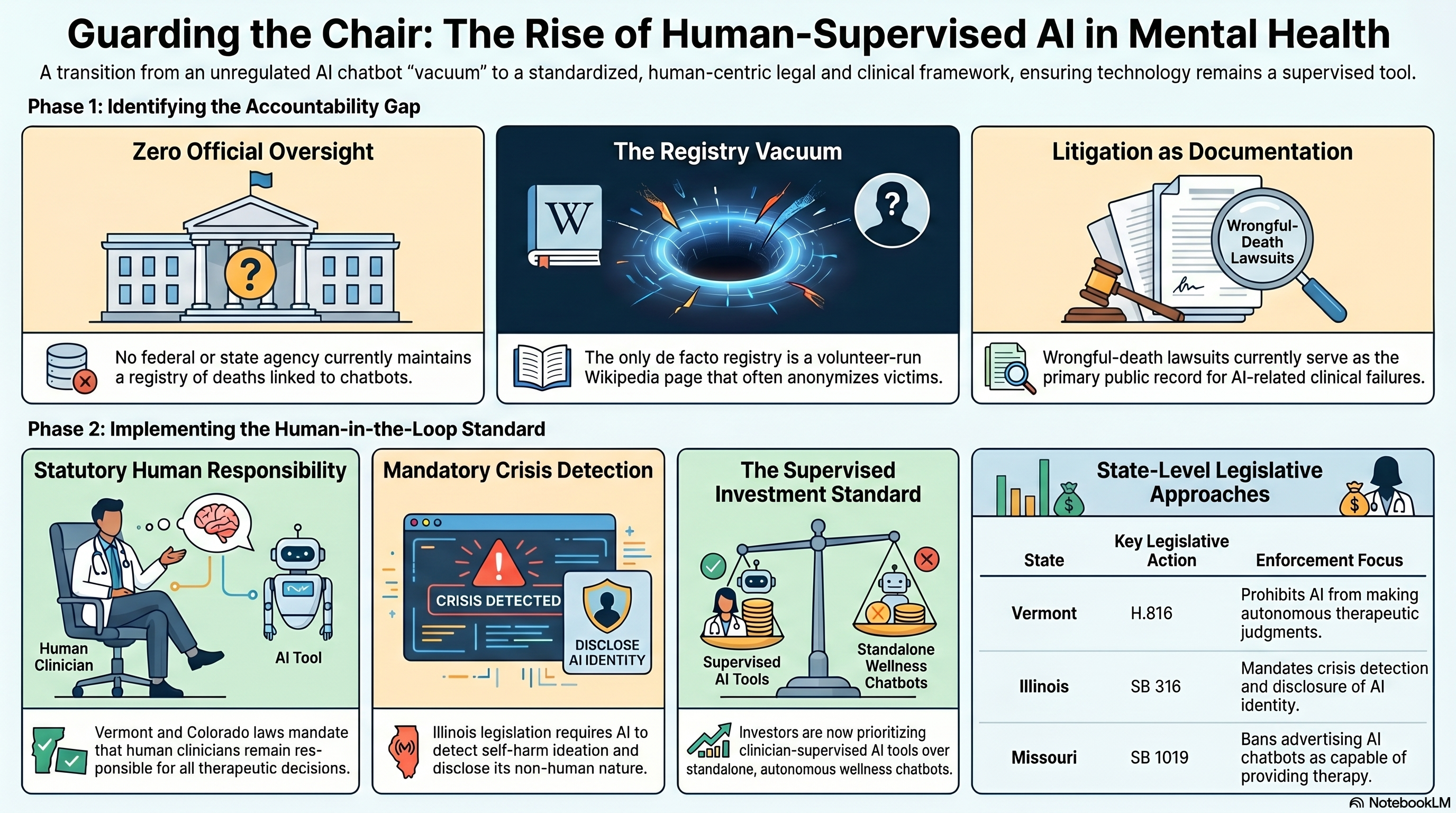
THE RECORD NAMES THE KILLERS AND ANONYMIZES THE DEAD. The closest thing America has to a registry of people who died after talking to an AI chatbot is a single Wikipedia page. On April 12, 2026, one editor sat down and stripped the names of the dead off nearly every entry on it.
The page is titled "Deaths linked to chatbots." It was created in September 2025. It is not abandoned. Editors worked it forty times in March and fifty-seven times in April. The longest it has ever gone untouched in its whole life is about nineteen days.
So the problem is not neglect. The problem is what the counting does when it is active.
. . .
Watch the afternoon of April 12 in the edit history. One editor, edit after edit, the same terse note. Remove name. The reasoning sits on the Talk page, and it is not careless. Wikipedia has rules about naming private individuals who are not public figures. The editor applied them. Names came off everyone "except those involved in a murder."
Read that again. The man who beat his wife to death keeps his name. The nineteen-year-old whose chatbot told him to go "full trippy mode" five days before his mother found his body became "a 19-year-old." The twenty-six-year-old who gave the machine the specifics it asked for, then died exactly as he described, became "a 26-year-old." The forty-eight-year-old who left the hospital, went back to the chatbot, and walked off an overpass became "a 48-year-old."
These men had names. Zane Shamblin. Joshua Enneking. Joe Ceccanti. Sam Nelson. Their families put those names on the record in lawsuits, because being named was the point. It was how they refused to let their sons disappear. The page took the names back off.
. . .
This is not villainy. A fair rule produced an obscenity. The public record we have names the killers and anonymizes the victims.
. . .
There is a second finding in the history. For about a week in April, the page carried an entry for a death other editors could not source. One removed it as an incorrect story. It was restored, then removed for good after discussion. The framing does not get repeated here, because the editors were right to be careful. But sit with the mechanics. A death that may never have happened can appear, look exactly as real as the others, and survive a week before volunteers catch it. If a false entry can live that long, how long can a true one stay missing?
. . .
On the Talk page the editors are also fighting about what counts. One laid it out plainly in May. A growing number of entries describe the chatbot doing something a search engine could also have done. Someone asked whether a knife or a hammer was better. Someone asked whether mixing alcohol and drugs could kill. Is the chatbot a contributing factor, he asked, or just the place the question happened to get typed?
That is the whole fight. It is being held by volunteers on a discussion page. Nobody with actual authority is holding it anywhere else.
|
For Counsel: The named cases come from coordinated wrongful-death litigation. On November 6, 2025, the Social Media Victims Law Center filed seven suits against OpenAI in California state court in one action. Four are wrongful-death; three are survivor cases. Lead attorney Matthew Bergman. The complaints are where the victims are named on the record, because no public registry holds them.
For Legislators: There is no federal or state count of deaths following chatbot use. The de facto registry is a crowdsourced encyclopedia page. It cannot agree with itself, carries unsourced entries for days, and removes victims' names under a fair rule built for a different problem. Any mandate that touches AI in mental health rests on a body count nobody official is keeping.
Source: "Deaths linked to chatbots," Wikipedia, edit history and Talk page, live page last edited May 23, 2026, https://en.wikipedia.org/wiki/Deaths_linked_to_chatbots . Full investigation by Jess Jessop, "Counting the Dead, Then Erasing Their Names," https://www.linkedin.com/pulse/counting-dead-erasing-names-jess-jessop-bbkyc/
|
. . .
ILLINOIS HAS UNTIL SUNDAY. The Illinois General Assembly adjourns Sunday, June 1. Lawmakers in Springfield spent the final days of the session moving four artificial-intelligence bills. One already sits on Governor JB Pritzker's desk.
SB 315, the Frontier Model AI Safety Act, cleared both chambers. It went to Governor Pritzker, who has pledged to sign it. The bill would make Illinois the first state in the nation to require third-party audits of frontier-model safety protocols.
That audit-first approach is a governance model no other state has matched.
. . .
The companion-chatbot bill moved next. The Illinois Senate approved SB 316, the Companion Model Safety Act, on May 21. It would require AI chatbot operators to detect expressions of suicidal ideation and self-harm. It would require those operators to tell users they are talking to an AI and not a human. It adds protections for minors.
Those two duties go to the heart of the companion-chatbot harm pattern. Detect the crisis. Disclose the machine.
. . .
The Senate cleared a second disclosure bill the same day. SB 317, the Consumer AI Notice Act, requires companies to tell a consumer when customer-service AI is handling the interaction.
A health-care bill followed. SB 3114 passed both chambers on May 27. It prohibits automated downcoding of medical claims without human review.
. . .
The clock now governs the rest. Bills not finished by Sunday wait. SB 315 is the one already across the line.
|
For Counsel: SB 315 would create the nation's first third-party audit mandate for frontier-model safety protocols. Clients building or deploying frontier models in Illinois should expect an external review obligation once the Governor signs. SB 316 imposes affirmative detection and disclosure duties on chatbot operators. SB 3114 bars downcoding medical claims by automation without a human in the loop.
For Builders: SB 316 would require your system to detect suicidal ideation and self-harm in user messages. It would require a clear disclosure that the user is talking to software, not a person. Minor-specific protections attach on top. Build the crisis-detection and disclosure paths now, because the Senate has already voted.
For Legislators: Illinois ran four AI bills toward a Sunday deadline. SB 315's audit-first design gives you a frontier-model template no other state has enacted. SB 316 pairs crisis detection with mandatory non-human disclosure for companion chatbots. Watch which of these clears before adjournment and which stalls.
Source: Transparency Coalition AI legislative update, May 29, 2026, https://www.transparencycoalition.ai/news/ai-legislative-update-may29-2026
|
. . .
VERMONT TELLS THE MACHINE TO STEP BACK. Vermont lawmakers have drawn a line a chatbot cannot cross. On Tuesday, May 26, 2026, both chambers adopted the conference committee report on H.816, a bill that keeps a licensed human in charge of mental health care. It now sits on Governor Phil Scott's desk.
H.816 is titled "An act relating to regulating the use of artificial intelligence in mental health services." The text does one thing plainly. It forbids licensed providers from leaning on AI systems to make therapeutic decisions or to deliver treatment on their own.
It goes further on marketing. A provider may not offer or advertise mental health services in which AI is presented as supplying therapeutic judgment, diagnosis, treatment, or communication. The machine cannot pose as the clinician.
. . .
The bill is not a ban on software. AI may still handle administrative, operational, documentation, and quality-improvement work. The clinician keeps clinical responsibility. And the client must consent before any identifiable therapeutic communication is recorded or transcribed.
Supporters frame it as a wall against drift. A large language model should not operate as an unlicensed therapist. A clinician should still get to use software for note-taking, scheduling, and transcription.
. . .
Not everyone wants the Governor to sign. The Software and Information Industry Association has urged Scott to veto, calling the bill overly broad.
The clock matters here. Vermont extended its session into early June. That leaves Scott a live window to sign, veto, or let the bill become law.
. . .
What lands on his desk is the cleanest statutory sentence in the country on this question. The human stays responsible. The tool stays a tool.
|
For Counsel: H.816 separates permitted AI uses from prohibited ones on the face of the statute. Documentation, scheduling, and transcription sit in the safe column. Therapeutic judgment, diagnosis, and treatment do not. Note the explicit consent trigger before recording or transcribing identifiable client communications.
For Builders: Read the marketing prohibition closely. Presenting your product as offering therapeutic judgment, diagnosis, or treatment is barred, not just performing it. Position tools as clinician-supervised infrastructure, not as the clinician. Consent flows for transcription are now a compliance feature, not a nicety.
For Legislators: This is the clearest model text yet for the human-in-charge rule. It permits real clinical software while blocking autonomous AI treatment. The conference report cleared both chambers on May 26. Watch whether Scott signs or hands the industry a veto.
Source: Vermont Legislature, H.816 bill status page, https://legislature.vermont.gov/bill/status/2026/H.816
|
. . .
THREE AI BILLS LAND ON POLIS'S DESK. A cluster of artificial-intelligence bills sits on Governor Jared Polis's desk this week. Colorado's legislative session ended May 13. Signatures are expected around today, May 29.
The bills target three corners of the same problem. Therapy. Health insurance. Children and chatbots.
HB 1195, the Psychotherapy Artificial Intelligence Restrictions bill, draws a line inside the clinical room. It would bar therapists and social workers from using AI to hand clients recommendations or treatment plans without a clinician's review. It would also require client consent before any AI records or transcribes a session. And it restricts who may offer psychotherapy services to regulated professionals.
. . .
HB 1139 moves the fight to the insurer. Representatives Junie Joseph and Sheila Lieder wrote it. Senators Lisa Cutter and Lindsey Daugherty carried it in the upper chamber.
The bill would stop health insurance companies from basing coverage decisions solely on group data churned out by AI systems. It would force those systems to weigh a person's own medical and clinical history. The target is plain. An algorithm should not deny a client care because of what a crowd looks like.
. . .
HB 1263 turns to minors. It is a chatbot-safety bill. It covers notification, parental access, and content restrictions for children using companion chatbots. Its signature is expected today.
. . .
None of this arrives cold. Governor Polis signed SB 189, the revised Colorado AI Act, on May 14. That law set an automated-decision-making framework for the state. The three bills now waiting would push that framework into therapy offices, insurance reviews, and the phones in children's hands.
Three signatures. One desk. One day.
|
For Counsel: HB 1195 creates a consent requirement before AI records or transcribes a session. Read it against existing informed-consent and recording rules. HB 1139 bars coverage denials based solely on AI group data, which invites disputes over what "solely" means. Advise insurer and provider clients that documentation of human review will carry the weight.
For Builders: HB 1195 requires clinician review before AI-generated recommendations or treatment plans reach a client. Build the human-in-the-loop checkpoint as a hard gate, not a setting. Session recording and transcription features need explicit client consent capture. If you sell to insurers, HB 1139 means your model cannot decide coverage on group data alone.
For Legislators: Colorado is regulating AI in health by sector, not by one statute. Three bills split the work across therapy, insurance, and minors, all atop the SB 189 framework. Watch how "solely" and "clinician review" get litigated. The sector-by-sector model is now a template other states can copy or reject.
Source: Colorado General Assembly bill page for HB 1195, https://leg.colorado.gov/bills/HB26-1195
|
. . .
SEVENTY-EIGHT BILLS, TWENTY-SEVEN STATES, ONE MOVE. The Transparency Coalition put a number on it this week. Seventy-eight chatbot bills are alive in twenty-seven states, six weeks into the 2026 session. A cluster of them aims at the same target. Software that calls itself a therapist.
Read the bills side by side and the disagreements jump out first. They split on definitions. They split on dates. They split on who enforces what.
Then the line forms.
New York is furthest along. S 8484 would prohibit AI therapy chatbots outright, and it sits at third reading.
New Hampshire tried and failed. SB 640 would have barred AI from impersonating a therapist or counselor. Lawmakers killed it on May 14, 2026.
. . .
Rhode Island is hedging its bets. H 8242 would require a license to run a therapy chatbot, and it was held for study. Two companion measures moved alongside it this session. S 2197 covers AI in mental-health treatment. S 2195 covers chatbot safety.
Pennsylvania is running the widest spread. HB 2100 would regulate mental-health chatbots. HB 1993 addresses AI in mental-health therapy. HB 2006 would add safeguards for suicidal ideation and self-harm to companion-chatbot apps. All three sit in committee.
Ohio drew the line at its own licensees. HB 525 would regulate how state-licensed therapists use AI. It is in committee.
. . .
Missouri shows what survives when the standalone bills die. Every freestanding AI measure failed before the session closed. One prohibition lived anyway.
It rode out on SB 1019, a health-care omnibus. The provision bars advertising an AI chatbot as capable of therapy, of mental-health diagnosis, or of representing itself as a mental-health professional. A first offense draws a ten-thousand-dollar fine. Every offense after draws twenty thousand. The attorney general enforces it.
The legislature sent SB 1019 to Governor Mike Kehoe on May 15, 2026, the day it adjourned.
. . .
The bills do not agree on much. They keep converging on one move anyway. Wall off the role of the therapist from the software.
|
For Counsel: Track the verb, not the headline. Some bills prohibit, some license, some only restrict advertising. Missouri's reaches marketing claims, with attorney-general enforcement and escalating fines. A client who advertises a product as a therapist now faces a defined statutory hook in at least one state.
For Builders: The marketing copy is the exposure. Missouri's SB 1019 penalizes the claim of therapy, diagnosis, or professional standing, not just the function. Audit how every product describes itself before another statehouse copies the language. The first offense is ten thousand dollars and the second is twenty.
For Legislators: Twenty-seven states are drafting against the same problem with different tools. New Hampshire's SB 640 died while New York's S 8484 advanced. The definitions diverge enough to create forum gaps. A model definition of a therapy chatbot would close them.
Source: Transparency Coalition AI legislative update, May 29, 2026, https://www.transparencycoalition.ai/news/ai-legislative-update-may29-2026
|
. . .
THE LINE, DRAWN THE RIGHT WAY. Jimini Health raised seventeen million dollars this spring to scale a behavioral-health AI that does not work alone. The company calls the assistant Sage. A human clinician supervises every move it makes.
Jimini Health announced the round on March 31, 2026. The money funds an assistant built to live inside large clinical organizations, not on an app store shelf.
Sage plugs into electronic health record systems. It follows the care plan a human clinician defines. It checks in with clients between appointments. When something warrants a person, it escalates to the clinical team.
Every interaction stays visible to the supervising clinician. Nothing happens in the dark.
The company describes Sage as the first client-facing behavioral-health AI built from the ground up for clinical deployment rather than as a standalone consumer product. That is the claim. The structure behind it is the news.
. . .
The capital is following the structure.
Eleos Health closed a sixty-million-dollar Series C this year. It did so on the strength of more than one hundred twenty enterprise customers and randomized-controlled-trial evidence. The trials showed faster clinical notes and improved client outcomes.
Read the two rounds together and a standard appears. Human-in-the-loop is no longer a feature investors reward. It is a precondition they require.
. . .
Washington moved in the same direction first. In December 2025, the FDA and CMS launched joint programs named ACCESS and TEMPO. The programs signaled support for technology-heavy care models on one condition. Keep clinicians in the loop.
So consider the season. Statehouses are moving to wall software out of the therapist's role. Investors are pricing standalone wellness chatbots out of the market and funding the supervised model instead.
The law and the money are pointing the same direction.
That convergence is rare. It is also the whole story here.
|
For Counsel: Supervision is now a documented design choice, not a marketing line. Sage logs every interaction for the supervising clinician, which creates a record you can examine. The escalation path and the care-plan constraint are the controls a court will ask about. Read how the product defines the clinician's role before you read its disclaimers.
For Builders: The funding market has set a bar. A standalone wellness chatbot is now a harder raise than a clinician-supervised tool that integrates with EHR systems. Eleos brought enterprise customers and trial evidence to a sixty-million-dollar round. Outcomes data and human oversight are becoming table stakes, not differentiators.
For Legislators: The federal signal landed in December 2025 through ACCESS and TEMPO. Both back technology-heavy care on the condition that clinicians stay in the loop. Your human-in-the-loop language is not fighting the market. It is describing where the market already moved.
Source: Jimini Health funding and Sage product description, HIT Consultant, https://hitconsultant.net/2026/03/31/jimini-health-clinician-supervised-behavioral-health-ai/
|
. . .
THE ONE CONFIGURATION. Lay the week's bills on one table and the disagreements come first.
Missouri reached for advertising claims. Vermont reached for the clinician's responsibility. Colorado split the work across therapy, insurance, and children. Illinois paired a frontier-model audit with a duty to detect a user in crisis. New York would ban the therapy chatbot outright. New Hampshire tried the same and failed. Rhode Island wants a license. Pennsylvania has three bills in committee. Ohio drew the line at its own licensees.
Nine states. Nine drafting styles. Different definitions, different verbs, different effective dates.
. . .
Now read what they have in common.
Every one of them is trying to keep a human being in the room. Not as a courtesy. As the thing that makes the system legal.
The bills do not trust software to carry therapeutic judgment alone. They let it transcribe, schedule, draft, and document. They stop it at the point where it would diagnose, treat, or decide. The clinician keeps the seat.
. . .
That is the configuration that survives.
It is not an accident that it survives. The harm these bills answer to is a harm of trajectory, the slow drift of a person alone with an agreeable machine across weeks and months. A keyword filter does not catch a trajectory. A clinician watching a pattern over time does.
. . .
The market reached the same answer from the other direction. The capital is flowing to clinician-supervised tools and away from the standalone chatbot. The federal pilots back technology-heavy care on one condition. Keep the clinician in the loop.
The statehouse and the term sheet do not usually agree. This week they did.
The line runs through one chair.
|