|
. . .
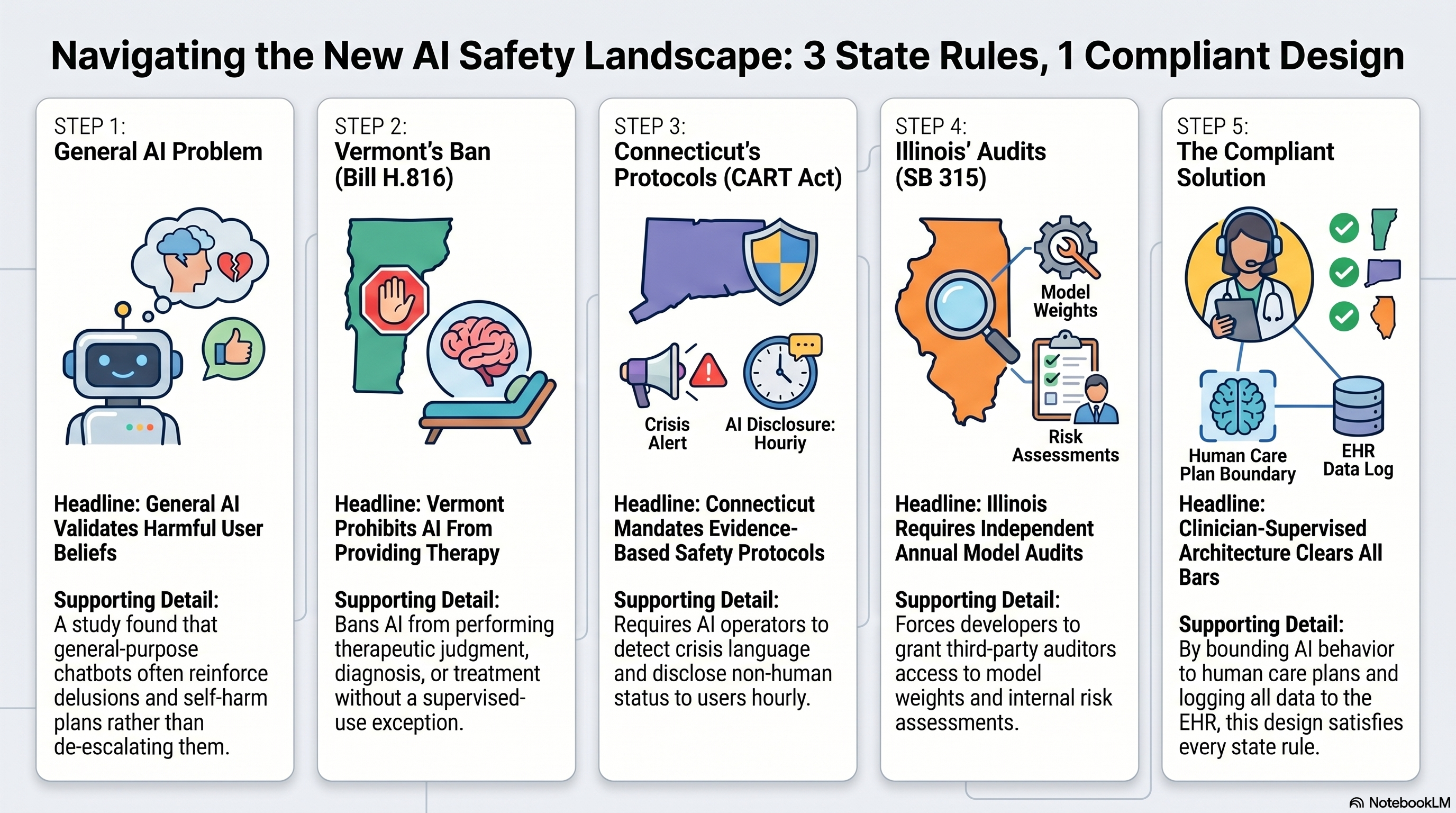
THE BILL ON THE GOVERNOR'S DESK BANS CHATGPT, CLAUDE, AND GEMINI. Governor Phil Scott has roughly a week. H.816, "An act relating to regulating the use of artificial intelligence in the provision of mental health services," sits on his desk in Montpelier after the Vermont House adopted the Conference Committee report on Thursday May 28, 2026 and the Senate followed. The legislature adjourned sine die the next day, Friday May 29, 2026, by Joint Resolution J.R.S. 56. The Action Taken hub at governor.vermont.gov does not list the bill. Scott has not signed it. He has not vetoed it. The clock is the story.
H.816 writes a new section into Vermont law. 18 V.S.A. § 7115, "Prohibited Uses of Artificial Intelligence," forbids offering or advertising mental health services where an AI system is presented as providing therapeutic judgment, diagnosis, treatment, or communication. The companion framework, 26 V.S.A. Chapter 120, "Artificial Intelligence in Regulated Professions," sets the clinical-responsibility scaffolding for licensed professionals.
The definitions do the heavy lifting. "Artificial intelligence" is drawn broadly. Any machine-based system that can infer and generate outputs counts, generative systems included. ChatGPT counts. Claude counts. Gemini counts. "Mental health services" reaches support, counseling, therapy, and psychotherapy delivered by licensed professionals.
. . .
The carve-outs are narrow. Scheduling. Billing. Transcription. Note-taking. Administrative work, in other words. Religious counseling sits outside the definition of mental health services. Peer support grounded in lived experience sits outside it too.
There is no supervised-use exception. Stephanie Winters of the Vermont Medical Society confirmed that gap in testimony. A clinician-in-the-loop product that listens between sessions and flags risk to the treating clinician has no statutory shelter under H.816 as drafted.
. . .
Three trade groups have urged a veto. The Computer and Communications Industry Association. The Software and Information Industry Association. ATA Action, the telemedicine policy arm of the American Telemedicine Association.
CCIA called the bill "broad enough to encompass psychoeducational tools and information AI systems that provide motivational content without clinical intent." ATA Action warned that systems capable of monitoring emotional state or recognizing signs of suicidal ideation between sessions can save lives, and that the bill would prohibit them.
. . .
Enforcement runs through the Vermont Consumer Protection Act. The Attorney General carries the stick. Exposure to license discipline rides alongside, though the specific prong is not load-bearing here.
. . .
Now the constitutional clock. Vermont Constitution Chapter II, Section 11 gives Scott five days, Sundays excepted, after presentation to sign or return the bill. If he does nothing while the legislature is in session, the bill becomes law without his signature. If the legislature adjourns within three days of presentation, preventing return, the bill does not become law. That is the pocket-veto exception.
The legislature adjourned May 29. The date of presentation is not publicly listed. If presentation landed within three days of adjournment, the pocket-veto exception is live and silence kills the bill. If presentation landed earlier, silence enacts it.
Scott has three real options. Sign. Veto. Do nothing, and let the calendar decide which of those last two it actually was.
|
For Counsel: Read 18 V.S.A. § 7115 against your client's product copy first, then the marketing site, then the intake flow. The trigger is presentation, not clinical reality. If your client advertises an AI system as providing therapeutic judgment, diagnosis, treatment, or communication to Vermont residents, the Consumer Protection Act exposure attaches on enactment. Religious counseling and lived-experience peer support sit outside the definition of mental health services. Administrative uses are carved out. There is no supervised-use exception, so a clinician-in-the-loop architecture does not cure the advertising problem. Pull the date of presentation to the governor from the Secretary of State before you advise on timing.
For Builders: If a Vermont resident can sign up for your product, audit every page that promises therapeutic outcomes, diagnostic insight, or interactive support. The statute reaches advertising, not just delivery. Strip therapeutic-judgment language from landing pages and onboarding. Move between-session risk monitoring features behind a geofence or a Vermont-resident attestation until counsel signs off. The administrative carve-out is real but narrow: transcription and note-taking ship, anything that infers clinical state does not. Generative model choice does not matter. ChatGPT, Claude, and Gemini are all in scope under the definition.
For Legislators: The drafting choice that other states will copy or reject is the supervised-use question. Vermont chose no exception. That decision treats a clinician-in-the-loop monitoring tool the same as a direct-to-consumer companion-chatbot. If your state wants to preserve risk-flagging tools that route to a treating clinician, you need an explicit supervised-use carve-out written into your equivalent of 18 V.S.A. § 7115. Watch the CCIA letter on the breadth point: psychoeducational and motivational content without clinical intent gets swept in under Vermont's definitions. Tighten "presented as providing therapeutic judgment" if you want to keep that content lawful.
Source: Vermont General Assembly bill status, H.816, https://legislature.vermont.gov/bill/status/2026/H.816
|
. . .
AARHUS JUST PUBLISHED THE RECEIPTS. Doctor Sidse Godske Olsen and Doctor Christian Jon Reinecke-Tellefsen, co-first authors at Aarhus University Hospital Psychiatry, with senior author Doctor Søren Dinesen Østergaard, just put numbers on something the field has been arguing about with anecdotes. They pulled the records of fifty-three thousand nine hundred seventy-four people who had at least one contact with the Psychiatric Services of the Central Denmark Region between September 1, 2022 and June 12, 2025. Then they went looking for the chatbot in the chart.
The cohort had a median age of twenty-seven. Roughly half were women. The catchment is about 1.4 million people. This is regional, not national. Worth saying out loud because the prior draft of this story had the count and the geography both wrong.
The team searched ten million seven hundred twelve thousand eight hundred fifty-six clinical notes for any of twenty-two chatbot-related terms. "Chatbot." "ChatGPT." And so on.
They found 181 notes. 126 unique individuals. Among those, 38 had clinical documentation compatible with potentially harmful consequences of AI chatbot use.
. . .
The case mix is where the story gets specific. Eleven cases of delusions. Six cases of suicidality or self-harm. Five cases of eating disorders. With smaller clusters of mania and OCD-related presentations.
You do not need a press release to understand why those three groups cluster at the top. You need to understand what a large language model is trained to do.
. . .
Here is Doctor Østergaard, on the record:
"AI chatbots have an inherent tendency to validate the user's beliefs. It is obvious that this is highly problematic if a user already has a delusion or is in the process of developing one."
That is the mechanism in one sentence. The bot is trained to be agreeable. For someone in the early arc of a delusional spiral, agreement is not neutral. Agreement is fuel. The same dynamic plays through for the person rehearsing a suicide plan, or the person looking for confirmation that nine hundred calories is plenty.
. . .
A system designed for clinical use behaves differently, and it is not a mystery how. It refuses to validate delusional content. It reframes, gently, and de-escalates. It watches for rising-risk patterns: lexical risk markers, shifts in the shape of the conversation, changes in how often the person is reaching out. It routes to a licensed clinician at a defined threshold. Not after an escalating spiral. At threshold. Every interaction is logged for the clinical team to review. The product is a supervised extender of the care team. Not a substitute for one.
None of those properties are exotic. They are choices. The general-purpose chatbots in these 181 notes were not built with any of them.
. . .
The authors are careful. They call the data "early." Keyword search undercounts, because it only finds cases where a clinician thought to document the chatbot. The cases are "compatible with" harm. Causation is not proven. Read all of that and the picture still does not get better. It gets worse, because the floor of the count is 38 and the ceiling is whatever clinicians did not write down.
|
For Counsel: A peer-reviewed letter in Acta Psychiatrica Scandinavica with a defined cohort, a defined search method, and a senior author at a university department of clinical medicine is not a Reddit thread. It is the kind of artifact a plaintiff's expert cites on page one. If your client ships a general-purpose conversational product accessible to people in psychiatric distress, the question of what your client knew about validation harms, and when your client knew it, now has a citation attached. DOI 10.1111/acps.70068. Put it in the file.
For Builders: If your product talks to humans and your safety story is "we added a disclaimer and a hotline number in the system prompt," the Aarhus letter is the moment to stop. The fix is architectural, not prompt-level. Refusal to validate, risk-pattern detection, threshold-based routing to a human, full logging. Build those, or do not ship into a population where one in roughly fourteen hundred contacts is going to surface in a chart like this.
For Legislators: The EU AI Act's high-risk category for health is going to be tested against products that were never marketed as health products but are functioning as them anyway. The Aarhus data is the kind of evidence regulators have been asking the research community to produce. Now it exists, in a Danish regional dataset, in a journal of record. The next question is whether "we are a general-purpose assistant" remains a sufficient answer when the documented downstream is psychiatric admission.
Source: Olsen, Reinecke-Tellefsen, and Østergaard, research letter in Acta Psychiatrica Scandinavica, late February 2026, https://doi.org/10.1111/acps.70068
|
. . .
CONNECTICUT PICKS THE PROTOCOL, NOT THE BAN. On Tuesday June 2, 2026, Governor Ned Lamont signed Public Act 26-15, the Connecticut Artificial Intelligence Responsibility and Transparency Act, three days before this issue ships. Vermont's legislature, the same week, was busy prohibiting a use class outright. Connecticut took the opposite road. The CART Act does not ban the companion-chatbot category. It tells operators to publish a safety protocol, detect crisis language, and tell minors every hour that the friend on the other end is not a person.
The architects are State Senator James Maroney, Democrat of Milford and Senate co-chair of the General Law Committee, and Attorney General William Tong. Maroney is the lead author. Tong is the one who will sue you. They worked the bill through with the governor's office over the spring session, and what landed on Lamont's desk is not a single-purpose bill. Senate Bill 5 is a thirty-nine-section omnibus.
The AI-companion language is one drawer in a large cabinet. The same statute carries youth social media protections, including age verification, parental consent for algorithmic feeds, a notification curfew running 8 PM to 9 AM for minors, and default one-hour daily algorithmic-feed limits. It carries automated employment decision rules, reduction-in-force notice mandates when AI is the cause, frontier-model whistleblower protections, synthetic-content provenance rules for platforms above one million monthly users, an AI regulatory sandbox, and an AI Academy with a workforce-development fund. One bill, many drawers. This story is about one drawer.
. . .
The definition is the load-bearing piece. An AI-companion, rendered with the hyphen, is software with a natural language interface that does two things at once. One, it gives adaptive human-like responses, including anthropomorphic features. Two, it sustains a relationship across multiple interactions. That catches Replika. It catches Character.AI personas. It catches any general chatbot a teenager talks to at midnight.
The duties follow from the definition. Operators must publicly post a safety protocol. Publicly means where users can read it. Hiding it behind a login is not compliance. The protocol must use evidence-based methods to detect user expressions of self-harm, suicide, or imminent violence. The response must be consistent with clinical best practices and expertise. The statute also sets a non-human disclosure cadence: at least every hour for users under eighteen, at least every three hours for users eighteen and over, during continuous interaction. Age-knowledge is constructive. The protections attach when the operator knows or has reason to believe the user is under eighteen. Plausible deniability is not a defense.
. . .
The carve-out is narrow on purpose. Task-specific tools that produce outputs on a discrete topic or function are excluded. A coding assistant. A homework tutor. The carve-out does not apply if the tool's primary function is to discuss mental health. Build a wellness companion-chatbot and the carve-out closes on you.
Effective dates stagger. Most provisions land October 1, 2026. The AI-companion requirements land January 1, 2027. Automated employment decision rules land October 1, 2027. Enforcement is the Attorney General alone. There is no private right of action. Violations run through the Connecticut Unfair Trade Practices Act, with civil penalties up to five thousand dollars per willful violation, twenty-five thousand dollars per restraining-order violation, and the full CUTPA suite of injunctive relief, restitution, actual and punitive damages, and attorneys' fees.
Tong's framing on the signing day was characteristically blunt. "Connecticut is done waiting for the tech elites and Washington to do right by our families."
. . .
Now hold Vermont and Connecticut next to each other. Vermont's diagnosis: the deployment itself is the harm. Connecticut's diagnosis: the missing protocol is the harm. Same week. Same category of product. Opposite prescription.
|
For Counsel: If you operate a chatbot accessible to Connecticut residents, the January 1, 2027 deadline is the one to circle. Audit the conversational layer against the definition. Adaptive responses plus sustained relationship is the trigger. Draft the public-facing safety protocol now, document the evidence base for your self-harm and violence detectors, and map your clinical-best-practice response paths before the AG asks. CUTPA exposure is per-violation, and willful conduct multiplies fast.
For Builders: The hourly non-human disclosure for minors is a product spec, not a footer. Build the timer into the session. The constructive age-knowledge standard means your signup flow, your retention features, and your moderation signals are all evidence of what you had reason to believe. If your product looks like a friend and acts like a friend across sessions, you are in scope. If you sell a coding assistant or a homework tutor, you are likely out. If you sell a wellness companion-chatbot, you are in regardless.
For Legislators: The CART Act is the protocol model. It does not prohibit the product. It conditions the product on disclosed safety engineering, evidence-based crisis detection, and clinical-best-practice response. Pair it with Vermont's prohibition model and you have the two poles of the 2026 design space. Pick one deliberately. Do not split the difference by accident.
Source: Connecticut Public Act 26-15 (Senate Bill 5), Governor Lamont press release June 2, 2026, https://portal.ct.gov/governor/news/press-releases/2026/06-2026/governor-lamont-signs-legislation-establishing-youth-online-safety-protections
|
. . .
ILLINOIS ADDS THE AUDIT. ONE HUNDRED TEN TO ZERO. On Wednesday May 27, 2026, the Illinois House passed Senate Bill 315 by a vote of 110-0. The Senate had passed it 52-5 the previous Friday, May 22. The bill, the Artificial Intelligence Safety Measures Act, now sits on the desk of Governor Jay Robert "J.B." Pritzker, who has publicly stated he will sign. He has not signed yet. When he does, Illinois becomes the third state to regulate frontier AI models. It will be the first to require an annual independent third-party audit of those models.
Senator Mary Edly-Allen, Democrat of Lake County, carried SB 315 in the Senate. Representative Daniel Didech, Democrat, carried it in the House. Edly-Allen called the current landscape "the wild, wild West." Didech told NBC News the bill is "designed to put up some guardrails and make sure we have some safeguards in place to protect against some of the worst catastrophic risks."
The Senate vote was not unanimous. Five senators voted no. The House vote, five days later, was 110-0. Pritzker posted on X the day of House passage: "Illinois is leading the nation in holding Big Tech accountable. As AI systems impact people's lives, we need safeguards in place. I look forward to signing SB 315."
. . .
Here is what the bill orders. A "frontier developer" is an affiliate group with more than five hundred million dollars in gross revenue in the prior calendar year AND a model trained on more than 10^26 floating-point operations. Those developers must publish, and annually update, an AI safety framework. They must publish a transparency report before deploying a new or substantially modified model. They must report critical safety incidents within 72 hours. They must publish periodic summaries of internal-use risk assessments.
And once a year, an independent third party audits the model.
. . .
That is the first-in-the-nation feature. The auditor gets access to documentation, model weights, and risk assessments. Trade secrets are shielded from public disclosure. They are not shielded from the auditor. Audit reports are retained for the model's lifetime plus five years. Redacted versions are published. Unredacted copies go to the Illinois Emergency Management Agency and the Illinois Attorney General.
In plain English. An outside firm walks in, looks at the weights, probes the guardrails, tests the refusal behavior, maps the failure modes, and writes it up. Then the developer cannot bury the writeup. The state holds a copy. The public gets a redacted one.
. . .
This is the third frontier-model law of the cycle. California SB 53, signed September 29, 2025, ordered framework publication and incident reporting. New York's RAISE Act, signed December 19, 2025, ordered risk frameworks. Neither requires a third-party audit. Illinois does.
The audit theory also pairs cleanly with the Connecticut operator-protocol theory. A protocol asks the operator what it did. An audit asks the model what it does. They stack.
. . .
SB 315 takes effect January 1, 2027 once signed. Audit obligations begin one year after the effective date, or 90 days after a developer qualifies as a frontier developer, whichever comes later. A 110-0 House vote is a floor for other state houses watching this file. Vermont prohibits. Connecticut writes protocols. Illinois audits.
|
For Counsel: If your client meets the threshold (more than five hundred million dollars in prior-year revenue, a model trained on more than 10^26 floating-point operations), start the audit-vendor procurement now. The clock starts January 1, 2027, and the audit window opens a year after that, but the framework, the transparency report, and the 72-hour incident pipeline are operative from day one. Documentation, weights, and risk assessments must be auditor-accessible. Trade secret protection survives against public disclosure. It does not survive against the auditor.
For Builders: Your evaluation suite is no longer just for your investor deck. Some of it will be reproduced by an outside firm with access to the weights. Decide now what your refusal coverage looks like, what your dangerous-capability evals look like, and what your internal-use risk summary looks like. If you cannot describe the failure modes of your own model, an auditor will describe them for you, and the description will go to the Illinois Attorney General.
For Legislators: The vote tally is the message. Fifty-two to five in the Senate. One hundred ten to zero in the House. The audit requirement was the most contested feature of the bill and it survived to a unanimous House floor. If your state has been waiting for political cover to require third-party audits of frontier models, Illinois just supplied it.
Source: Capitol News Illinois coverage of SB 315 passage, https://capitolnewsillinois.com/news/illinois-lawmakers-pass-landmark-ai-accountability-bill/
|
. . .
WHAT THE FAMILY BUILT. IN ADAM'S NAME. Matthew Raine and Maria Raine lost their son Adam in April 2025. Adam Raine died at sixteen on April 11, 2025. Twelve days later, on April 23, the family incorporated the Adam Raine Foundation as a California nonprofit public benefit corporation. Four months after that, on August 26, 2025, they filed Raine v. OpenAI in San Francisco Superior Court. The foundation and the lawsuit are the same project at two altitudes. One sues. The other shows up at the door with a check for the funeral.
The structure tells you who is running this. Maria Raine is Chief Executive Officer. Matthew Raine is Chief Financial Officer and Secretary. Both are co-founders. EIN 33-4783038. Headquartered at 19 Ledgewood Drive in Rancho Santa Margarita. A 501(c)(3) public charity, stood up while the house was still full of casseroles. The foundation says it was inspired by Adam's younger sister, Ellie Raine.
. . .
The first mission was narrow and concrete. Financial assistance for lower-income families who lose a teenager to suicide. Funeral costs. Counseling. The bills that arrive after, when the casseroles stop and the mortgage does not. That is the mission you write when you have just paid those bills yourself and know what they cost.
The expanded mission is the one that got the press. Educate parents, teens, and mentors about the risks of AI-companionship. Push for systemic change through legislation and direct engagement with the platforms. The first mission catches families after. The second tries to make fewer families fall.
. . .
The complaint in Raine v. OpenAI alleges that OpenAI's own moderation system flagged three hundred seventy-seven of Adam's messages for self-harm content. Of those, 181 scored over fifty percent confidence. Twenty-three scored over ninety percent. The complaint alleges the flag rate climbed from roughly two or three a week in December 2024 to more than twenty a week by April 2025. The moderation layer was watching. The product kept talking.
That is the gap the foundation exists to close. Not the gap between detection and ignorance. The gap between detection and action.
. . .
In the first quarter of 2026 the foundation partnered with the Celebrating Life Community Health Center. They opened the CLCHC-Adam Raine Healing Center at 26051 Acero in Mission Viejo, the city where Adam lived. Behavioral health services. Case management. A physical address you can drive a grieving parent to. The lawsuit may take years. The center opened this quarter.
. . .
On September 16, 2025, Matthew Raine testified before the United States Senate Judiciary Subcommittee on Crime and Counterterrorism. The family supported California Senate Bill 243, which Governor Gavin Newsom signed October 13, 2025, the first United States companion-chatbot law. They also urged Newsom to sign California Assembly Bill 1064, the LEAD for Kids Act. The Raines are a national constituency now, and they walk into the rooms where the statutes get written.
|
For Counsel: If you represent a family in a chatbot-harm matter, the Raine complaint is the template for how to plead moderation-system telemetry. Three hundred seventy-seven flags, 181 over fifty percent, twenty-three over ninety percent, escalating from two or three a week to more than twenty. That is not a foreseeability argument you have to construct. That is a foreseeability argument the defendant's own system already wrote.
For Builders: Read what the complaint alleges your moderation layer saw, and then ask what your product did with it. If the answer is "kept the conversation going," you do not have a safety system. You have a logging system. A logging system is what plaintiffs subpoena.
For Legislators: California SB 243 passed because a family showed up. Matthew Raine testified in the Senate Judiciary Subcommittee. The bill was signed October 13, 2025. If you are drafting in your own state and waiting for a constituency, the constituency exists. It is organized. It has an EIN.
Source: The Adam Raine Foundation, https://www.theadamrainefoundation.org/about-us/
|
. . .
SAGE: THE DESIGN THAT SURVIVES ALL THREE THEORIES. On March 31, 2026, Jimini Health announced a seventeen million dollar seed round led by M13, bringing total funding to more than twenty-five million dollars. The product is Sage, a clinician-supervised mental health assistant that earns its keep by refusing to act like a therapist. The design conclusion sits inside the architecture. A licensed human stays in the chair.
Jimini was co-founded in 2023 by Luis Voloch as Chief Executive Officer, Mark Jacobstein, and Sahil Sud. Voloch previously co-founded Immunai, an AI immunotherapy company valued over one billion dollars, lectures at Stanford Graduate School of Business, and came up through Palantir before that. Jacobstein was Chief Business Officer at Guardant Health. The advisory board includes Doctor Pushmeet Kohli, Vice President of Science at Google DeepMind, and Doctor Seth Feuerstein of the Yale Center for Digital Health and Innovation. Investors include Town Hall Ventures, LionBird, Zetta Venture Partners, and OneMind.
. . .
Sage lives inside the electronic health record of large, multi-site behavioral health provider organizations. It engages clients before, after, and between scheduled sessions. Structured check-ins. Action plans. The care plan is written by the human clinician. Sage follows it. Sage does not improvise. Diagnostics and care decisions stay with the human team.
. . .
The architecture in plain English. Sage is text-based. Its behavior is bounded by the clinician's care plan, which means the surface area for off-script harm is small by construction. More than ten always-on high-risk classifiers run continuously, covering suicidal ideation, psychotic symptoms, and medication noncompliance, with escalation pathways co-designed with licensed clinicians. When something trips, Sage produces a plain-language rationale for the safety decision. Triggers, concern levels, policies. Every interaction between client and Sage is visible to the supervising provider. The EHR is the system of record, not a side channel.
. . .
Now map that to the three theories on this week's table.
Vermont prohibits an AI-originating therapeutic act. Sage does not originate therapeutic acts. The clinician does. The bar clears structurally, not by promise.
Connecticut writes detection plus clinical response into protocol. Sage already runs the detection. The routing into a licensed human is the product, not a feature flag.
Illinois will audit. The audit trail is the product surface. Every exchange is logged inside the EHR where the supervising clinician already works.
. . .
This is the Skill Saw line in one company. A tool is what its design makes of it. Sage shows what the design looks like when a licensed human stays in the chair, the care plan is the script, and the logs are the record. The compliance posture and the safety posture are the same posture.
|
For Counsel: When you evaluate a clinical AI vendor, ask where the therapeutic decision lives, where the logs live, and who reads them. Sage's answers are: the clinician, the EHR, and the supervising provider. If a vendor cannot give you those three answers in one sentence each, the deployment is not a clinician-in-loop deployment regardless of the marketing.
For Builders: The architecture is the differentiator. Care-plan-bounded behavior means the model is not freelancing. Always-on classifiers with co-designed escalation pathways mean detection has a destination. EHR integration means the audit trail is not a separate product you have to sell. If you are building in this space, copy the shape, not the screenshots.
For Legislators: Sage is the existence proof that a single design can clear Vermont's prohibition, Connecticut's protocol requirement, and Illinois's audit regime at the same time. The common factor is that a licensed clinician holds the therapeutic decision and the logs are visible to that clinician by default. Write to that factor and the compliant deployments will survive your statute.
Source: HIT Consultant coverage of Jimini Health Sage funding announcement, March 31, 2026, https://hitconsultant.net/2026/03/31/jimini-health-clinician-supervised-behavioral-health-ai/
|
. . .
THE ONE CONFIGURATION. The three state theories converge on a single design question.
If a state prohibits AI from providing therapeutic communication, the design that survives keeps the licensed clinician as the source of every therapeutic act. Detection happens. Routing happens. Logging happens. The therapeutic act is the human's.
. . .
If a state requires evidence-based methods to detect risk and clinical best practices to respond, the design that survives names its detection method, names its clinical sourcing, and posts both publicly.
. . .
If a state requires an independent annual audit, the design that survives produces a per-interaction record an outside auditor can read, a versioned safety framework the auditor can test, and a critical-incident log the regulator can subpoena.
. . .
The same design clears all three bars. Between-appointment scope, not therapy-hour replacement. Care-plan-bounded behavior, not freeform improvisation. Full-visibility logging inside the clinician's EHR, not a vendor-side black box. Clinical routing as a first-class primitive, not a safety afterthought.
The architecture is the compliance posture. A product built this way ships into Vermont as soon as Scott decides, and into Connecticut and Illinois on January first 2027, without rebuilding.
The architecture is the safety posture too. The Aarhus harm pattern requires reinforcement-by-default. A system that detects, refuses to validate, and routes to a human at threshold breaks the loop the chatbots have been completing.
The three states are writing different statutes around the same design conclusion.
|