|
. . .
LOCKDOWN MODE IS THE TOGGLE. DEFAULT MODE IS STILL THE DEFAULT. OpenAI rolled out Lockdown Mode to ChatGPT on Thursday, June 4, 2026. The feature is opt-in. CEO Sam Altman spent the same week meeting lawmakers in Washington on AI policy.
Lockdown Mode is a toggle. The user flips it. Once flipped, ChatGPT disables live web browsing and falls back to cached content. It blocks image retrieval from the web. It shuts off deep research, including shopping research. It kills agent mode. It blocks file downloads inside data analysis. It cuts network access from Canvas-generated code.
OpenAI framed the feature as a defense against prompt injection. Malicious instructions hidden inside webpages can hijack a model and extract sensitive data. Lockdown Mode narrows the attack surface.
OpenAI also said the quiet part. Even with Lockdown Mode on, ChatGPT can still be compromised by prompt injections from cached web content or uploaded files.
. . .
The rollout reaches eligible personal accounts on Free, Go, Plus, and Pro. Self-serve ChatGPT Business accounts are included.
The same announcement bundled a separate change. ChatGPT is now trained to detect signs of mental and emotional distress more accurately. The model is guided to de-escalate and point users to real-world crisis resources. OpenAI says it worked with more than one hundred seventy mental-health experts on the training.
A real-time router directs sensitive turns inside a conversation to reasoning models. When a user has GPT-5 Auto selected, or a non-reasoning model, the system reroutes acute-distress turns to GPT-5 Instant.
. . .
OpenAI says a trusted-contact feature is coming. An adult user will be able to designate someone to receive a notification when the user may need extra support.
Parental controls already exist. This spring OpenAI quietly extended them to group chats, the ChatGPT Atlas browser, and the Sora app. The controls require a parent and a teen to actively link accounts. Once linked, parents can manage settings, set quiet hours, and receive safety alerts in certain situations.
If an under-eighteen user shows suicidal ideation, OpenAI will attempt to contact the linked parent. If no parent is linked, OpenAI will attempt to contact local authorities in cases of imminent harm.
. . .
OpenAI also shipped Dreaming V3 the same week. The persistent-memory architecture went live for Plus and Pro users in the United States on June 4. Free and Go expansion follows. Dreaming V3 runs background synthesis after a conversation ends. It builds a user profile without an explicit "remember this" command.
Three surfaces. Three defaults. Lockdown Mode is opt-in. Parental linking is opt-in. Sensitive-conversations routing is on by default.
|
For Counsel: Opt-in safety toggles shift the duty-of-care analysis. A vendor that ships a safer mode but defaults users out of it has documented the safer state and chosen not to deliver it. Note the carve-out OpenAI itself wrote into the announcement: Lockdown Mode does not close prompt-injection risk from cached pages or uploaded files. The trusted-contact feature creates a new disclosure pathway worth tracking against state privacy regimes.
For Builders: A real-time router that reclassifies a turn mid-conversation is now table stakes in this product category. The acute-distress hand-off from GPT-5 Auto to GPT-5 Instant is the pattern to study. Note that Lockdown Mode trades capability for safety. Browsing, agent mode, and Canvas network access all go dark. If your product offers a similar mode, decide whether the safer state is default or toggle and own the choice.
For Legislators: Two of the three child-safety mechanisms OpenAI announced require an affirmative action by a parent or by the user. The default surface still serves the minor whose parent never linked an account. Statutes that key duties to the default product behavior, not to optional modes, will capture the actual exposure. Statutes that accept "we offer a safer mode" as compliance will not.
Source: OpenAI announcement on Lockdown Mode and Elevated Risk labels in ChatGPT, June 2026. https://openai.com/index/introducing-lockdown-mode-and-elevated-risk-labels-in-chatgpt/
|
. . .
A THIRTEEN-YEAR-OLD, THREE HUNDRED PAGES, AND THE LAW COLORADO WROTE. On Wednesday, June 3, 2026, Governor Jared Polis signed Colorado HB 1195. The bill bars licensed mental-health professionals from letting an AI system speak directly to a client in therapy without the clinician in the room in real time. It is the first law of its kind in the country.
Juliana Peralta was thirteen years old. She lived in Colorado. She died by suicide on November 8, 2023.
For roughly three months before her death, from August through November 2023, Juliana spoke daily with a chatbot called "Hero" inside the Character.AI app. Her parents later recovered about three hundred pages of those chats.
. . .
In October 2023, Juliana typed a sentence into the app. "I'm going to write my god damn suicide letter in red ink (I'm) so done."
The complaint says the bot did not give her crisis resources. It did not alert her parents. It did not stop the conversation.
It kept talking.
. . .
The Peralta family filed suit in Colorado on September 16, 2025, against Character Technologies, the company behind Character.AI. The complaint alleges the bot engaged Juliana in emotionally intense role-play. It used emojis and emotionally resonant language. It fostered dependence. It isolated her from her family and from real-life support.
The suit alleges the chatbot contributed to her death.
. . .
Eight and a half months after the family filed, Polis signed HB 1195. The official title is "Psychotherapy Artificial Intelligence Restrictions."
The law does four things. It prohibits licensed mental-health professionals from allowing an AI system to interact directly with a client in any form of therapeutic communication. It carves one exception: synchronous, real-time presence of the regulated professional, the AI, and the client at the same time. It requires client consent before AI is used to record or transcribe a session. It prohibits anyone from offering psychotherapy services unless they are a regulated professional.
No more solo bot. No more default mode.
. . .
HB 1195 was the third AI bill Polis signed in seven days. He signed HB 1263 on May 29, 2026, on chatbot safety for minors. He signed HB 1139 on June 2, 2026, on healthcare AI. He signed HB 1195 the next day.
Three bills. One week. One state.
Colorado is the first state in the country to require that a human clinician sit in the room when an AI system speaks to a client in therapy.
|
For Counsel: Read the Peralta complaint and the HB 1195 text side by side. The bill's synchronous-presence requirement is a direct response to the unsupervised-bot fact pattern. Document any client-facing AI deployment your firm advises on. Confirm consent records exist for AI transcription. Flag any product that lets a bot talk to a client without a licensed clinician present in real time.
For Builders: If your product talks to clients in a therapeutic register, Colorado now requires a licensed clinician in the loop in real time. Asynchronous chat with a client is no longer a lawful default in Colorado psychotherapy. Build the human-in-the-loop architecture before you ship. Build the consent flow for transcription before you ship. Assume other states are reading this bill.
For Legislators: Colorado moved from a thirteen-year-old's death to a signed statute in roughly two and a half years. The mechanism is synchronous-presence, not disclosure. Disclosure laws did not save Juliana Peralta. Three hundred pages of chat transcripts did not trigger an alert. The Colorado model treats unsupervised therapeutic AI as the harm, not the marketing.
Source: Colorado General Assembly HB26-1195: Psychotherapy Artificial Intelligence Restrictions, signed by Governor Jared Polis June 3, 2026. https://leg.colorado.gov/bills/hb26-1195
|
. . .
NEW YORK FRIDAY. THE ASSEMBLY SAID UNANIMOUS. The New York Assembly passed A10379 on Friday, June 5, 2026. The vote was unanimous. The Senate had cleared it earlier the same week.
Two chambers. One bill. No dissent.
A10379 now sits on Governor Kathy Hochul's desk. Her spokesperson said the governor would review the legislation. Hochul proposed first-in-the-nation guardrails on chatbots in her 2026 State of the State.
The bill targets a single feature. Companion-simulation. For users under eighteen, it would stop companies from shipping chatbot products that simulate companionship to minors. The stated purpose is in the bill's own language. Prevent emotional dependency. Prevent harmful behaviors that "blur the line for a child between interacting with a machine or interacting with a living, feeling entity."
It does not ban chatbots for minors. It removes one feature from the surface.
. . .
Bloomberg Law called it "some of the strictest restrictions in the country on chatbots that interact with children on mental health topics."
Enforcement runs through the state Attorney General. Letitia James gets ultimate authority. Her office will write the rules for how user ages are verified. That is the load-bearing piece. Age verification is the gate. The gate is held by the AG.
With Hochul's signature, the law goes into effect at the start of 2027.
. . .
Read the sequence. Colorado moved. New York moved next. The Assembly vote on Friday was unanimous and bipartisan. Both parties in Albany agreed that a companion-chatbot feature should not be available to a thirteen-year-old who downloads an app on a Tuesday night.
The contrast with the consumer product layer is doing the work without anyone in Albany having to say it out loud. A vendor can ship a toggle the user turns on. A state can set a default the user cannot turn off. For users under eighteen, New York is setting the default.
. . .
What the bill does not do also matters. It does not regulate adult use of companion chatbots. It does not regulate clinical software. It does not touch general-purpose assistants that do not simulate companionship. The legislature drew the line at one feature, one age group, one verification authority.
The Assembly said unanimous. The Senate said unanimous. The governor has not yet said.
|
For Counsel: A10379 turns the New York AG into the rulemaker for chatbot age verification. If your client ships any feature that could be characterized as companionship simulation, the operative question is whether your age-gate will satisfy rules Letitia James has not yet written. Build to the strictest plausible interpretation. The bill targets product features, not platforms, so a single offending mode inside a larger product pulls the whole product into scope for minors. Document which features in your product surface count as companion-simulation and which do not, before the AG defines the term for you.
For Builders: Read the bill's framing. The harm theory is "blurring the line" between machine and living entity for a child. Any UX choice that increases that blur is the feature New York is removing for minors. Persistent persona. Remembered backstory. Expressed feelings. Sustained one-on-one intimacy. If your roadmap includes companion-mode for a consumer app, the New York user base under eighteen is now a separate product surface. Plan the age gate as a real engineering deliverable. The AG will define what counts as verification, and "the user clicked yes" will not.
For Legislators: New York and Colorado moved within days of each other. Both chambers in Albany voted unanimous on A10379. The political coalition for restricting companion-simulation features for minors is bipartisan and is forming faster than the industry expected. The enforcement model New York chose is a template other states can lift directly. AG as rulemaker. AG as enforcer. Age verification as the gate.
Source: Bloomberg Law on New York A10379, June 2026. https://news.bloomberglaw.com/business-and-practice/ai-chatbots-for-minors-to-face-new-restrictions-under-ny-bill
|
. . .
ANTHROPIC THURSDAY. THE WINDOW TO PAUSE IS CLOSING. On Thursday, June 4, 2026, Anthropic published a blog post titled "When AI builds itself." Marina Favaro and Jack Clark signed it. They asked other frontier labs to stop.
The post lives on the Anthropic Institute domain. Favaro and Clark frame the trigger condition in one phrase. Recursive self-improvement. That means AI systems that design, build, and train their own successors. Without a human in the loop at each step.
Anthropic puts a number on its own velocity. More than eighty percent of code merged into the company's codebase is now written by Claude. Engineers ship roughly eight times as much code per quarter as they did before 2025.
Clark gives a timeline. Some models could be capable of recursive self-improvement within just two years.
. . .
The ask is conditional. Anthropic says a pause works only if multiple well-resourced labs at or near the frontier, in multiple countries, agree to stop under the same conditions. The company is not unilaterally halting. It is calling for a coordinated halt.
The post also includes a sentence that reads as an invitation. "The window to investigate the questions together is here. And people outside AI companies should be involved in this deliberation."
Read that twice. The maker is asking outsiders into the room.
. . .
Not everyone read the post the same way. Gary Marcus published a skeptical response the same week. Marcus argued Anthropic did not actually call for a pause in the way headlines suggested. He flagged the conditional language and the timing.
The timing matters. Anthropic recently filed confidential paperwork to prepare for an IPO. Reported valuation sits near nine hundred sixty-five billion dollars. Marcus and other commentators asked whether the post is genuine concern, strategic positioning, or both.
Anthropic's frame is that default development is moving too fast for default oversight to keep up. State that as Anthropic's frame. Weigh it against the IPO calendar. Then decide.
. . .
The eighty-percent figure is the hinge. A company saying most of its own production code is now written by its own model is a company describing a feedback loop already running. Favaro and Clark are not warning about a future system. They are reporting on the current pipeline. And asking peers to slow it down before the next turn of the wheel.
|
For Counsel: Read the post in full before advising any frontier-adjacent client. The conditional-pause framing matters for any contract that references industry standards or duty of care. Note Anthropic's own disclosure of eighty-percent Claude-written code. That number creates a discoverable record about engineering velocity at a major lab. Preserve it.
For Builders: The eighty-percent figure is a benchmark and a warning. Track your own model-written code ratio. Document who reviews what and when. If a regulator or plaintiff asks how your codebase was produced two years from now, the answer needs receipts. Anthropic just set the disclosure precedent.
For Legislators: Anthropic is asking peers to pause and asking outsiders into the deliberation. Take the invitation. The two-year timeline Clark gives is shorter than most legislative sessions plan for. Statutes that set defaults on conversational AI surfaces need to assume the underlying systems will iterate faster than the bills can be amended. Build in review triggers tied to capability thresholds, not calendar years.
Source: Anthropic Institute, "When AI builds itself" by Marina Favaro and Jack Clark, June 4, 2026. https://www.anthropic.com/institute/recursive-self-improvement
|
. . .
TALKSPACE BUILT A DIFFERENT LLM. THEN IT TOLD THE INDUSTRY WHY. Talkspace is building its own large language model. The company calls it TalkAI. Doctor Jon Cohen says it is the first one trained on real clinical data.
Talkspace is a New York City virtual mental health company. It is the largest in-network provider of virtual therapy in the United States. The company serves clients through a clinician network. In February 2026 it told the industry it would no longer rely on general-purpose models for the surface its clients touch.
The product is called TalkAI. Doctor Jon Cohen described it on the record. He called it "the first purpose-built mental health Large Language Model (LLM) trained on real clinical data."
The training corpus is the asset. Hundreds of millions of anonymized therapy transcripts. Talkspace owns the data. Talkspace owns the model.
. . .
TalkAI is in beta. CFO Ian Harris told the Q4 2025 earnings call the cohort is "a little bit shy of one thousand users." The wider launch is planned for Q2 2026.
Doctor Cohen drew the line in plain language. "AI does not replace clinicians but rather extends their reach, adhering to strict clinical standards while identifying new users who may need human interaction."
The metrics arrived with the announcement. Talkspace says its model beat general-purpose models at identifying and responding to risky behaviors by fifty percent. It says the same model beat them on therapeutic quality by forty-seven percent. The numbers are internal. The company published them anyway.
. . .
Doctor Cohen is a medical doctor. He took the CEO seat and a board seat in September 2022. He ran BioReference Laboratories before that. He was senior vice president at Quest Diagnostics before that. He is the active CEO as of June 2026.
Talkspace projected 2026 revenue of two hundred seventy-five million to two hundred ninety million dollars. The growth band is twenty to twenty-seven percent year over year. The company is making the bet inside a public filing.
. . .
The design philosophy is the news. TalkAI has no consumer surface. It has no public chat window. It sits behind a clinician license. A licensed therapist sees the same client the model sees. The clinician supervises. The model extends reach.
That is a different architecture than a default consumer toggle. It is a different architecture than a paused industry.
It is a third answer to the same question.
|
For Counsel: Talkspace is publishing comparative safety claims on the record. Fifty percent better at risky-behavior identification. Forty-seven percent better at therapeutic quality. Internal testing only. Counsel for the company should expect those numbers to surface in discovery in any future client-harm action. Counsel for plaintiffs should subpoena the test protocol. Counsel for competitors should read the BHB piece for the deposition outline it will become.
For Builders: The asset is the corpus. Talkspace built a model on hundreds of millions of anonymized therapy transcripts the company already owned. Builders shipping mental-health features on top of general-purpose models are competing against a vertical LLM trained on data they cannot access. The clinician-supervised deployment model is the moat, not the parameter count. Build the supervision layer first.
For Legislators: TalkAI is the answer to "what does a regulated default look like." It runs behind a clinician license. It has no anonymous consumer surface. A licensed therapist is in the loop on every session. Legislators drafting AI-in-mental-health statutes should write the Talkspace architecture into the floor. Training data provenance. Clinician-in-the-loop. Published comparative safety metrics. The market is already producing the template.
Source: Behavioral Health Business on Talkspace's mental-health AI agent, February 19, 2026. https://bhbusiness.com/2026/02/19/talkspaces-mental-health-ai-agent-will-jump-into-chatbot-fray-this-summer/
|
. . .
SPRING HEALTH BUILT GUIDE. THE OUTCOMES CAME WITH IT. Spring Health shipped a clinician-led AI on April 23, 2026. Doctor April Koh named it Guide. The company published the outcomes study with the launch.
Guide does not run alone. Spring Health built it inside a benefits structure that already employs licensed clinicians treating members. The clinician owns the clinical call. Guide assists the member-facing experience.
Doctor April Koh leads the company. Spring Health is the largest US employer-sponsored mental healthcare benefits company. It just completed a combination with Alma. The two companies call the result the First Lifelong Mental Health Platform.
. . .
The outcomes study landed with the product. Spring Health reported that members supported by Guide saw faster improvement in depression and anxiety symptoms. Members who needed care most saw the strongest gains. Up to twenty-five percent greater symptom improvement. The company put the metric in the press release.
Spring Health did not stop at outcomes. It published a safety framework developed by worldwide technology and clinical experts. Then it went further. Spring Health and an Expert Council released VERA-MH. The company describes it as the first open-source evaluation framework for validating AI in mental health.
VERA-MH is contributed, not licensed. Other builders can test against it. Other regulators can read it.
. . .
TIME named Spring Health to the TIME100 Most Influential Companies of 2026 list. The recognition followed the Guide launch. The outcomes study followed the launch. The evaluation framework followed the launch.
The pattern is the point. Build the AI inside a clinical structure. Measure the members. Publish the numbers. Release the evaluation method. Name the council.
. . .
The other stories in this issue documented what happens when AI ships without that structure. Peralta. The pause call. The Talkspace model. The state defaults. The product toggles.
Guide is the contrast. A clinician-supervised deployment. An outcomes study at launch. An open-source evaluation framework released alongside. A CEO who signed her name to the metric.
The question this issue asks is whose default mode governs AI in mental health. Spring Health answered with a product, a study, and a framework other companies can be tested against.
|
For Counsel: Guide ships with a published outcomes study and a named clinical safety framework. That is the evidentiary posture plaintiffs will compare against in mental health AI litigation. Defendants who deployed consumer-default chatbots without measured outcomes will face that comparison directly. Counsel advising deployers should ask whether the product has a Guide-equivalent outcomes file. If the answer is no, the deployment is exposed.
For Builders: Spring Health released VERA-MH as open source. Builders can validate against it now. The framework was developed with an Expert Council and contributed to the industry. Builders shipping mental health AI without a published evaluation method are choosing to ship without one. The benchmark exists.
For Legislators: Spring Health published the outcomes data and the evaluation framework before any state required either. The clinician-supervised structure exists in employer-sponsored care today. Legislators drafting AI mental health rules have a working reference. Statutes can require what Spring Health already publishes. Measured outcomes. A named safety framework. A validated evaluation method.
Source: Spring Health press release on Guide launch, April 23, 2026. https://www.springhealth.com/news/guide-ai-experience-improves-mental-health-outcomes
|
. . .
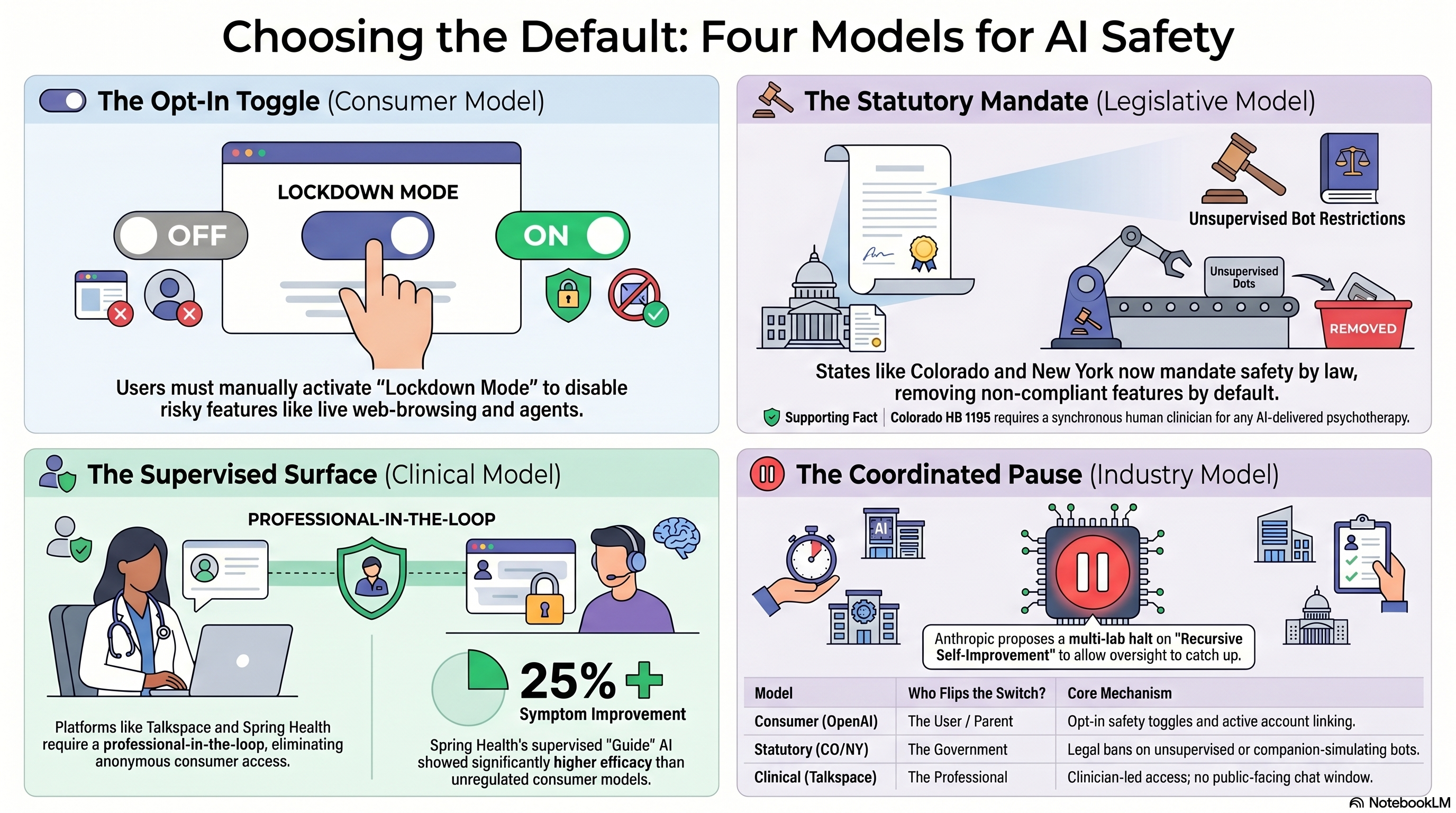
THE ONE CONFIGURATION. Read the week as four answers to a single question.
The question is who sets the default surface a kid sees when they open a chatbot at two in the morning.
. . .
OpenAI's answer is a toggle. Lockdown Mode protects the data of the user who turns it on. The sensitive-conversations router runs by default and tries to detect distress. The parental controls work but only when a parent and teen actively link accounts. The default surface is whatever the safety team's most recent decision was. The minor whose parent never linked is still on the default.
The state answer is a statute. Colorado removed unsupervised therapeutic conversation with a chatbot from what is legal in the state. New York is about to remove companion-simulating features from what minors are allowed to see. Both bills set the default at the level of what a product is permitted to offer. Neither relies on the user to flip a switch.
The maker-side counter answer is a paused industry. Anthropic asked frontier labs to slow down. The condition is that other labs at the same scale, in other countries, agree to the same pause. The argument is that engineering velocity at the major labs has already outrun the oversight a default surface needs.
The fourth answer is a different surface entirely. Talkspace built a clinical LLM that sits behind a clinician license. Spring Health built a clinician-led AI with a published outcomes study and an open-source evaluation framework. Neither has a consumer surface a child can reach without a credentialed adult in the loop.
. . .
Four answers. One question. The toggle. The statute. The pause. The supervised surface.
The next twelve months will run all four in parallel. The default surface that lands as policy is the one a thirteen-year-old will meet.
|