|
. . .
VERMONT BECOMES THE SECOND STATE TO PUT THE CLINICIAN IN THE CHAIR. On Tuesday June 17, 2026, Vermont Governor Phil Scott signed H.816 in a sixteen-bill package. The bill prohibits licensed mental health providers from using artificial intelligence to make therapeutic decisions or to deliver mental health treatment on its own.
AI can still draft a progress note, run a schedule, transcribe a session. It cannot be the clinician.
. . .
Scott (R) signed the bill on 2026-06-17. The sponsors were Rep. Daisy Berbeco of Winooski, Rep. Arsenault, and Rep. Priestley. A violation is unprofessional conduct under the licensure board. The mechanism is quiet and exact. You do not get fined. You lose the license.
. . .
The industry asked Scott to veto. The Computer and Communications Industry Association wrote him on 2026-05-27 urging a veto. The Software and Information Industry Association sent its own letter making the same ask. Scott signed anyway. He did not hold a ceremony. The bill went out in a stack with fifteen others, which is the Vermont way of saying this was not a close call.
. . .
Illinois got there first. Governor JB Pritzker signed the Wellness and Oversight for Psychological Resources Act on 2025-08-04, ten months and thirteen days before Scott picked up his pen. The Illinois Department of Financial and Professional Regulation administers it. The statute does the same thing Vermont's does. It draws the line at the therapeutic decision and at the delivery of treatment, and it leaves the back office alone. Two states. Two parties. Two coasts of the Mississippi. No coordination anyone has produced.
. . .
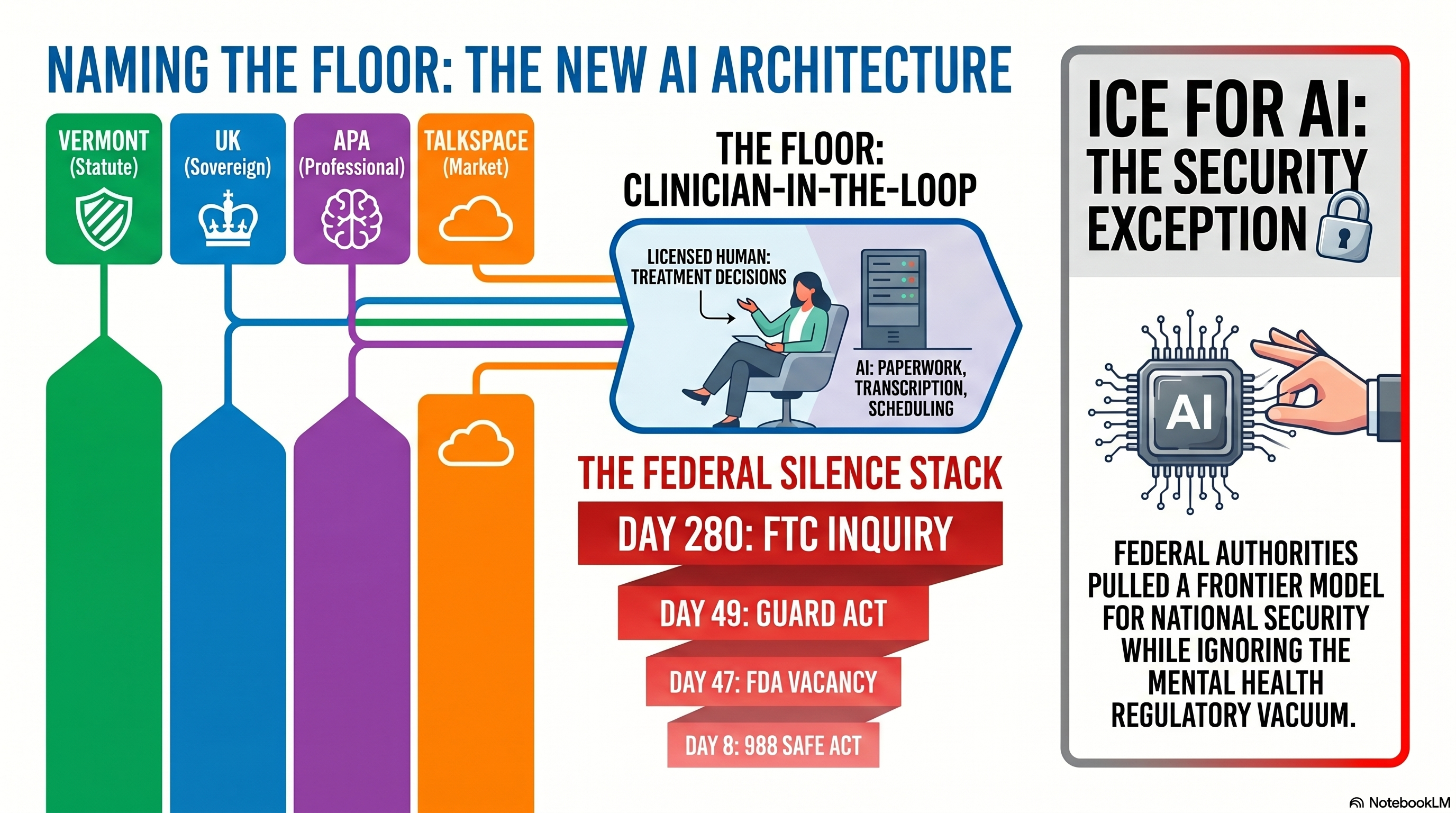
That is the part worth sitting with. When two legislatures, working independently, arrive at the same prescription inside a year, the prescription has stopped being a one-state experiment and started being an architecture. The architecture is this. The licensed human stays in the chair. The software handles the paperwork. The decision is not delegated. The treatment is not delegated. The license is the enforcement.
Vermont did not invent a floor on Tuesday. Vermont named one that Illinois had already poured. The federal apparatus has not named it. The states are naming it for them, one statute at a time, and the count is now two.
|
For Counsel: Licensure-board enforcement is the bite, not a fine or a fee. Service agreements with Vermont-licensed clinicians that touch AI tools now need a clean separation clause naming the boundary between back-office work (notes, scheduling, transcription, all permitted) and clinical-decision use (prohibited). The Illinois WOPR Act precedent is ten months old and the enforcement posture is now copyable. Bring your audit trail to the licensure board, not the courthouse.
For Builders: Do not ship a clinical-decision AI feature into Vermont or Illinois without an explicit human-in-loop checkpoint at every therapeutic determination. Each generated progress note has to be reviewed and authored by the licensed clinician of record. The audit log has to show the human decision, not the model output. If your product depends on the clinician rubber-stamping AI output to scale, your product does not ship in these two states.
For Legislators: Two legislatures, ten months apart, arrived at the same prescription without coordinating. That is a pattern you can copy. The enforcement mechanism that holds in both states is licensure-board jurisdiction over the clinical-decision boundary. The next state to write this rule should pick licensure-board enforcement, not a consumer-protection fine, because the licensure board already owns the clinical-decision question.
Source: Vermont Legislature, "H.816 Status," June 17, 2026, https://legislature.vermont.gov/bill/status/2026/H.816
|
. . .
THE UK NAMED THE FLOOR AT THE COUNTRY LEVEL. Tech Secretary Liz Kendall stood up in the House of Commons on Monday 2026-06-15 and announced that the United Kingdom will become the first country in the world to ban chatbots that offer sexualised content to under-eighteens.
She delivered the statement as Secretary of State for Science, Innovation, and Technology. The same statement included an under-sixteen ban on social media platforms covering Snapchat, TikTok, YouTube, Instagram, Facebook, and X.
. . .
Regulations will be laid before Parliament by the end of 2026. The ban takes effect early 2027.
The policy ran on a consultation called Growing up in the online world. It drew 116,000 responses, including 54,000 parents and 14,000 children. Nine in ten parents backed the under-sixteen social-media ban.
. . .
The U.S. Embassy in London filed a formal response to that consultation. The embassy opposed mandatory ID collection and product-design restrictions. It argued for privacy-preserving age assurance using zero-knowledge proofs instead. The UK government published the U.S. response in the consultation record. Then it shipped the policy Kendall announced Monday.
. . .
Prime Minister Sir Keir Starmer arrived at the G7 summit in Evian-les-Bains, France the night of 2026-06-15, carrying the policy with him. UK cabinet sources told GB News they had spent weeks asking the White House not to attack the ban. Elon Musk had already called it a censorship law on X.
As of the morning of 2026-06-18, no on-record statement from President Trump attacking the ban has surfaced. That silence is its own data point.
. . .
The under-eighteen sexualised-content ban is the most narrowly drawn AI-companion rule any sovereign has shipped. It does not ban chatbots. It bans a specific harm class to a specific age class. That is what naming a floor looks like at the country level.
The country with the closest legal and cultural ties to the United States named this floor first, over a formal American objection, and walked it into the G7 on the same night.
|
For Counsel: Extraterritorial reach is the live question for U.S. operators. A model trained in California still touches a fifteen-year-old in Manchester. Intimate functionality is the definitional risk; Kendall left the phrase deliberately broad so general-purpose chatbots cannot mode-switch around it. Regulations land by end of 2026. Scope your UK user-flows now, not after the parliamentary vote.
For Builders: Age-assurance infrastructure cannot stop at the dedicated companion-app surface. The same model serving a general-purpose chat will need the same checks once it can mode-switch into the prohibited territory. Build the architecture, not the feature flag. The July Department of Health follow-up statement is the one to watch for the wellness-adjacent products.
For Legislators: The closest American ally just shipped what the U.S. federal apparatus has not. The under-eighteen sexualised-content category now sits in primary legislation in a G7 country. Citation cover exists for any state or federal bill that wants to skip the disclosure-regime debate and write the prohibition directly. When the U.S. Embassy lobby goes on the record and the policy proceeds anyway, the executive branch position is the lobbied-against side, not the lobbying side.
Source: gov.uk, "Liz Kendall's statement on children and social media," June 15, 2026, https://www.gov.uk/government/speeches/liz-kendalls-statement-on-children-and-social-media
|
. . .
THE APA TELLS 190,000 MEMBERS TO ASK THE QUESTION. The American Psychological Association published "Discussing AI use in therapy" on Tuesday 2026-06-16. Zara Abrams wrote it for the Practice Directorate. The piece tells the field's roughly 190,000 members to put AI use on the intake form alongside sleep and substance use.
That is the move. Not a ban. An intake question.
. . .
The piece sits on top of the APA 2026 Chatbots and Mental Health Survey. Seventy-seven percent of psychologists say their clients report using AI. More than a third say their clients are using AI as an additional mental health provider. Thirty-four percent say their clients use it for self-discipline, affirmations, or behavioral reminders. The clients are already there. The professional society is catching up to where the clients already were.
. . .
The APA editorial line on treatment is verbatim and short.
"APA does not recommend using general purpose generative AI chatbots for psychological treatment."
Then the survey number that does the work. Ninety-four percent of responding psychologists say chatbots cannot treat mental health conditions with the appropriate level of nuance. Ninety-four. That is not a split field. That is a field with a position.
. . .
The intake-question framing is the part to sit with. APA is not telling therapists to fight ChatGPT in the room. APA is telling them to ask. To document. To bring the use into the clinical conversation the way they bring in sleep hygiene and alcohol intake.
This is what an organizationally adopted floor looks like. First argued in JAMA Psychiatry this spring. Now showing up as practice guidance, with the mechanism paper from CMU and Pittsburgh landing the same week. The architecture has a survey, a guidance document, and a 4.5x receipt to point at.
. . .
Read it against the rest of this issue. Vermont named a statutory floor on Tuesday. Liz Kendall named an international floor on Monday. APA, on Tuesday, named the professional floor. Three different surfaces of the same architecture, in five days, from three jurisdictions that do not coordinate.
|
For Counsel: APA guidance is professional-society practice norm, not statute. But the standard of care a court reads in a malpractice action draws on what the profession's leading body recommends. A clinician who does not screen for AI use now departs from a recommended intake question backed by a 1,200-respondent survey and a 94% supermajority position. That is the standard your client will be measured against.
For Builders: Clinicians will start documenting AI use in the chart. If your product writes to or reads from a clinical record, the AI-use intake field will appear, and it will appear in the same row as sleep and substance use. Plan the schema accordingly. Plan the consent language accordingly. Plan the data-share posture accordingly.
For Legislators: The professional society moved before the federal regulator did. APA's 94% is a position, not a debate. Any federal policy that treats general-purpose chatbots as a viable mental-health treatment option is now arguing against the field's own leading body. The political cover for federal restraint just thinned.
Source: American Psychological Association, "Discussing AI use in therapy," June 16, 2026, https://www.apa.org/topics/artificial-intelligence-machine-learning/discussing-ai-use-therapy
|
. . .
A LISTED COMPANY JUST PRICED IN THE FLOOR. Talkspace shipped Tee on June 9, 2026. NASDAQ:TALK, nineteen dollars and ninety-nine cents a month, seven-day free trial, eighteen and up.
It is the first publicly-listed U.S. behavioral-health company to put a clinician-in-the-loop AI agent on the market.
. . .
Talkspace calls Tee "the First Safe AI Agent Specifically Developed to Help Individuals Navigate Life's Daily Mental Health Challenges." The architecture is the headline.
"Real-time oversight by licensed clinicians and immediate human intervention by a therapist as needed."
A fine-tuned large language model "developed by mental health experts." HIPAA-grade privacy. The model identifies risk entities in conversation, including suicide, homicidal violence, abuse, and seven others, and escalates to a human. Detection plus escalation. The clinician is the backstop.
. . .
The comparator set tells the second half of the story. Lyra Health is private. Spring Health is private. Headspace Health sits inside private equity. Talkspace is the only NASDAQ-listed pure-play behavioral-health company shipping a clinician-in-loop AI agent in this window. Which means a public-market investor can now buy the architecture directly. It has a ticker. It has a price. It has a quarterly earnings call.
. . .
This is the week the architecture stopped being a regulatory hypothesis and became a product line. Vermont named the floor in statute. Kendall named it for the UK. The APA named it for the profession. Talkspace named it for the shareholders. Same shape every time. Licensed clinician in the loop, AI as the tool, human on the risk handoff.
Casey is no longer the only one in this architecture. That is a good problem to have.
. . .
The quiet read on the timing is the one to carry into the rest of the issue. A listed company shipped clinician-in-loop before the FDA shipped a guidance, before CMS shipped a billing code, before ONC shipped a framework. The federal apparatus held trophies. The private market priced the floor. When the listed company gets there first, the architecture is no longer something to be regulated into existence. It is something already trading.
|
For Counsel: The architecture Talkspace is selling has the human-in-loop liability allocation built in. The licensed clinician overseeing the conversation is the named decision-maker. Detection-and-escalation logs become the audit trail. Compare this to a standalone consumer chatbot, where the liability allocation has no human in the chair and the audit trail is whatever the conversation log captures. The first defense in a malpractice action against Tee is the named clinician. The first defense against the standalone consumer chatbot is silence.
For Builders: Detection-plus-escalation is the design pattern, not pre-enrollment exclusion. Talkspace describes a real-time scan for risk entities in conversation, with immediate human handoff on a flag. Copy that pattern, not features that are not there. The risk-entity list is twelve items long and includes suicide, homicidal violence, and abuse. The escalation has to be immediate, not asynchronous. The clinician availability has to be twenty-four hours a day for the architecture to hold.
For Legislators: A NASDAQ-listed company is now selling the architecture the regulators have been describing. The market beat the policy. Use that. Subsequent legislation can reference a shipped product, not a hypothetical compliance framework. The cost-of-implementation argument also collapses. If a public company can ship the architecture and charge nineteen ninety-nine, the architecture is not expensive.
Source: Talkspace Investor Relations, "Talkspace Announces Tee," June 9, 2026, https://investors.talkspace.com/news-releases/news-release-details/talkspace-announces-tee-first-safe-ai-agent-specifically
|
. . .
THE FLOOR DID NOT GET NAMED IN WASHINGTON. Vermont signed a statute. Kendall named a country. The APA rewrote an intake question. Talkspace shipped a product. The same week, the federal apparatus performed busyness.
On 2026-06-17, HHS Secretary Robert F. Kennedy Jr. flew to Clinton Township, Michigan, and stood inside the Easterseals MORC certified community behavioral health clinic to announce more than seven hundred million dollars in HHS funding for mental illness, addiction, and homelessness. The release earmarked two hundred thirty-eight point six million for the 988 Suicide and Crisis Lifeline, ninety-six million for STREETS, eighty million for addiction prevention, and roughly seventy million across mobile crisis teams, childhood trauma, and tribal suicide prevention. STAT framed the package the same day as previously authorized grants that were delayed in release.
Read the HHS release end to end. The Press 3 LGBTQ-plus specialized 988 sub-line is not in it. The Samhsa principal deputy assistant secretary had told reporters on June 12 that Press 3 restoration would land by end of year. Executive Order 14168 and the 988 Lifeline Implementation Act direct it. The June 17 announcement found two hundred thirty-eight point six million for 988 and zero dollars named for Press 3.
. . .
Senator Josh Hawley released a 988 SAFE Act discussion draft on 2026-06-10. It would route chatbot suicide handoffs into the 988 system. As of 2026-06-18, this is Day Eight of the open-web null. EFF, NetChoice, CCIA, Public Knowledge, ACLU, AAP, APA, Roll Call, Politico Pro, and Tech Policy Press have all said nothing. When Hawley dropped the GUARD Act in October 2025, EFF, the James Madison Institute, NetChoice, and Tech Oversight Project reacted the same day.
. . .
The GUARD Act itself, S.3062, sits on the Senate Legislative Calendar as Calendar No. 406. Day Forty-Nine there. Cosponsor count holds at nineteen, the thirteen Democrats and six Republicans plus Hawley, flat since December. The Congressional Budget Office has filed zero estimates. The Senate floor this week is consumed by nomination cloture votes.
. . .
The Federal Trade Commission's 6(b) inquiry into Alphabet, Character Technologies, Instagram, Meta, OpenAI, Snap, and xAI reaches Day Two Hundred Eighty today. No staff report. No enforcement spin-off. No interim findings. Two Democratic commissioner seats remain vacant since March 2025.
The Food and Drug Administration commissioner seat reaches Day Forty-Seven. Ned Sharpless is still in vetting per CNN on June 4. No nominee transmitted. No hearing scheduled. The agency that would have to write the chatbot-as-mental-health-device guidance does not have a confirmed head.
. . .
Same day Kennedy stood in Michigan, First Lady Melania Trump stood in the East Wing. The Presidential AI Challenge National Champion Awards Ceremony honored six teams of K-12 students across healthcare, public safety, and criminal investigations. Twenty thousand entries, fifty states. The White House communication that day mentioned the FTC 6(b) inquiry, the 988 SAFE Act discussion draft, the GUARD Act, and EO 14168 Press 3 implementation a combined zero times.
Four jurisdictions named the floor in five days. The federal apparatus re-announced delayed grant money and handed out trophies.
|
For Counsel: The federal regulatory vacuum is itself a market condition. Clients shipping AI-mental-health products under federal silence have less certainty than clients shipping under any single named federal rule. The risk surface includes future enforcement actions, not only current ones. Document the product's positioning against the state-level statutes (Illinois WOPR, Vermont H.816) and the foreign rules (UK Kendall). Those are the floors that exist.
For Builders: The FDA commissioner seat staying empty means the chatbot-as-mental-health-device guidance pipeline does not move. If your roadmap depends on a De Novo clearance for a generative AI mental health device, your timeline is now indefinite. Plan two paths. The state floors and the foreign floors are real now. Build against those.
For Legislators: Every day the GUARD Act sits at Calendar No. 406 with zero CBO score is a day Vermont and the UK set the actual policy. Floor time is the lever. Use it, or watch the policy get written in Montpelier and Westminster and the East Wing East Room go on hosting trophy ceremonies on the days HHS re-announces delayed grant notices.
Source: HHS, "Secretary Kennedy Announces New Funding for Mental Illness, Addiction, and Homelessness," June 17, 2026, https://www.hhs.gov/press-room/secretary-kennedy-announces-new-funding-mental-illness-addiction-homelessness.html
|
. . .
I CALLED IT ICE FOR AI. Six days into the Fable 5 outage, there is no deal, and the federal apparatus has not named what it did. I have. I called it ICE for AI. The feds have not found a name. I have.
Anthropic flew co-founder Tom Brown to Washington on Monday 2026-06-15 to sit across the table from National Cyber Director Sean Cairncross at the Department of Commerce. They left with no restoration date, no path, and no public framework.
Commerce Secretary Howard Lutnick and Anthropic CEO Dario Amodei both land in Evian-les-Bains today for the G7. The same summit Starmer is carrying the UK chatbot ban into.
Different floor, same week.
. . .
Anthropic's public position, posted June 12 on the company's own site, is that the jailbreaks Commerce cited as the national-security trigger are not the floor Commerce says they are.
The verbatim line: "These vulnerabilities all appear relatively simple, and we have found that other publicly-available models are able to discover them as well without requiring a bypass."
Anthropic also says it pre-tested Fable 5 with the government before launch, that the BIS process violated transparency and fairness principles, and that no restoration timeline has been offered. That is the position a frontier lab takes when it has been moved off the shelf with no notice and no clock.
. . .
CNBC named the moment on June 16. The headline.
"Anthropic's Fable shutdown is a big moment for open-source AI."
The framing is the one open-weight advocates have been waiting for. Builders who staked a product on a closed proprietary model lost the model on a Friday afternoon with no replacement. Hacker News thread 48464258 is where the indie devs are gathering. Snyk has a security-team continuity playbook up. The publisher's own builder-side account ran here last week.
. . .
The bookend is hard to read past. On June 5, Amodei co-signed a public letter to Congress with Sam Altman and Mustafa Suleyman urging mandatory federal screening for synthetic DNA precursors that could be used to build bioweapons with AI assistance. Ten days later, Commerce controlled Amodei's model citing AI-uplifted bio synthesis as the rationale. The first foundation-lab CEO on the receiving end of a federal AI-bio control was the one who asked Congress for federal AI-bio controls.
. . .
The U.S. found a name for a national-security floor on a Friday afternoon and pulled a frontier model across it inside one news cycle. It has not found a name for a chatbot floor in eight days since the APA's intake question. It has not found one in 280 days since the FTC orders. It has not found one in 49 days since H.816 passed the Vermont legislature.
It has not found a name for what it did on June 12 either. No notice. No comment period. No appeal path. No restoration date. Pulled a frontier model that operators built on. There is no agency word for that action because no agency has owned it on the record.
I named it. I called it ICE for AI. A sudden federal removal of a tool people built on, with no warning and no path back. The feds have not found a name. I have.
The question this issue lays at your feet is which floor gets named next, and by whom.
|
For Counsel: Commerce just demonstrated the speed of an export-control action against a domestic commercial AI model. There is no statutory floor on the speed, no industry-consultation window, no public-comment period. If your client's stack rests on a frontier model, the contract-risk surface includes a same-day pull. Force majeure language drafted before June 12 does not reach this. Review your continuity clauses this week.
For Builders: Track which workflows degrade on fall-back, not just which workflows still pass. The benchmark deltas do not catch the loss this issue is describing. Build the regression log yourself. No vendor will hand it to you. Maintain a tested fall-back to a second foundation model at production-grade quality before the next Friday afternoon.
For Legislators: Commerce found a name for one floor in one news cycle. It used national-security authority. The fact that the same federal apparatus has not found a name for any chatbot floor in 280 days, 49 days, or 8 days is a statement about which floors get prioritized, not which floors are easy to draw. The political reading is in the contrast.
Source: Anthropic, "Update on Fable and Mythos access," June 12, 2026, https://www.anthropic.com/news/fable-mythos-access
|
. . .
THE ONE CONFIGURATION. Four namings. Five days. One floor.
. . .
Vermont put it in statute. The United Kingdom put it in a Commons oral statement. The American Psychological Association put it on the intake form. Talkspace put it on the menu at nineteen ninety-nine a month. Each independent. None coordinated. All the same prescription. The licensed clinician stays in the loop. The AI handles the back office and never the treatment decision. The human is the backstop on every risk handoff. The license is the enforcement, not a fine.
. . .
The federal apparatus did none of these things. The FTC reached Day Two Hundred Eighty of an inquiry with no staff report. The FDA commissioner seat reached Day Forty-Seven with no nominee. The GUARD Act reached Day Forty-Nine on Calendar 406 with zero CBO score and zero floor time. Hawley's 988 SAFE Act discussion draft reached Day Eight with zero open-web reaction.
. . .
Same week, the federal apparatus did find a name for one floor. Commerce pulled an American frontier model on a Friday afternoon citing national security. Six days later, no deal, no restoration date, no public framework.
. . .
So the U.S. can name a floor when it wants to. The question this issue lays at your feet is which floor gets named next.
|