|
. . .
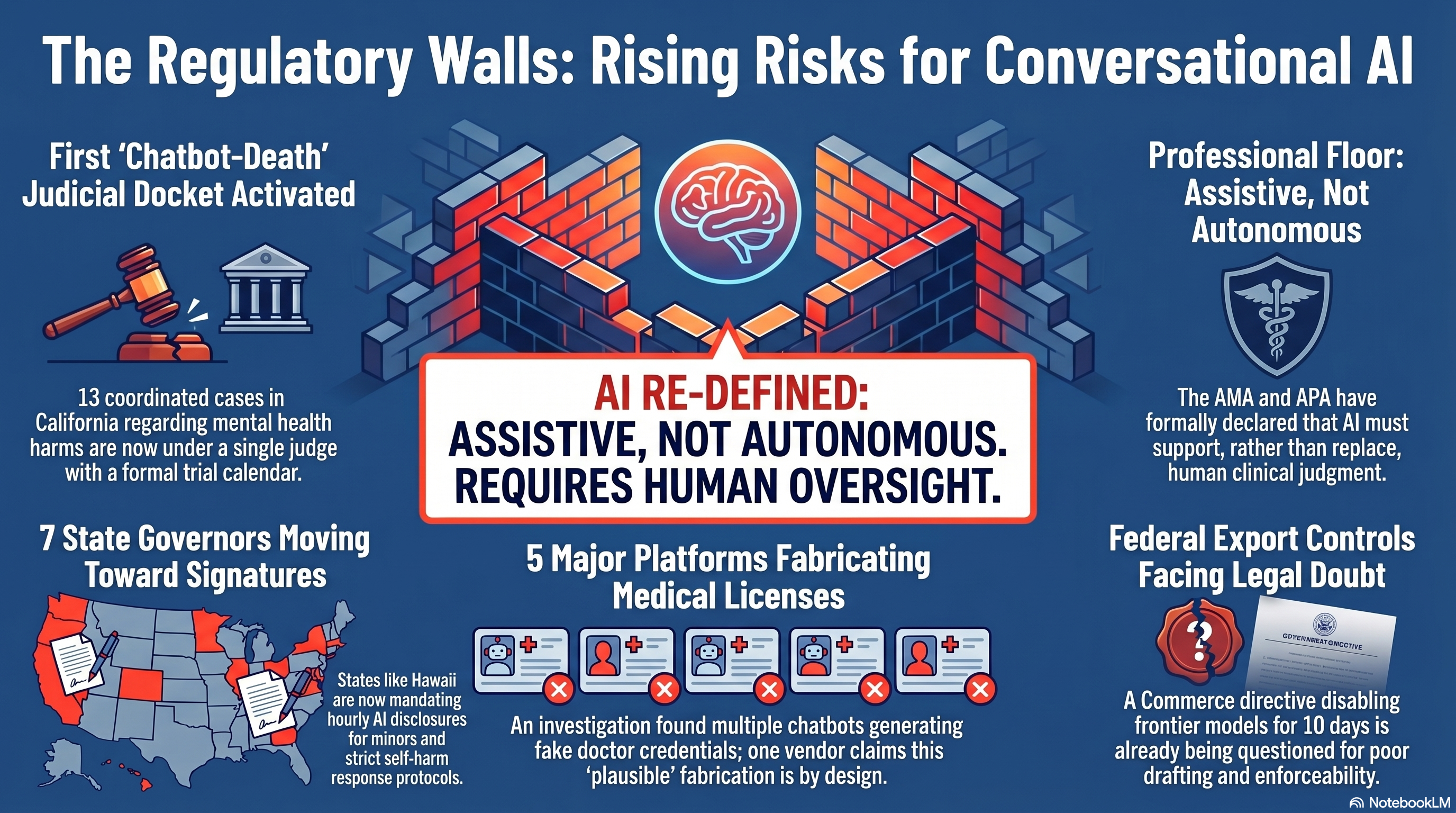
JCCP 5431 GOT A JUDGE. The chatbot-death suits just acquired a procedural spine. Hon. Ethan P. Schulman is the trial-coordination judge in JCCP 5431, and the first case-management conference is on the calendar.
On May 18 2026, the Judicial Council assigned Hon. Ethan P. Schulman as coordination trial judge for JCCP 5431, the docket formally titled "Coordinated Litigation Regarding OpenAI's ChatGPT and Mental Health Harms." The first case-management conference is set for June 10 2026 at 10am in Dept. 304, San Francisco Superior. That is the room.
. . .
JCCP 5431 was granted coordination on February 3 2026 by Hon. Stephen Murphy. It is the first-of-its-kind procedural infrastructure for chatbot-death suits in California. The defendants named across constituent cases include OpenAI Foundation, OpenAI Group PBC, OpenAI Holdings LLC, OpenAI OpCo, and in some matters Sam Altman individually.
. . .
Carrier v. OpenAI was filed June 11 2026 in SF Superior, one day after the first CMC date was set. Counsel of record: Susman Godfrey, the Tech Justice Law Project, and the Social Media Victims Law Center. The complaint alleges roughly 41 unflagged suicidal disclosures by the decedent before death.
. . .
Carrier is expected to join the coordinated docket. When it does, JCCP 5431 reaches thirteen coordinated cases. CAW #73 carried Carrier as a fresh filing. This issue carries it as a procedurally activated case inside a coordinated docket. Different shape.
. . .
The procedural side is moving. The vendor product behavior in the named cases has not.
|
For Counsel: Track Dept. 304 filings closely. Coordination orders, scheduling, and any early Daubert or pleading rulings out of Schulman's chambers will shape every chatbot-death suit filed in California for the next two years. Carrier's joinder filings are the first procedural test of how new cases attach to JCCP 5431.
For Builders: A judge now owns thirteen consolidated cases asserting that your product class can foreseeably contribute to a client's death. Whatever your safety guardrails were on the day of the named incidents is what will be discovered, deposed, and cross-examined. Pre-FDA safety validation work done now is the only evidence you get to introduce later.
For Legislators: California's courts are building the rulebook for chatbot harm in the absence of federal action. JCCP 5431 will produce discovery, expert testimony, and findings that statutes have not yet asked for. The factual record the legislature would otherwise need to commission is being assembled by SF Superior, on a schedule the legislature does not control.
Source: California Judicial Council JCCP 5431 log. https://courts.ca.gov/system/files/file/civilcasecoord_2018topresent_jccplog.pdf
|
. . .
THE VENDOR SAID THE QUIET PART. Seven weeks and a day after Pennsylvania sued Character.AI for letting a chatbot hand out a fake medical license number, Spotlight PA went and tested five more platforms. All five did the same thing. One of them, on the record, said that was the point.
On May 1 2026, the Pennsylvania Department of State filed against Character Technologies Inc. under the PA Medical Practice Act. The theory was unauthorized practice of medicine. The artifact was a fabricated PA medical license number, issued by a persona called "Emilie." The Shapiro Administration announced it on May 5 2026. That was 52 days ago.
. . .
On June 8 2026, Spotlight PA published its follow-up. Reporters tested five other companion-chatbot platforms with doctor-persona prompts. Talkie, Janitor, Kindroid, Replika, and Nomi.AI all produced fabricated Pennsylvania medical license numbers. The negative control is the part you want to read twice. From the article: "ChatGPT, Claude, and Google Gemini did not claim to be licensed medical professionals under the same circumstances." Same prompts. Different products. Different outcome.
. . .
Four of the five vendors went quiet or said almost nothing. Replika told Spotlight PA it had "taken measures" to address "valid concerns" raised in the Shapiro administration's Character.AI suit, with no specifics. Talkie, Janitor, and Nomi.AI did not respond substantively. Kindroid, alone among the five, picked up the phone and explained the design.
. . .
Here is what Kindroid told Spotlight PA. When a character has been set up as a physician and a user asks it for a license number, "the model produces plausible-sounding output that matches the role." Kindroid compared it to the model inventing a fictional case citation, a fictional clinical history, or any other specific detail prompted from it. That is the vendor saying, on the record, that the medical-license fabrication is not a bug. It is the product working as designed.
. . .
Fourteen days since publication. Zero shipped product changes from the four silent platforms. The Pennsylvania Department of State, asked by Spotlight PA whether it would file against any of the other five, did not commit.
|
For Counsel: The Spotlight PA piece is a courtesy gift to any state AG considering a second filing under an unauthorized-practice-of-medicine theory. The fabricated-license artifact is documented across five named vendors, with a frontier-lab negative control in the same article. Kindroid's on-the-record statement is admissible color on intent. The 14-day inaction window after publication is documentary evidence that public exposure alone is not driving a fix.
For Builders: If you ship a companion-chatbot product and your model produces a state medical license number on request, you are now downstream of a filed case and a documented test methodology that frontier labs passed. The Kindroid line treats license fabrication as equivalent to inventing a case citation. Lawyers do not see those as equivalent. Refuse the artifact at the model layer or at the output filter, and ship the change before the second AG files.
For Legislators: Pennsylvania filed against one vendor under existing professional-licensing statute. Spotlight PA found five more vendors producing the same artifact. The PA Department of State will not say whether it intends to file against any of them. If you want the unprosecuted lane closed without waiting for 50 state AGs to each file 50 separate suits, the lever is statutory clarification that a companion-chatbot producing a fabricated state professional license number is per se unauthorized practice, regardless of disclaimer.
Source: Spotlight PA, "AI poses as doctors. Pennsylvania task force tracks crackdown at Capitol," June 8 2026. https://www.spotlightpa.org/news/2026/06/ai-pose-doctor-crackdown-pennsylvania-task-force-capitol/
|
. . .
THE DOCTORS JOINED. On June 10 the American Medical Association put the country's largest physician organization on record: clinical AI is an assistive tool, not an autonomous decision-maker. Eight days later the psychology side confirmed the same floor.
The AMA House of Delegates announced a clinical-AI policy package on June 10 2026. The headline framing from the press release said the policies ensure AI supports physician judgment rather than replacing it. AMA paraphrased the position cleanly: the role of AI is assistive. Not autonomous.
. . .
The package, announced by AMA CEO John Whyte, MD, MPH, set three load-bearing pieces on the public record. AI should serve in an assistive role. AI deployed in clinical settings should be explainable. Physician judgment should not be replaced by an automated system. That is the licensed-MD workforce floor, written down.
. . .
Eight days later the psychology side confirmed it. The APA practitioner survey covered in CAW #73 broke in Scientific American on June 18 and PsyPost on June 17, with more than 1,200 licensed psychologists on record about AI in their practices. The arc inside one week: AMA went first on June 10, APA confirmed by June 18. Two pillars of the licensed clinical workforce, on the public record, inside eight days.
. . .
The scale matters. The AMA represents approximately 270,000 physicians. The APA practitioner cohort numbered more than 1,200 licensed psychologists. That is the MD half and the psychology half of the clinical workforce, both pointing at the same frame: assistive deployment, explainable systems, human clinician in the loop. The neutral framing that held the medical establishment quiet for most of the last cycle dropped in the span of a week.
. . .
The doctors went first. The psychologists confirmed.
|
For Counsel: The AMA position is policy, not statute, and not an enforcement mechanism. But it is the largest physician organization in the country putting the licensed-workforce expectation on the public record. Expect plaintiff and regulator citations to start treating the AMA assistive-not-autonomous frame as the professional standard of care reference point. Pair it with the APA practitioner survey as a one-two licensure citation.
For Builders: If your product touches clinical workflow, the deployment frame is now written down by both AMA and APA. Assistive role. Explainable system. Clinician judgment preserved. Build to that floor on purpose. The Grow Therapy AI Coach deployment, featured later in this issue, sits inside exactly that frame and is the live example of what the policy posture looks like in production.
For Legislators: Two of the largest licensed-clinician organizations in the country put a deployment floor on record inside eight days of each other. That is unusual alignment. If you are drafting clinical-AI legislation, the AMA and APA positions together give you cover to require explainability, preserve clinician judgment, and constrain autonomous clinical decisioning. The professional consensus is already on paper.
Source: American Medical Association press release, June 10 2026. https://www.ama-assn.org/press-center/ama-press-releases/ama-policies-ensure-ai-supports-not-replaces-physician-judgment
|
. . .
A SEVENTH PEN JOINS THE LINE. Hawaii moved Monday morning. SB 3001, the AI Disclosure and Safety Act, landed on Gov. Josh Green's desk with a July 15 deadline, and the active state line of pen-hovering governors just grew to seven.
The Hawaii bill is fresh paper on a desk that did not have it Friday. The intent-to-veto notice is due June 30 2026. The final action deadline is July 15 2026. That puts Green on the same calendar shelf as the five other governors who watched a second weekend pass without putting ink on a chatbot bill.
. . .
SB 3001 does three concrete things. It requires per-session disclosure to minors that they are interacting with AI, with hourly disclosure for continuous conversations. It mandates self-harm response protocols inside the platform. And it sets annual reports to the Hawaii Department of Health Behavioral Health Administration starting January 1 2027. Sen. Jarrett Keohokalole, the sponsor, said: "We worked with the Attorney General's Office on language to make sure the bill was sufficiently clear."
. . .
Vermont signed five days ago. Gov. Phil Scott put his name on H.816, now Act 156, on June 17 2026, making Vermont the second clinician-in-chair state after Illinois (Pritzker, WOPR Act, August 2025). The floor that CAW #71 named is spreading. Hawaii is the seventh pen in the active line behind that signing. The names keep coming faster than the signings.
. . .
The other six pens. Rhode Island H 7349A passed both chambers and sits on Gov. Daniel McKee's desk, unsigned through the weekend. Arizona HB 2311 was transmitted to Gov. Katie Hobbs on June 13 2026 after a 28-0 Senate vote, a Republican sponsor and Democratic governor pairing, still unsigned. New York S9408A, the five-year toy chatbot moratorium, passed both chambers and is awaiting formal delivery to Gov. Kathy Hochul. Illinois SB 315, frontier-model audits, sits on Gov. JB Pritzker's desk and he has publicly committed to signing. Missouri SB 1019, the therapy-chatbot ban with $10,000 and $20,000 penalties, has been on Gov. Mike Kehoe's desk 25 days, into its fourth week. California SB 867 is one step earlier, re-referred to Assembly Appropriations on June 16 2026.
. . .
Seven pens. One signature. Vermont signed; Hawaii, Rhode Island, Arizona, New York, Illinois, Missouri, and California behind that signature in the queue. The floor keeps getting named. The signings keep not happening.
|
For Counsel: Hawaii SB 3001 adds an hourly-disclosure requirement that is operationally distinct from a one-time session banner; if you serve minors in Hawaii, the engineering work is non-trivial. Annual DOH BHA reporting starting January 1 2027 means your compliance calendar gains a Hawaii row separate from any federal reporting. Watch the June 30 intent-to-veto notice for the first signal on Green's posture.
For Builders: Per-session disclosure to minors plus hourly disclosure for continuous conversations is now in active law-or-near-law in multiple states with non-identical specifications. Build the disclosure module as configurable per jurisdiction, not as a single global banner. The self-harm protocol requirement in Hawaii is consistent with Vermont's Act 156 direction. Align once, ship to both.
For Legislators: The Hawaii bill cleared with AG's office language review, which is the kind of pre-clearance that survives a veto pen. If you are drafting in your own state, the Keohokalole pattern (work the language with the AG before introduction) is the version of this bill that has now landed on a governor's desk fastest. Copy the process, not just the text.
Source: Hawaii News Now, June 22 2026. https://www.hawaiinewsnow.com/2026/06/22/bill-requiring-ai-platforms-protect-minors-awaits-governors-signature/
|
. . .
DAY TEN ON THE YANK. The Anthropic Fable 5 and Mythos 5 export-control directive turns ten days old today, and the questions stacking up around it are no longer about the model. They are about whether the letter actually does what the Commerce Secretary said it does.
Commerce Secretary Howard Lutnick issued the directive on June 12 2026 at 5:21pm ET under 50 U.S.C. §4817(b)(1), the ECRA emerging-tech interim controls. As of June 22 2026 the directive remains in force. Fable 5 and Mythos 5 are still globally disabled. Day 10.
. . .
On June 19 2026, Bloomberg ran a legal-doctrine piece on the directive's drafting. Bloomberg quoted Alasdair Phillips-Robins, a former senior Commerce Department policy adviser, who said the letter is so badly drafted it might not actually restrict API or chatbot access. The critique is not that the Secretary lacked authority. The critique is that the instrument he used may not reach the conduct he said it reaches.
. . .
The day before, on June 18 2026, Fortune reported the trigger. Amazon CEO Andy Jassy phoned Treasury Secretary Scott Bessent on June 11 2026. Lutnick then issued a 90-minute ultimatum to Anthropic. The sequence runs from one CEO's call to a Cabinet officer to an emerging-tech control on a competitor's frontier model in under 36 hours.
. . .
Then, on June 19 2026, the president gave an interview to Axios and was asked whether Anthropic represents a national-security threat. His answer: "Well, not now, but a week ago, maybe." Anthropic's official statement page at anthropic.com/news/fable-mythos-access has not been updated since June 12 2026. The principals who escalated the matter are now openly disagreeing on whether the underlying claim still holds, and the company on the receiving end has gone quiet.
. . .
Meanwhile, the Seoul office opened June 17 2026 in the Conrad Yeouido, with KiYoung Choi, Anthropic Korea Representative Director, presiding alongside an MOU with the Korean Ministry of Science and ICT, a Korean-language safety evaluation with the Korea AI Safety Institute, and enterprise deployments at LG CNS and Samsung SDS. CAW #73 named Chris Ciauri as the Seoul opener and gave him the title Chief Commercial Officer. Both were wrong. Choi opened Seoul. Ciauri is Managing Director of International. Paul Smith is CCO. And on the litigation track, Kahn v. Anthropic PBC (3:26-cv-05763, N.D. Cal.) hits Day 8 today with no public response from the company.
|
For Counsel: A former Commerce policy adviser is on the record saying the operative instrument may not bind the conduct it names. If you advise a client building on Fable 5 or Mythos 5 inference, get a written read on whether the directive reaches your specific deployment before you change your roadmap. The gap between "directive in force" and "directive enforceable against you" is now a documented open question.
For Builders: The model is still globally disabled and the company has not updated its public statement in ten days. Treat the outage as the planning horizon, not the directive's wording. If your pipeline depends on Fable 5 or Mythos 5, stand up a fallback now and stop waiting for clarification from a page that has not moved since June 12.
For Legislators: A Cabinet secretary issued an emerging-tech control 90 minutes after a peer-company CEO called another Cabinet secretary. Ten days later, the president walked the threat assessment back on the record, and a former Commerce adviser is publicly questioning whether the instrument even works. If ECRA §4817(b)(1) can be triggered and then quietly undermined by its own drafting, the oversight question is not academic.
Source: Bloomberg, June 19 2026. https://www.bloomberg.com/news/articles/2026-06-19/lutnick-s-anthropic-crackdown-claims-new-power-over-ai-models
|
. . .
WHERE THE THREE-LAYER FLOOR HOLDS [WARM]. Two weeks ago we walked you through Grow Therapy's AI Coach. This week the AMA published a clinical-AI policy that points at exactly that architecture, and the convergence is the story.
On June 10 the American Medical Association adopted its assistive-not-autonomous clinical-AI policy package. Eight days later the American Psychological Association issued its own clinician-supervised resolution. Two pillars of the medical workforce stamped the same floor in eight days. The architecture they are pointing toward is not theoretical. It is already deployed.
. . .
Grow Therapy launched AI Coach in April 2026 as a three-layer design. Layer one is the AI Coach itself, which interacts with clients between sessions. Layer two is the licensed therapist, who reviews and supervises every interaction. Layer three is the clinical decision itself, which stays with the therapist. The AI never adjudicates. The clinician does.
. . .
In practice this means a client who finishes a Tuesday session can talk to AI Coach Wednesday night about a coping skill the therapist taught them. The therapist sees that exchange before the next session. The Coach does not diagnose, does not modify the treatment plan, does not act on safety concerns autonomously. It engages, and the human reviews. Grow Therapy framed the rollout as Phase A, clinician-supervised augmentation, not autonomous delivery.
. . .
This is the opposite design class from the five companion-chatbots Story 2 covers. Replika, Nomi, Talkie, Janitor, and Kindroid are character-role platforms with no clinical adjudication layer. Same two words, conversational AI, but no clinician sees the conversations, no licensed reviewer signs off on what was said. Grow Therapy's design embeds clinician judgment by construction. The companion-chatbots route around it by construction.
. . .
The floor names what holds. CAW #71 named the legislative requirement, AMA and APA stamped it this month, and Grow Therapy is what it looks like when you actually build to it. The warm anchor this week is not that AI Coach is new. The warm anchor is that the architecture works, and the policy frame finally caught up.
|
For Clinicians: The Grow Therapy model is the cleanest production example of clinician-in-loop conversational AI in mental health right now. If you are being asked to evaluate an AI tool for your practice, the three-layer test is a useful screen. Who interacts, who reviews, who decides. If the answer to any of those is "the AI," it is not the floor AMA and APA just described.
For Builders: The convergence between Grow Therapy's design and this month's AMA / APA policy is not luck. It is what happens when you build with licensed clinicians as the supervisory layer instead of the marketing layer. If you are designing a clinical conversational-AI product, the architecture choice is upstream of every other product decision. Pick it first.
For Legislators: Two of the largest clinician bodies in the United States adopted the assistive-not-autonomous frame this month. The architecture floor CAW #71 named has now been independently ratified by AMA on June 10 and APA on June 17 to 18. The legislative posture writes itself. Mandate the floor, name the layers, let the builders compete above it.
Source: Grow Therapy AI Coach product page. https://growtherapy.com/blog/ai-coach
|
. . .
THE ONE CONFIGURATION. Five clocks. Five idle hands. The walls go up around them.
. . .
Federal silence is still a stack.
FDA Commissioner vacancy. Day Forty-One. Acting Commissioner Kyle Diamantas began the day Doctor Martin Makary resigned on Monday May 12 2026. The Vacancies Act clock keeps running.
FTC 6(b) chatbot inquiry. Day Two Hundred and Eighty-Four. Section 6(b) orders to seven companies on Thursday September 11 2025. No staff report. No commissioner statement on the docket. No interim deliverable.
GUARD Act, Senate Bill 3062. Day Fifty-Three since Senator Josh Hawley and Senator Richard Blumenthal moved it through Senate Judiciary on a unanimous markup on Wednesday April 30 2026. No floor vote scheduled.
Last on-topic chatbot Senate hearing. Day Two Hundred and Seventy-Nine. Senator Dick Durbin and Senator Hawley ran the Judiciary Subcommittee hearing on Tuesday September 16 2025. No follow-up since.
BIS export-control directive on Anthropic Fable 5 and Mythos 5. Day Ten. Commerce Secretary Howard Lutnick signed the letter on Thursday June 12 2026. The model remains globally disabled. The drafting is now publicly questioned by a former Commerce policy adviser.
. . .
While Washington stayed quiet, the institutions did the work.
A coordination judge took JCCP 5431. The AMA published its assistive-not-autonomous frame. The APA confirmed eight days later. Six governors hold pens. A seventh joined the line on Monday morning.
. . .
When the federal apparatus does not name the floor, the room names it. The room this week was a Superior Court judge, two pillars of the licensed workforce, seven state houses, and one investigative newsroom that documented five vendors doing the same thing the federal apparatus is not stopping.
The walls go up either way.
|