|
. . .
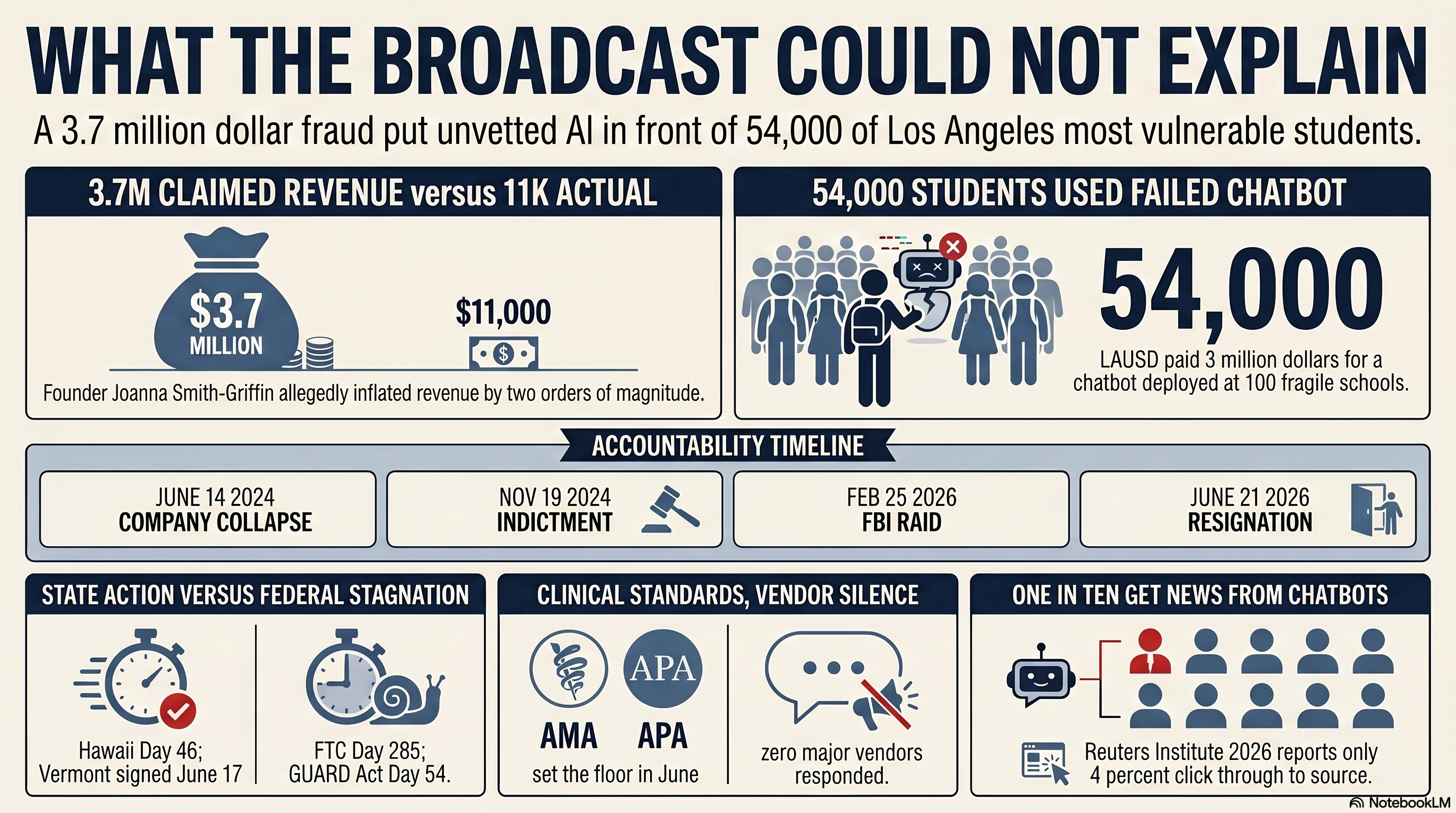
THE INDICTMENT THE NATIONAL NEWS WILL NOT READ. A federal indictment unsealed twenty months ago charged an AI ed-tech founder with three counts of fraud. Her chatbot reached fifty-four thousand of Los Angeles's most fragile kids. The superintendent who signed the deal got raided in February and resigned on Sunday. Two days of national coverage. None of it read the indictment out loud.
Joanna Smith-Griffin. Age thirty-three. Raleigh, North Carolina. Founded AllHere Education while she was at Harvard.
November 19, 2024. SDNY prosecutors unseal the indictment. Three counts. Judge John G. Koeltl. The case is still active.
The conduct it alleges is plain.
. . .
Spring 2021. She tells investors AllHere did three point seven million in revenue the year before. Actual: eleven thousand.
She tells them she has two point five million in the bank. Actual: four hundred ninety-four thousand.
Two orders of magnitude. Both numbers.
She told investors AllHere had contracts with NYC schools and Atlanta. It did not.
When the accountant started asking questions, she invented a financial consultant. Used a real person's name. Stood up a fake email address. Used it to lie to her largest investor in his own voice.
. . .
She raised nearly ten million on the strength of all of it. Pitched another thirty-five million to a PE firm that walked.
Some of the money went to the down payment on her North Carolina house. Some paid for her wedding.
. . .
That is what twenty months of public record looks like. Now look at what came next.
March 20, 2024. LAUSD Superintendent Alberto Carvalho stands at Roybal Learning Center and introduces Ed, the AI personal assistant.
The deal points Ed at the hundred schools the district itself called fragile. Fifty-four thousand kids out of about four hundred twenty thousand.
Six million dollar contract. Two years.
. . .
Ed hallucinated. Parents got wrong answers. The integration with the Student Information System never worked.
Ed was sold to parents as a tool that would reach kids in emotional distress and connect them to mental-health resources.
No clinician in the design. No crisis-escalation protocol on the public record. No school psychologist or social worker named anywhere.
For a chatbot in front of fifty-four thousand fragile kids, the absence is the finding.
. . .
June 14, 2024. AllHere furloughs most of its staff. LAUSD terminates in July. The district paid about three million by then.
. . .
Eighteen months later the federal investigation reached the superintendent.
February 25, 2026. FBI search warrants at three addresses the same morning.
Carvalho's San Pedro home. LAUSD headquarters. The Florida residence of Debra Kerr, former AllHere head of sales and the largest disputed creditor in the company's bankruptcy at six hundred thirty thousand dollars.
That Friday Carvalho went on paid leave at four hundred forty thousand a year. Andrés E. Chait took the chair the same day.
Brittny Mejia, Howard Blume, and Richard Winton traced the Carvalho-Kerr acquaintance for the L.A. Times back to her Pearson days, around 2010.
Social and professional acquaintance. No disclosed financial relationship.
Carvalho is not charged. He is not named in the Smith-Griffin indictment. The affidavits behind the February raids are sealed.
He resigned Sunday, June 21. His words: "Because I believe our schools must remain focused on students and learning without distraction."
And AllHere is not even an outlier.
Paper Education. Three point three million dollar New Mexico contract. Terminated for non-performance about ten weeks in.
FEV Tutor. Collapsed mid-school-year on January 25, 2025. Forty million in contracts across thirty states.
Character.AI is the regulator-active peer. The Garcia wrongful-death suit. Texas AG demands. The forty-four-state AG coalition letter from August 2025. The FTC's September 2025 inquiry on seven chatbot companies, now Day 285. No staff report.
. . .
The pattern is the same under every one of them.
Single-source procurement on ESSER and pandemic-recovery money. Superintendent-level signature with thin board oversight. No clinician of record. No state ed-agency pre-approval. No federal age-appropriate-design floor for ed-tech vendors.
AllHere's founder fraud is the loudest example. It is not the pattern.
. . .
"This case is about a CEO who allegedly lied to investors over and over again," then-U.S. Attorney Damian Williams said when the indictment was unsealed.
Read the counts again.
Securities fraud. Wire fraud. Aggravated identity theft.
Not one of the three asks whether the chatbot was safe for the fifty-four thousand children the district had designated most fragile.
The criminal system is asking whether investors got conned. It is not asking whether the children did.
|
For Counsel: The SDNY case is the diligence roadmap most procurement counsel are not using yet. Customer-logo verification. Revenue substantiation. The identity of every party on a financial email chain. All baseline now.
For Builders: If your deck names districts you have not signed, stop. If your revenue number is one you "expect to hit," say so in writing.
For Educators: Single-source procurement on emergency-funding timelines is how districts end up in a U.S. Attorney's press release.
Source: https://www.justice.gov/usao-sdny/pr/ceo-artificial-intelligence-startup-company-charged-defrauding-investors
|
. . .
HAWAII'S SEVEN DAYS. Hawaii SB 3001 has sat on Gov. Josh Green's desk for forty-six days. The intent-to-veto deadline is seven days away. The final-action deadline is twenty-two.
The bill cleared its final legislative vote on 2026-05-07 and was enrolled to the governor on 2026-05-08. As of today, 2026-06-23, the clock reads Day 46.
What the bill does, in plain language.
. . .
It puts a clear-and-conspicuous disclosure floor on the chatbot category it regulates. The user has to be told they are talking to artificial intelligence.
For continuous interactions, the statute requires an at-least-once-per-hour reminder that the conversation is artificial.
Operators must build crisis-response protocols for suicide and self-harm prompts, including reasonable referral to crisis intervention services.
Annual reports go to the Hawaii Department of Health Behavioral Health Administration beginning 2028-01-01. Enforcement rides on the state's unfair-or-deceptive-acts-or-practices regime.
. . .
The procedural detail that matters is the Attorney General pre-clearance. Sen. Jarrett Keohokalole said it on the record: "We worked with the Attorney General's Office on language to make sure the bill was sufficiently clear."
That is the version of the bill that survives a veto pen.
. . .
Vermont moved first this month. Gov. Phil Scott signed H.816 on 2026-06-17, the second clinician-in-chair state after Illinois (WOPR Act, August 2025). Hawaii would be the third state with a meaningful disclosure floor on the public record, and the first to wire hourly-cadence disclosure into statute for minors.
. . .
Green has three options on the seven-day window. He signs. He vetoes with notice and keeps the legislative override path open. He lets it become law without a signature.
Each posture is a different signal to the six other governors holding similar bills.
|
For Counsel: Hourly disclosure is not the same compliance shape as one-time onboarding consent. The UDAP enforcement record will reflect the difference.
For Builders: Build disclosure modules to Hawaii's hourly cadence and Vermont's clinician-in-chair framing. Not whichever statute shipped first.
For Legislators: Work the language with the AG before introduction. That is the Keohokalole pre-clearance pattern, and it is the version of this bill that lands on a governor's desk fastest.
Source: https://www.capitol.hawaii.gov/sessions/session2026/bills/SB3001_CD1_.HTM
|
. . .
DAY ELEVEN ON THE YANK. The Lutnick letter is eleven days old today. The loudest legal read on it says the instrument may not actually reach the conduct the Secretary said it reaches. Fable 5 and Mythos 5 stay globally dark while that question hangs.
The directive landed 2026-06-12 at 5:21pm ET under 50 U.S.C. §4817(b)(1), the Export Control Reform Act emerging-tech provision. Day 11 today.
Anthropic Fable 5 and Mythos 5 remain globally disabled. Anthropic's anthropic.com/news/fable-mythos-access statement page has not been touched since the day the letter arrived.
Eleven days of silence on a page the entire frontier-model market is refreshing.
. . .
The Bloomberg piece from 2026-06-19 is the operative read.
Bloomberg quoted Alasdair Phillips-Robins, a former senior Commerce Department policy adviser, who said the letter is so badly drafted it might not actually restrict API or chatbot access at all.
The critique is not that the Secretary lacked the authority to issue an emerging-tech control. The critique is that the instrument he chose may not reach the conduct he said it reaches.
That distinction is now the wedge sitting under the entire enforcement posture.
. . .
Fortune reported the trigger sequence on 2026-06-18. Amazon CEO Andy Jassy phoned Treasury Secretary Scott Bessent on 2026-06-11. Lutnick issued a ninety-minute ultimatum to Anthropic.
The sequence runs from one CEO's call to a Cabinet officer to an emerging-tech control on a competitor's frontier model in under thirty-six hours.
That compression is itself becoming part of the legal story.
. . .
Then the President walked the threat assessment back on camera.
On 2026-06-19, asked by Axios whether Anthropic represents a national-security threat, Trump said: "Well, not now, but a week ago, maybe."
The principals who escalated the matter are now openly disagreeing on whether the underlying claim still holds. Anthropic itself has gone publicly silent for eleven straight days while the people who pulled the trigger argue about whether it should have been pulled.
. . .
The legal exposure stack moves alongside all of this.
KiYoung Choi opened Anthropic's Seoul office on 2026-06-17 as Anthropic Korea Representative Director, with an MOU with the Korean Ministry of Science and ICT and a Korean-language safety evaluation with the Korea AI Safety Institute. Chris Ciauri is Managing Director of International. Paul Smith is CCO. CAW #74 corrected the title attribution from the original #73 read.
Meanwhile Kahn v. Anthropic PBC, 3:26-cv-05763 in the Northern District of California, hits Day 9 today with no public response from the company.
Here is the wedge.
If ECRA §4817(b)(1) can be triggered by a peer-CEO phone call, walked back on camera by the President, and publicly questioned by a former Commerce policy adviser as possibly unenforceable, the question is no longer whether the Secretary had the power.
The question is whether the instrument he chose actually constrains the conduct he named.
The frontier model is still offline. The legal posture around its disablement is now visibly weaker than the disablement itself.
. . .
THE SILENCE THAT IS NOW A POSITION. Thirteen days ago the American Medical Association stamped a clinical-AI floor on the public record. Five days ago the American Psychological Association confirmed the same floor with more than a thousand psychologists behind it. Not one named chatbot vendor has responded. The silence stopped being silence at about Day Seven.
On 2026-06-10 the AMA House of Delegates announced its clinical-AI policy package under CEO John Whyte, MD, MPH.
AI should serve in an assistive role. AI deployed in clinical settings should be explainable. Physician judgment should not be replaced by an automated system.
That is the licensed-MD workforce floor, written down by the country's largest physician organization. Two hundred seventy thousand physicians behind it.
. . .
Eight days later the psychology side confirmed.
On 2026-06-17 and 2026-06-18, the APA practitioner survey broke in Scientific American and PsyPost. More than twelve hundred licensed psychologists on record.
The numbers were stark. Ninety-four percent said chatbots cannot treat with the nuance a licensed clinician brings. Ninety-seven percent said chatbots can reinforce delusions. Ninety-four percent said they distrust tech companies on data.
Two pillars of the licensed clinical workforce. Same floor. Eight days.
. . .
Now read who has not said anything since.
As of today, Day 13 since the AMA and Day 5 since the APA, there is zero on-the-record public response from OpenAI, Anthropic, Google, Meta, Character.AI, Replika, Talkspace, or Grow Therapy on either the AMA position or the APA survey.
None of them issued a statement. None of them updated a press page. None of them put a single named executive on the record.
. . .
The closest thing to a vendor word on the matter is a Replika line from 2026-06-08, before either body moved, given to Spotlight PA reporters investigating the Pennsylvania fake-medical-license fact pattern.
That quote remains the only on-record vendor sentence on the floor the licensed workforce now both points at.
. . .
A non-response of one day reads as silence. A non-response of five days reads as awareness without comment. A non-response of thirteen days, against the largest physician organization in the country, on a policy framework that names your product class, is a position.
The position is that the vendor side does not intend to engage the licensed-clinician floor on the public record while the regulatory and procurement-market consequences of that floor are still being written by other people.
|
For Counsel: The vendor non-response is itself fact for any chatbot-harm filing, consumer-protection action, or state-AG inquiry that proceeds from here.
For Builders: If your product is on the named list and you have nothing to say about the AMA or the APA, your competitors who build to the assistive-not-autonomous frame on purpose will read your silence as confirmation that you do not.
For Legislators: The two largest licensed-clinician organizations in the country put a deployment floor on the public record inside eight days of each other. Not a single named vendor has acknowledged it.
Source: https://www.ama-assn.org/press-center/ama-press-releases/ama-policies-ensure-ai-supports-not-replaces-physician-judgment
|
. . .
THE PIPELINE THAT ROUTED AROUND THE BROADCAST. The Reuters Institute landed a number on June 16 that ties straight to this issue's wedge. One in ten readers worldwide now gets news from an AI chatbot at least weekly. Only four percent ever click through to the source.
The Digital News Report 2026 is the annual benchmark for global news consumption, published by the Reuters Institute for the Study of Journalism at Oxford.
This year's edition draws on 97,520 survey responses across 48 markets. Presented June 16. Authored by Jim Egan, Craig T. Robertson, Amy Ross Arguedas, Nic Newman, Rasmus Nielsen, Mitali Mukherjee, and Richard Fletcher.
When this report moves a number three percentage points in a single year, it is the field's headline.
. . .
It moved a number three percentage points this year.
Weekly use of standalone AI chatbots for news rose from seven percent to ten percent of all audiences globally.
The harder finding sits underneath. Only four percent of respondents say they always or often click through from a chatbot answer to the original news source. Search engines: nineteen percent. Social media: seventeen percent.
. . .
The age skew is sharper than the headline.
Seventeen percent of eighteen-to-twenty-four year olds use AI chatbots for news weekly. Five percent of those fifty-five and older. A roughly threefold gap.
The growth is also uneven by country. South Korea, Greece, and Spain doubled year on year. The United States, United Kingdom, France, and Germany reported no increase at all. The global ten percent is being pulled up by markets where the chatbot is replacing a news habit that was already weakening.
. . .
Now read this against today's lead.
Twenty months ago a federal grand jury filed an indictment that explains exactly what an AI ed-tech founder allegedly did to investors and to LAUSD. National broadcast television ran the resignation story for two days last weekend without reading the indictment out loud.
If the readers who would have otherwise reached for the broadcast or the newspaper are increasingly taking a chatbot's summary instead, and ninety-six percent of those summaries never get clicked through to a source, then the indictment may never reach those readers at all.
. . .
ChatGPT, Perplexity, and Google Gemini are the three products the Reuters Institute names as driving the ten percent figure, with Anthropic Claude, DeepSeek, and Grok in the broader chatbot category.
None of these products are bound by the AMA and APA clinical-AI floor CAW has tracked across issues seventy-three and seventy-four. None are bound by the Hawaii hourly-disclosure rule or the Vermont clinician-in-chair rule. None are touched by the seven governors' bills now sitting on desks.
The product class that increasingly delivers news to one in ten readers is the same product class CAW has spent fifteen issues documenting as unregulated on the safety surface, and is now also functionally unregulated on the journalism surface.
|
For Counsel: The Reuters Institute Digital News Report 2026 is now a citable primary source on chatbot news consumption.
For Builders: If your chatbot summarizes news and your product is competing for the front-door read, you are in a different regulatory category than you were last year.
For Legislators: Ten percent of readers worldwide now get news primarily through an AI chatbot at least weekly. Four percent click through to a source.
Source: https://reutersinstitute.politics.ox.ac.uk/digital-news-report/2026/dnr-executive-summary
|
. . .
SAME SURFACE, DIFFERENT FRONT DOOR [WARM]. Cartwheel sits in the exact K-12 mental-health gap AllHere targeted. Same students, same counselors, same districts. The difference is who answers when the kid actually needs help.
Cartwheel partners with K-12 school districts to deliver licensed-clinician telehealth to students.
As of 2026 the company works with three hundred fifty districts across fifteen states, with statewide partnerships now active in Arizona, Georgia, and Virginia. District partnerships grew three hundred percent year over year. The Series B closed February 2026, led by A-Street.
. . .
The front door is a school counselor referring a student.
The next step is a licensed clinician. Services span individual therapy, family therapy, parent guidance, psychiatric evaluation, and medication management.
There is no chatbot in the student-facing surface anywhere in the stack. The AI inside the company lives in clinician-facing tooling, not in the conversation with the kid.
. . .
Cartwheel publishes outcomes data the public can see.
Fifty-eight percent of students reach full remission from anxiety, against a thirty-three percent industry benchmark for traditional telehealth. Severe and moderate depression reduced threefold. Absences down sixty-two percent per student. Suspensions down sixty-eight percent among previously disciplined students.
The mental-health surface that AllHere put a chatbot in front of is the same surface Cartwheel puts a licensed clinician in front of.
. . .
The AMA House of Delegates passed its clinical-AI policy on 2026-06-10. The APA practitioner survey landed 2026-06-17 and 2026-06-18. Both name the same floor: assistive not autonomous, clinician judgment preserved, explainable AI.
Cartwheel's design sits inside that frame. Not by reacting to the policy. By being there before the policy was written.
. . .
AllHere is what happens when the architecture is wrong and the founder is fraudulent. Cartwheel is what happens when the architecture is right and the company is real.
The question for the next school district procurement is not whether to do AI mental-health support. It is which front door the child sees first.
|
For Counsel: Use Cartwheel-style architecture as the model defense in any K-12 AI-mental-health procurement contract you draft.
For Builders: If you ship into K-12 mental health, ship the front door the AMA and APA floor already requires. A licensed human answering the student.
For Educators: Superintendents. School boards. Student-services directors evaluating mental-health vendors. The front-door question is which professional answers the call.
Source: https://pulse2.com/cartwheel-k-12-school-telehealth-mental-health-provider-closes-series-b-after-300-growth/
|
. . .
THE ONE CONFIGURATION. The federal stack is idle. The clocks are still running.
. . .
FDA Commissioner. Day Forty-Two vacant. Acting is Kyle Diamantas, since Martin Makary resigned May 12. The Vacancies Act clock keeps running.
FTC 6(b) chatbot inquiry. Day Two Hundred Eighty-Five. Orders to seven companies September 11, 2025. No staff report. No commissioner statement on the docket.
GUARD Act, S. 3062. Day Fifty-Four since Hawley and Blumenthal moved it through Senate Judiciary on a unanimous markup. No floor vote scheduled.
Last on-topic chatbot Senate hearing. Day Two Hundred Eighty. Durbin and Hawley ran the Judiciary Subcommittee. No follow-up since.
BIS export-control directive on Fable 5 and Mythos 5. Day Eleven. Lutnick signed June 12. The model is still dark. The drafting is now publicly questioned by a former Commerce policy adviser.
. . .
Washington stayed quiet. The institutions did the work without it.
A federal grand jury wrote the indictment twenty months ago.
The Pennsylvania Department of State filed the unauthorized-practice case in May.
The AMA House of Delegates published its assistive-not-autonomous policy on June tenth. The APA practitioner survey confirmed the same floor eight days later.
Vermont's governor signed his clinician-in-chair law last Tuesday. Hawaii's governor is seven days from a forced answer on his.
. . .
Courtrooms. Licensing boards. Legislative chambers. Newsrooms.
None of the broadcasts read the work out loud.
. . .
That is how a chatbot built on eleven thousand dollars of actual revenue ends up in front of fifty-four thousand of the most fragile kids in Los Angeles.
You have to read the indictment yourself to find out why.
|