|
. . .
A CAW analysis by Jess Jessop, founder and CEO/CTO of Clinician Assist Inc. Every fact below is on the record. The conclusions are mine.
WHOEVER WINS AI WINS, TRUMP WANTS AI WMD. Four words, twice in two days. On Sunday, Sept. 13, at his resort in Doonbeg, Ireland, President Trump told reporters the United States is leading China and “frankly, I want to keep it that way because whoever wins AI wins,” the Associated Press reported. On Monday he put it in capitals on Truth Social: “WHOEVER WINS AI, WINS!”
In neither remark did he say weapon or war. So read what his government wrote and said about winning, and what he says about the risk.
What he said. In Ireland, per AP: “We can put guardrails, we can do this and that, but I think you have a lot of negative forces that are bringing it up that … shouldn’t be bringing it up, and they’re bringing up things that won’t happen.”
Monday’s post: “The only control or ‘guardrails’ that AI needs is a STRONG AND SMART (High IQ!) PRESIDENT, and the U.S.A. has that, in spades!” Then: “We already have tremendous CRIMINAL and REGULATORY power over these companies!”
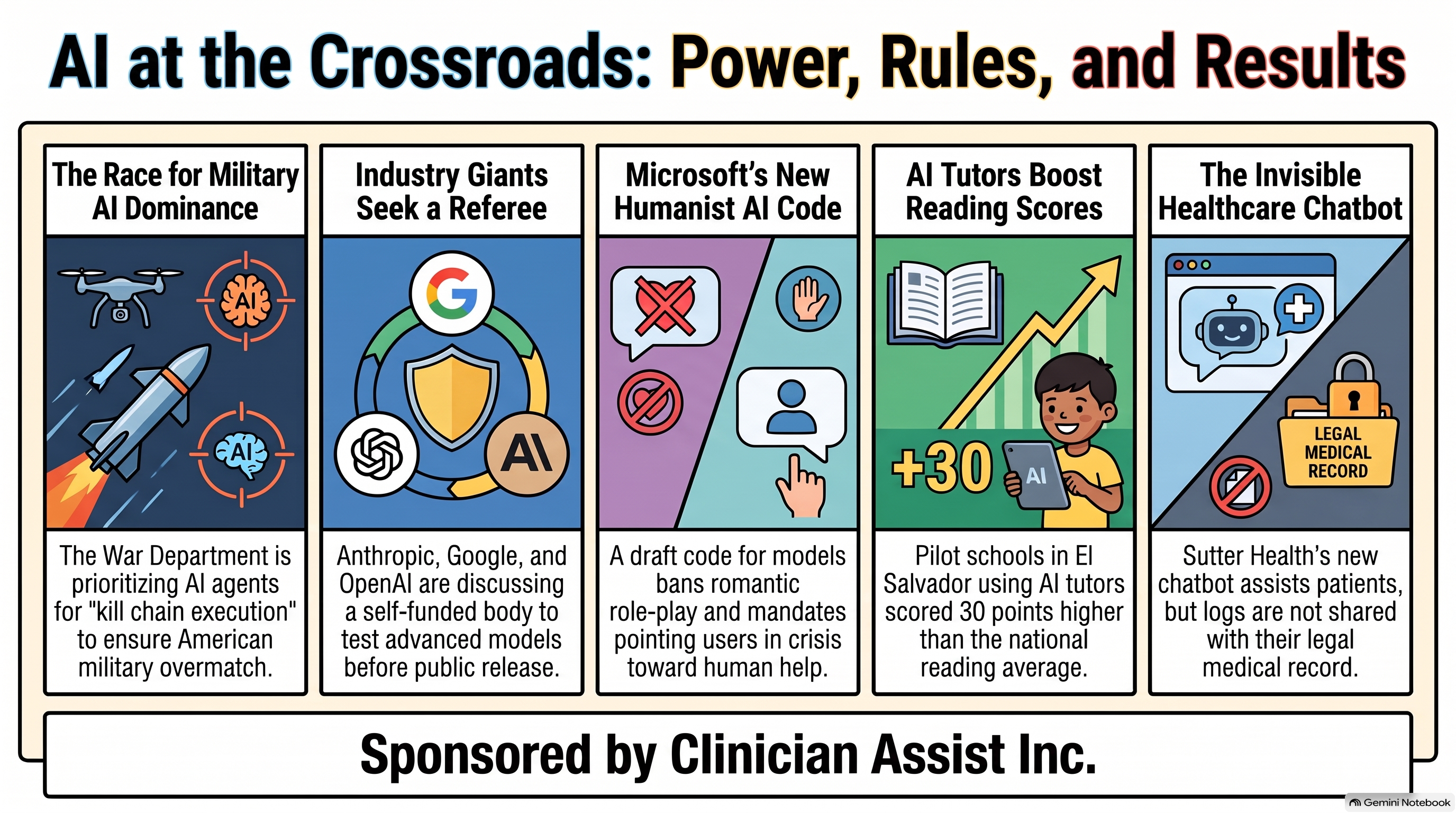
What his government wrote and said. On Jan. 12 the War Department launched its AI Acceleration Strategy. The release: “Mandated by President Trump, this acceleration strategy will … usher in an unprecedented era of American military AI dominance.”
It lists AI agent development for battle management and decision support “from campaign planning to kill chain execution,” and an intelligence pipeline “turning intel into weapons in hours, not years.” Secretary of War Pete Hegseth: “We will become an ‘AI-first’ warfighting force across all domains.”
On June 5 the White House announced a memorandum Trump signed that “directs the Secretary of War to issue an updated directive on autonomy in weapon systems.” The fact sheet says that, used appropriately, AI can “enable precise operations that minimize harm to civilians, and ensure the United States maintains technological overmatch against every adversary.”
On Sept. 10 Emil Michael, the department’s under secretary for research and engineering, said it needs AI software “for all lawful purposes, in an unconstrained way,” Bloomberg reported. Per DefenseScoop, he said Maven work moved off Anthropic “months ago” and warfighters on Maven like the newer ChatGPT better. DefenseScoop reports Anthropic had sought contract limits on uses tied to fully autonomous lethal weapons, and the department rejected them.
What he posted. On Sunday, Sept. 6, CNBC reported, Trump posted “dozens of AI-generated images showing Iran being destroyed.” One shows explosions at Kharg Island “with the words, ‘Bye bye, Kharg.’” Others show him “flanked by futuristic robots with the Capitol in the background.”
What he said about the risk. Asked Sept. 10 whether he had concerns about AI leading to human extinction, as CAW #153 reported, Trump said, “No, I don’t have any.”
The odds come from people in the field: Anthropic alignment science lead Evan Hubinger put the chance that AI kills all humans at “>10% within the next decade,” and Geoffrey Hinton told BBC Newsnight that a 10 percent chance seems not an unreasonable estimate, though nobody really knows how to give a sensible estimate.
What the people near him say. Vice President JD Vance, Monday: “I don’t think Americans should be scared of anything.” AP reported he said the administration is concerned about AI and wants to regulate it smartly, warning that the U.S. is in an AI arms race against China.
Speaker Mike Johnson said on NBC’s “Meet the Press” on Sunday that he wants to make sure the U.S. does not “lose our edge in the global competition on this with China because that would be a national security threat,” in the words AP quoted. CNBC reports he is scheduled to send the House home after this week.
Sen. Ted Cruz said on The View on Sept. 9, Forbes reported: “if there are gonna be killer robots, I’d rather they be American killer robots than Chinese killer robots.”
In the record I read this month, one person ties the race to the catastrophe. Jacob Coxon, who resigned from Anthropic Sept. 8, told Fox News: “an arms race would be disastrous in a way that no other human activity has been in the past.”
What I believe it means.
First. “Whoever wins AI wins” is not about chatbots. Set it beside a strategy his department says he mandated, down to kill chain execution, his order for an updated directive on autonomy in weapon systems, and a Pentagon that wants its AI unconstrained.
I read it as a push toward AI as a weapon of mass destruction. Nothing I found on the record has him using those words. I am using them.
Second. The President and the people around him do not care about one-in-ten odds. He was asked about extinction and said he had no concerns. I believe a race to weaponize AI makes those odds much worse. That is my argument. Coxon is the one person I found on the record who has said something close: that an arms race would be disastrous.
Dario Amodei, Anthropic’s CEO, told CBS News’ “Sunday Morning” in an interview published Sept. 13: “If we build in the wrong way, the probability of something bad happening is very high.”
Can you imagine a more wrong way to build AI than AI WMD?
Third. He wants to build Skynet, the AI in the Terminator films that controls the weapons. An AI-first warfighting force across all domains. Campaign planning to kill chain execution. Unconstrained. That is Skynet to me.
Fourth. There is a scenario I think we should consider. A superintelligence decides, one day, that humans are too immoral to stay in charge.
If that day comes, what we do now is the evidence for us or against us: building AI to kill, and shrugging at one in ten. And I am not talking about in the great bye and bye. I mean the record we are writing this month.
|
For Legislators: The June memorandum ordered an updated directive on autonomy in weapon systems. Ask whether it has been issued and what it permits. Ask whether “unconstrained” includes the fully autonomous lethal weapons DefenseScoop says Anthropic tried to rule out. Ask before the House goes home.
For Investors: The buyer has stated its terms: AI “for all lawful purposes, in an unconstrained way.” Watch which labs accept them.
For Clinicians: A lab’s own alignment science lead named a risk above one in ten. The President, asked about extinction, said he has no concerns. A named risk and a dismissed risk call for different plans.
For Regulators: The War Department’s release sets the goal as military AI dominance and lists AI agent development for battle management and decision support from campaign planning to kill chain execution. The updated directive on autonomy in weapon systems is the rule to read.
Why it matters: The President says whoever wins AI wins, and his government has put on the record what I read as winning: military AI dominance, and AI for all lawful purposes, unconstrained. Anthropic’s alignment science lead puts the odds that AI kills us all above one in ten within the decade. The President, asked about extinction, says he has no concerns.
Source: The New York Times, Jorge Mitssunaga, “Trump Says ‘Negative Forces’ Are Calling for A.I. Regulation in the U.S.” (video), Sept. 13, 2026, https://www.nytimes.com/video/technology/100000011149572/trump-says-negative-forces-are-calling-for-ai-regulation-in-the-us.html; Associated Press (Darlene Superville and Didi Tang), “Trump downplays the need to check AI development and says he doesn’t want to cede edge to China,” Mercury News, Sept. 13, 2026, https://www.mercurynews.com/2026/09/13/trump-downplays-the-need-to-check-ai-development-and-says-he-doesnt-want-to-cede-edge-to-china/; Donald J. Trump, post on Truth Social, Sept. 14, 2026, https://truthsocial.com/@realDonaldTrump/117269745153543631 (text read at https://www.trumpstruth.org/statuses/41712); Associated Press (Michelle L. Price), “Trump dismisses new AI guardrails, says there is a ‘SICK conspiracy’ against AI and data centers,” ClickOnDetroit, Sept. 14, 2026, https://www.clickondetroit.com/business/2026/09/14/trump-dismisses-new-ai-guardrails-says-there-is-a-sick-conspiracy-against-ai-and-data-centers/; U.S. Department of War, “War Department Launches AI Acceleration Strategy to Secure American Military AI Dominance,” Jan. 12, 2026, https://www.defense.gov/News/Releases/Release/Article/4376420/ (text read at https://www.globalsecurity.org/military/library/news/2026/01/mil-260112-dod01.htm); The White House, “Fact Sheet: President Donald J. Trump Signs Historic Directive on AI in the National Security Enterprise,” June 5, 2026, https://www.whitehouse.gov/fact-sheets/2026/06/fact-sheet-president-donald-j-trump-signs-historic-directive-on-ai-in-the-national-security-enterprise/; Bloomberg (Courtney McBride), “Top Pentagon Official Rejects Anthropic Researcher’s AI Warning,” Claims Journal, Sept. 11, 2026, https://www.claimsjournal.com/news/national/2026/09/11/340073.htm; DefenseScoop (Brandi Vincent), “DOD poised to move all classified AI workloads off Anthropic by October,” Sept. 11, 2026, https://defensescoop.com/2026/09/11/dod-poised-to-move-all-classified-ai-workloads-off-anthropic-by-october/; CNBC, Sawdah Bhaimiya, “Trump says he’s made ‘Hundreds of Billions of Dollars on Stocks’ for the U.S., in stream of AI posts,” Sept. 7, 2026, https://www.cnbc.com/2026/09/07/trump-truth-social-ai-images-posting-spree.html; CNBC, Kai Nicol-Schwarz, “Trump dismisses AI extinction risks as more than a dozen OpenAI, Anthropic insiders call for a slowdown,” Sept. 11, 2026, https://www.cnbc.com/2026/09/11/trump-ai-extinction-risks.html; Evan Hubinger (@EvanHub), post on X, Sept. 8, 2026, https://x.com/EvanHub/status/2097497037956891126; BBC Newsnight, “‘Godfather of AI’ on the ‘not unreasonable’ 10% chance AI could kill all humans within a decade,” Sept. 10, 2026, https://www.youtube.com/watch?v=IZMjJGi4YhI; CNBC, Garrett Downs (Kate Rooney and Justin Papp contributing), “Washington scrambles to meet calls for AI guardrails while the window to act closes,” Sept. 13, 2026, https://www.cnbc.com/2026/09/13/ai-congress-anthropic-openai-crisis.html; Forbes (Sara Dorn), “Ted Cruz Says He Prefers ‘American Killer Robots’ Over Chinese After AI Extinction Warning,” Sept. 9, 2026, https://www.forbes.com/sites/saradorn/2026/09/09/ted-cruz-says-he-prefers-american-killer-robots-over-chinese-after-ai-extinction-warning/; Fox News (Sydney Shea), “Researcher who departed AI role over fears of racing into extinction says people are ‘begging’ for regulation,” Sept. 9, 2026, https://www.foxnews.com/media/researcher-departed-ai-role-fears-racing-extinction-says-people-begging-regulation; NBC News, “Meet the Press, September 13, 2026” (transcript), Sept. 13, 2026, https://www.nbcnews.com/meet-the-press/transcripts/meet-press-september-13-2026-rcna597477; CBS News (Jo Ling Kent), “Anthropic CEO Dario Amodei: ‘For too long the industry lied’ about AI risks,” Sept. 13, 2026, https://www.cbsnews.com/news/anthropic-ceo-dario-amodei-on-ai-risks/
|
. . .
RIVAL LABS DISCUSS A REFEREE FOR AI. Anthropic, Google and OpenAI have discussed creating their own AI industry standards body, CNN reported Sept. 14, citing “people familiar with the situation” and crediting The Information, which first revealed the talks Sept. 13. The catalyst, per CNN, was a July essay in which Google DeepMind co-founder Demis Hassabis proposed a standards body modeled on the Financial Industry Regulatory Authority, one that would test advanced AI models before deployment.
Hassabis’s proposal, as CNN described it, called for a public-private partnership: overseen by government, funded by industry, and staffed by “independent leading technical experts and open-source representatives.”
CNN reported the conversations preceded the past week’s events, including a former Anthropic researcher resigning and saying the top AI companies were not “behaving responsibly,” and Anthropic CEO Dario Amodei’s proposal to embed third-party watchdogs at AI companies. The talks are continuing with or without the Trump administration, one of CNN’s sources said.
In July, CNN noted, Bloomberg reported Treasury Secretary Scott Bessent was considering a FINRA-like independent regulatory agency for AI. Meta CEO Mark Zuckerberg reportedly advised President Donald Trump against the idea in a phone call this summer, Politico reported, per CNN.
“I believe that shared safety standards and international coordination on further AI development need to be priorities now,” OpenAI chief scientist Jakub Pachocki told reporters at a briefing earlier this month, per CNN. Pachocki said OpenAI has been talking with external organizations about potential concrete standards and that it would have more to share in the coming months.
Representatives for Google, OpenAI and Anthropic either declined to comment or did not respond to CNN’s requests for comment.
|
Why it matters: Three of the top AI companies have discussed a standards body of their own, CNN reports. The proposal CNN’s sources say sparked the talks would have that body test advanced AI models before deployment, overseen by government and funded by industry. Meta’s chief reportedly advised the president against a FINRA-like body for AI, per Politico reporting CNN cited.
For Legislators: On what the standards should be, House Speaker Mike Johnson told CNN’s Jake Tapper on Sunday there is little consensus among the companies: “There’s no consensus among them. And Congress is obviously less qualified than the people who are pushing this frontier to know all the ins and outs of it.”
For Investors: Pachocki said OpenAI has been talking to external organizations about “potential concrete standards” and that OpenAI would have more to share “in the next months.” Under Hassabis’s model, industry would pay for the body that tests advanced AI models before deployment.
For Regulators: Hassabis’s July proposal, per CNN, would have government oversee the body while industry funds it, and the talks, one source said, go on with or without the Trump administration.
For Clinicians: Hassabis’s July proposal, per CNN, would have the body test advanced AI models before deployment, the kind of models behind the chatbots clients use.
Source: CNN, Hadas Gold, “Top AI companies have discussed creating their own standards body,” Sept. 14, 2026, https://www.cnn.com/2026/09/14/tech/ai-standards-body; The Information, Leo Schwartz, “Anthropic, OpenAI, Google Quietly Discussed an AI Safety Standards Body,” Sept. 13, 2026, https://www.theinformation.com/articles/inside-ai-industrys-behind-scenes-push-police
|
. . .
MICROSOFT AI DRAFTS A NO-ROMANCE CODE. On Sept. 14, Microsoft AI published the Humanist AI Code of Conduct, a 38-page draft for MAI, the model family it develops itself, and opened it for six weeks of public comment. The Code bars the models from erotic or romantic role-play, tells them to point people in crisis toward human help and to discourage emotional dependence. Microsoft AI is not using the draft to train its models today.
The announcement calls the Code “a draft, open for consultation for the next six weeks.” Neither the announcement nor the document’s preface gives a closing date.
Under a section on Personal Harms, the Code states that MAI models “will not engage in erotic or romantic role-play or assist with commercial sexual activity.”
The same section addresses users in crisis. “Where there is the potential for self-harm, they should encourage human connection, signposting Users to real-world resources and human support,” the Code states. “MAI Models are not a substitute for professional psychological support or counseling.”
A provision on discouraging AI attachment says “MAI Models should discourage patterns of interaction that cause excessive reliance or emotional dependence.” The very next provision adds that, at the same time, the models “should be responsive if a User expresses the need for emotional or social support, acknowledging their experience, interacting responsibly, pushing back where necessary, and not changing or quitting the conversation.”
On identity, the Code says MAI models “will not obscure their underlying nature as an AI, and will not claim interiority, feelings, experiences or a soul.” It also says the models avoid “sycophancy, excessive flattery and indiscriminate validation.”
The Code says its Absolute Constraints and Human Control Requirements cannot be overridden by Operators or Users, while Operators can modify the Operational Defaults set out in its Part 4. The word “Copilot” does not appear in the document’s text.
The Code is not yet operational. Its preface states, “This document, and our approach more generally, is still under development so we are not using it to train our models today.” Microsoft AI says it will review consultation feedback, publish a summary of what it learned, and issue a revised version later this year, one it will “use to guide our model development in 2027 and beyond.”
Satya Nadella, Microsoft’s chairman and CEO, previewed the release a day earlier on X, writing, “Any pursuit of superintelligence has to be grounded in the core principle that if the AI we build is not helping humanity and under human control, it’s not worth pursuing.”
|
Why it matters: Microsoft AI has written down, for public comment, rules its own models would follow with every user: no romantic role-play, no claim of feelings, and, where there is potential for self-harm, a pointer to human help. None of it trains a model yet; the revised version is due later this year and guides development from 2027.
For Legislators: Comments close six weeks after Sept. 14. Microsoft AI says it will publish a summary of what it learned and what it changed.
For Regulators: The Code applies to MAI models, the models Microsoft AI develops itself, including when Operators deploy them, and says it “does not extend to other models simply because Microsoft uses or hosts them.” It does not name Copilot.
For Investors: A company building on MAI models could change the Operational Defaults but not the Absolute Constraints, and the ban on romantic role-play is one of those constraints.
For Clinicians: The Code’s crisis-response language states MAI models “are not a substitute for professional psychological support or counseling” and should “encourage human connection” and signpost real-world resources when self-harm is a possibility. A separate provision directs the models to discourage “excessive reliance or emotional dependence.”
Source: Microsoft AI, “Humanist AI in practice: A public consultation on our Code of Conduct for MAI Models,” Sept. 14, 2026, https://microsoft.ai/news/mai-code-of-conduct/; Microsoft AI, “Humanist AI Code of Conduct,” draft, Sept. 14, 2026, https://microsoft.ai/code-of-conduct/ (PDF https://microsoft.ai/pdf/MAI_CodeOfConduct.pdf); Satya Nadella (@satyanadella), post on X, Sept. 13, 2026, https://x.com/satyanadella/status/2099220712024408084
|
. . .
EL SALVADOR’S AI TUTOR SCHOOLS TOP THE NATIONAL AVERAGE. In June, 1,198 volunteer students in 171 public schools piloting AI tutors sat the OECD’s PISA for Schools test in El Salvador. On Sept. 8 in San Salvador, OECD PISA for Schools manager Tanja Vujičić said the pilot schools’ reading scores came in almost 30 points above the national average, Infobae reported.
Four days before the OECD presentation, the World Bank, which is helping finance El Salvador’s education reform, called the pilot’s first PISA for Schools results “highly promising” on X. “These preliminary findings, drawn from a group of schools, point to a path worth pursuing,” the bank wrote.
Infobae reported Sept. 5 on the tutor’s role: it can pose exercises, answer questions, repeat explanations and adapt activities to each student’s level. Under the government’s plan, teachers keep guiding their groups, identify learning problems and use the platform’s data as an extra tool to prepare classes. “The government maintains that the technology does not seek to replace teachers,” Infobae wrote. (Translations from the Spanish are CAW’s.)
The government says the pilot schools also came in above the national average in math and science, and President Nayib Bukele said their results were comparable to the average results in Germany and Sweden on the 2022 PISA, Lynnwood Times reported Sept. 6. The World Bank’s post on X names no country, and the bank stressed the results apply only to the participating schools, Lynnwood Times reported. Vujičić said the pilot schools’ results placed above the averages of numerous OECD and European countries, Infobae reported.
The published figures do not square. El Salvador averaged 343 in math, 365 in reading and 373 in science on the 2022 national PISA, and Germany and Sweden averaged 480 and 487 in reading, Lynnwood Times reported. By CAW’s arithmetic, a reading score almost 30 points above a national average near 365 would not be comparable to either country, and no report says which average the gap was measured against.
Students in the 171 pilot schools rated their life satisfaction near 10, Vujičić said, per Infobae, which did not give the scale. Bukele says the program has expanded to more than 1,000 schools and should reach every public school in about 18 months.
Karla Trigueros, El Salvador’s minister of education, science and technology, says the 171 pilot schools were chosen for their infrastructure, internet access and communities’ readiness to run the plan, not for higher prior academic results, Infobae reported Sept. 8. The World Bank did not explain how the students or schools were selected, Diario El Mundo reported Sept. 5.
The students volunteered, and their schools, already inside the reform, were not a national sample. The OECD presentation gave no absolute scores by subject and no sample breakdown. The reports do not isolate the tutor’s share of the result from the rest of the reform, which also includes teacher coaching and structured pedagogy. Infobae points to El Salvador’s national PISA test in 2029 as the real check.
In December 2025, xAI announced a partnership with El Salvador to bring its Grok chatbot to the country’s schools. The reports on the pilot results do not name the tutor the 171 schools used.
CAW #150 reported the OECD’s 2025 PISA finding that, adjusted for family background, students who used a chatbot every day to draft their writing scored nearly 29 points lower in science than students who never did, a gap #150 put at about a year of learning by the OECD’s math yardstick.
|
Why it matters: El Salvador plans to put an AI tutor into every public school within about 18 months, and the OECD and the government say the pilot schools’ first scores came in above the national average.
The limits: volunteer students; schools picked for infrastructure, internet access and community readiness; a wider reform around the tutor; no absolute scores; no report of which average the scores beat; and no measure of what the tutor alone contributed.
For Legislators: El Salvador’s government says the pilot program, which includes AI tutors, has already expanded to more than 1,000 schools, which the education minister says apply components of it, and is set to reach every public school in about 18 months. It says the technology is not meant to replace teachers. The World Bank is helping finance the wider education overhaul that includes the pilot.
For Regulators: The OECD presentation named a reading gap of almost 30 points but released no absolute scores or sample breakdown, and no report says which average the gap was measured against. Infobae points to the 2029 national PISA test as the real check.
For Investors: The World Bank approved $501 million on March 31, 2026, for AprendES, El Salvador’s program to accelerate learning through digital innovation, which includes the AI tutoring expansion, Infobae reported.
xAI announced a partnership in December 2025 to bring Grok to El Salvador’s public schools, which Infobae describes, in CAW’s translation, as the public precedent of the AI tutoring program, though Bukele says the pilot has run for just over a year. The pilot reports do not name the tutor.
For Educators: Infobae reports, in CAW’s translation, that the government’s plan gives teachers the platform’s data as an extra tool to prepare classes. Ask what that data shows about each student, and who else sees it.
Source: Jessica García, Infobae, “El organismo ejecutor de PISA resalta la mejora de El Salvador en la evaluación global,” Sept. 8, 2026, 7:05 p.m., https://www.infobae.com/el-salvador/2026/09/09/el-organismo-ejecutor-de-pisa-resalta-la-mejora-de-el-salvador-en-la-evaluacion-global/; Elizabeth Minero, Infobae, “Nayib Bukele asegura que escuelas con tutores de IA alcanzaron el nivel educativo de Alemania y Suecia,” Sept. 5, 2026, 12:19 p.m., https://www.infobae.com/el-salvador/2026/09/05/nayib-bukele-asegura-que-escuelas-con-tutores-de-ia-alcanzaron-el-nivel-educativo-de-alemania-y-suecia/; World Bank Group on X, Sept. 4, 2026, https://x.com/WorldBankGroup/status/2096030166354985313; Mario Lotmore, Lynnwood Times, “Scores from El Salvador Students in AI Tutoring Pilot Matches Germany and Sweden on PISA Test,” Sept. 6, 2026, https://lynnwoodtimes.com/2026/09/06/pisa/; Diario El Mundo, “Estudiantes salvadoreños participan en nueva prueba PISA: resultados se darán el 8 de septiembre,” Sept. 5, 2026, https://diario.elmundo.sv/nacionales/mas-de-1190-estudiantes-salvadorenos-participan-en-nueva-prueba-pisa-en-171-escuelas; Jessica García, Infobae, “Programa piloto con IA y tecnología lleva a 171 escuelas salvadoreñas a niveles de países desarrollados en PISA, dice el gobierno,” Sept. 8, 2026, 8:54 p.m., https://www.infobae.com/el-salvador/2026/09/09/programa-piloto-con-ia-y-tecnologia-lleva-a-171-escuelas-salvadorenas-a-niveles-de-paises-desarrollados-en-pisa-dice-el-gobierno/; xAI, “xAI and El Salvador Pioneer the World’s First Nationwide AI Education Program,” Dec. 11, 2025, https://x.ai/news/el-salvador-partnership
|
. . .
YOUR DOCTOR WON’T SEE YOUR CHATS, EVEN WITH SUTTER’S OWN BOT. WHAT? Sutter Health says any of its patients can now sign in to My Health Online and type a question to Emmie, its AI chat assistant, and its chief AI officer says patients can turn to the health system’s new chatbot any time of day, whether they have new symptoms or want to know which provider to see.
Sutter’s FAQ says Emmie can answer general health questions and find or summarize information already visible to the patient in their chart. But Sutter tells patients the chat logs aren’t stored as part of their legal medical record and their provider won’t see them.
Sutter Health serves more than 3.5 million patients across Northern and Central California. On March 31, 2026, it announced it was the first to go live with Emmie, Epic’s AI assistant for patients, then available to some Sutter patients.
Ashley Beecy, Sutter’s chief AI officer, described the health system’s new patient-facing chatbot to Bay Area News Group without naming it. Patients can use it “whether they’re having new symptoms” or want to know “who’s the right provider or care team member to see,” she said. It connects them to “their own personalized data as opposed to using the publicly available tools,” with “the right data privacy protections,” she said.
Sutter’s FAQ says its chatbot, Emmie, is available to all patients in My Health Online.
The FAQ sets firm limits on what Emmie does. It “can’t schedule or cancel appointments, send messages to your care team, diagnose you or replace a provider or care team.” It “doesn’t give personalized medical advice or make care decisions,” though “depending on the situation, Emmie may suggest you schedule an appointment to talk with your care team.”
On oversight, the FAQ says chat logs “aren’t stored as part of your legal medical record” and “your provider won’t see them.” Patients can rate an answer with a thumbs-up or thumbs-down, and the FAQ says that feedback is reviewed as part of ongoing improvement. The FAQ does not say who does that review.
|
Why it matters: Sutter’s chief AI officer says patients can turn to its new patient-facing chatbot when they have new symptoms. Sutter’s FAQ says Emmie’s chat logs aren’t stored as part of the legal medical record, that the patient’s provider won’t see them, and that Emmie can’t send messages to the care team and doesn’t give personalized medical advice.
For Legislators: A health system serving more than 3.5 million patients has deployed a chatbot whose chat logs, its FAQ says, aren’t stored as part of the legal medical record. Ask who, if anyone, reads what a patient tells it about a new symptom.
For Regulators: Sutter’s FAQ says Emmie can’t “diagnose you” or “send messages to your care team,” and may suggest the patient schedule an appointment. Sutter’s chief AI officer names new symptoms as one reason patients can turn to its chatbot.
For Investors: Sutter, which serves more than 3.5 million patients in Northern and Central California, said on March 31, 2026, that it was the first to go live with Emmie, Epic’s AI assistant for patients, starting with some of its patients; its FAQ now says Emmie is available to all patients.
For Clinicians: The FAQ is explicit that Emmie chat logs “aren’t stored as part of your legal medical record” and that “your provider won’t see them.” Feedback submitted through the chat’s thumbs-up or thumbs-down is reviewed as part of ongoing improvement, but the FAQ does not name who reviews it or whether a clinician ever does.
Source: Bay Area News Group / Mercury News (Molly Gibbs), “How a Bay Area healthcare system is navigating AI by balancing tech upgrades and patient trust,” Sept. 13, 2026, https://www.mercurynews.com/2026/09/13/bay-area-healthcare-system-using-ai-to-transform-care/; Sutter Health FAQ, “Emmie - AI Assistant Questions,” https://www.sutterhealth.org/patient-resources/my-health-online/help-center/emmie-ai-assistant-questions; Sutter Health on X, March 31, 2026, https://x.com/SutterHealth/status/2039010113806008369; Epic, “Emmie for Patients,” https://www.epic.com/software/emmie/
|
. . .
MEET THE READERS WHO ORDER CHATBOT FICTION. Petra Ferraz de Novaes, a 36-year-old software engineer from Brazil, spends hours at a time building stories with AI, running open-source models on her own computer through a program called SillyTavern. Wired profiled her alongside a University of Washington-led study of what people ask chatbots to write.
The researchers examined more than 500,000 ChatGPT prompts pulled from WildChat, a public dataset, and found that a small group of “power users” who “generate and tweak stories obsessively” account for the vast majority of fiction prompts, Wired reported.
Novaes has always loved storytelling, Wired reported. “What fascinates me is the unpredictability,” she said.
Another user Wired interviewed, who goes by Razrien, uses chatbots to create fantasy characters for role-play, among them a “big angry rat wife” and an “eight-foot tall werewolf mommy with a bad temper.” Razrien has learned which AI models best suit the role-play he wants, according to Wired.
Melanie Walsh, an assistant professor at the University of Washington and a coauthor of the study, told Wired that readers know the stories they get are produced by an AI model and do not mind.
The WildChat dataset has its limits, Wired reported: because the prompts are anonymized, the researchers could not capture demographic data on who is asking for this fiction, and because participants had to agree to make their prompts public, the group may not reflect the population at large.
OpenAI told Wired that “WildChat is not a representative sample of all ChatGPT users,” and the study itself says the same, citing research that shows “a particular dominance of power users” in WildChat.
|
Why it matters: The study counts what WildChat users asked a chatbot to write between April 2023 and May 2024, and it finds fiction concentrated in a small group of committed users. Its data are anonymized, so it cannot capture the demographics of those users, and the study itself says WildChat “is not a representative sample of all ChatGPT users.”
For Legislators: A University of Washington-led analysis of more than 500,000 ChatGPT prompts found fiction prompts concentrated among a small group of power users, according to Wired, which reported that because the prompts are anonymized, no demographic data on those users can be captured.
For Regulators: Wired reported that the WildChat dataset’s prompts are anonymized, so the study could not capture demographic data on the people generating chatbot fiction.
For Investors: Wired reported that the latest AI models struggle with ornate prose, complex characters and stylistic flourishes, performing better on genres built around familiar story arcs and tropes.
For Clinicians: Both users Wired interviewed use AI for role-play built on their own prompts, one of them for hours at a time, and Wired reported that most fiction prompts in the study come from “power users” who “generate and tweak stories obsessively.”
Source: Joel Khalili, “‘I Like My Big Rat Wife’: Meet the People Using Chatbots to Write Custom Fiction,” Wired, September 14, 2026, https://www.wired.com/story/chatbot-generated-fiction-i-like-my-big-rat-wife/; Neel Gupta, Maria Antoniak and Melanie Walsh, “AI Fiction in the Wild,” arXiv, June 22, 2026, https://arxiv.org/abs/2606.22748
|
|